Verbs
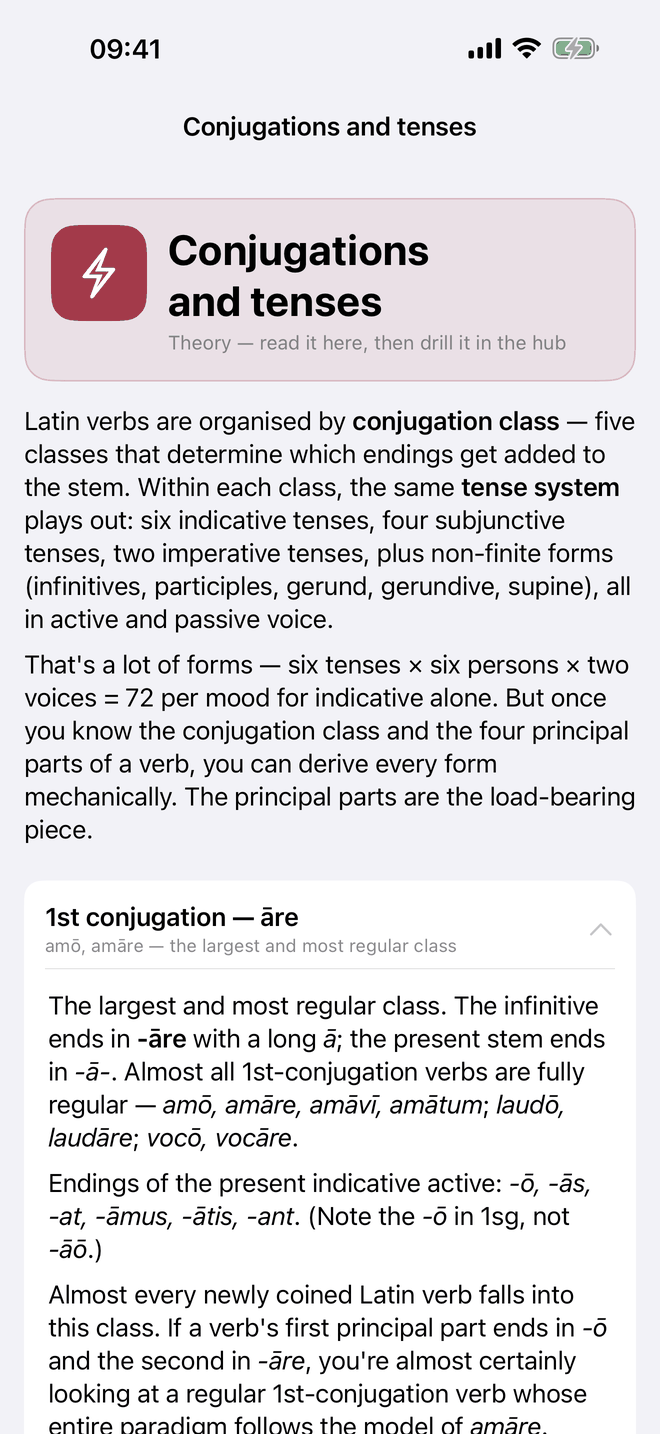
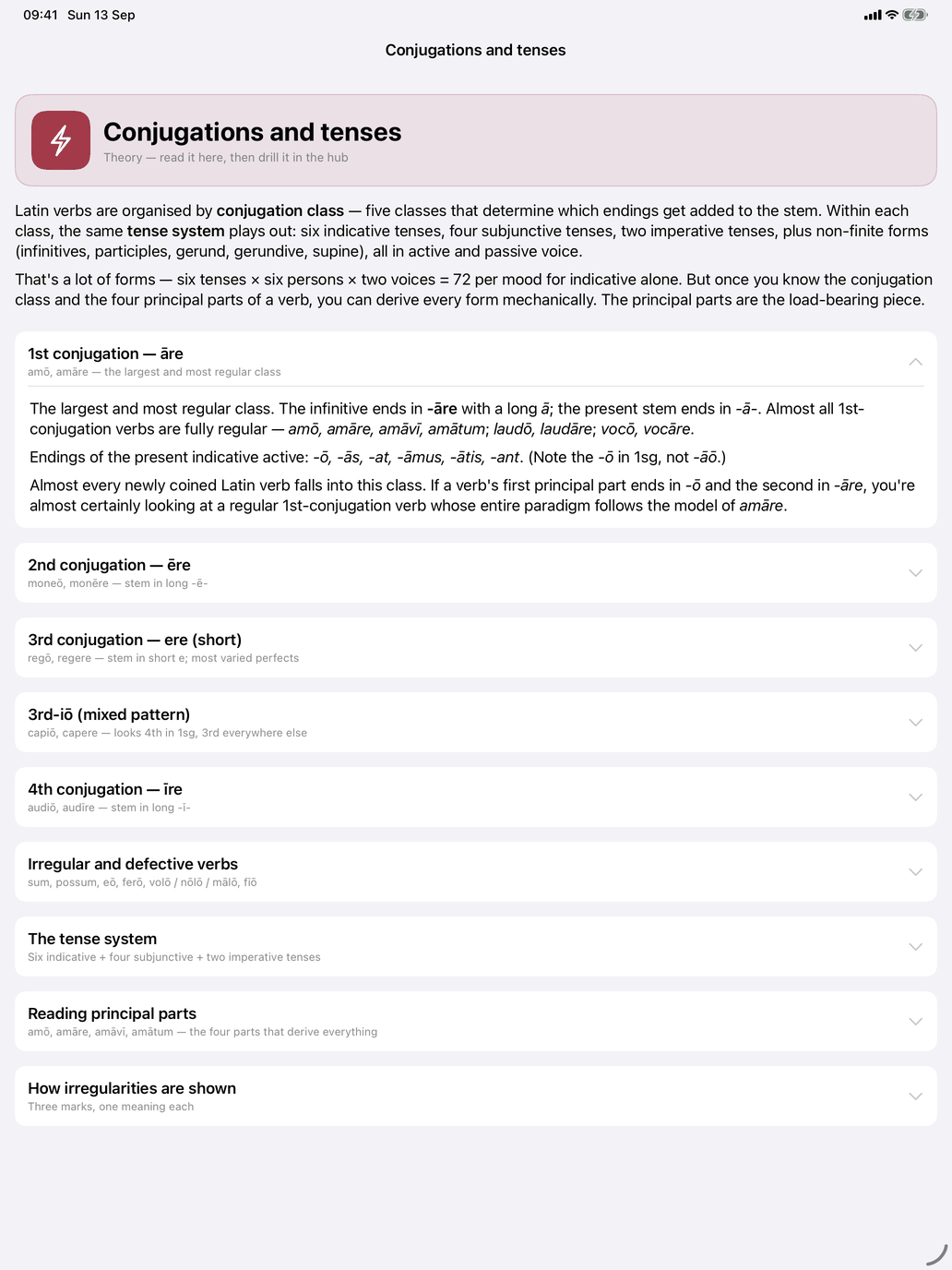
The Latin Verbs section covers over 600 verbs, with the full classical tense system: present and perfect systems, indicative, subjunctive and imperative, active and passive, plus the non-finite forms (six infinitives, four participles, gerund, supine). Open it from the Verbs tile on the Self Study screen. Like every topic hub, it has four sections: Setup, Theory, Study and Drills.
The verbs are filed in six verb groups:
- 1st conjugation (-āre): amō, amāre; laudō, laudāre. The largest group, over 200 verbs.
- 2nd conjugation (-ēre), with a long stem vowel: moneō, monēre; videō, vidēre.
- 3rd conjugation (-ere), with a short stem vowel: regō, regere; dūcō, dūcere. The biggest group after the 1st.
- 3rd-iō conjugation: capiō, capere; faciō, facere. A mixed pattern.
- 4th conjugation (-īre): audiō, audīre; veniō, venīre.
- Fully irregular: sum / esse, possum / posse, eō / īre, fīō / fierī, and compounds such as abesse and redīre.
ferō / ferre, volō / velle, nōlō / nōlle and mālō / mālle are filed under the 3rd conjugation. Their irregular forms (fers, fert; vīs, vult; velim) are stored one by one, and the tables mark them as irregular. Deponents (hortārī, loquī, patī) and defectives are not groups of their own; each is filed under its conjugation. The defectives meminisse, ōdisse and coepisse show a dash for the tenses they lack.
For the endings of each conjugation, see Appendix A. For the tenses, see Appendix B.
Setup: Select verb groups
Select verb groups decides which verbs are in your drill pool. The rows are the six groups above, under two headings, Conjugations and Irregular, and each row shows how many verbs it holds. Tap ⓘ on a row to read about that group, or long-press a heading to read about the whole family. The hub row shows how many groups you have ticked ("5 of 6").
Verb group is the only filter on this screen. There is no textbook-chapter or frequency filter. CEFR level and topic apply everywhere and are set in Self Study → Select word scope. If your topic scope removes every verb you picked, the hub shows a red warning above Setup.
Setup: Select tenses
Select tenses turns individual tenses on or off. Latin has 36 of them, and the hub row shows how many are on ("12 of 36"). Two views are available:
- By Section: the tenses grouped as Indicātīvus – Tempora Imperfecta, Indicātīvus – Tempora Perfecta, Subjūnctīvus, Imperātīvus, Imperātīvus Passīvum, the three passive sections, Fōrmae Nōn Fīnītae, Participia, and Gerundium et Supīnum. Long-press a section heading for an explanation.
- By Level: the same tenses grouped by CEFR level.
Tap ⓘ on a tense to open its info sheet: when the tense is used, its endings table, how it is formed, and examples. Use this screen to limit a drill to the tense you are learning, or to leave out tenses you haven't covered yet. The drills, the tables and the verb example sentences only show tenses that are switched on.
Theory: Conjugations and tenses
This page explains the verb system in collapsible cards:
- one card for each of the five conjugations, plus Irregular and defective verbs
- The tense system: the present stem and the perfect stem, and how the passive is built
- Reading principal parts: how amō, amāre, amāvī, amātum give you every form, with capiō as a worked example
- How irregularities are shown: the marks used in the tables
The conjugation tables use two marks. Red marks the part of a form you have to learn for this verb. When a whole form is red (esse, posse), it has no regular connection to any pattern. An underline marks the ending the pattern predicts, on regular and irregular forms alike. Latin has only one set of endings, so the blue mark used in other languages never appears in Latin tables.
Study: Verb reference
Verb reference lists every verb in your selection from A to Z. Search by the Latin infinitive or by the translation. Tap a verb to open its detail screen (see Inside a verb: the tabbed detail).
Inside a verb: the tabbed detail
The screen is titled with the verb's infinitive. Under the title are the four principal parts (amō, amāre, amāvī, amātum) and the verb's group. Four tabs follow: Conjugation · Usage · Structure · Reference sheet. The screen opens on Conjugation.
Conjugation shows the tables for the tenses you have selected. A List / Filter picker switches between two views:
- List shows each tense as a full table.
- Filter has chips for Modus, Tense, Stem (Praesens, Perfectum, Supinum) and Voice (Activum, Passivum), so you can narrow the forms down. For example, you can show only the tenses built on the perfect stem.
In List view, the translations button in the toolbar shows a translation under every form. Every Latin verb has these translations. Where a verb has a second meaning, a ⇄ button switches all the translations to that meaning.
Usage shows the verb in use, where the data has it:
- Extended meaning: the verb's separate senses, each with an example. Over 400 verbs have this card.
- Tense Examples: example sentences for the tenses you have selected, with translations. About 165 verbs have them. Tap a tense name on a sentence to open that tense's table.
- Details: a collapsible section showing the verb's Level, Voice (only when the verb is Deponent, Intransitive or has No passive) and Topics.
Structure goes through the verb tense by tense. Each row gives a verdict (Regular, Regular endings, Partly irregular, Irregular, Not used) and the stems the tense is built on. A stem you have to memorise, such as ferre's tul- or capere's cēp-, is shown in amber. For the perfect system, that is the perfect stem taken from the third principal part. Tap a row to compare the expected forms with the actual forms. The filter button in the toolbar hides the tenses that follow the pattern. For a fully regular verb, the screen then tells you there is nothing to single out.
The two colours answer different questions. Amber on Structure names a whole stem to learn. Red in a conjugation table marks the letters of a single form that depart from the pattern.
Reference sheet is a printable one-page PDF of the active voice. Its header shows the principal parts, the conjugation and any notes (Deponent, Active only, Defective, or which verb it is a compound of). Below that are the main non-finite forms and the indicative, subjunctive and imperative tables. On iPhone and iPad, share it from the share button. On the Mac, the share menu has Copy and Save as….
Drills: Verb meaning
Flashcards for the verbs in your pool: turn the card and mark whether you knew the meaning. The book icon on a card opens the verb's conjugation.
Drills: Produce the conjugation
This is the production drill. The question names the verb and gives the Mood, Tense, Voice and Person on separate lines, so you see each part of the question separately. You give the form in one of two modes:
- Type: type the form.
- Pick: choose it from a wheel of up to ten options: the right form and forms that look like it.
For how macrons are checked, see Macron-accurate checking. If you type a real form of the wrong tense or person, the feedback tells you which form you produced. The gear button opens Production settings. There you can limit the drill to chosen values of Verb, Mood, Tense, Voice and Person. Leave a line empty to let it vary.
Drills: Recognise the conjugation
This is the recognition drill. You see a conjugated form and identify it. The gear button opens Recognition settings:
- Picker style: Chips (the default) or Wheel.
- Multi-answer mode: Latin forms are often ambiguous. With this mode off, any one correct analysis counts. With it on, you add each analysis with Add this analysis before checking, and only the complete set counts as a perfect answer.
- Test me on: choose which of Verb, Mood, Tense, Voice and Person you are asked. The rest appear as hints above the form. Stem is always a hint. By default you are asked verb, tense and person.
- Verb options: how many verbs the verb picker offers: 5, 10, 15 (the default), 25 or All. The extra choices are verbs that look like the right one.
After you check, the feedback lists all the valid analyses of the form.
Drills: Irregular verbs
This screen has one row for each tense with at least three irregular verbs, showing how many verbs are irregular in that tense. A row opens Produce the conjugation, limited to those verbs in that one tense. The list comes from the same marking as the red in the tables.
Drills: Perfectum or imperfectum
This is a choice drill. You see an English sentence and a Latin sentence with a gap, and you choose between the perfect and the imperfect form of the verb. The bank has 36 sentences of three kinds:
- sentences with a time marker (herī)
- stories where one action is the background and another interrupts it
- verbs whose meaning changes with the tense (tacēbat, "he was silent", against tacuit, "he fell silent")
After each answer, an explanation shows why that tense is right.
Drills: Indicativus or coniunctivus
This drill works the same way, but you choose the mood. It has 33 sentences. Most test clauses where the clause type decides the mood: purpose, result, indirect question, cum-clauses, relative clauses of characteristic, and unreal conditions. Others use the indicative correctly, so that you learn not to use the subjunctive everywhere.
The two choice drills and the other multiple-choice drills have fixed-length sessions. Set the length with Questions per session in Settings → Study. The Incorrect answers switch on the drill screen limits a session to the items you got wrong before.
Recommended workflow
For learners new to Latin verbs:
- Select the 1st conjugation only, and switch on only the present indicative active (Praesens).
- Run Produce the conjugation in Type mode until the present comes without thinking.
- Add the Imperfectum and Futurum, still active and still 1st conjugation.
- Add the 2nd and 3rd conjugations. The stem vowel is what tells them apart.
- Add the perfect system (Perfectum, Plūsquamperfectum, Futūrum exāctum). Use each verb's Structure tab and Reference sheet to learn its principal parts. There is no separate principal-parts drill.
- Add the passive once the active forms are solid. Most students slow down at the periphrastic perfect passive (amātus sum).
- Add the subjunctive last. Its forms are regular, but when to use it is a subject of its own. Indicativus or coniunctivus drills exactly that.
If you follow a textbook (Wheelock, Lingua Latina per se Illustrata), use Select tenses to switch on each tense as the book introduces it. The catalogue is not tagged by textbook chapter, so there is no chapter filter.