Verbs
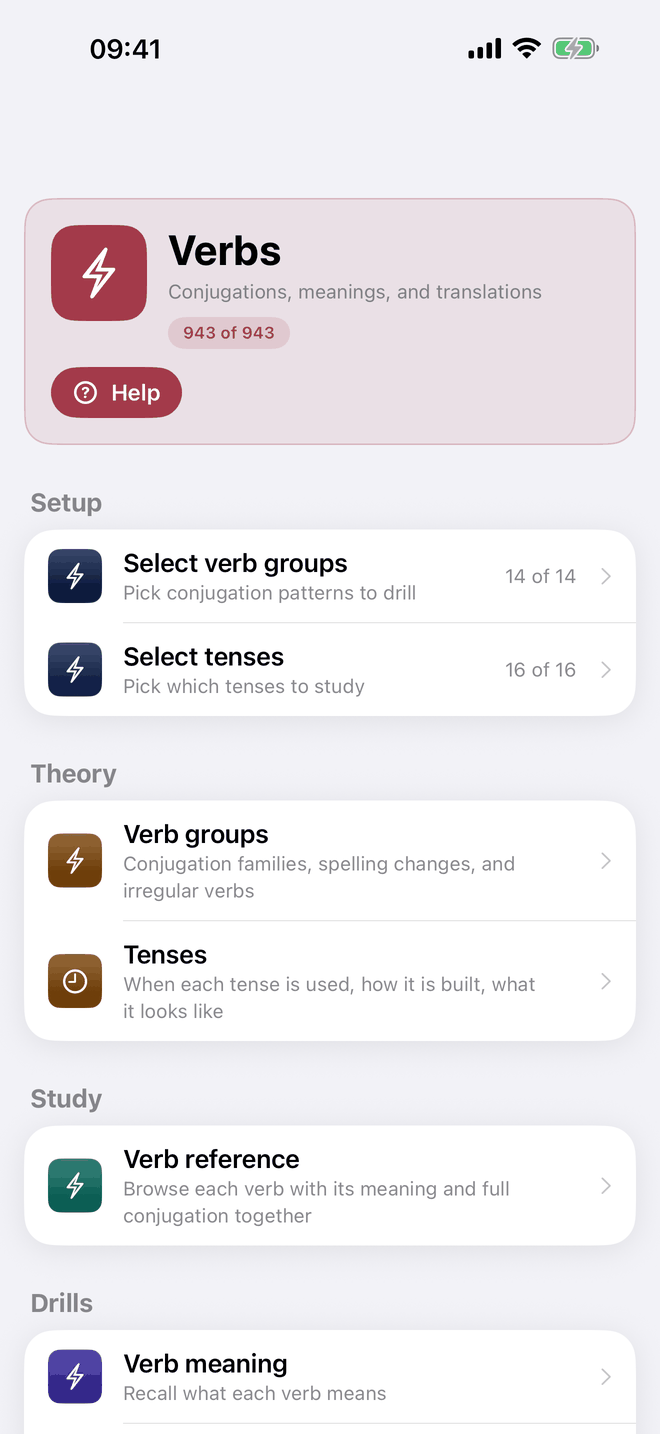
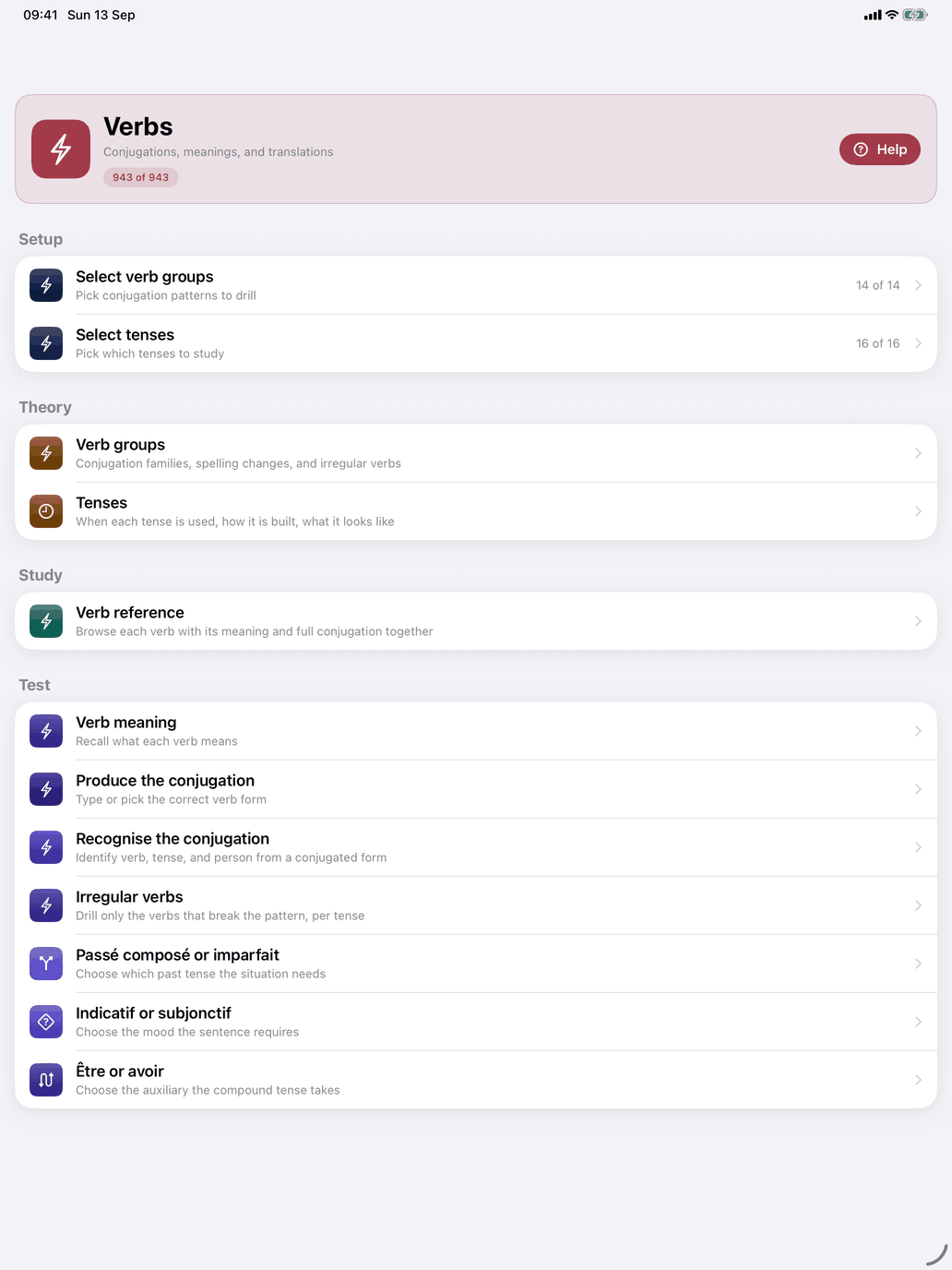
Open Self Study → Verbs to reach the verbs hub. The card at the top reads "Conjugations, meanings, and translations" and shows how many verbs your current selection gives you out of the whole catalogue, for example "212 of 943". Its Help button explains the hub. A long press on a Setup, Study or Drills row (on the Mac, press and hold) explains that row.
If your verb groups select verbs but your word scope (level and topic) removes all of them, a warning appears above Setup: "No verbs match once your topic scope is applied." Widen your topics or clear the topic filter to get the verbs back.
The hub has four sections.
Setup
- Select verb groups — pick the conjugation patterns to drill, and with them the verbs in your pool. The badge shows how many of the 14 groups are ticked, e.g. "14 of 14", and turns red at zero. See Select verb groups.
- Select tenses — pick which of the sixteen tenses to study, e.g. "16 of 16". See Select tenses.
Theory
- Verb groups — how the three French groups differ, how the conjugation tables mark irregular forms, and a card for each verb group. See Verb groups.
- Tenses — when each tense is used, how it is built and what it looks like. See Tenses.
Study
- Verb reference — every verb in your selection with its translation. Tap a verb for its full conjugation, usage and structure. See Verb reference and Conjugation tables.
Drills
- Verb meaning
- Produce the conjugation
- Recognise the conjugation
- Irregular verbs
- Passé composé or imparfait
- Indicatif or subjonctif
- Être or avoir
Each drill has its own section in this guide.
Studying verbs goes in three steps
- Choose what to study. In Select verb groups, tick the patterns you want. In Select tenses, narrow to the tenses you are learning: the conjugation tables and the drills then show only those. Level and topic come from Self Study → Select word scope; set the level to A1 there to start with the most common verbs.
- Study. Read Verb groups and Tenses under Theory, then open verbs in Verb reference to see their tables before you drill them.
- Drill. Warm up with Verb meaning so you know what the verbs mean, then move to Produce the conjugation and Recognise the conjugation. Add tenses one at a time as each becomes solid; imparfait and passé composé are the most useful after présent. Use Irregular verbs for the forms that break the pattern, and the choice drills once the forms are secure.
The three verb groups
Every French verb belongs to one of three groups, set by its infinitive and how it conjugates.
- 1st group — -er (parler, aimer, travailler) — by far the largest and most regular group. Aller looks like a member but belongs to the 3rd group.
- 2nd group — -ir with the -iss- infix (finir, choisir, réussir) — regular -ir verbs that insert -iss- in the plural of the present and throughout the imperfect (nous finissons, je finissais).
- 3rd group — everything else (aller, faire, prendre, venir, pouvoir, vouloir, devoir, voir) — the -re and -oir verbs and the -ir verbs that take no -iss-. Many follow a pattern of their own; this is where most of the memorising is.
The three groups take different endings in only two tenses, the présent and the passé simple. In the imparfait, futur simple and conditionnel présent all three take the same endings.
Compound tenses (passé composé, plus-que-parfait, …) are built with an auxiliary: avoir for most verbs, être for a short list of verbs of movement and change of state (aller, venir, arriver, partir, naître, mourir, devenir, …) and for all pronominal verbs. A few verbs, such as monter, descendre, sortir and passer, take avoir when they have a direct object. With être, the past participle agrees with the subject.
The conjugation colour code (French)
The conjugation tables mark each form so you can see where a verb departs from its group's pattern, and by how much. French uses the same three marks as the other courses, and each mark means one thing.
Underline — the regular ending. The ending is underlined where it is the one the pattern predicts: parlons**. It appears on irregular forms too, because most irregular forms are irregular only in the stem.
Red on part of a form — something changed. Only the part that departs is red, and a regular ending is still underlined. For example:
- Stem changes and spelling adjustments: in acheter, the present j'achète has the è in red, while nous achetons has no red because its stem does not change. Manger → nous mangeons and commencer → nous commençons show the adjusted letter in red.
- Irregular future stems: faire → je ferai has the e in red, and the ending -ai is underlined.
- Group-3 présent: only the part of the stem that changes is red. Pouvoir → nous pouvons has no red at all: pouv- is the stem the infinitive gives, and -ons is underlined.
- Strong passé simple stems: the stem is red and the ending underlined, as in boire → je bus.
Red across the whole form — completely irregular. The form has no systematic connection to the pattern and must be learned as a whole: the présent of être (je suis, nous sommes), avoir (ils ont) and aller (je vais, ils vont).
Compound tenses. The auxiliary is never marked; the past participle carries the mark. An irregular participle such as pris, mis or ouvert is red in every compound tense. A regular one (parlé, fini, entendu) has its last letter underlined.
Blue marks an ending from a second set of endings in the other courses. French has one set per group, so blue never appears in French tables.