Nouns
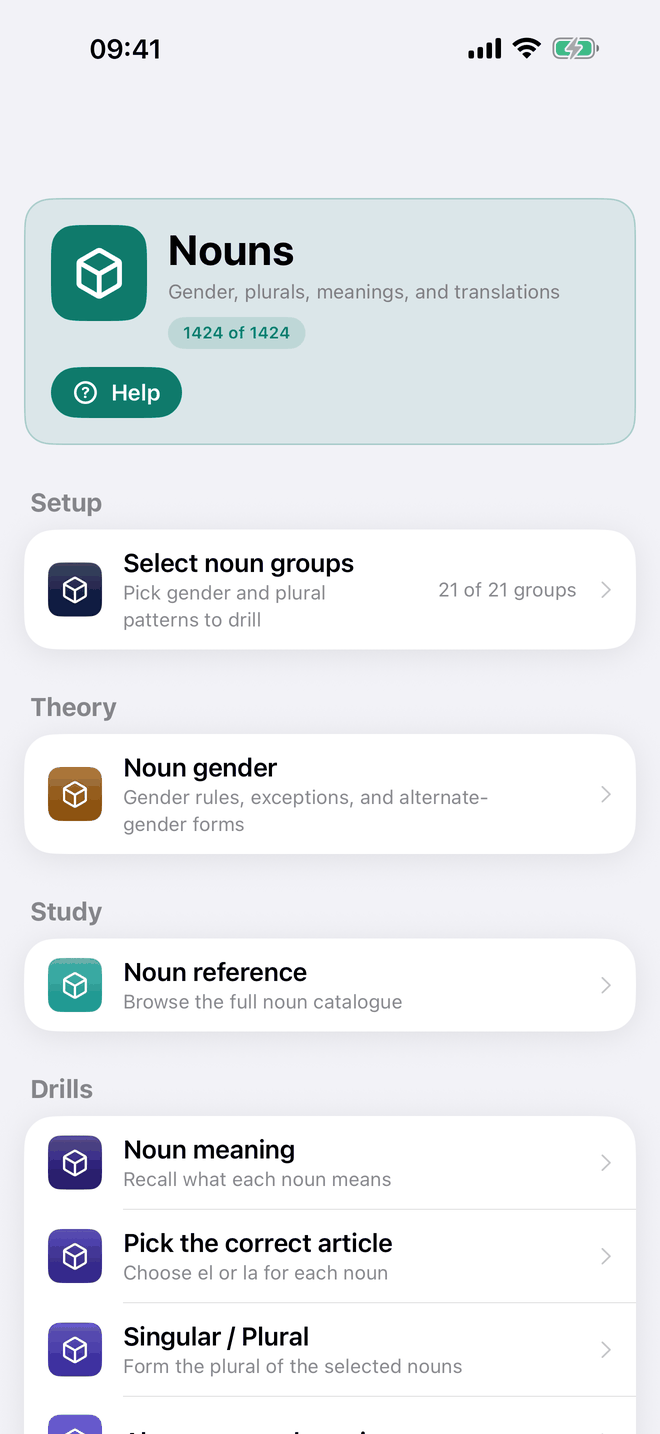
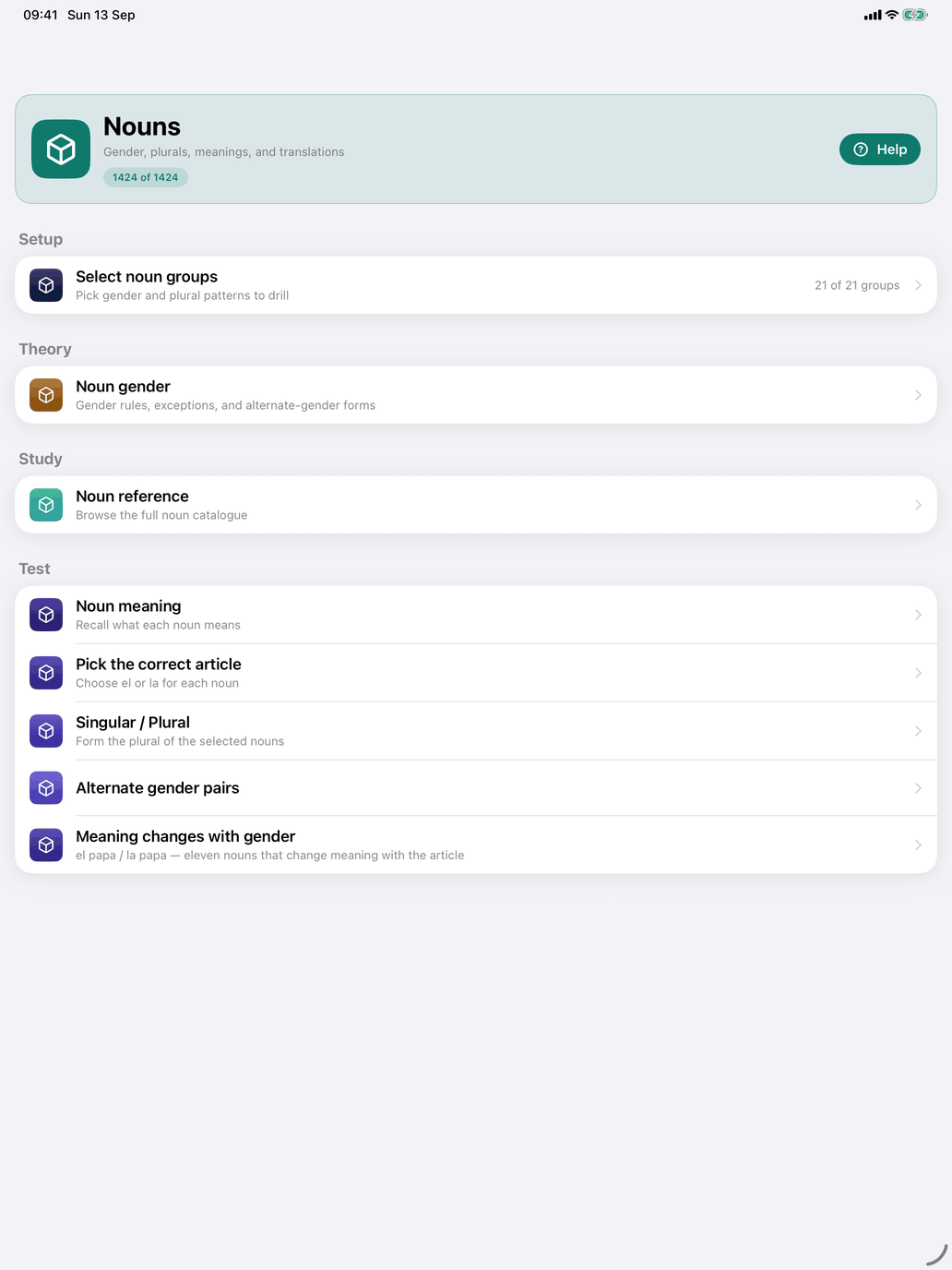
The Spanish course has over 1,400 nouns. Every noun has its article, its plural (where it has one), a translation and three example sentences. The Nouns hub is where you practise the parts of noun vocabulary that cause the most mistakes: gender, plurals, and the nouns whose form or meaning changes with the article.
Open Self Study → Nouns to reach the hub. It has four sections:
- Setup — Select noun groups: choose the kinds of noun to practise. See Select noun groups.
- Theory — Noun gender: gender rules, the exceptions, and the nouns that take both articles. See Noun gender.
- Study — Noun reference: browse the full noun catalogue. See Noun reference.
- Drills:
- Noun meaning — flashcards: recall what each noun means. See Noun meaning.
- Pick the correct article — choose el or la for each noun. See Pick the correct article.
- Singular / Plural — form the plural (or the singular) of the selected nouns. See Singular / Plural.
- Alternate gender pairs — give the masculine or feminine form of a noun. See Alternate gender pairs.
- Meaning changes with gender — flashcards for the eleven nouns whose meaning depends on the article. See Meaning changes with gender.
The line under the hub title shows how many nouns your selection gives you, out of the whole catalogue (for example "212 of 1424"). The Select noun groups row shows how many of the 21 groups you have ticked; the count turns red when none are ticked. Touch and hold a drill row for a short explanation of that drill, or use the Help button at the top of the hub.
Which drills follow your selection. Noun meaning, Pick the correct article and Singular / Plural use the nouns in your selected groups, narrowed by the level and topic you set in Self Study → Select word scope. Alternate gender pairs and Meaning changes with gender use their own fixed set of nouns and ignore your selection. Noun reference always lists the whole catalogue.
A recommended workflow
- In Select noun groups, start with Regular and the two predictable-suffix groups, and limit Select word scope to A1. Set Questions per session to 20 in Settings → Study.
- Run Noun meaning until the core vocabulary feels solid.
- Add Pick the correct article to fix el and la in memory.
- Move on to Singular / Plural once the meanings and articles are secure.
- Leave Alternate gender pairs and Meaning changes with gender until later — both assume you already know the ordinary gender of a noun.