Traps
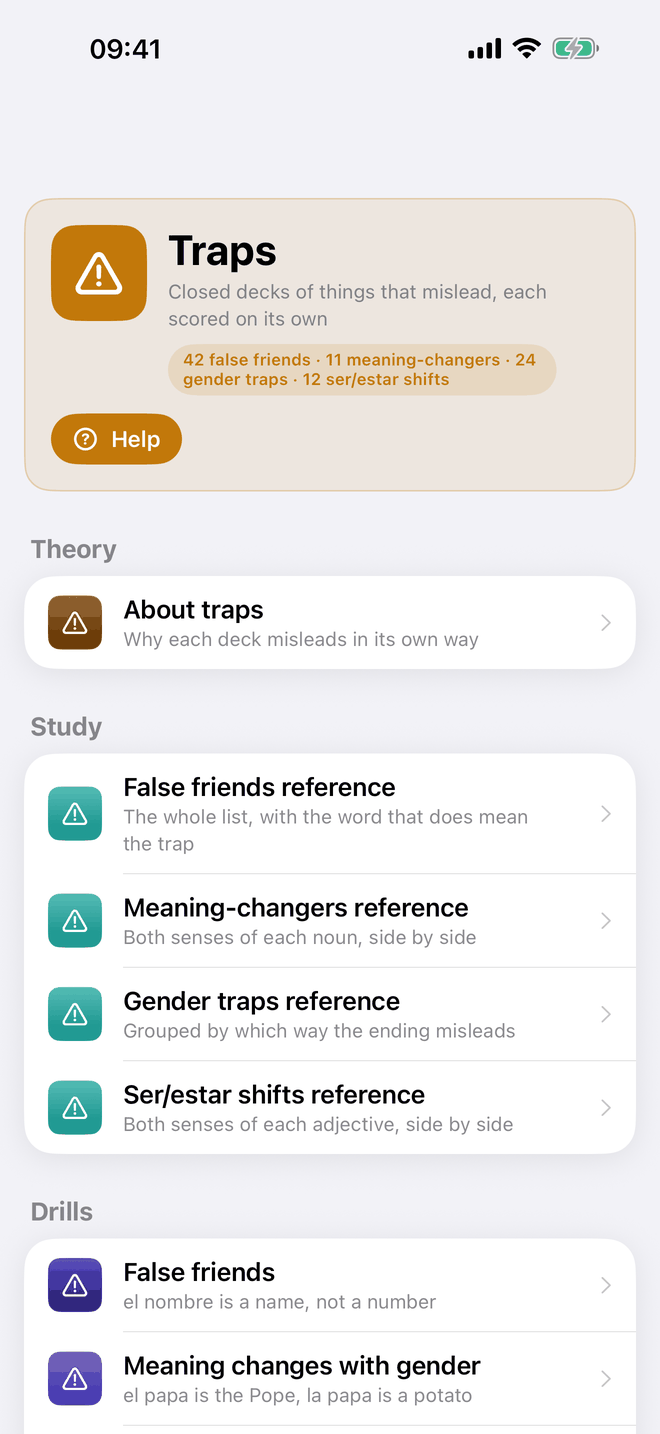
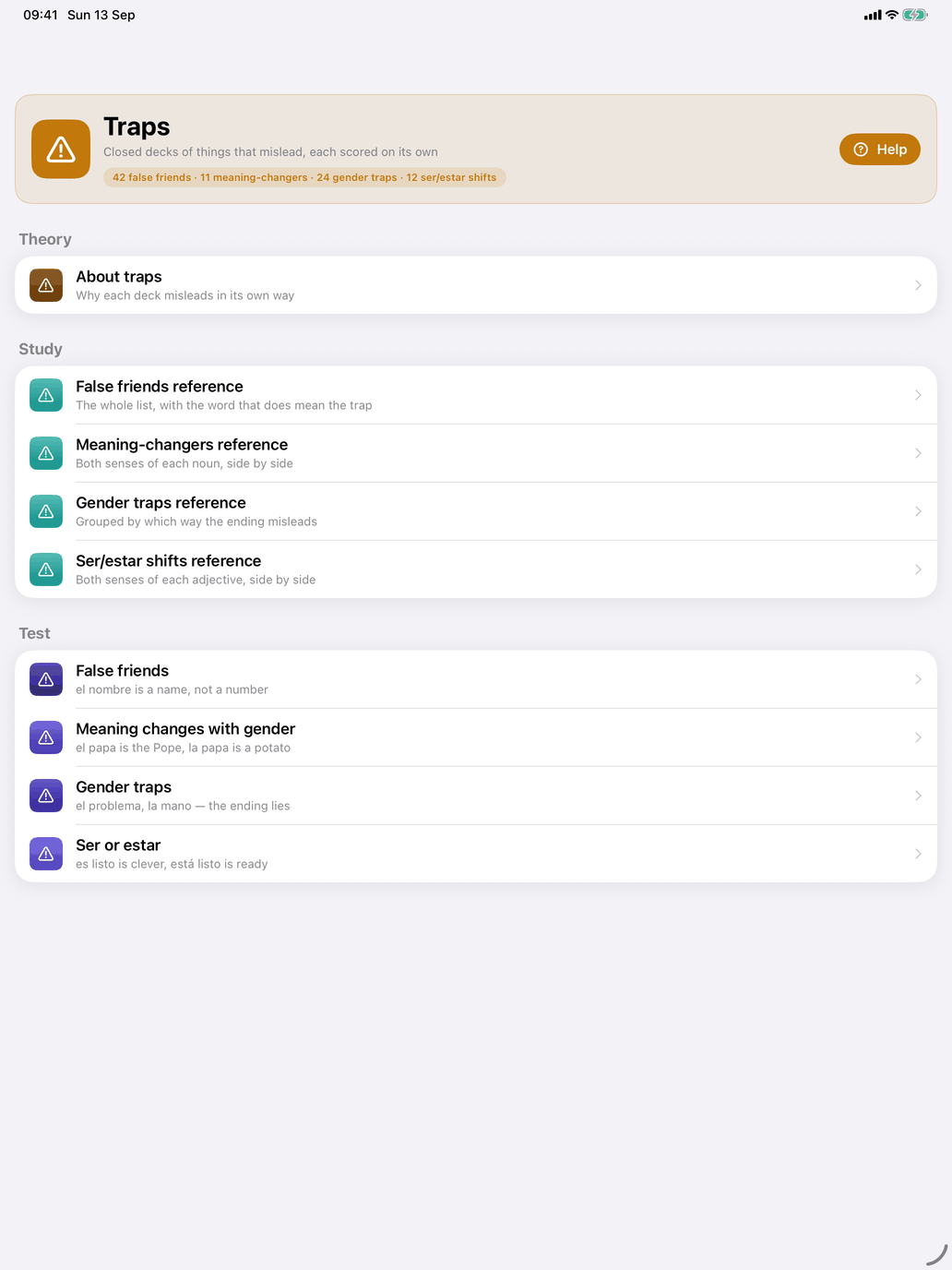
Most of the app is a catalogue: everything there is to know about a word class, filtered down to what you want to work on. Traps is the opposite. It holds small, closed, curated decks of things that actively mislead a learner:
- False friends — Spanish words that look or sound like a word in your language and mean something else.
- Meaning changes with gender — nouns that are one word with two unrelated meanings, where only el or la tells you which is meant.
- Gender traps — nouns whose ending points to the wrong gender: el problema, la mano.
- Ser/estar shifts — adjectives whose meaning depends on the verb: es listo is clever, está listo is ready.
Where to find it. On iPhone and iPad, open Self Study and tap Traps under Tools. On the Mac, choose Traps in the Tools section of the sidebar. Traps exists only in the Spanish course.
The decks sit together because they have the same shape, not the same cause. Each is a fixed set that brings its own words: you don't select anything first, and Select word scope doesn't narrow them. So the hub has no Setup section, only Theory, Study and Drills. The line under the hub title shows how many entries each of the four decks holds for you.
The false-friend flashcards keep their own record, so getting sensible wrong there doesn't count against the adjective in the adjective drills. The other three drills record your answers the same way as the ordinary drills they are built on. A gender-trap card counts as an article answer for that noun, a meaning-change card as a noun-meaning answer, and a ser/estar shift question as a ser/estar answer.
About traps
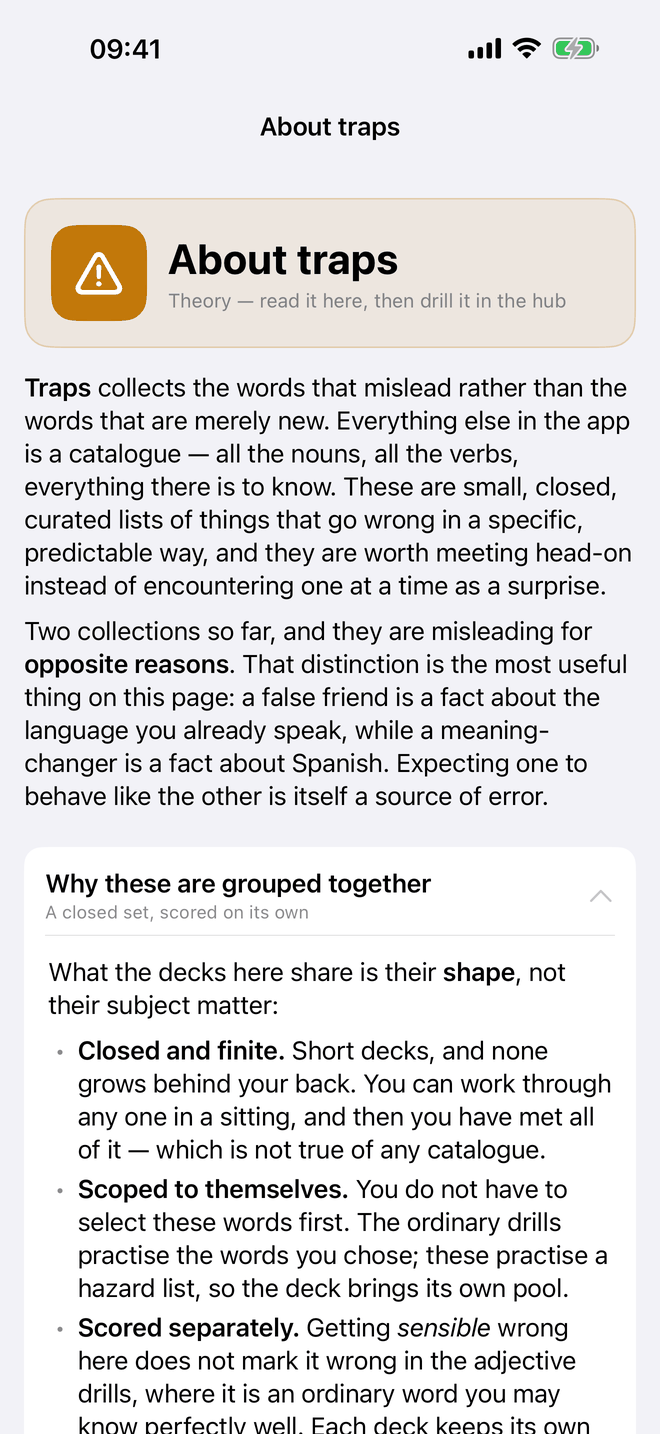
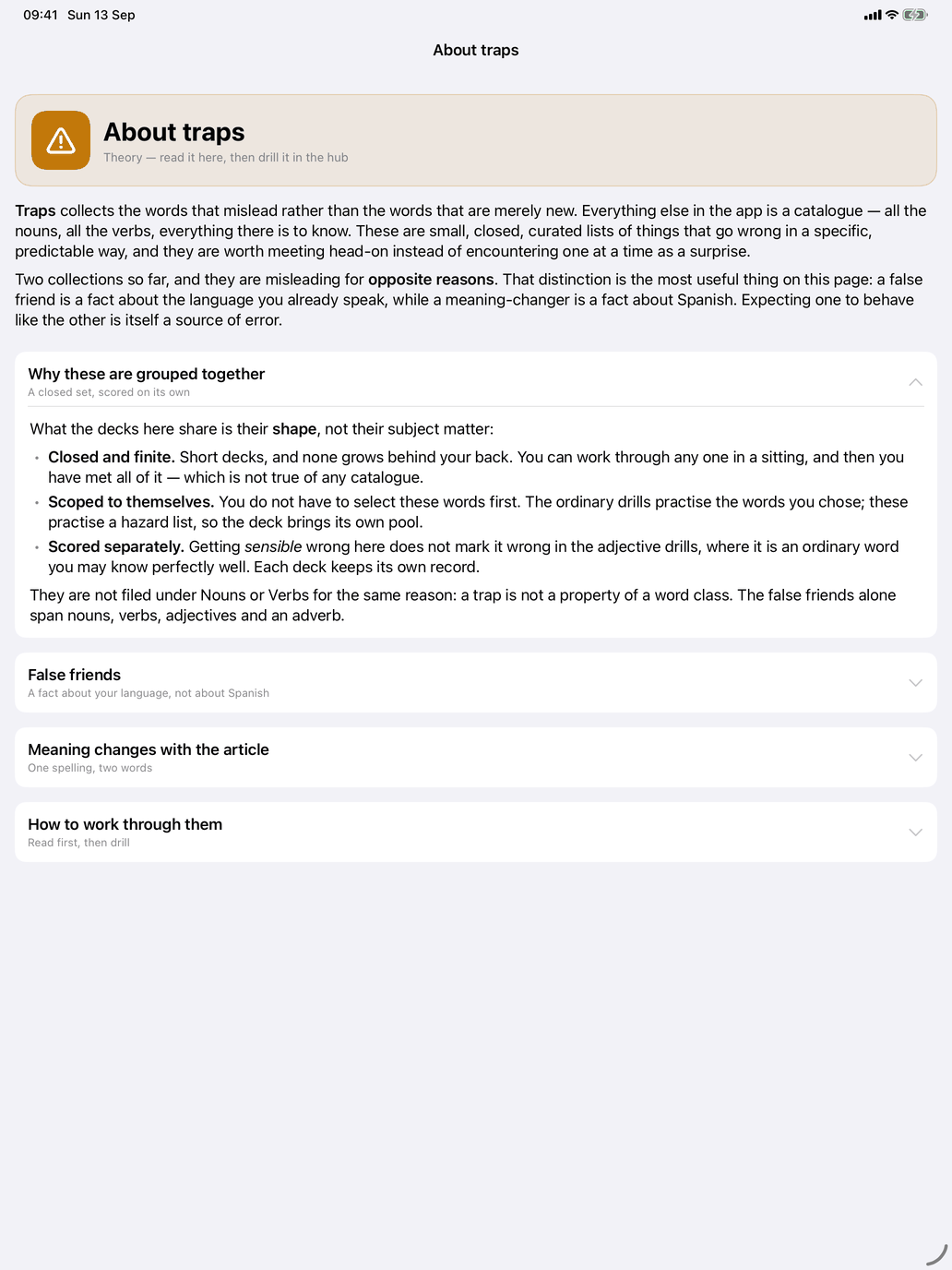
The Theory row opens About traps. It explains why these words are collected, and the one thing you can't work out from the decks themselves:
A false friend is a fact about the language you already speak. A meaning-changer is a fact about Spanish.
Embarazada is only a trap if your language has embarrassed in it. El capital and la capital catch everyone equally. The page also explains why the meaning-changers are drilled as two cards each, and suggests an order of work: read the list first, then drill.
False friends reference
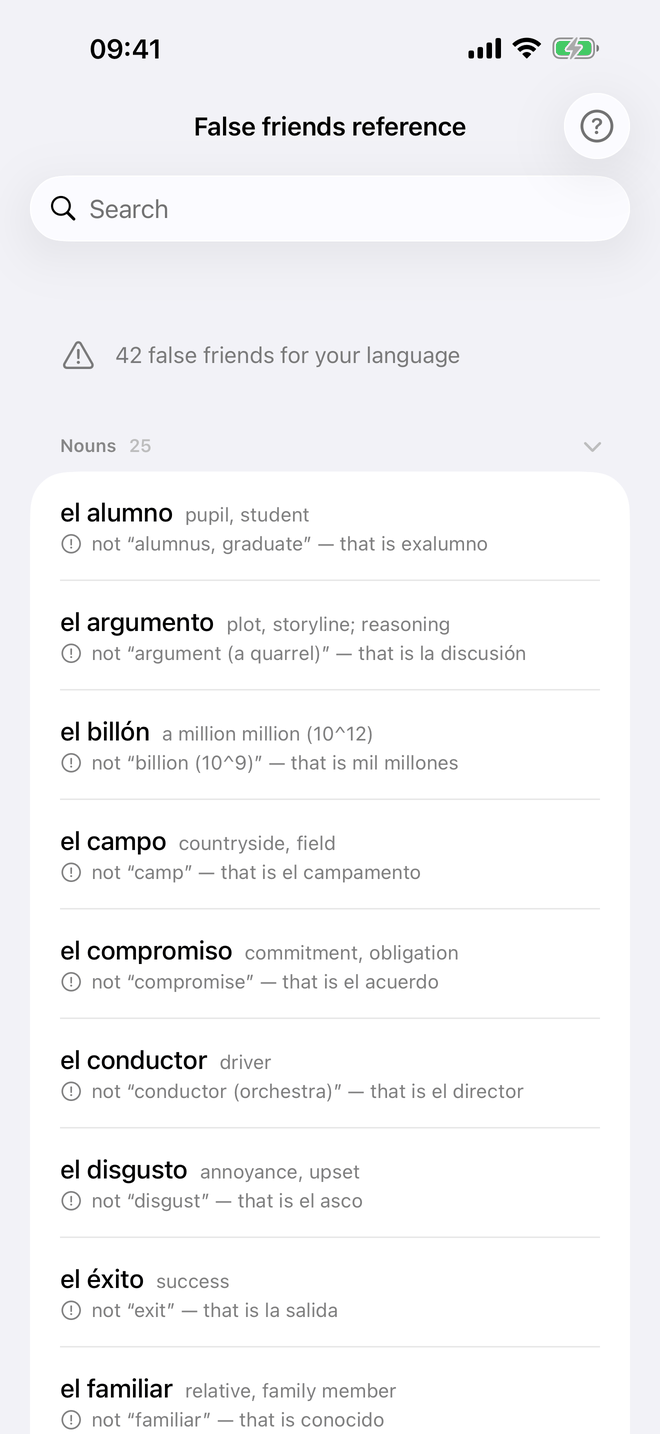
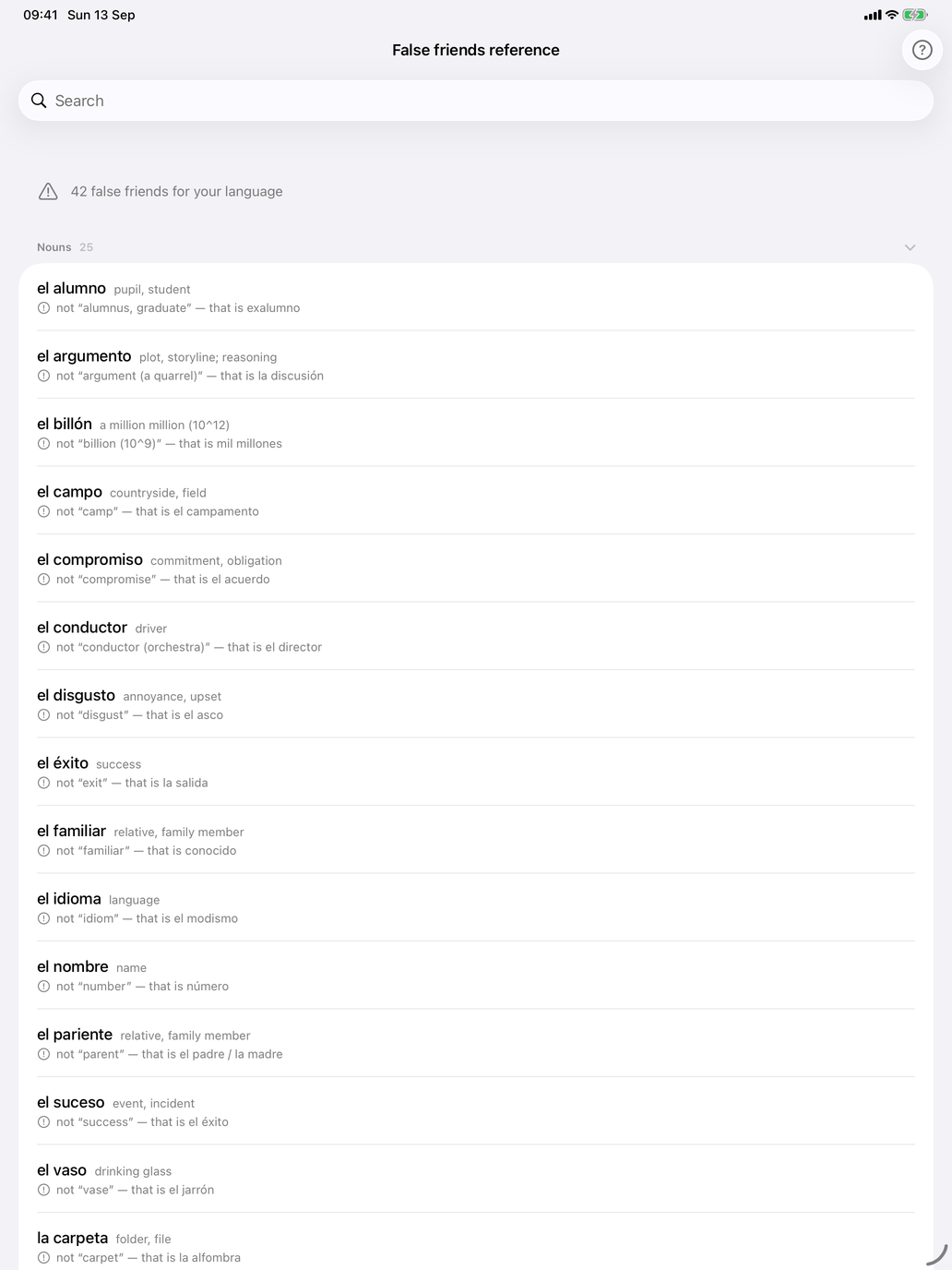
The whole false-friend deck on one page, grouped under Nouns, Verbs, Adjectives and Adverbs, with a search field. Each row shows three things:
- the Spanish word (nouns with their article: el nombre),
- what it really means,
- what it is mistaken for, and the Spanish word that does mean that: not "number" — that is número.
The deck depends on your display language. A false friend has to resemble a word in the language you already speak, so the app shows only the entries that are traps for you. The deck holds 42 entries: 25 nouns, 10 verbs, 5 adjectives and 2 adverbs. With English as display language you see all 42. With Dutch you see 19, because the other 23 are no trap for a Dutch speaker. Sensible catches an English speaker (Spanish sensible means sensitive), but Dutch sensibel already means sensitive. El nombre catches both: it means name, and the Spanish for number is número. The line at the top shows how many entries apply to you.
False friends flashcards
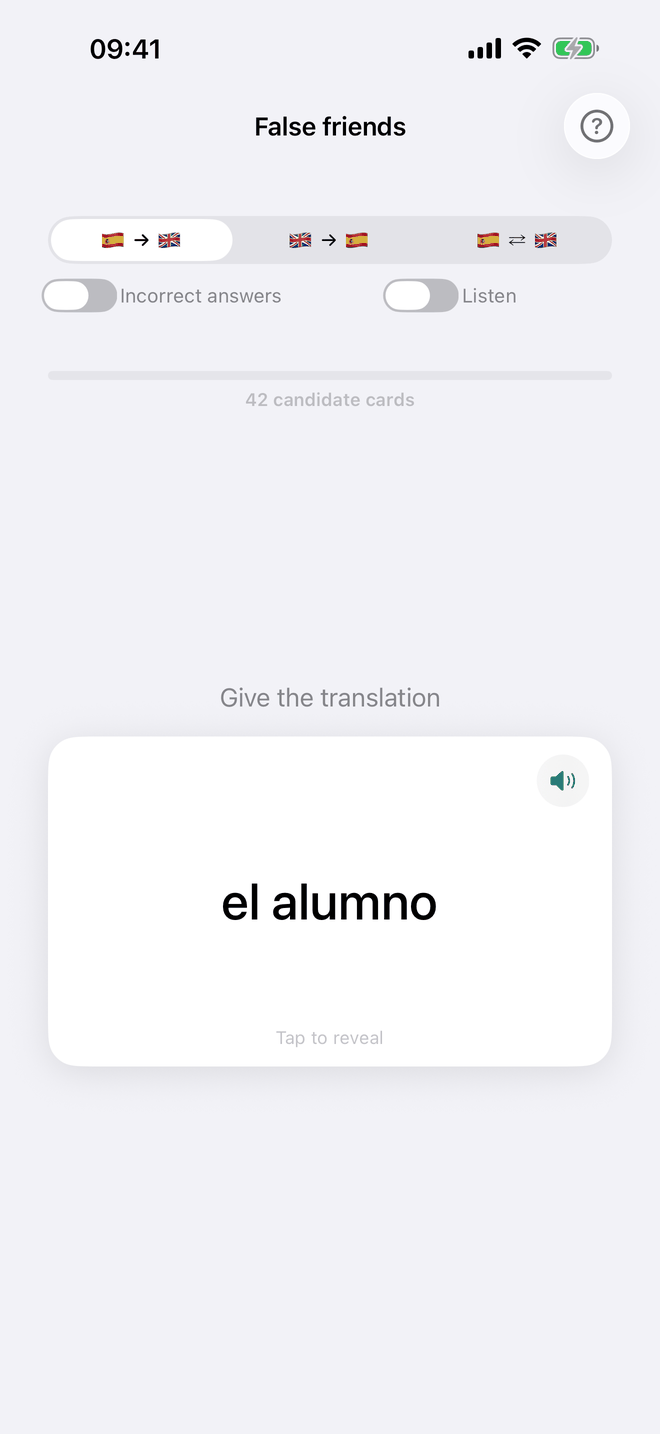
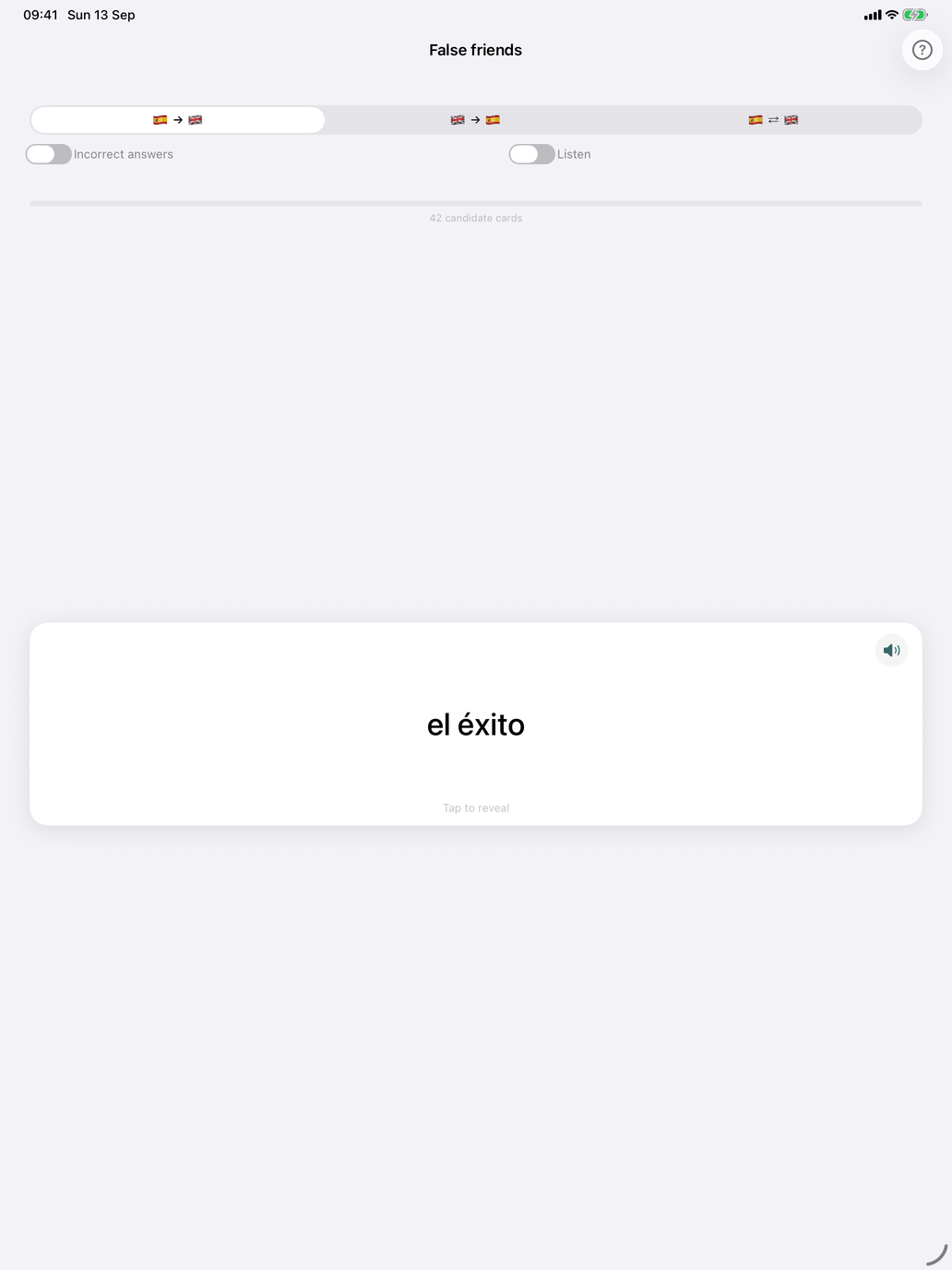
The False friends drill turns the same deck into flashcards: translate the word, then flip the card. The back shows the answer and a short note:
- Looks like "…" — the word it is mistaken for,
- "…" is … — the Spanish word that does mean that,
- a line explaining where the resemblance comes from.
A session draws from the whole deck in random order, up to your Questions per session (Settings → General → Study). The switch at the top sets the direction: Spanish → your language, or the other way round.
Meaning-changers reference
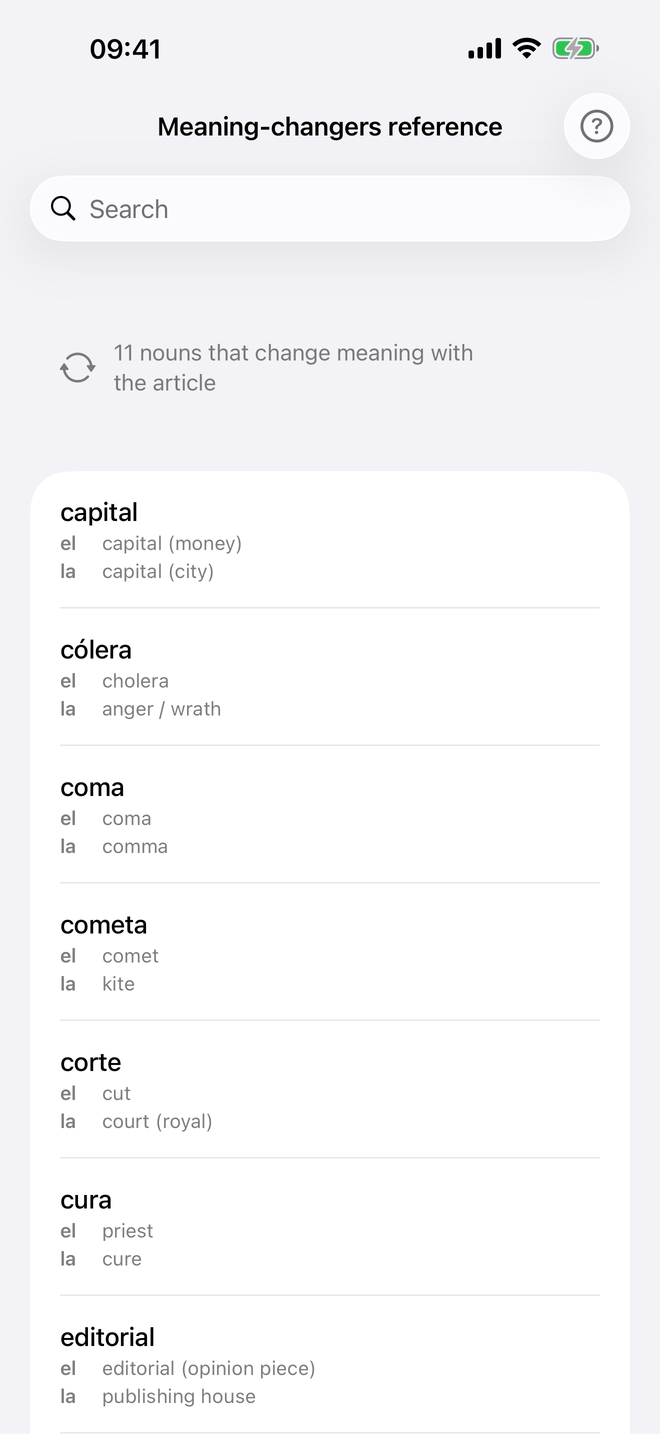
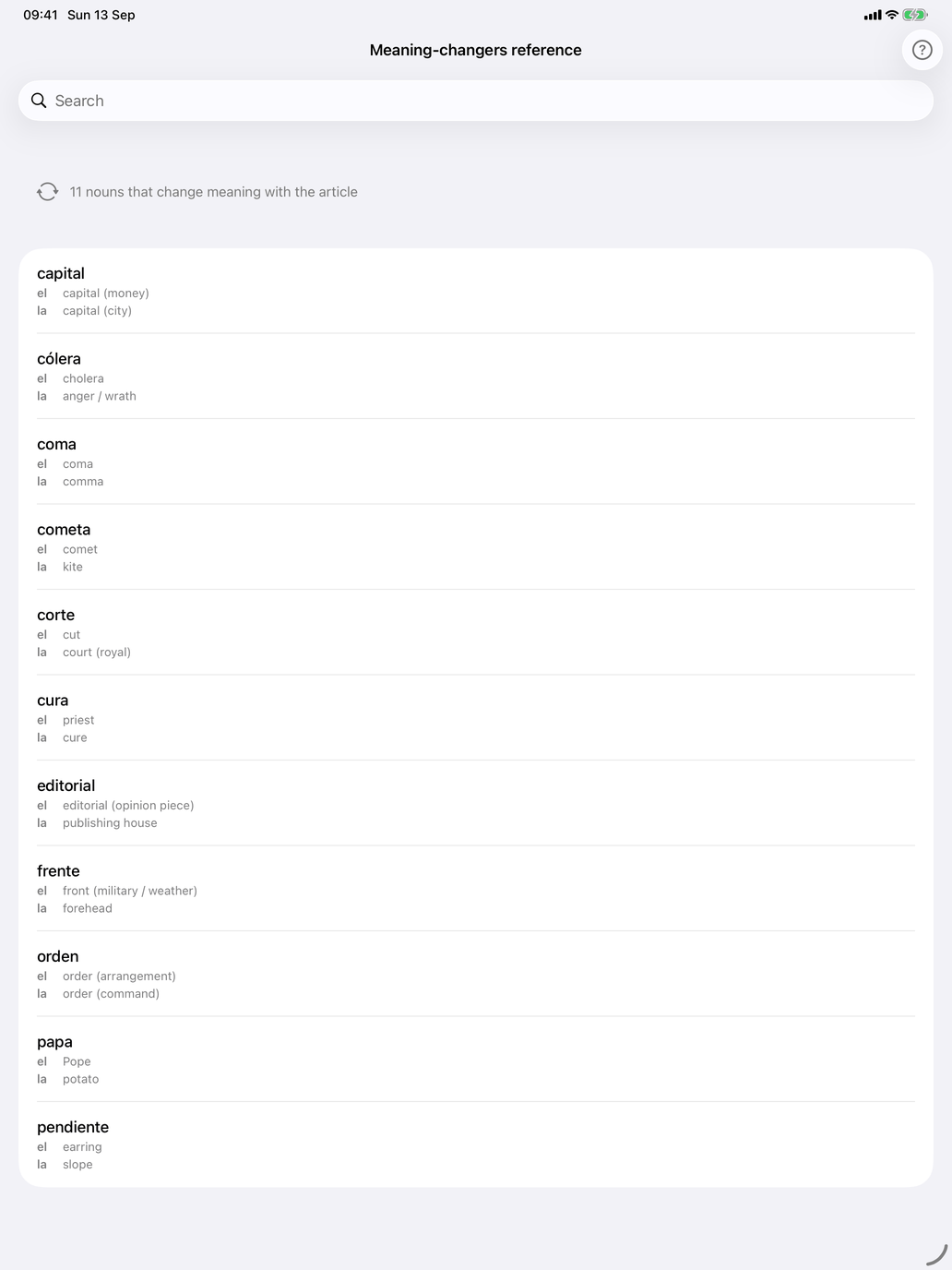
Eleven nouns carry two unrelated meanings that only the article separates. The reference shows each noun once, with an el line and a la line:
| Noun | With el | With la |
|---|---|---|
| capital | money, capital | capital city |
| coma | coma | comma |
| cometa | comet | kite |
| corte | cut | court (royal) |
| cura | priest | cure |
| cólera | cholera | anger, wrath |
| editorial | editorial (opinion piece) | publishing house |
| frente | front (military, weather) | forehead |
| orden | order (arrangement) | order (command) |
| papa | Pope | potato (Latin America; Spain says la patata) |
| pendiente | earring | slope |
Hay un orden and hay una orden are both grammatical, but only one of them means what you intended. That is why these nouns are worth drilling as a group rather than meeting them one at a time.
This is not the same as a noun with two genders. El dentista and la dentista are one word for one job, and the article only tells you who is meant. El papa and la papa are two different words that happen to share a spelling.
The list comes from the noun catalogue, so these are the same eleven nouns that carry the Different meaning by article group under Nouns.
Meaning changes with gender
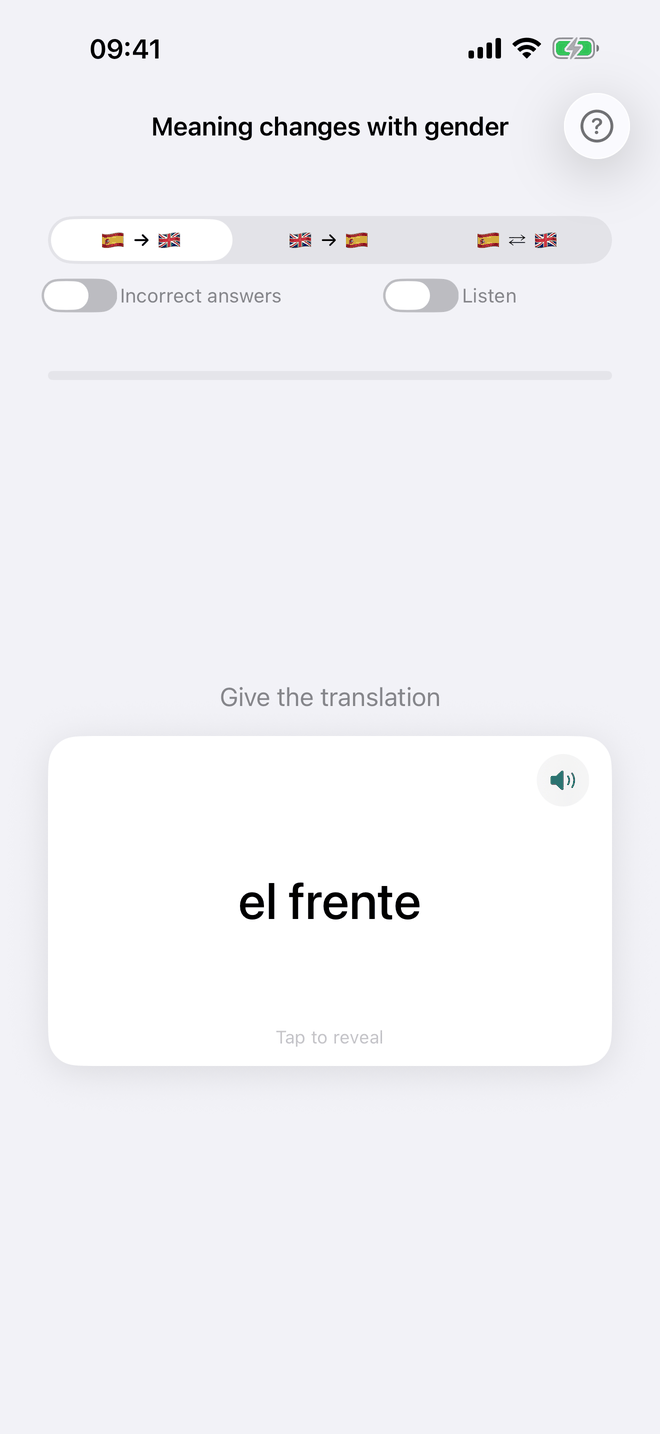
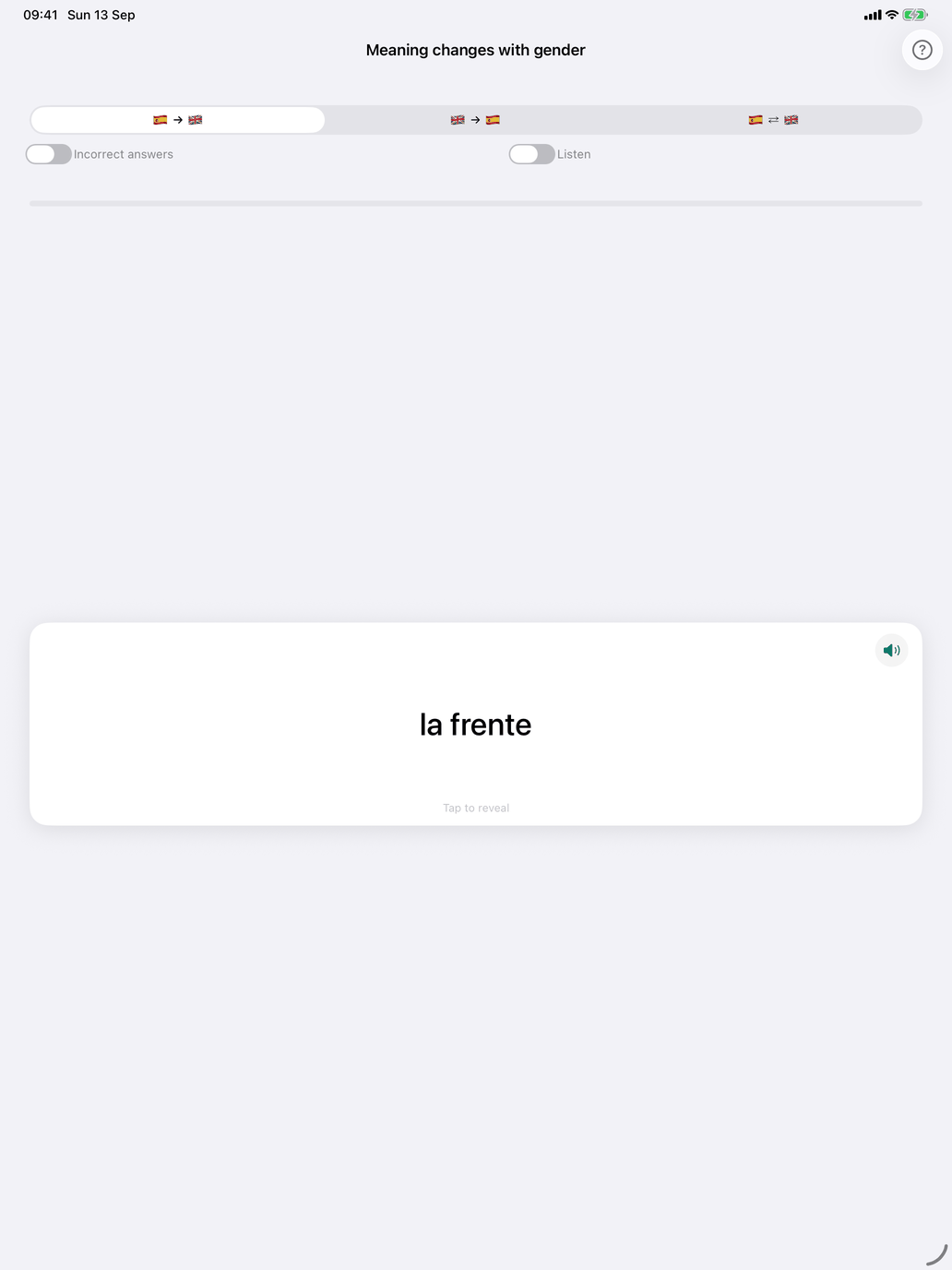
The flashcard drill for the eleven meaning-changers. Each noun becomes two cards, one per article (el papa → Pope, la papa → potato), because a single card for el/la papa would have no one right answer. The deck is always the same 22 cards, whatever your noun selection. The same drill also appears on the Nouns hub.
Gender traps reference
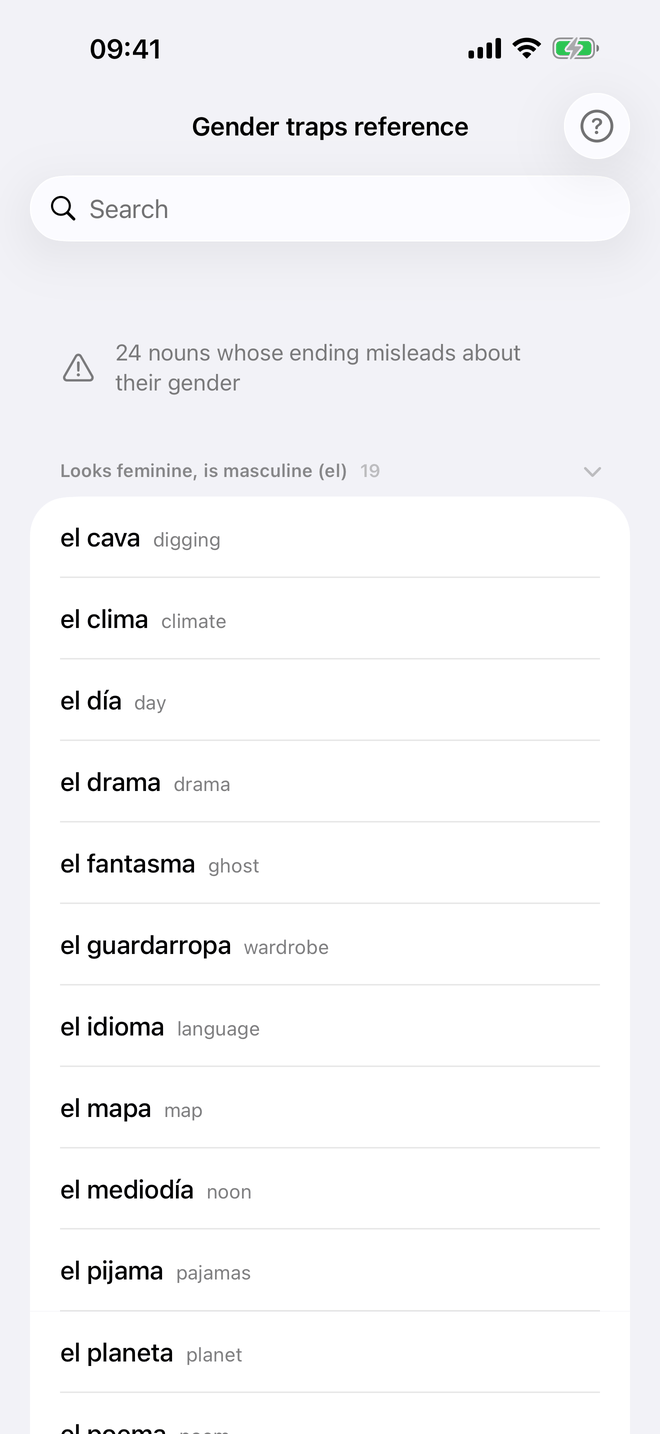
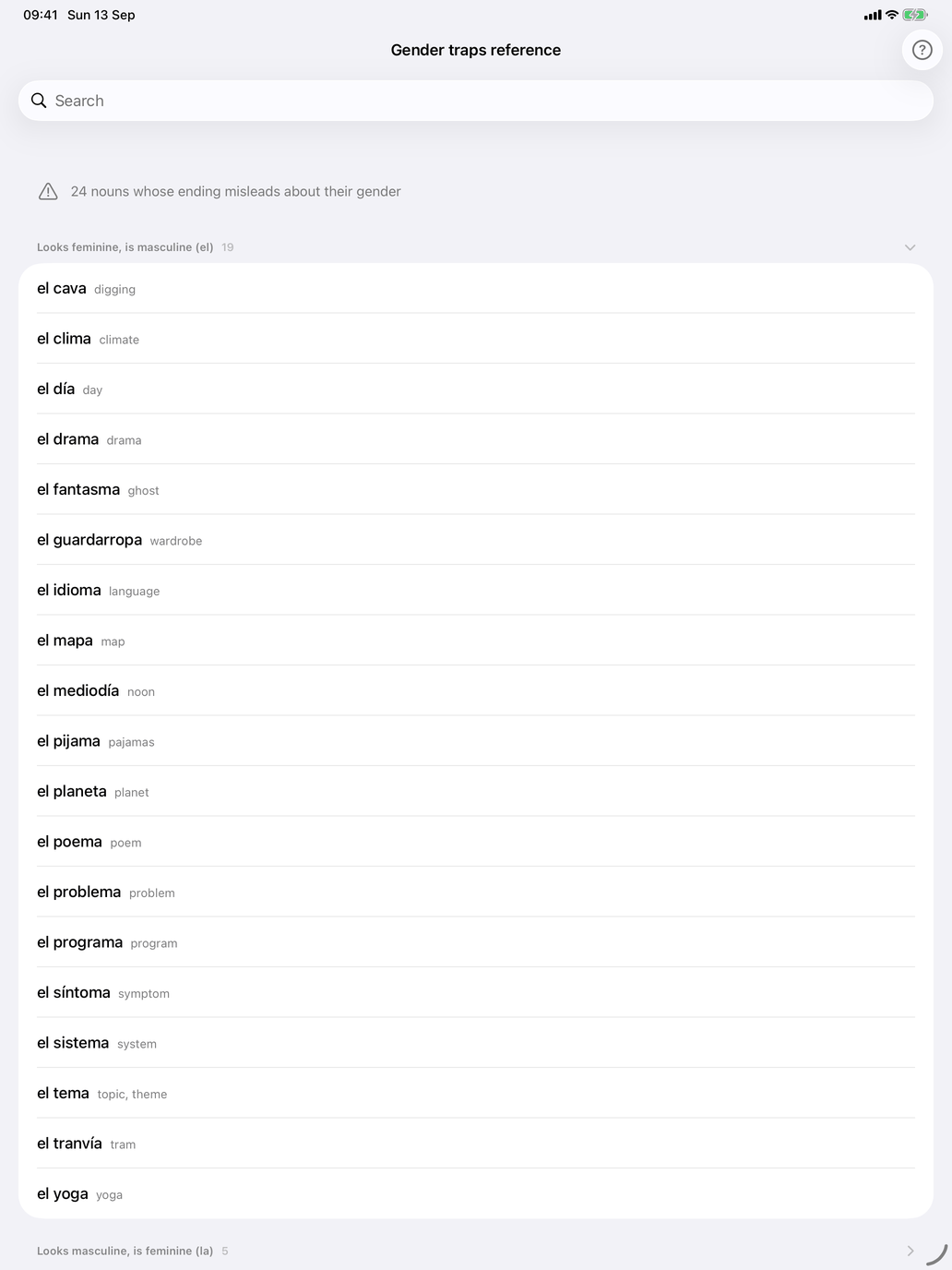
Spanish noun endings usually predict the gender: -a, -ción, -sión, -dad, -tad and -umbre are typically feminine, -o masculine. This deck holds every catalogue noun that ending gets wrong:
- the Greek-derived -ma masculines: el problema, el idioma, el clima, el sistema, el tema,
- other masculines in -a: el día, el mapa, el planeta, el tranvía,
- feminines in -o, most of them shortened words: la mano, la foto, la moto, la radio.
The list has two sections: Looks feminine, is masculine (el) and Looks masculine, is feminine (la). Every word is shown with its article, because the article is what you are learning. Reading each section in one go makes the patterns visible: the -ma words cluster, and so do the shortened feminines.
The deck is built from the noun catalogue, so a new noun with a misleading ending joins it automatically. Nouns that take both genders and multi-word nouns are left out.
Stressed-á feminines are not traps. El agua and el aula take el in the singular for the sake of sound, but they are feminine (las aguas, el agua fría), and they follow a rule rather than break one. They have their own group under Nouns, Stressed-á feminines.
Gender traps drill
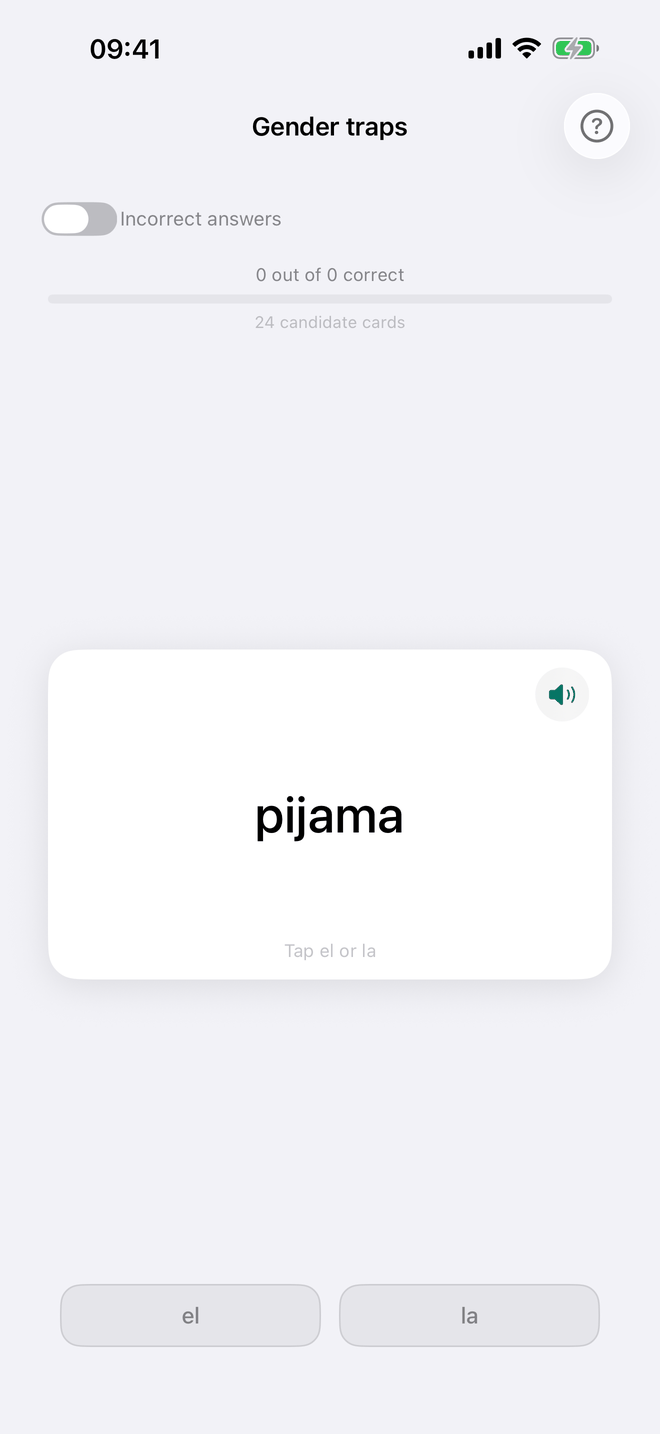
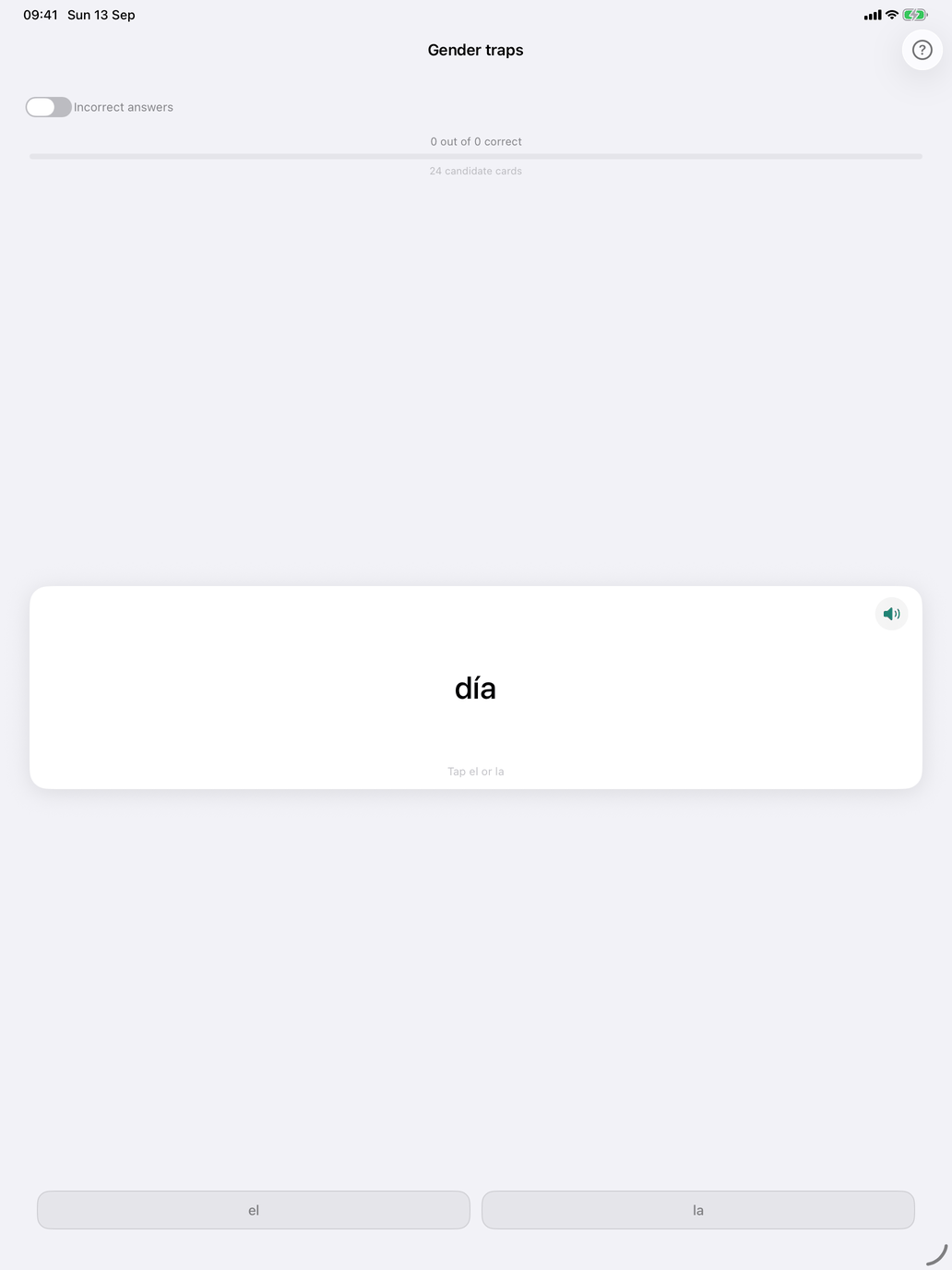
The Gender traps drill is the familiar el/la article drill, limited to exactly this deck. In the ordinary drill, most nouns in your selection follow the ending rule. Here every card is one where the rule gives the wrong answer, and each session asks all of them.
Ser/estar shifts reference
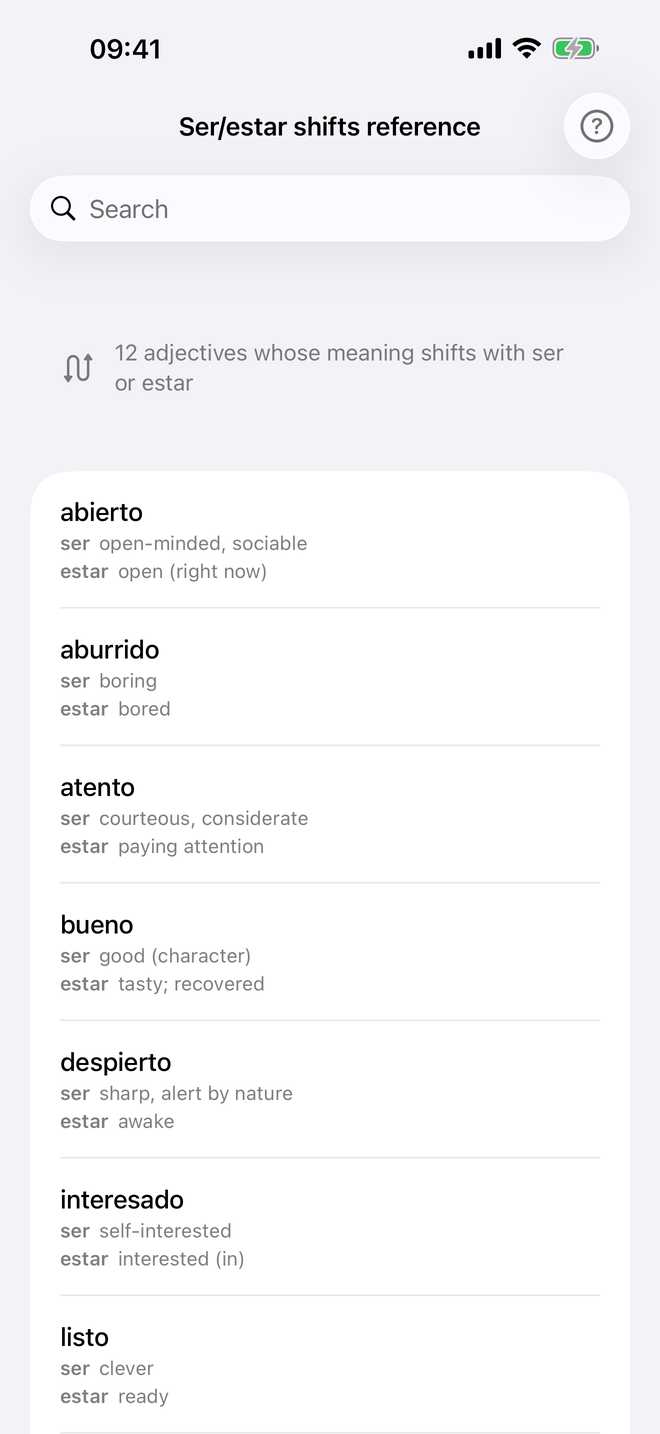
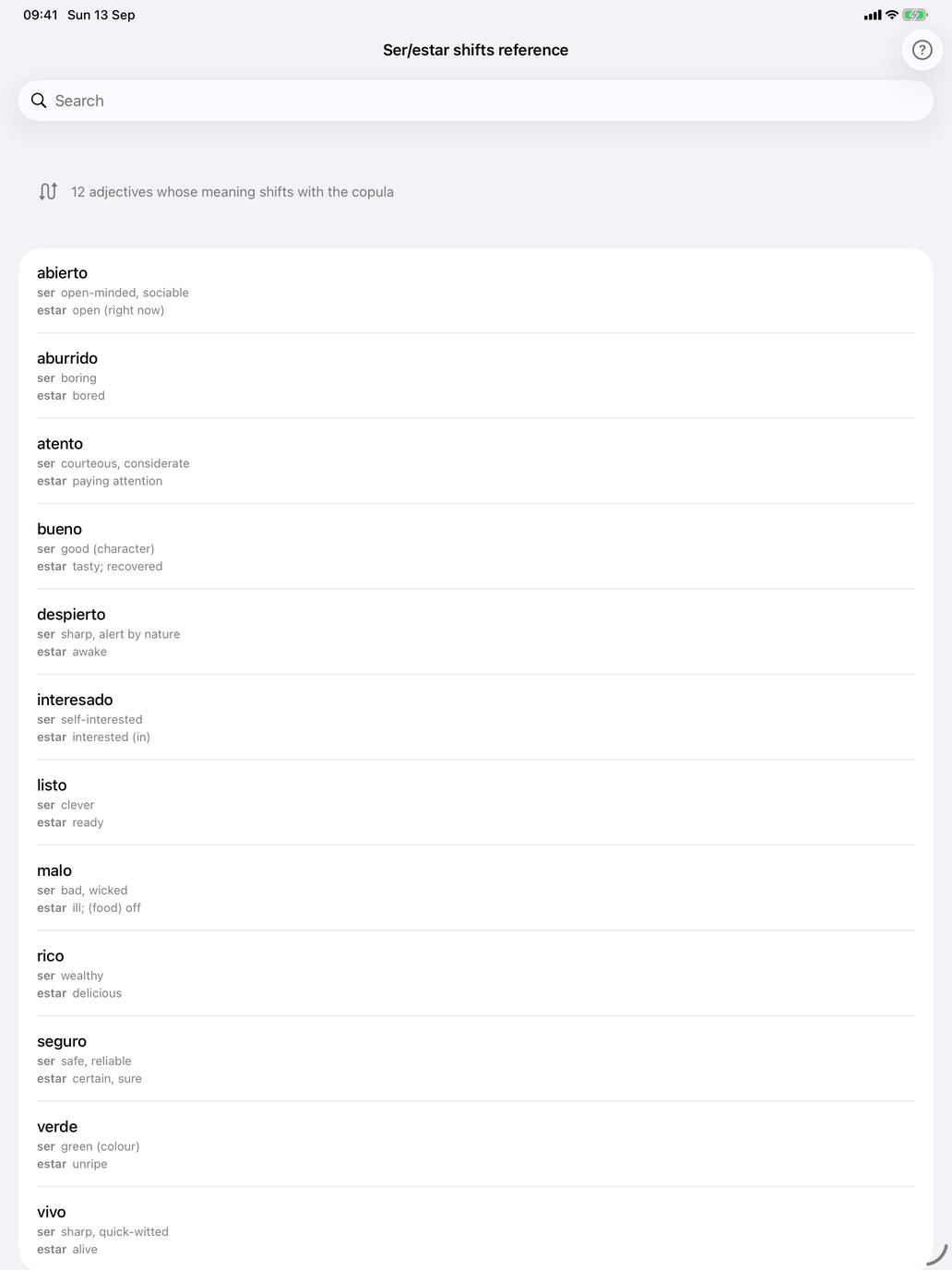
Twelve adjectives mean one thing with ser and another with estar. The reference shows each adjective with a ser line and an estar line:
| Adjective | With ser | With estar |
|---|---|---|
| aburrido | boring | bored |
| abierto | open-minded, sociable | open (right now) |
| atento | courteous, considerate | paying attention |
| bueno | good (character) | tasty; recovered |
| despierto | sharp, alert by nature | awake |
| interesado | self-interested | interested (in) |
| listo | clever | ready |
| malo | bad, wicked | ill; (food) off |
| rico | wealthy | delicious |
| seguro | safe, reliable | certain, sure |
| verde | green (colour) | unripe |
| vivo | sharp, quick-witted | alive |
This is the sharpest of the four hazards. With a false friend you use the wrong word. Here you say a perfectly grammatical sentence that means something else: es interesada is an insult, está interesada is a plain fact. The deck keeps to systematic shifts and leaves out idioms such as estar católico.
Ser or estar (shift drill)
The Ser or estar row under Traps opens the ser/estar drill, limited to these twelve adjectives. Each question gives an English sentence and a Spanish sentence with a gap (El profesor ___ aburrido.). You choose the right form of ser or estar. Each adjective is asked in both directions (The teacher is boring / The teacher is bored), so the English sentence is your only clue. After you answer, a short explanation shows the two meanings. The number of questions comes from Questions per session. The open Ser or estar drill under Verbs keeps its full set of sentences and includes these as well.
Working through the decks
- Read About traps once. The difference between a false friend and a meaning-changer is what makes the rest make sense.
- Read the False friends reference, including the "that is …" part of each row. The Spanish word you were actually looking for is what makes the pair stick.
- Run the False friends flashcards until the deck feels comfortable.
- Do the same for the meaning-changers: read the pairs side by side, then drill Meaning changes with gender.
- Browse the Gender traps reference section by section, then run the Gender traps drill.
- Read the Ser/estar shifts reference, then run Ser or estar.
- Come back from time to time. A trap stays tempting long after you have learned it, and these decks are small enough to finish, unlike the noun catalogue.
The trap entries and their notes are written as teaching material and are still waiting to be checked by someone who knows both languages well.