Adjectives
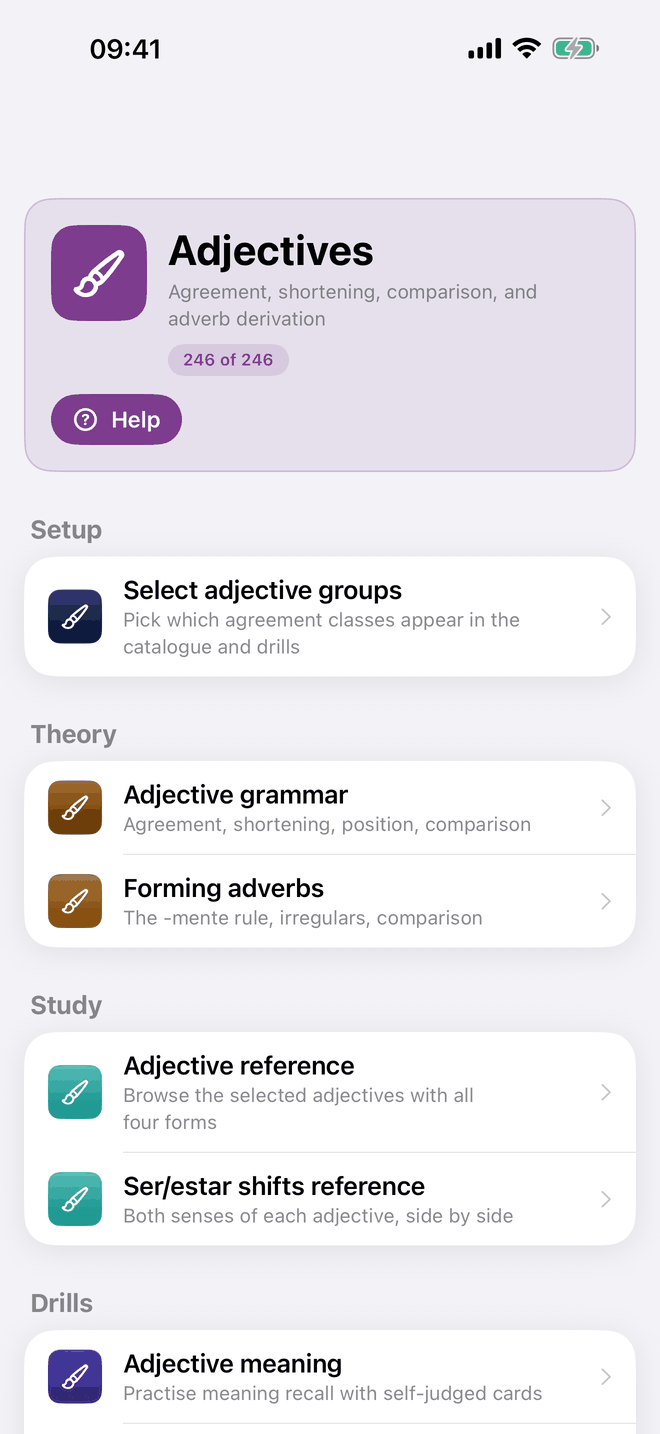
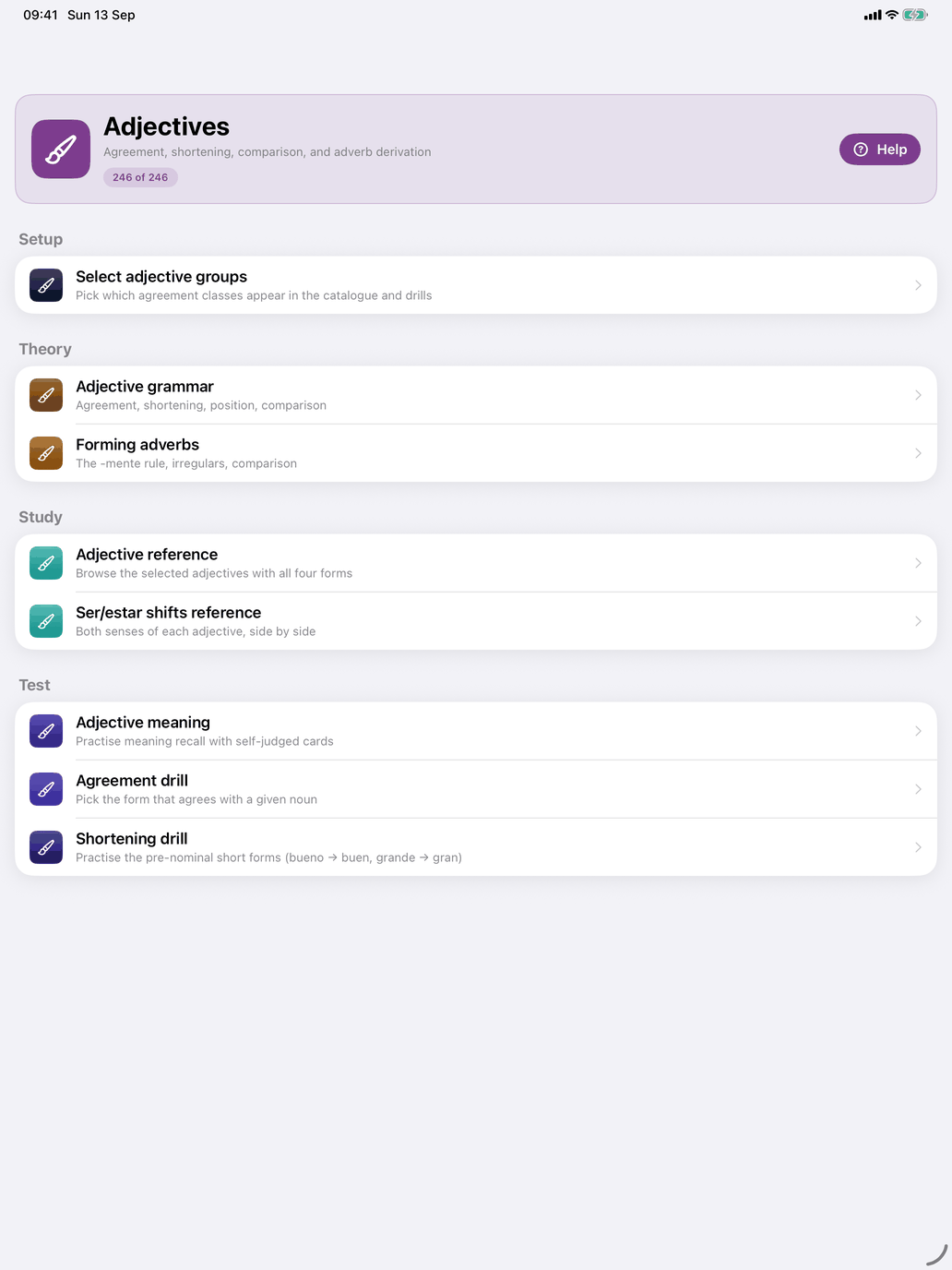
Open the Adjectives hub from the Adjectives tile on the Self Study screen. The Spanish catalogue has almost 250 adjectives, each with its four forms (masculine and feminine, singular and plural). The hub covers agreement, shortening, position, comparison and how an adjective becomes an adverb. It has the usual Setup / Theory / Study / Drills layout.
Under the title, a badge such as "246 of 246" shows how many adjectives you are working with. It counts the agreement classes you ticked in Setup, narrowed by the level and topics in Select word scope. The badge turns red when nothing is left to drill.
The hub has these screens:
- Select adjective groups (Setup): tick the agreement classes you want.
- Adjective grammar (Theory): agreement, plurals, shortening, position and comparison.
- Forming adverbs (Theory): the -mente rule. This is the same page as in the Adverbs hub (see Adverbs).
- Adjective reference (Study): the selected adjectives.
- Ser/estar shifts reference (Study): adjectives whose meaning changes with ser or estar, both senses side by side. This is the same list as in Traps.
- Adjective meaning, Agreement drill and Shortening drill (Drills).
Nothing you do on the Setup, Theory and Study screens is recorded. Every answer in a drill is recorded.
Select adjective groups
Spanish adjectives fall into three agreement classes:
| Class | Example | Adjectives |
|---|---|---|
| Variable (-o / -a) | rápido / rápida / rápidos / rápidas | 158 |
| Invariant (-e) | grande / grandes | 41 |
| Invariant (consonant) | fácil / fáciles | 47 |
Tap a class to switch it on or off. Tap ⓘ for an explanation of the class and a Browse all adjectives row that lists its members. Adjectives of nationality and those in -or, -án, -ón, -ín end in a consonant but count as variable, because they have a feminine in -a: español → española, trabajador → trabajadora.
The line at the top shows how many adjectives you selected and how many of those are left after Select word scope. The Select word scope row takes you there.
Adjective grammar
This Theory page has five sections:
- Agreement: an adjective takes the gender and number of its noun. Una casa alta, un edificio alto, casas altas, edificios altos: one adjective, four forms, all decided by the noun.
- Forming plurals: add -s after an unstressed vowel (alto → altos, grande → grandes) and -es after a consonant (fácil → fáciles). A final -z becomes -ces (feliz → felices). A written accent on a final -án, -ón, -ín disappears in the plural (alemán → alemanes, común → comunes). Joven gains one: jóvenes.
- Shortening (apócope): a few adjectives lose their ending directly before a masculine singular noun: bueno → buen, malo → mal, primero → primer, tercero → tercer, alguno → algún, ninguno → ningún. Grande → gran and cualquiera → cualquier shorten before a singular noun of either gender: una gran ciudad, cualquier persona. Santo → san before most masculine names (san Pedro), but santo Tomás, santo Domingo. After the noun, and after ser or estar, the full form is used: un hombre bueno, el día es bueno.
- Position: most adjectives follow the noun (una casa blanca). Some change meaning when they come first: un gran hombre (a great man) and un hombre grande (a big man), un viejo amigo (an old friend, of long standing) and un amigo viejo (an elderly friend), el pobre niño (the unfortunate child) and el niño pobre (the child without money).
- Comparison: más … que, menos … que, tan … como. The superlative puts the article in front: la más rápida. Four adjectives have an irregular comparative: bueno → mejor, malo → peor, grande → mayor, pequeño → menor. Mayor and menor are used mainly for age (mi hermano mayor). The suffix -ísimo means "very": altísimo.
Adjective reference
A list of the selected adjectives with their translations, in alphabetical order, with an A–Z index and a search field. Search matches the adjective or its translation and ignores accents. Tap an adjective to open its page. The page shows the four forms, the agreement class, the short form if there is one, and the irregular comparative if there is one.
Adjective meaning
Flashcards for the meaning of each adjective. The card shows the masculine singular form (rápido), and you recall the translation, or the other way round. See Word meaning for how the flashcards work.
How the choice drills work
The Agreement drill and Shortening drill here, and the choice drills in the Pronouns, Numerals and Prepositions hubs, all work the same way:
- At the top is the Incorrect answers switch. Turn it on to practise only the items you have got wrong and have not yet mastered.
- The header shows Question 3 of 20 and your score so far.
- The screen says what to do (for example "Which form of bueno goes with this noun?"), shows the material and lists the options. Tap an option. The correct answer turns green with a tick. If you chose wrong, your answer turns red with a cross. In the sentence drills, the option you tap fills the gap, so you can read the whole sentence.
- Tap Next question, and after the last question See results. At the end, tap New session for a new round.
The number of questions comes from Questions per session in Settings → General → Study. Which items come up depends on your earlier answers. Learning pace in the same place sets the mix of new and weak items.
Agreement drill
You see a noun with its gender and number, for example casas (houses (f.pl)), and the task "Which form of alto goes with this noun?". Pick the form that agrees with the noun. The options are the adjective's different forms, so an invariant adjective such as fácil has only two.
Shortening drill
This drill uses the adjectives that have a short form: bueno (buen), malo (mal) and grande (gran). You see a short phrase with a gap, and the task "Which form of bueno completes the phrase?". There are always two options: the short form and a full form. The phrase takes one of four shapes, and the drill cycles through them:
| Phrase | Answer |
|---|---|
| un ___ libro | buen, mal, gran: shortening applies |
| un libro ___ | bueno, malo, grande: the adjective comes after the noun |
| una ___ idea | buena, mala, but gran |
| unos ___ libros | buenos, malos, grandes: shortening only applies in the singular |
The feminine phrase tests the difference between the two rules: grande shortens before any singular noun, bueno and malo only before a masculine one.
Recommended workflow
- Start with all agreement classes switched on and a low level in Select word scope.
- Run Adjective meaning until the common adjectives are familiar.
- Add the Agreement drill to practise gender and number.
- When agreement is automatic, add the Shortening drill.