Declension Paradigms
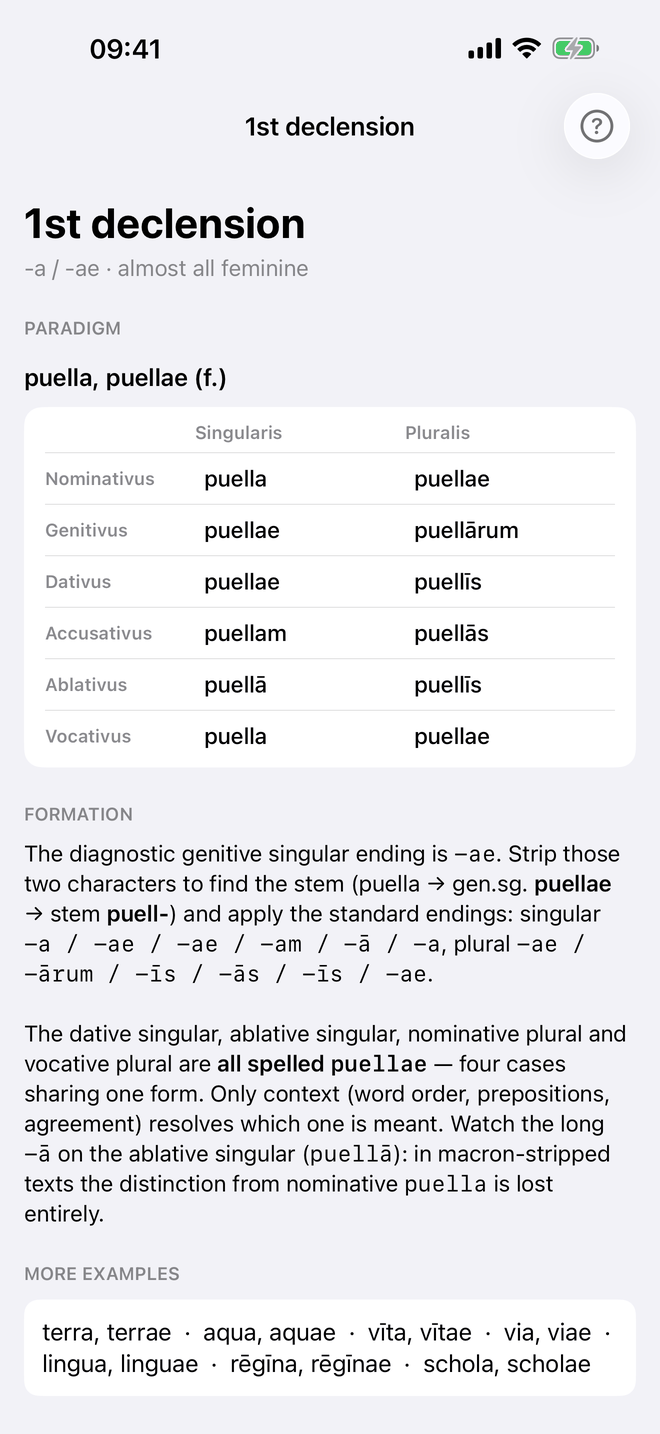
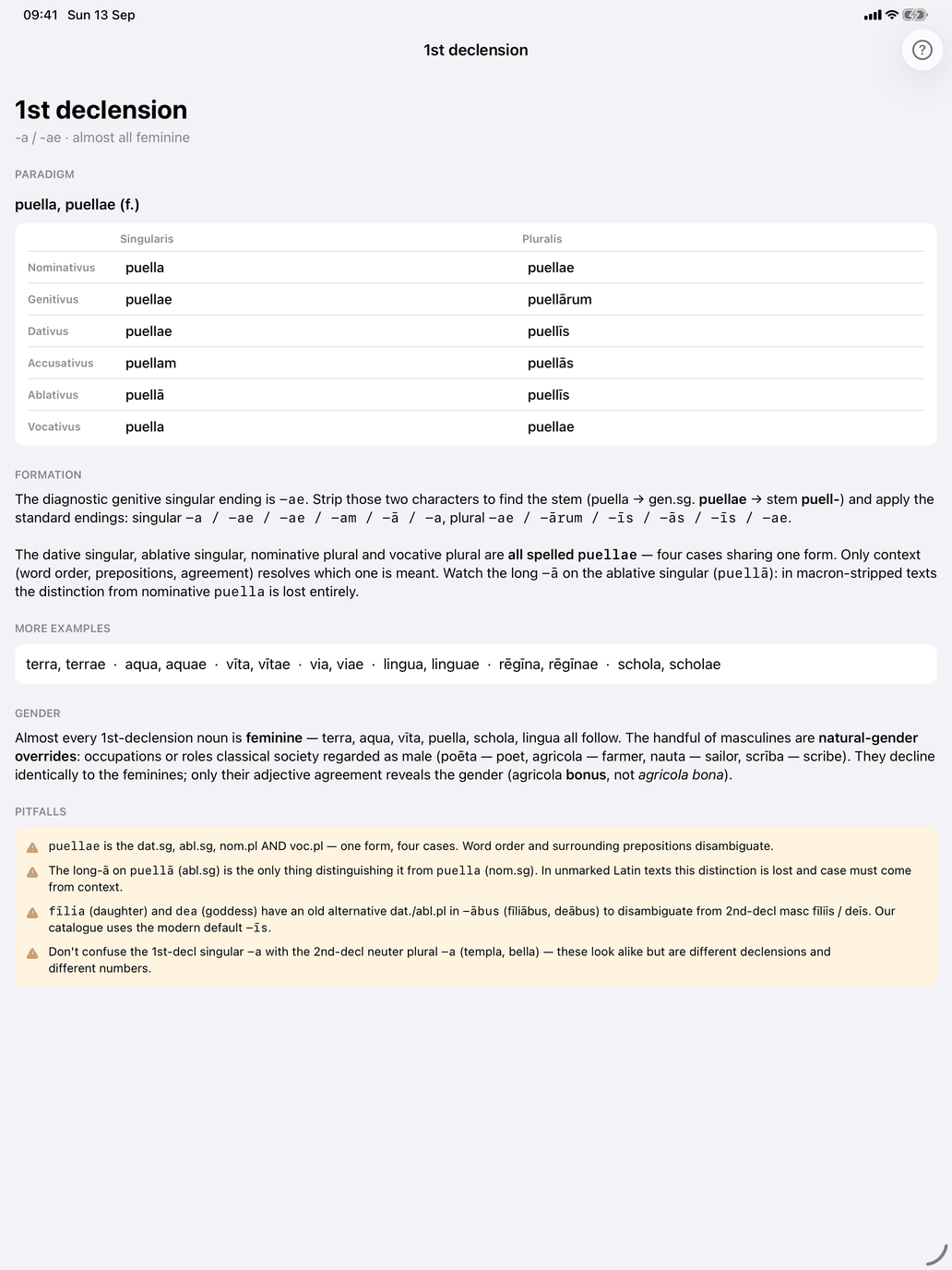
Pure reference: no testing and no scoring. Tap Declension paradigms in the hub's Theory section to open an overview of the five declensions. From there you can go to a side-by-side table or to a detail screen for each declension.
The overview. A short introduction is followed by one card per declension. The first card is open when you arrive; tap a card's header to open or close it. An open card shows:
- a note on how to recognise the declension and which genders it has;
- a worked paradigm for each example noun, headed by its citation (puella, puellae (f.)). The 2nd declension shows amīcus and templum, the 3rd rēx and tempus;
- a More link to that declension's detail screen.
Each paradigm is a six-by-two table. The rows are the six cases, with full Latin names (Nominativus, Genitivus, Dativus, Accusativus, Ablativus, Vocativus), and the columns are Singularis and Pluralis. All six rows are always shown, so the vocative row appears even when it matches the nominative. A form that does not exist, such as the singular of a plural-only noun, is shown as a faded dash (—).
All declensions side by side. The card above the declensions opens the Synoptic table, which shows the endings of all five declensions in one grid, with a singular table and a plural table. Choose the layout at the top:
- Basic — one column per declension (1st, 2nd, 3rd, 4th, 5th), with the masculine or feminine endings.
- Detailed — separate neuter columns for the 2nd, 3rd and 4th declensions (1st, 2nd m, 2nd n, 3rd, 3rd n, 4th, 4th n, 5th). The table scrolls sideways if it doesn't fit.
The app remembers your choice. In the 3rd declension the nominative singular (and the vocative, and for neuters the accusative) cannot be predicted from an ending, so those cells say varies. Tap one to see example 3rd-declension nouns, each with its nominative, genitive and meaning. The genitive shows the stem that the rest of the paradigm is built on. Blue varies cells draw masculine/feminine examples; purple ones draw neuter examples.
The declension detail screen. More opens a full write-up of one declension:
- Paradigm — the worked tables again;
- Formation — how the stem and endings combine;
- More examples — further nouns of the declension, each shown with its genitive;
- Gender — which genders occur and the main exceptions;
- Pitfalls — common confusions, highlighted as warnings.
Paradigms of individual nouns. For the paradigm of any one noun, use Noun reference in the Study section. It lists the nouns in your current selection alphabetically, with a search field and an A–Z index. Search ignores macrons. Tap a noun to open its detail screen:
- the lemma and translation, with a citation line: lemma, genitive, gender and declension (puella, puellae (f.) · 1st declension (-ae));
- the full case × number table. Plural-only nouns (arma, līberī, tenebrae, dīvitiae, īnsidiae, hīberna, moenia) show dashes in the singular column;
- the noun's CEFR level and topic;
- Examples — example sentences for the noun, each with a translation and a tag naming the case and number the noun takes in that sentence (Accusativus · Singularis).
When you reach a noun from a parsed word in the Sentence parser, the table highlights every cell with that form, so you can see at a glance all the cases it could be.
The tables have no tap-to-hear.