Adverbs
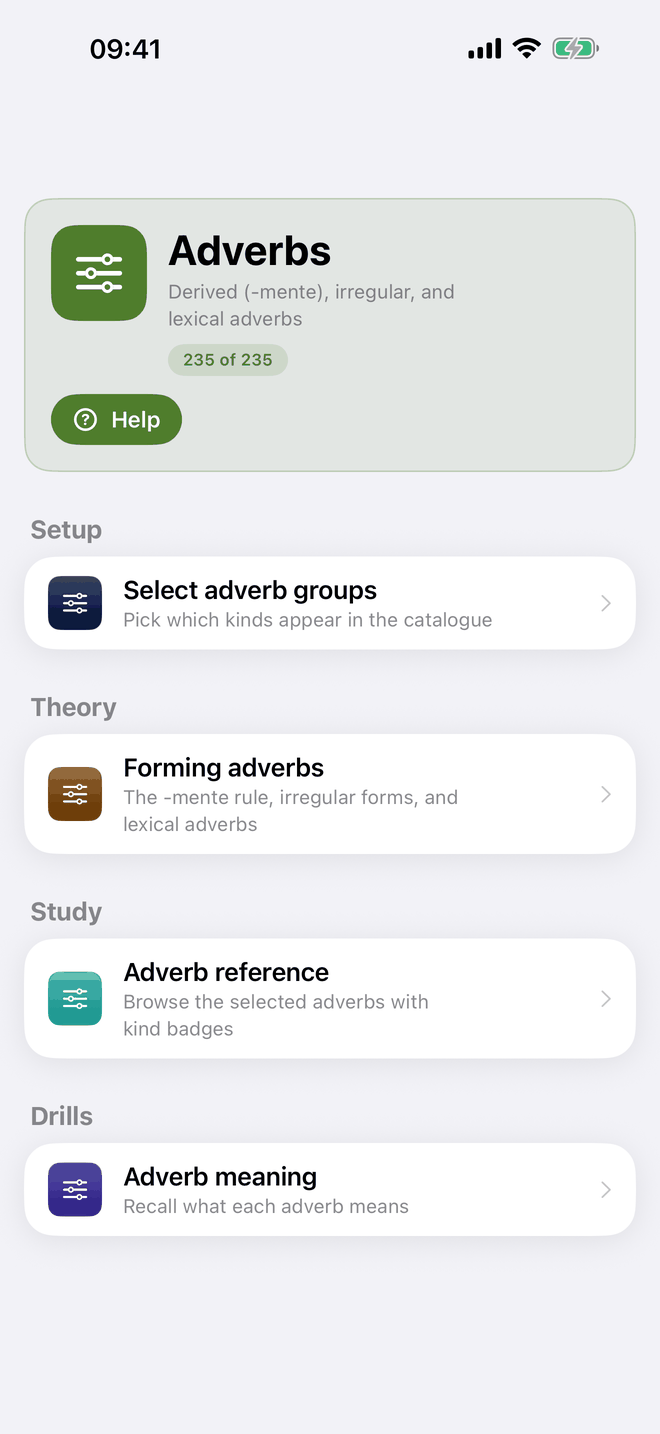
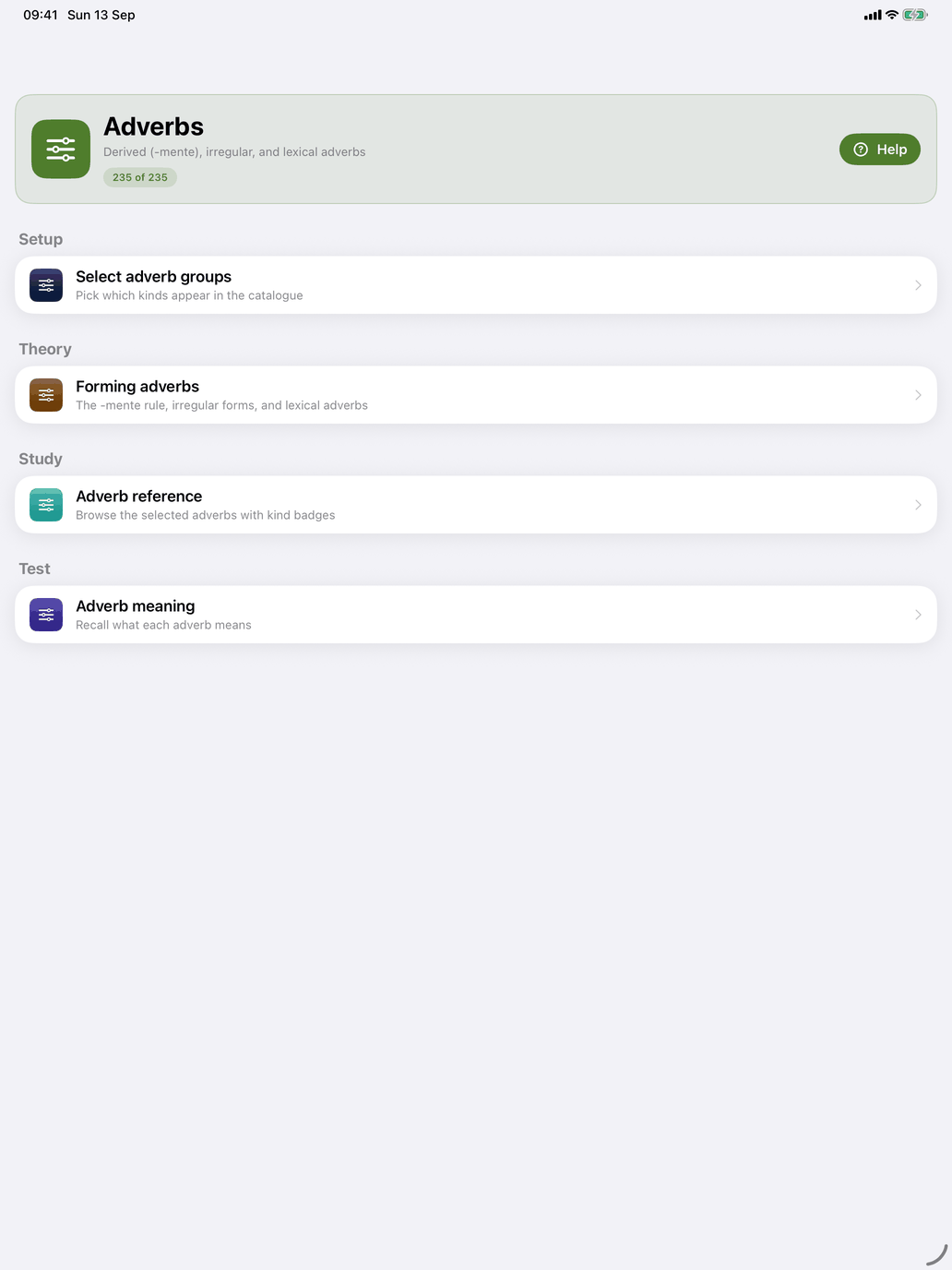
Open the Adverbs hub from the Adverbs tile on the Self Study screen. The Spanish catalogue has 235 adverbs of three kinds:
- Derived (183): built from an adjective with -mente: rápidamente, fácilmente.
- Irregular (2): built from an adjective, but not by the rule: bien (from bueno) and mal (from malo).
- Lexical (50): not built from an adjective. These include place words (aquí, allí, cerca), time words (ahora, ayer, siempre, nunca, ya), degree words (muy, casi, bastante) and words like también and tampoco.
The derived adverbs in the catalogue are a chosen list. The app does not make an adverb from every adjective, because many adjectives have none (see Forming adverbs below).
The badge under the title shows how many adverbs your selected kinds contain. The level and topics in Select word scope do not narrow this hub.
The hub has these screens:
- Select adverb groups (Setup): tick the kinds you want. Tap ⓘ on a kind for an explanation and a list of its adverbs. Tap an adverb to open its page.
- Forming adverbs (Theory): the rule and its limits.
- Adverb reference (Study): the selected adverbs.
- Adverb meaning (Drills): flashcards for the meaning of each adverb. See Word meaning for how the flashcards work.
There is no form drill for adverbs. Once you know the rule, derived adverbs are predictable, so the drill tests meaning only.
Forming adverbs
- Add -mente to the feminine singular of the adjective: rápida → rápidamente, cuidadosa → cuidadosamente. An adjective with one form for both genders uses that form: fácil → fácilmente, triste → tristemente.
- The adjective keeps its written accent: rápida → rápidamente.
- With two adverbs in a row, only the last one takes -mente: lenta y cuidadosamente.
- The two irregular adverbs are bien (not buenamente) and mal (not malamente).
- Not every adjective forms an adverb. -mente works with adjectives that describe a manner or a degree, the kind you can be more or less of. Adjectives that classify have no -mente form: colours (no rojamente), nationality (no españolamente; say a la española), states such as muerto or casado, and adjectives such as ferroviario (railway).
- Adverbs are compared like adjectives: más rápidamente que, tan rápidamente como. Bien and mal have the irregular comparatives mejor and peor.
Adverb reference
The selected adverbs in three sections, Derived, Irregular and Lexical. Only the first section is open when you arrive. Tap a heading to open or close it. A search opens all sections. Irregular adverbs carry an irr. badge and lexical adverbs a lex. badge. The search matches the start of the adverb (so rapid finds rápidamente) or any part of its translation.
Tap an adverb to open its page. It shows the kind (Derived (regular), Derived (irregular) or Lexical) and, for a derived adverb, the adjective it comes from.
Recommended workflow
- Run Adverb meaning on the Lexical adverbs first. These are the ones you have to memorise.
- For the derived adverbs, learn the rule in Forming adverbs rather than drilling each one.