Self Study
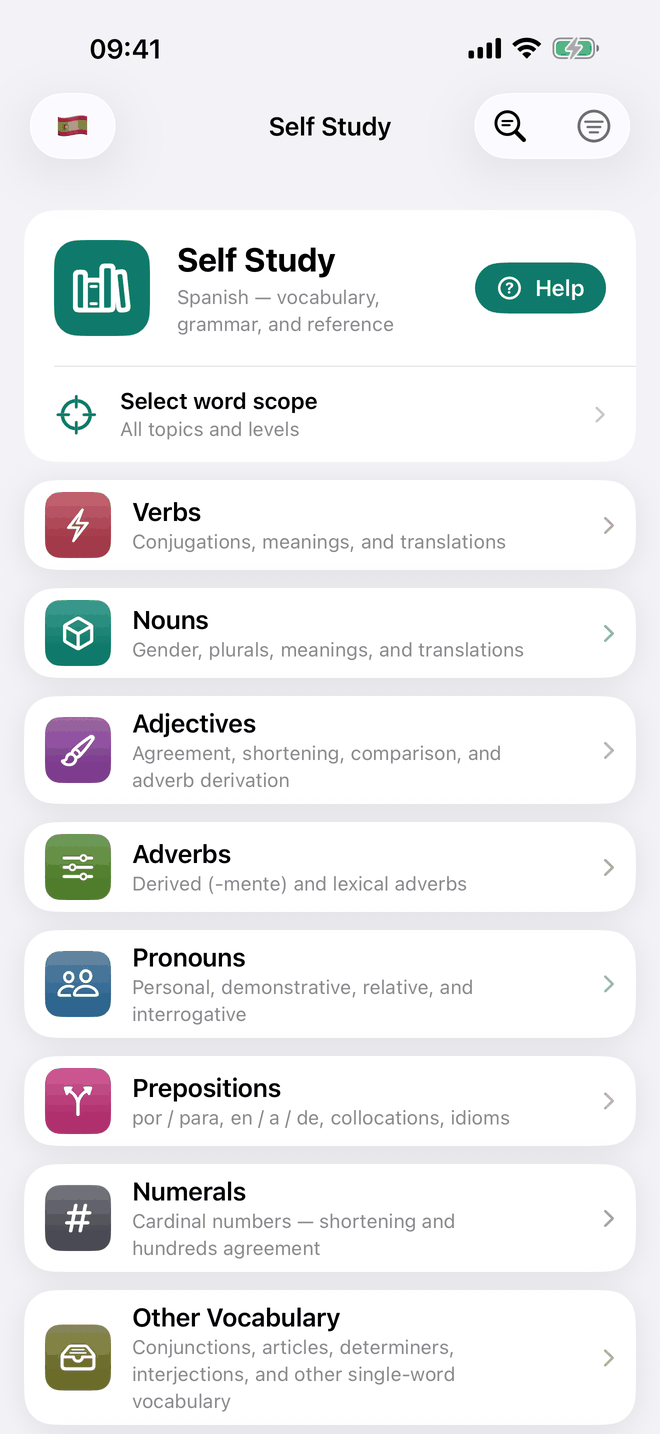
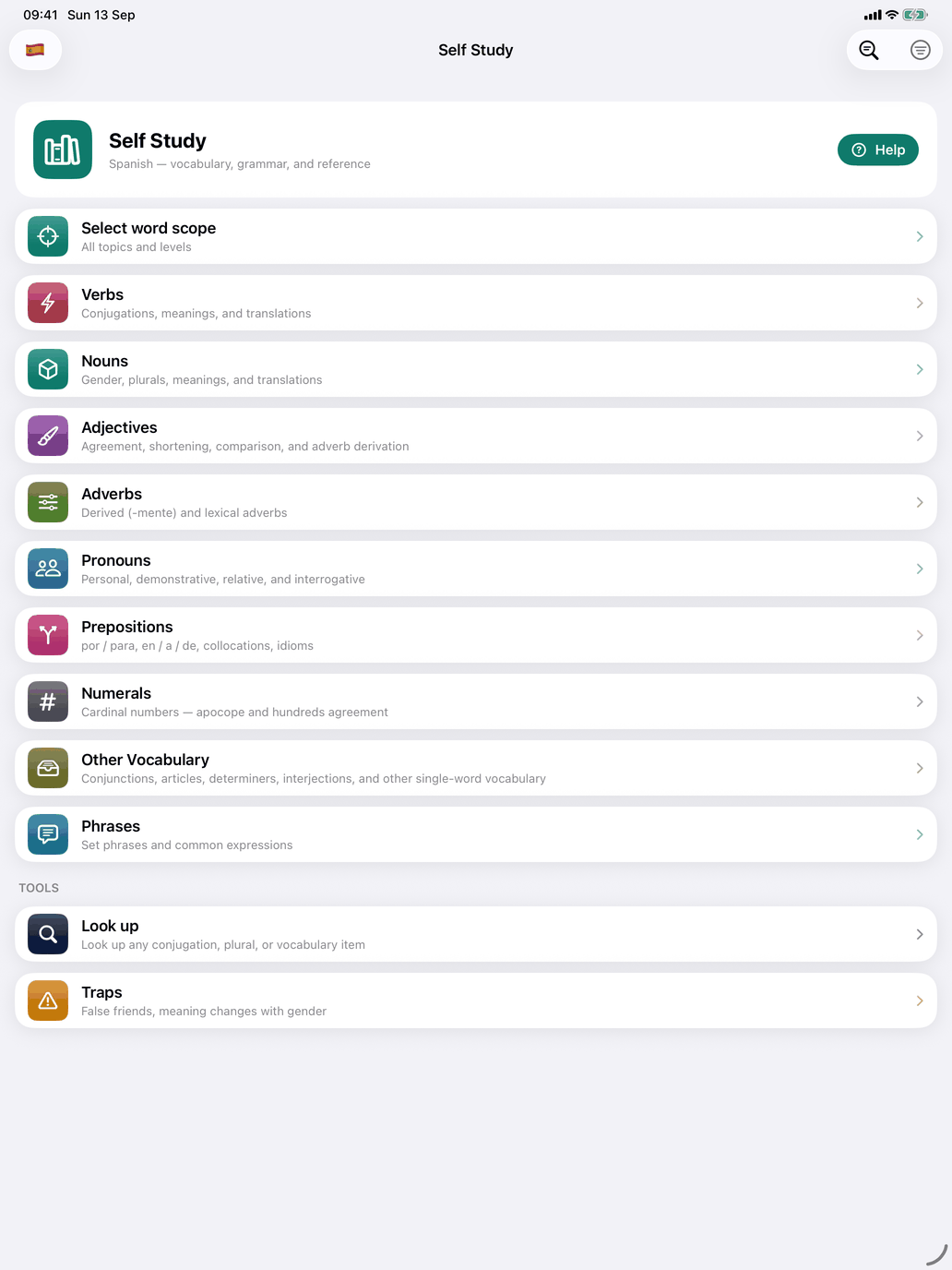
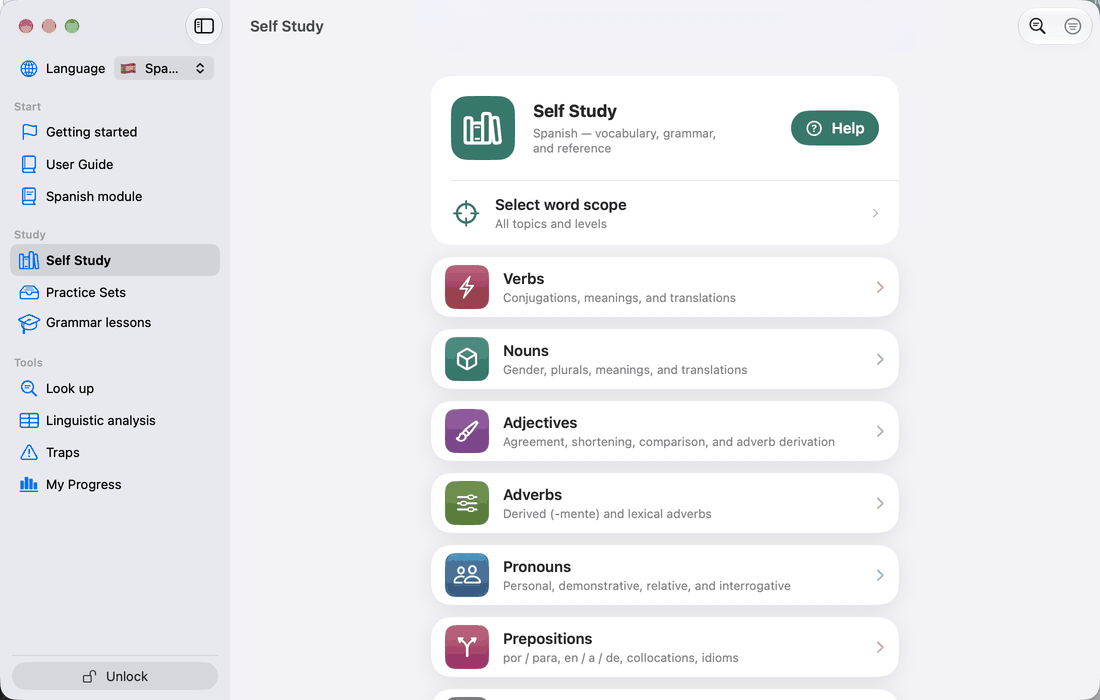
The Self Study screen is where you pick a word type to practise. Each word type opens its own hub with Setup, Theory, Study and Drills sections, so meaning practice and grammar drills live together in one place (see The Setup / Theory / Study / Drills pattern).
At the top is a card titled Self Study, naming the course you are studying, with a Help button. Under it is the Select word scope row, which sets the level and topics every hub below draws on; its second line reads All topics and levels or Filtered by topic or level. See Choosing what is in play.
The word-type cards follow. A card appears only when the course has content for it:
- Verbs — conjugations, meanings, and translations.
- Nouns — gender, plurals, meanings, and translations.
- Adjectives — declension paradigms across all three genders in Latin; agreement, shortening, comparison and adverb derivation in Spanish; agreement across gender and number in French.
- Adverbs — derived and lexical adverbs (-mente in Spanish, -ment in French, -ē / -iter / -nter in Latin).
- Pronouns — personal, demonstrative, relative, and interrogative.
- Prepositions — in Spanish por / para, en / a / de, collocations and idioms; in French spatial, temporal and grammatical relations; in Latin which case each preposition governs.
- Numerals — cardinal numbers, with a focus that shifts by course: in Latin the three that decline against the invariant rest, in Spanish shortening and hundreds agreement, in French 1 to 100 including the vigesimal pattern.
- Other Vocabulary — conjunctions, articles, determiners, interjections and other single-word vocabulary.
- Phrases — set phrases and common expressions.
In Latin, a Texts card follows: passages to read with every word parsed. The Latin course guide covers it.
On iPhone and iPad a Tools section comes last:
- Look up — look up any conjugation, plural or vocabulary item. See Look up.
- Traps (Spanish) — false friends, meaning-changers, gender traps and ser/estar shifts. Closed decks, each scored on its own; they do not follow your word scope.
On the Mac these two are in the sidebar under Tools instead.
Toolbar. The Look up icon opens Look up. The filter icon opens Selection, an overview of the word types with how many items each type's own picker leaves in, shown as in / total — green when everything is included, red when nothing is. Tap a row with a chevron to change that selection; rows without one have nothing to choose. These counts reflect each type's own picker only; level and topics are set under Select word scope, and the filter icon is filled while that filter is active. On iPhone and iPad the flag at the left switches course.
If you would rather have the app decide what to study next, use Grammar lessons instead.