The Setup / Theory / Study / Drills pattern
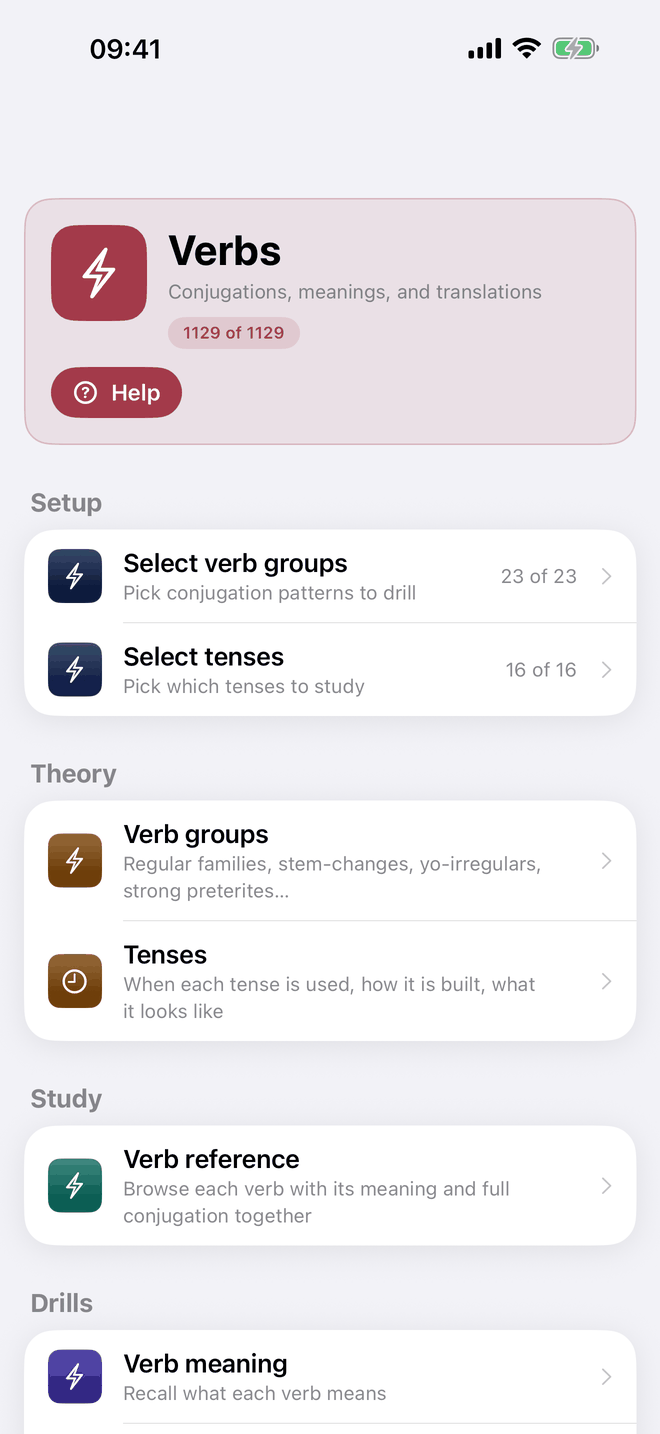
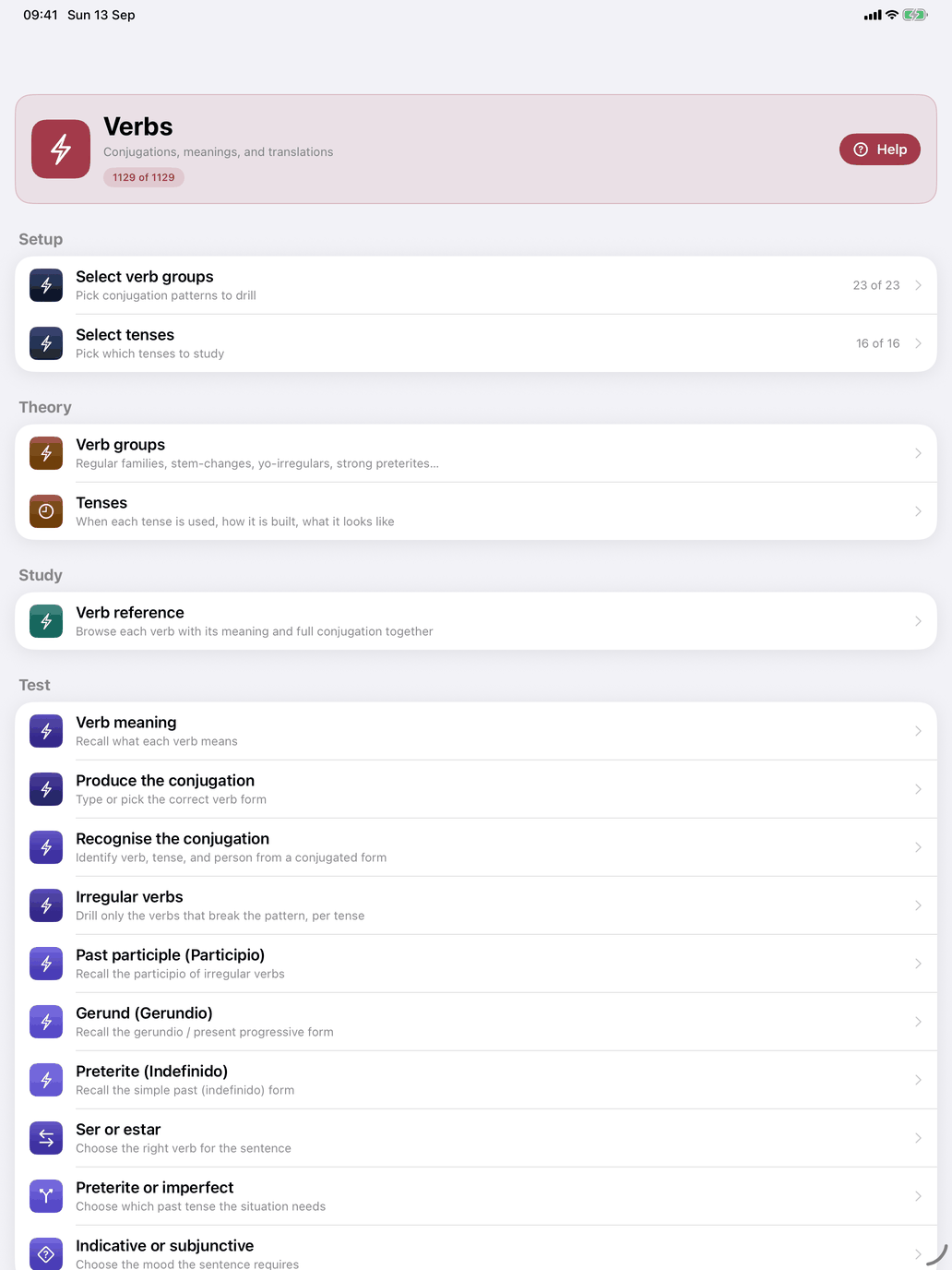
Every word-type hub in Self Study — Verbs, Nouns, Adjectives, Adverbs, Pronouns, Prepositions, Numerals, Other Vocabulary, Phrases — follows the same pattern. At the top is a card with the hub's name, a short description, often a count of what is in play (for verbs, n of m verbs), and a Help button. Below it are up to four sections:
- Setup — choose which kinds are in play: verb groups and tenses, noun groups, adjective groups, word groups and so on (Select verb groups, Select tenses, Select noun groups, …). Each row shows how many you have chosen (12 of 40), in red when nothing is chosen. The picker it opens shows a running count of what your choice matches — for verbs, "12 of 40 groups · 310 of 1105 verbs" — and, where it applies, how many of those survive your word scope ("· 250 in scope"), with a Select word scope row to change that. So the pool a hub works from is what passes both the Setup choice and the level and topics you set under Select word scope.
- Theory — explanations: grammar prose, paradigms, how the catalogue is organised. No drills, no tests; just read until the pattern makes sense.
- Study — the reference: browse the items in your pool with their translations, and open any one for its full forms. Nothing is recorded here.
- Drills — active practice: flashcard decks and graded drills. Every answer is recorded and feeds the adaptive engine.
The Spanish Traps hub follows the same pattern without Setup: its decks are closed, so there is nothing to choose.
If your Setup choice has verbs but your word scope removes all of them, a red banner at the top of the Verbs hub says so.
Opening a verb. Tapping a verb opens a tabbed detail screen — Conjugation · Usage · Structure · Reference sheet — with the verb's translation beside the infinitive in the header. It opens on Conjugation: the tables for the tenses you have selected, each with a speaker button, and a toolbar button that shows a translation under every form. In Latin a List / Filter picker adds a filtered view. Usage gathers tense examples (one sentence per tense, the first few shown with a Show more tenses button), then example sentences and the Details rows. Structure answers a different question: which tenses follow the regular pattern and where this verb departs from it — one verdict per tense (Regular, Regular endings, Partly irregular, Irregular, No regular pattern or Not used), with the stem each tense is built on. Tap a tense for the detail; the toolbar filter Only what deviates hides the rest. Reference sheet, where the course has one, is a one-page PDF of the verb; share or save it from the share button (on the Mac, Copy or Save as…).
The colours answer different questions. On the Structure tab a stem you have to memorise is shown in amber; in the conjugation table the letters of a form that depart from the pattern are shown in red. A tense can therefore read Regular endings — the endings hold, the stem does not — which is the ordinary case for a tense built on a stem of its own.
Word pool vs session size. Your word pool is the full set of items eligible to appear (defined by Setup and your word scope). Your session size is how many questions a single sitting asks: Questions per session in Settings → Study — 10, 20, 30, 50 or ∞ (until you stop). Each session the app draws from your pool, mixing words you have not seen yet with ones you find hard, in the proportion set by Learning pace.
Always configure Setup before starting a drill. If nothing is selected, the drill has nothing to ask.