Nouns
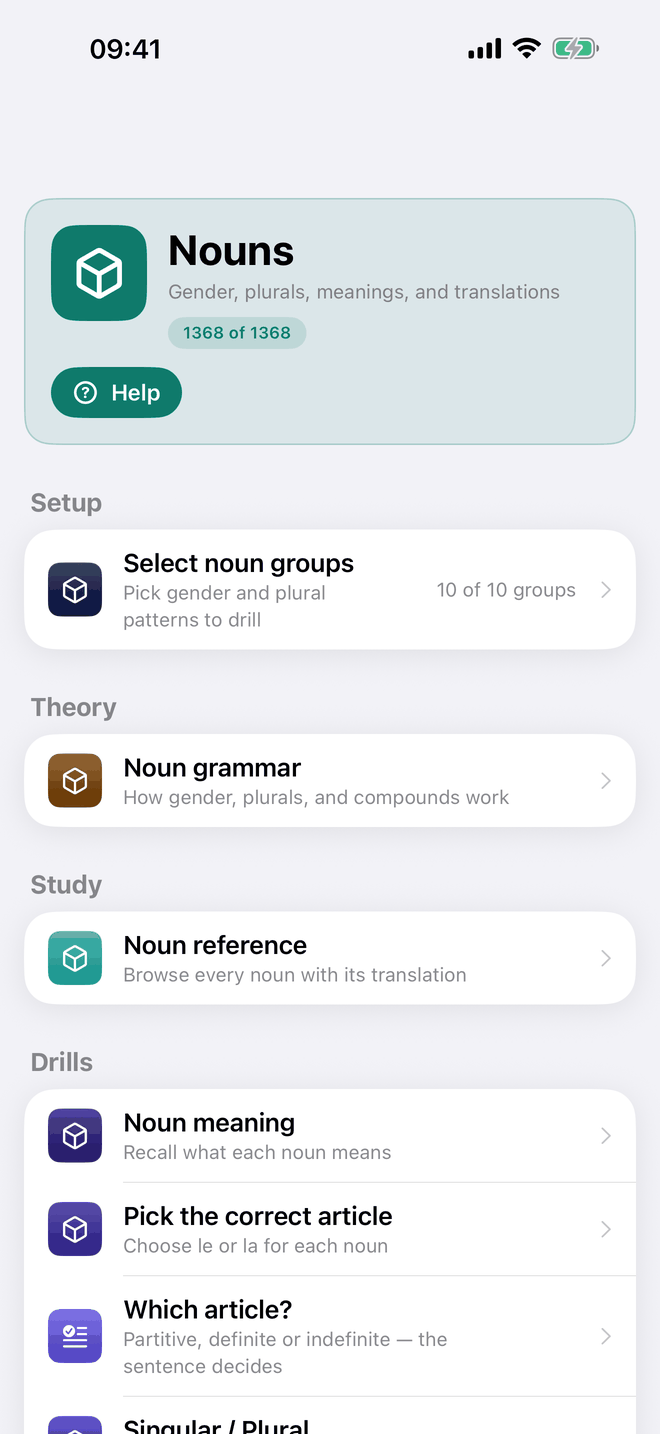
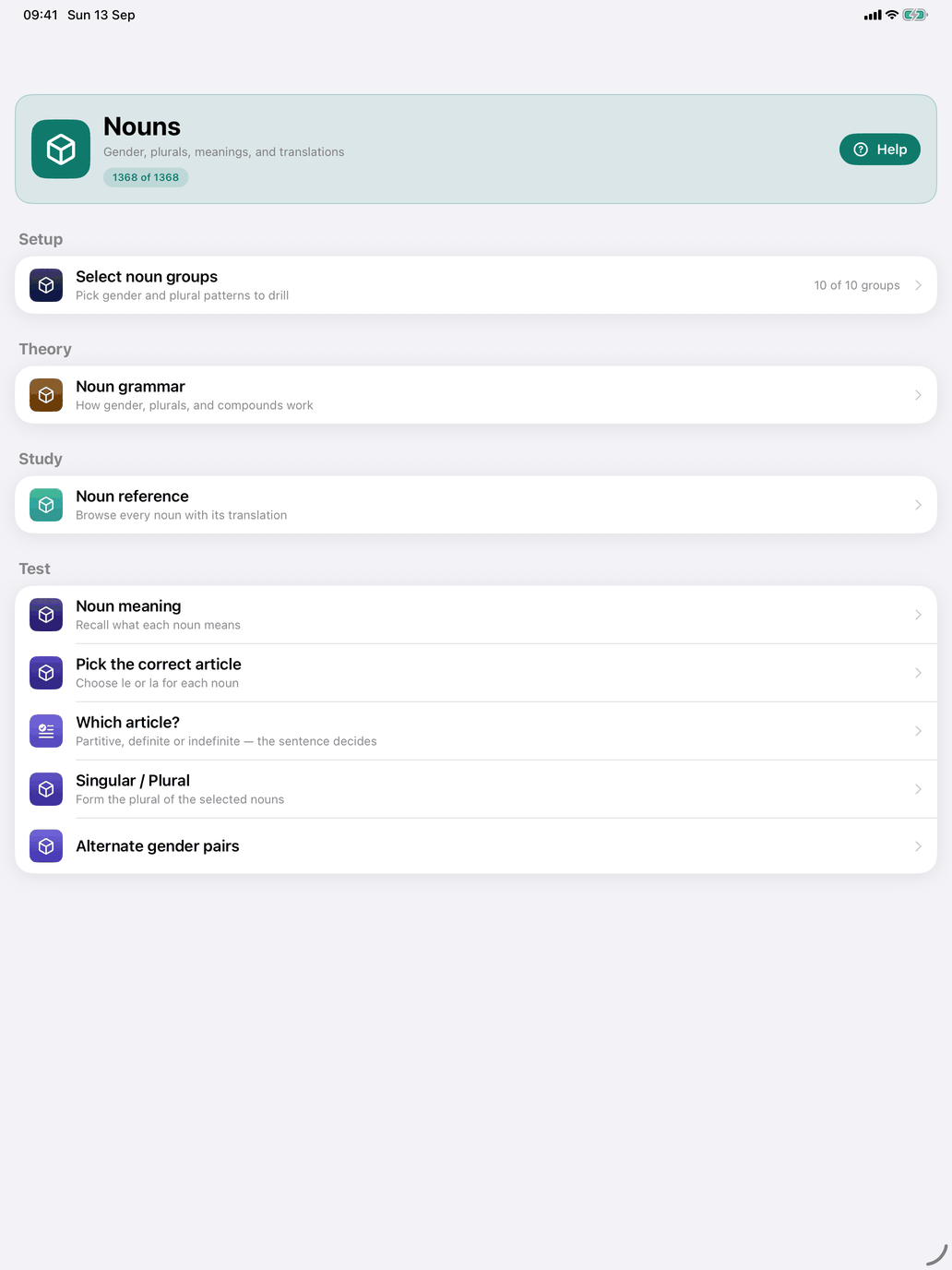
The French course has over 1,350 nouns. Every noun has its gender, its plural (where it has one) and a translation and three example sentences. The Nouns hub is where you practise the parts of noun vocabulary that cause the most mistakes: gender (le or la), plurals, and the nouns that have a masculine and a feminine form.
Open Self Study → Nouns to reach the hub. It has four sections:
- Setup — Select noun groups: choose the kinds of noun to practise.
- Theory — Noun grammar: how gender, plurals and compounds work.
- Study — Noun reference: browse every noun with its translation.
- Drills:
- Noun meaning — flashcards: recall what each noun means.
- Pick the correct article — choose le or la for each noun.
- Which article? — choose the article a sentence needs: definite, indefinite, partitive or bare de.
- Singular / Plural — form the plural (or the singular) of the selected nouns.
- Alternate gender pairs — give the masculine or feminine form of a noun.
The line under the hub title shows how many nouns your selection gives you, out of the whole catalogue (for example "212 of 1368"). The Select noun groups row shows how many of the ten groups you have ticked; the count turns red when none are ticked. Touch and hold a Setup or Drills row for a short explanation, or use the Help button at the top of the hub.
Which drills follow your selection. Noun meaning, Pick the correct article and Singular / Plural use the nouns in your selected groups, narrowed by the level and topics you set in Self Study → Select word scope. Alternate gender pairs always uses every noun that has both a masculine and a feminine form. Which article? uses its own fixed set of sentences. Noun reference always lists the whole catalogue.
A recommended workflow
- In Select noun groups, start with Regular, and limit Select word scope to A1. Set Questions per session to 20 in Settings → Study.
- Run Noun meaning until the core vocabulary and its articles are solid.
- Add Pick the correct article to fix le and la in memory, and Which article? once you meet the partitive.
- Move on to Singular / Plural, then add the plural-formation groups in Setup.
- Leave Alternate gender pairs until the ordinary genders are secure.
Select noun groups
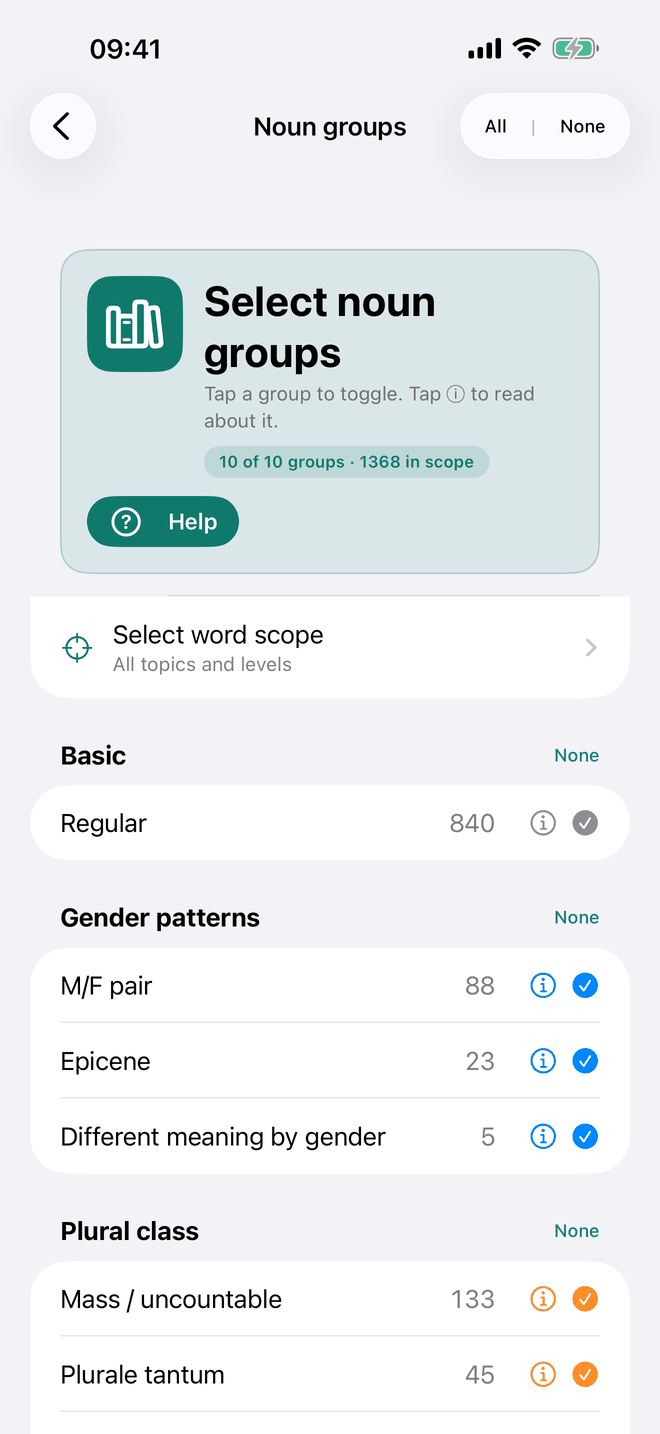
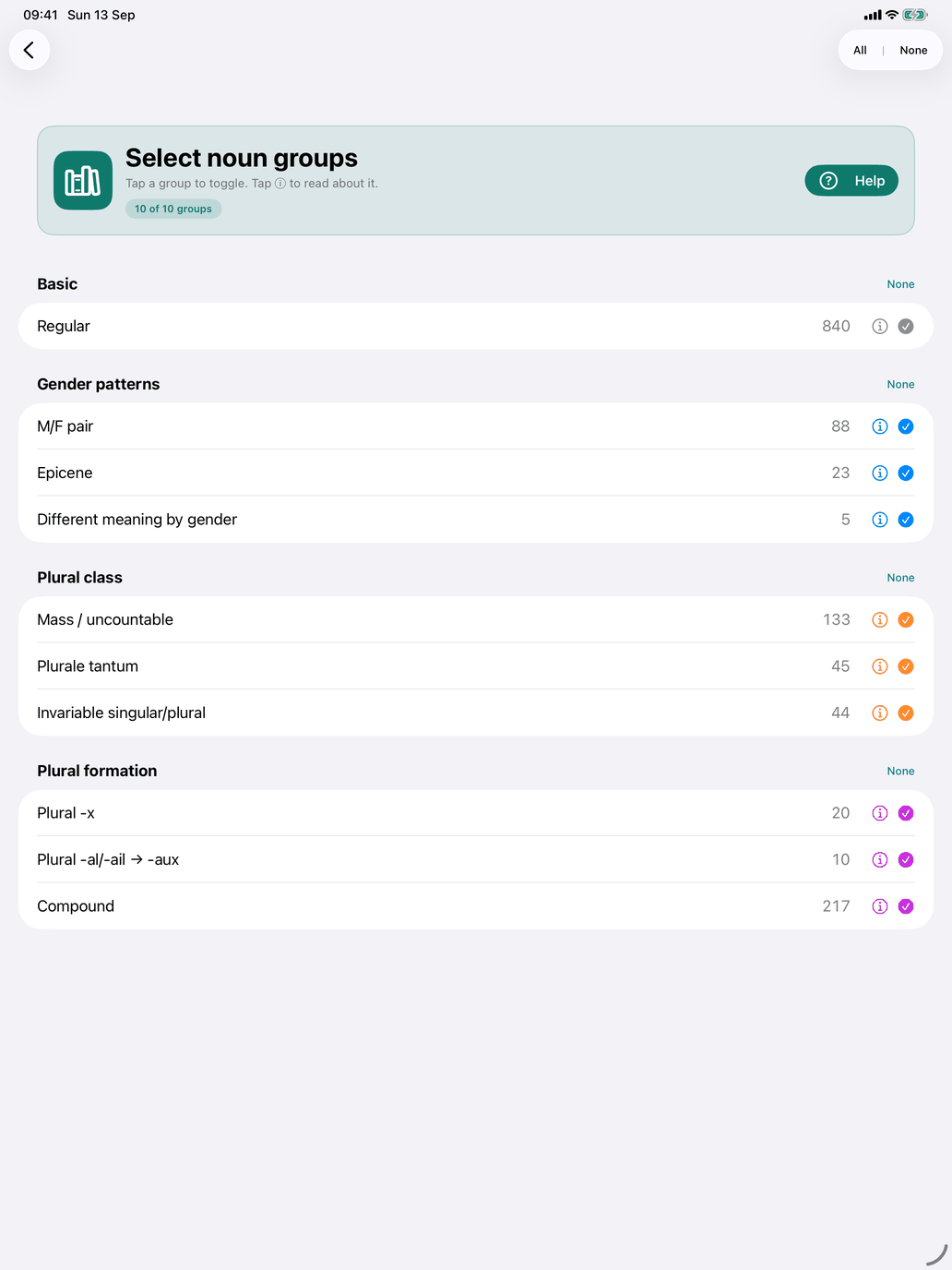
Select noun groups decides which nouns can appear in Noun meaning, Pick the correct article and Singular / Plural. Nouns are grouped by their grammatical behaviour, not by vocabulary. Level and topic are separate filters for every word type, set in Self Study → Select word scope; there is no frequency filter in Self Study.
The ten groups are arranged in four sections:
- Basic — Regular: one gender, a plural in -s, nothing else to learn. This is by far the largest group; a noun is only here when it belongs to no other group.
- Gender patterns — M/F pair (a masculine and a feminine form: boulanger / boulangère, chien / chienne), Epicene (one form for both genders, only the article changes: un élève / une élève) and Different meaning by gender (the gender picks the meaning: le tour is a turn, la tour is a tower).
- Plural class — Mass / uncountable (no plural in normal use: le lait, le courage), Plurale tantum (only plural: les affaires, les gens) and Invariable singular/plural (the same form in both numbers: le bras / les bras, le choix / les choix).
- Plural formation — Plural -x (bateau → bateaux, jeu → jeux, genou → genoux), Plural -al/-ail → -aux (animal → animaux, travail → travaux) and Compound (nouns of several words or with a hyphen: salle de bains → salles de bains).
A noun can belong to several groups at once, and it is in your selection when any of its groups is ticked.
Using the screen
- Tap a group's row to include or exclude it. Each row shows how many nouns it contains.
- Tap ⓘ on a row to open the group's info page: what the group covers and an example. For the smaller groups it also lists the nouns that belong to it.
- All and None at the top select or clear every group at once; each section header has its own All / None button.
- An unticked group can show a note such as "12 still in scope via Regular": those nouns are already in your selection through another group you have ticked.
- The line at the top shows how many groups you have ticked and how many nouns that gives you within your word scope. The Select word scope row takes you to the level and topic filters.
- If you leave the screen with no group ticked, the app warns you that the noun drills will be empty. Choose Stay and select or Go back anyway.
Selection and session size are two separate things. Your selection is the set of nouns that can appear in a drill. Your session size is how many questions one session asks: Questions per session in Settings → Study (10, 20, 30, 50, or ∞ to keep going until you stop).
Noun grammar
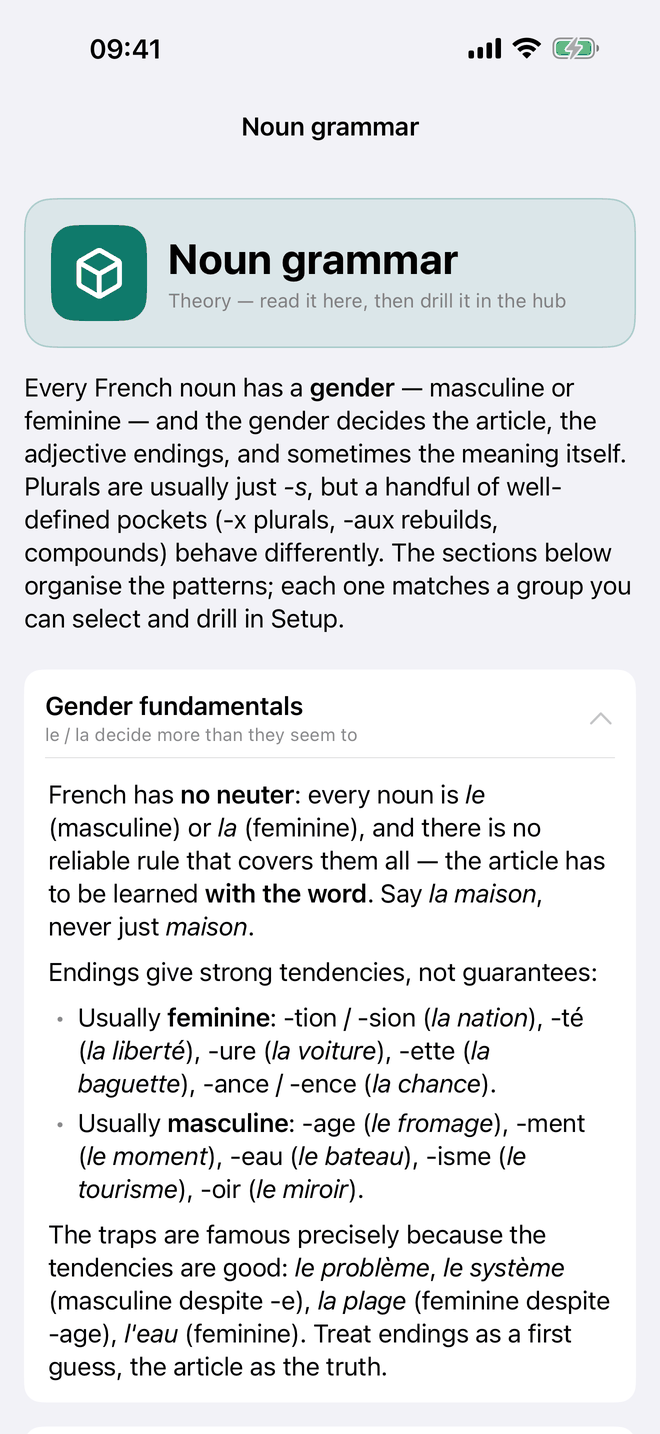
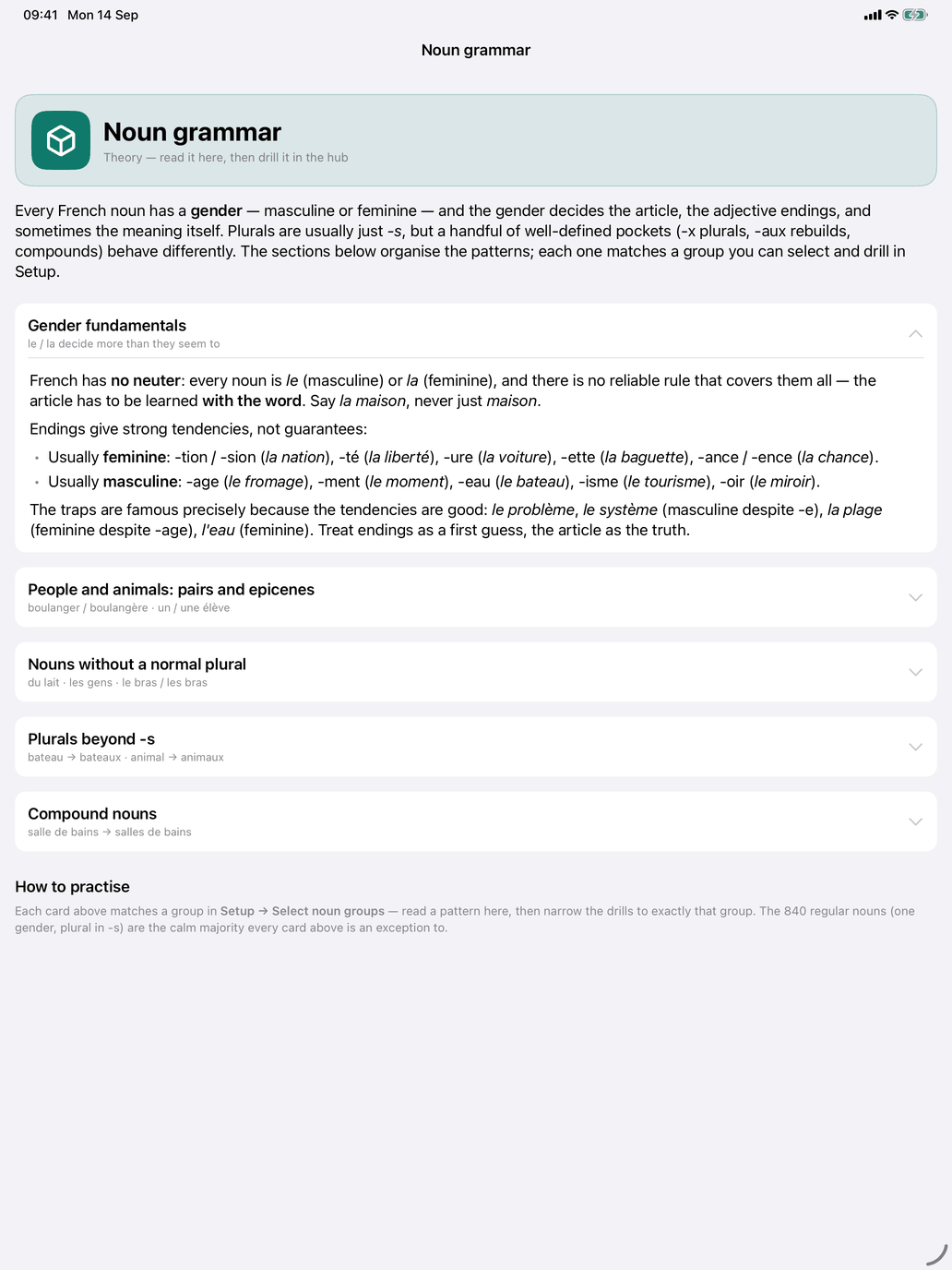
Noun grammar is a reference page: nothing is tested and nothing is recorded. Each section matches one or more groups in Select noun groups, so you can read about a pattern and then narrow the drills to exactly that group.
Gender. French has no neuter: every noun is masculine (le) or feminine (la), and no rule covers them all, so learn the article with the word — la maison, never just maison. Endings give strong tendencies, not guarantees:
- Usually feminine: -tion / -sion (la nation), -té (la liberté), -ure (la voiture), -ette (la baguette), -ance / -ence (la chance).
- Usually masculine: -age (le fromage), -ment (le moment), -eau (le bateau), -isme (le tourisme), -oir (le miroir).
The exceptions are famous precisely because the tendencies are good: le problème, le système (masculine despite -e), la plage (feminine despite -age), l'eau (feminine). Treat the ending as a first guess and the article as the truth.
People and animals. M/F pairs usually derive the feminine with a suffix (boulanger → boulangère, chien → chienne, acteur → actrice), and occasionally use a different word. Epicenes use one form for both genders, and the article does all the work: un artiste / une artiste. A small set changes meaning with gender: le tour (turn) and la tour (tower), le voile (veil) and la voile (sail). Getting the article wrong there changes what you said.
Nouns without a normal plural. Mass nouns stay singular and take the partitive (du lait, du courage) rather than a number. Plurale tantum nouns exist only in the plural (les gens). Nouns that already end in -s, -x or -z don't change (le nez / les nez); only the article shows the number.
Plurals beyond -s.
- -eau, -au and -eu take -x: bateau → bateaux, jeu → jeux. Seven nouns in -ou do too — bijoux, cailloux, choux, genoux, hiboux, joujoux, poux; every other -ou noun takes -s (trou → trous).
- -al and some -ail nouns rebuild the ending as -aux: animal → animaux, travail → travaux. Exceptions such as bal → bals and festival → festivals take a plain -s.
In speech none of this is audible — bateau and bateaux sound the same. The plural is heard in the article: le / les.
Compound nouns. The plural goes on the parts that are nouns or adjectives, not simply on the end: salle de bains → salles de bains, arrière-grand-père → arrière-grands-pères, chef-d'œuvre → chefs-d'œuvre. Verbs and invariable words inside the compound don't change: un porte-monnaie → des porte-monnaie.
Noun reference
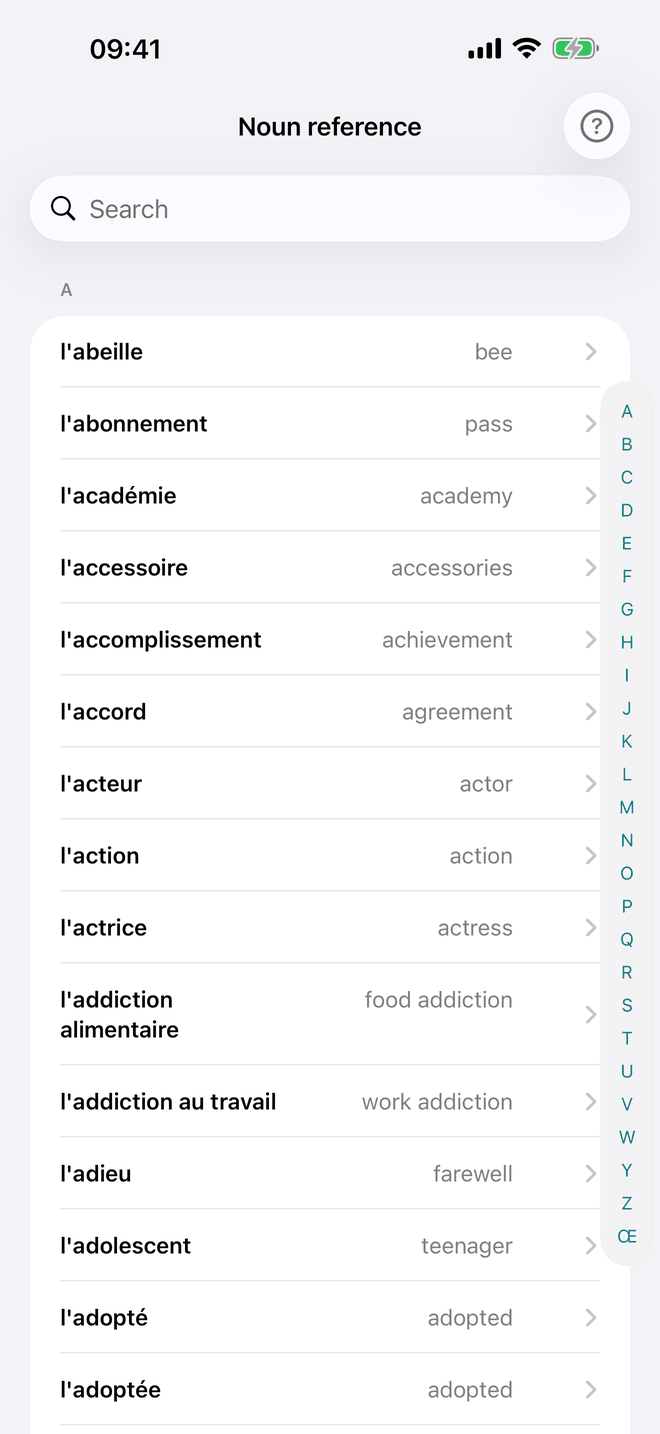
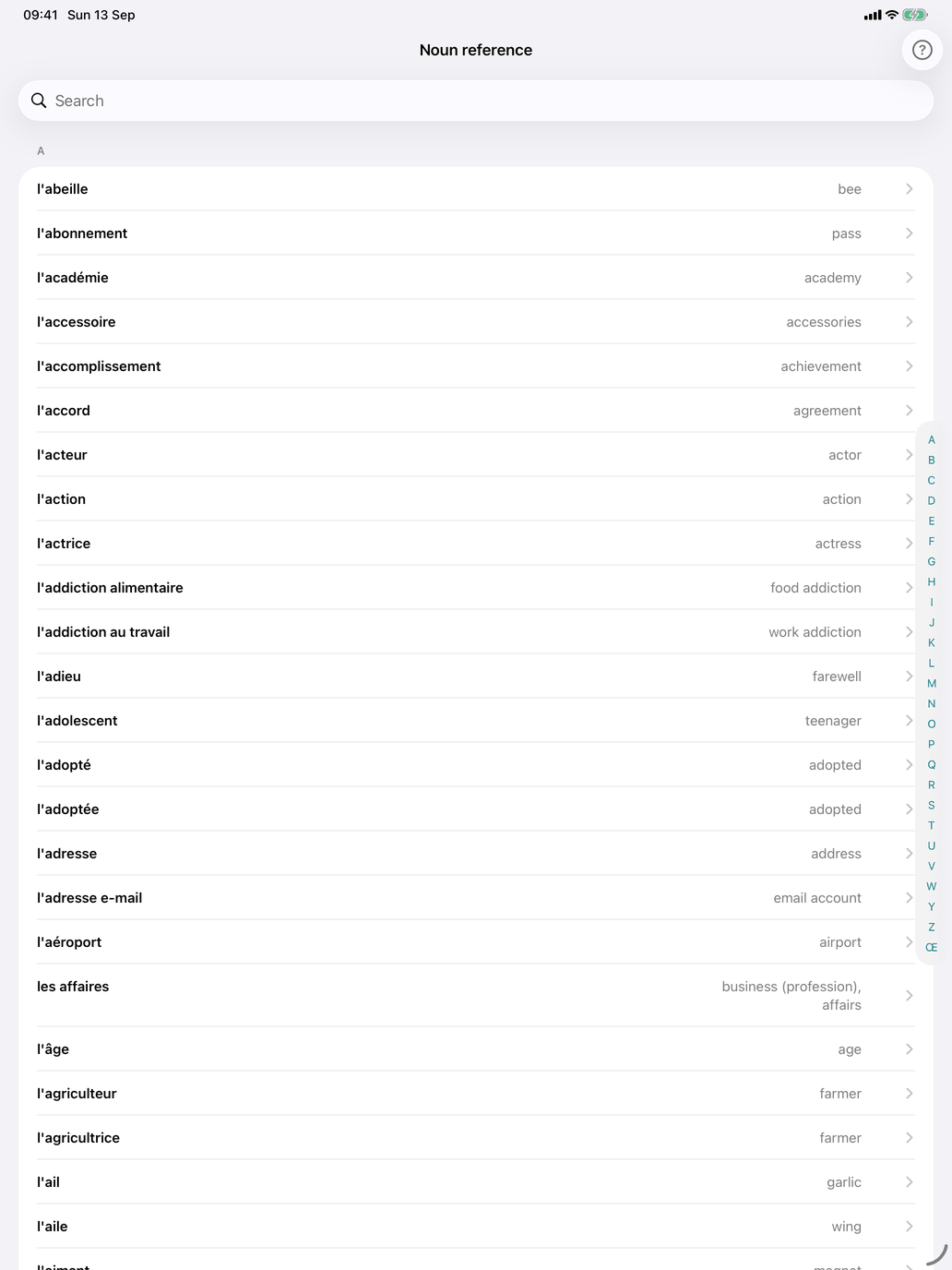
Noun reference is a browse-only list: nothing is tested and nothing is recorded. It lists the whole noun catalogue, not just your selection, so a noun never disappears from it because of a filter. Use it to check a translation before a session, or to look up a noun you got wrong.
The list is alphabetical with a search field; on iPhone and iPad an A–Z index runs down the side. Each row shows the noun with its article and its translation. A masculine/feminine pair such as chien / chienne appears as two separate rows, each with its own article and meaning.
The noun's page. Tap a noun to open it:
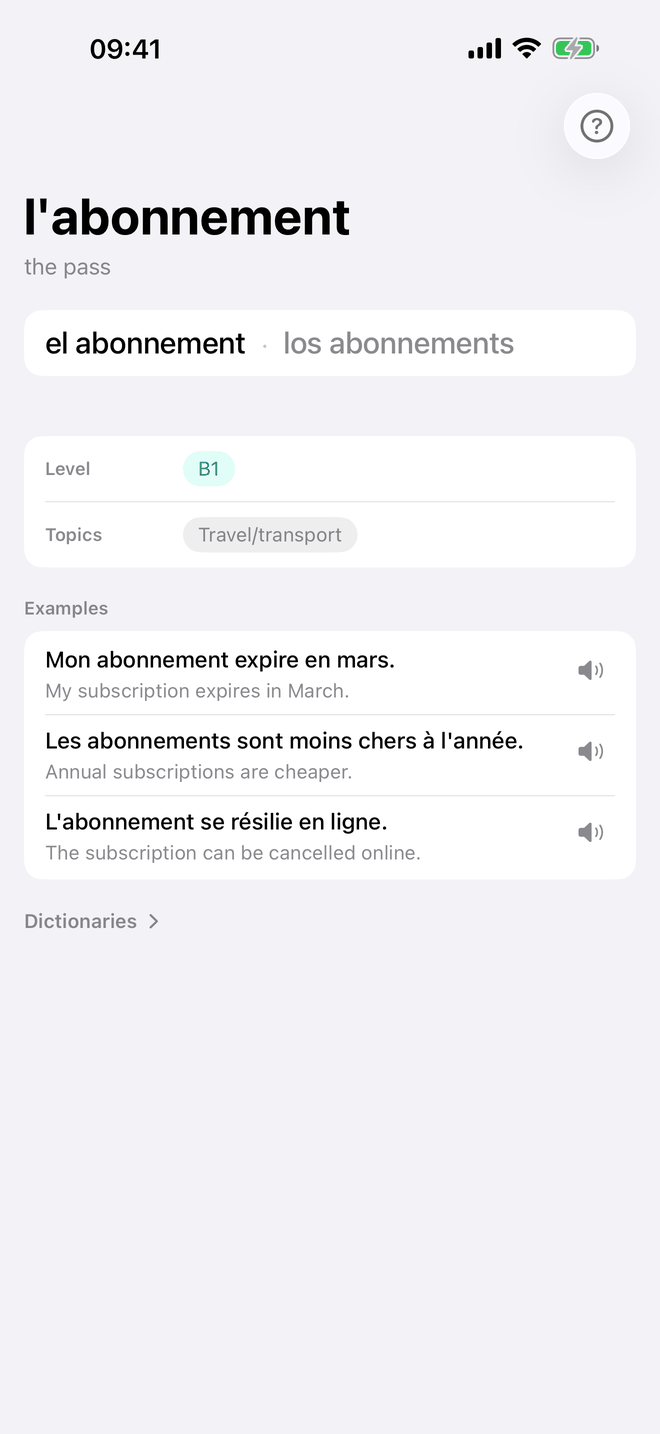
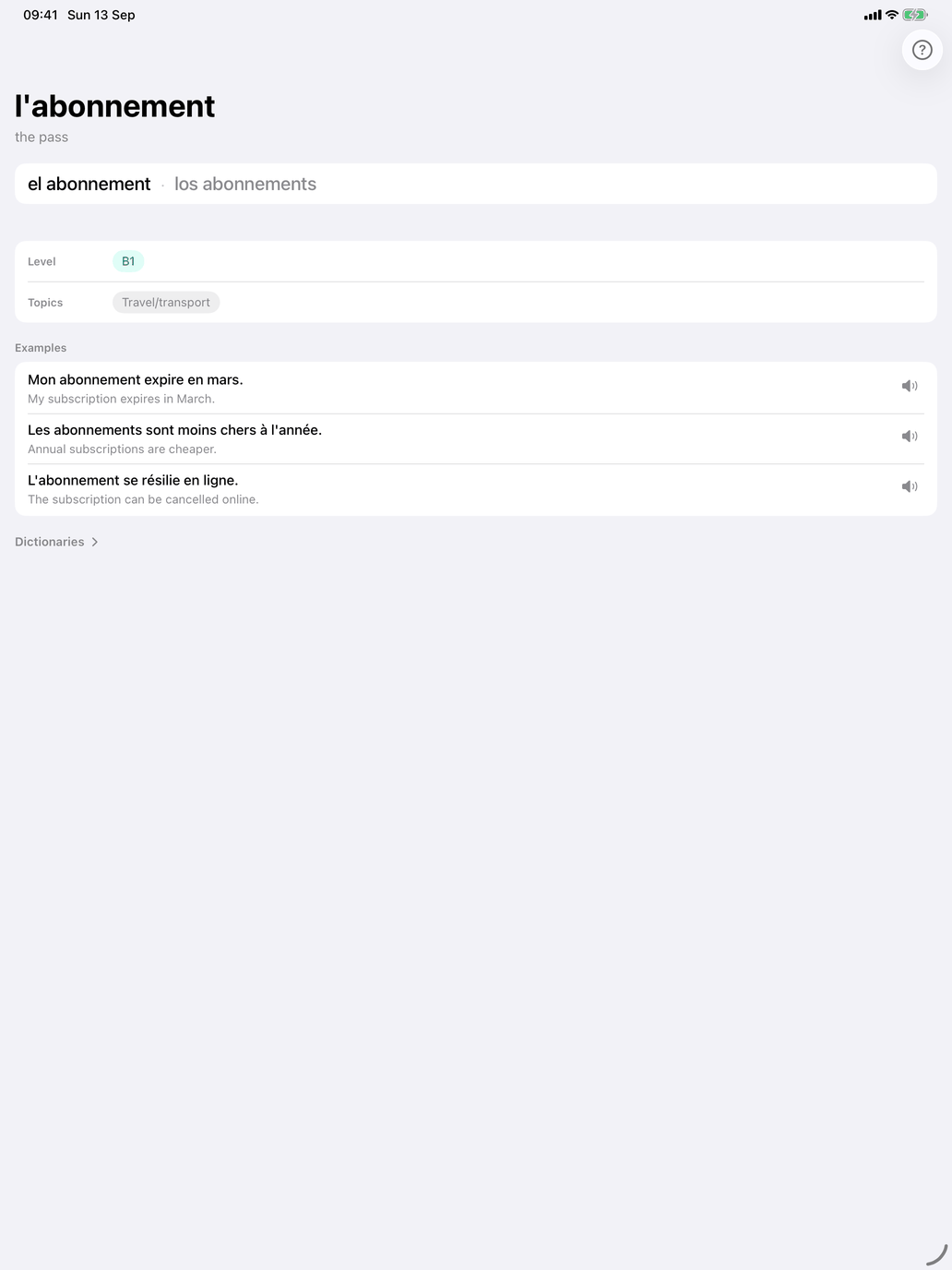
- the noun with its article and its translation
- its singular and plural forms
- its Level and Topics
- Examples: French sentences, each with a translation and a speaker button to hear it
- the Dictionaries row (see External dictionary lookups)
Noun meaning
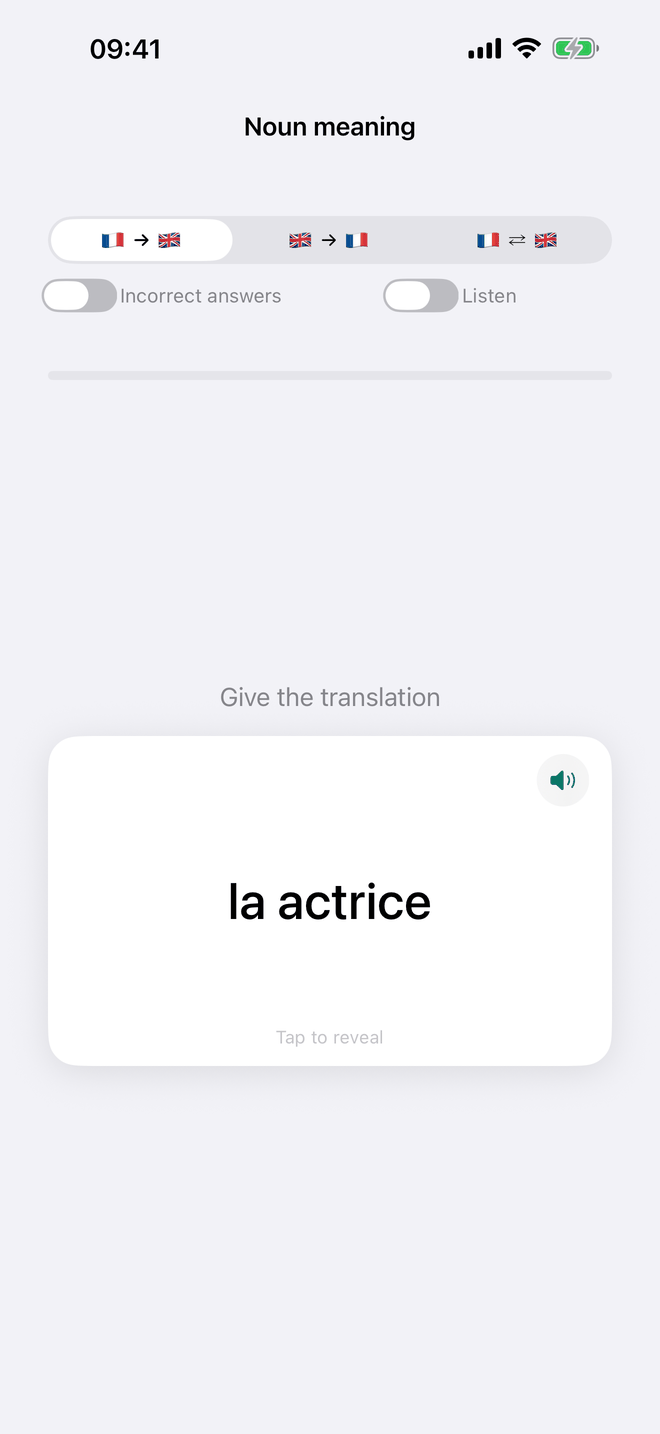
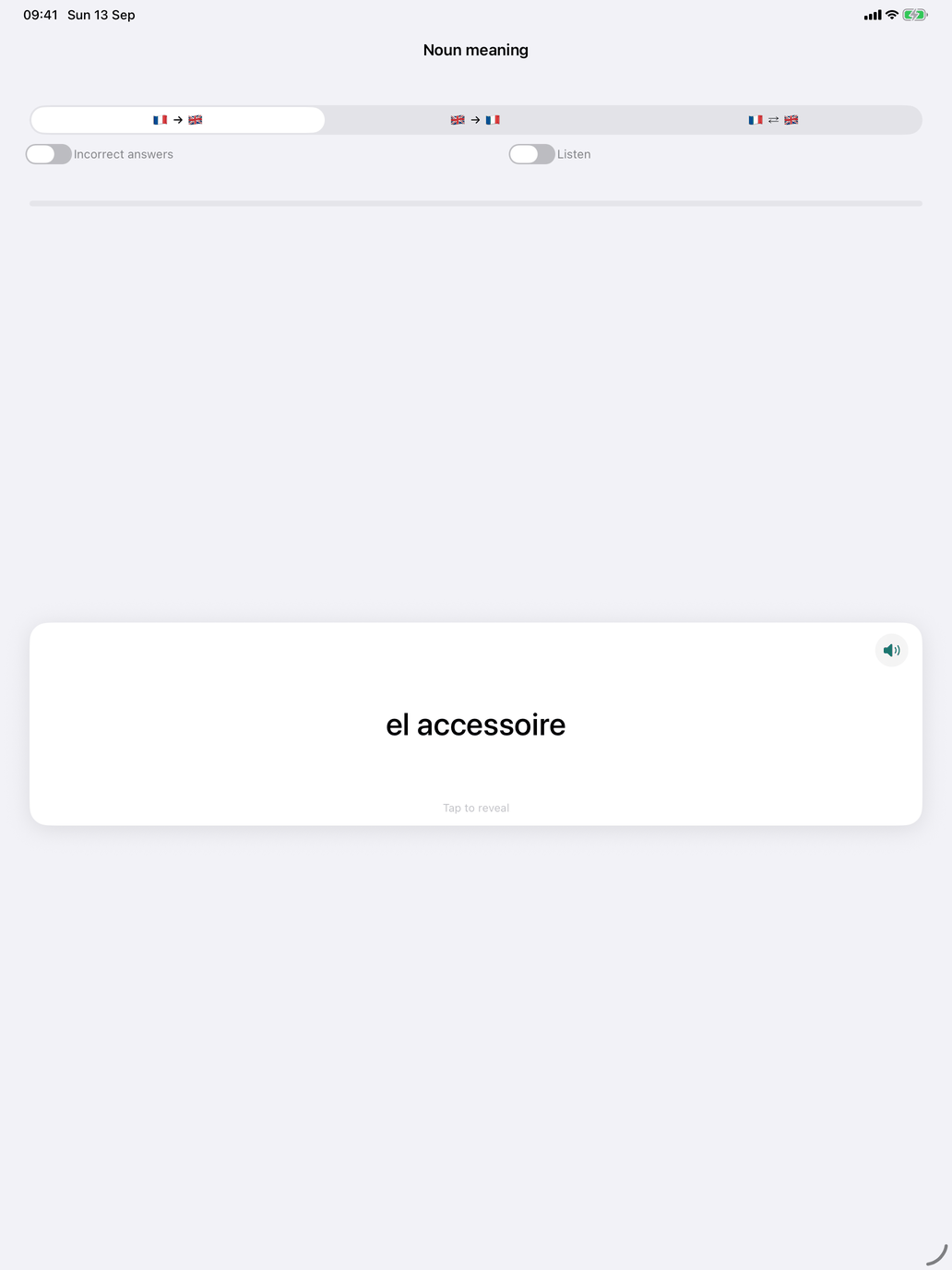
A flashcard deck for the meaning of the nouns in your selection. Each noun is shown with its article, so you learn its gender along with its meaning. Every answer is recorded, and nouns you get wrong come back more often. The other meaning decks in the French course (adjectives, adverbs, pronouns, numerals, prepositions, phrases and other vocabulary) work in the same way.
How a card works. The card shows a word; you recall its translation, then tap the card to turn it (Tap to reveal). On iPhone and iPad, swipe right if you knew it and left if you didn't. On a Mac (and with VoiceOver) you use the Correct and Wrong buttons instead. The next card follows automatically.
The controls at the top:
- Direction — French → your language, your language → French, or a random mix of both.
- Incorrect answers — only show the cards you have answered wrongly. If there are none, the app tells you and switches the filter off.
- Listen — when a French voice is available, the French side is spoken instead of shown; turn the card to see how it is spelt.
The speaker button on the card reads the visible side aloud. After a run of seven correct answers the app offers to end the session early: choose Stop — session complete or Continue. At the end, New session starts another round.
Pick the correct article
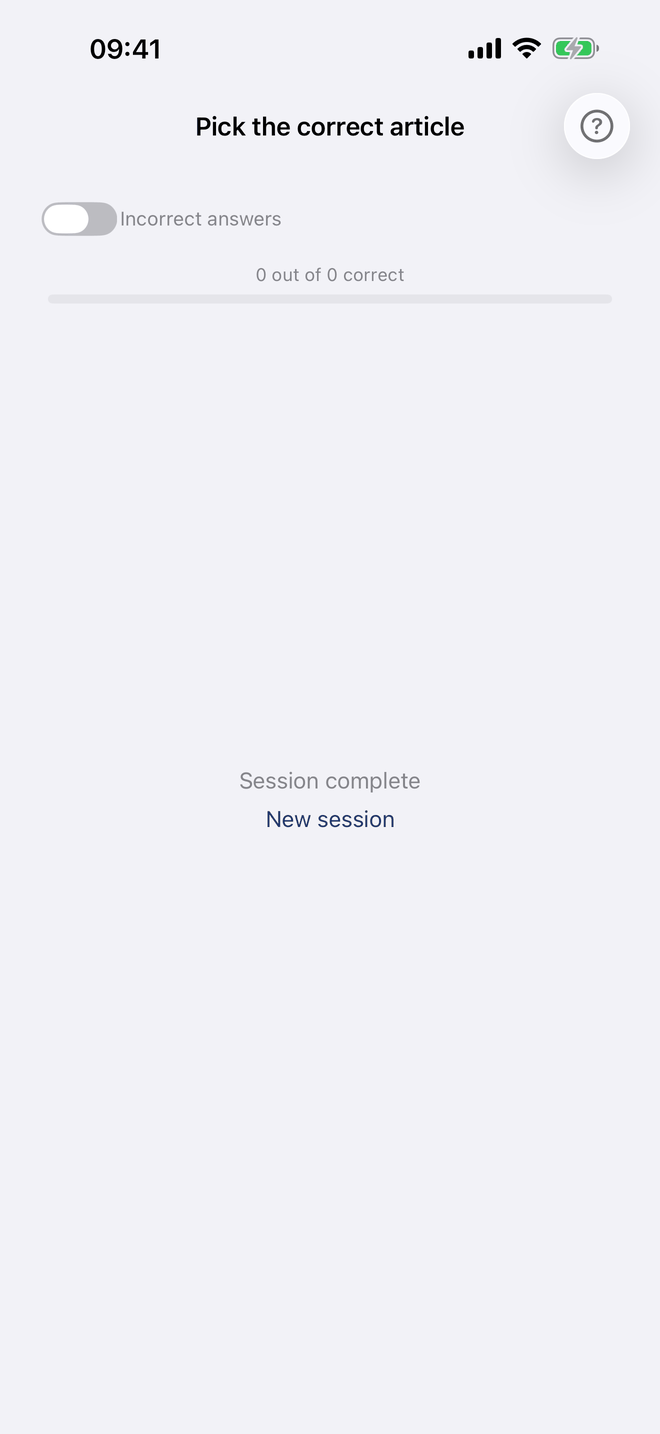
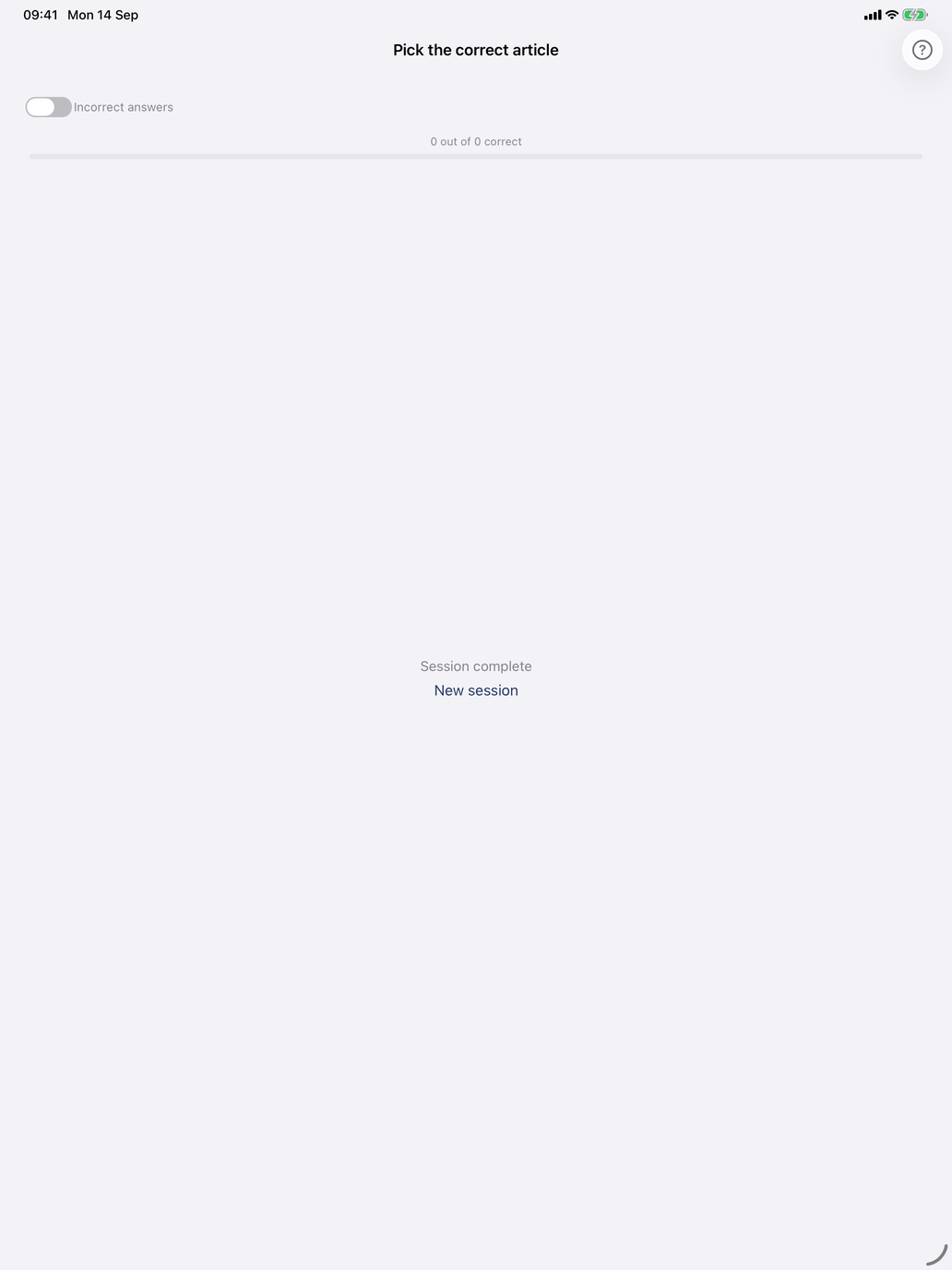
A noun is shown without its article. Tap le or la. The card flashes green or red and turns round to show the noun with its article and its translation; after two seconds the next noun appears. The speaker button reads the noun aloud.
- The nouns come from your selection. Nouns of more than one word, and nouns ending in -s, are left out.
- For a noun that takes both genders (élève), either answer is right, and the card says so.
- Each noun is asked once per session. The line at the top shows your score so far ("6 out of 8 correct") and how many nouns are candidates.
- Incorrect answers limits the session to the nouns whose gender you have got wrong.
Which article?
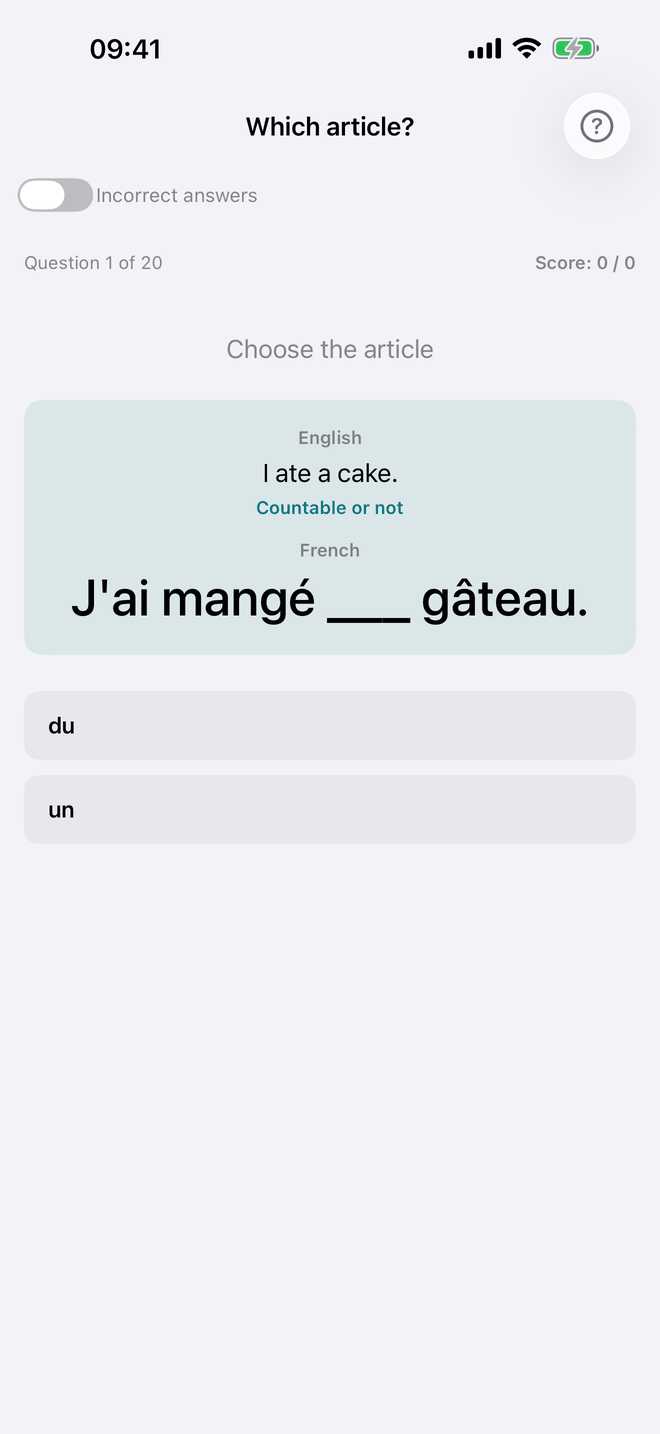
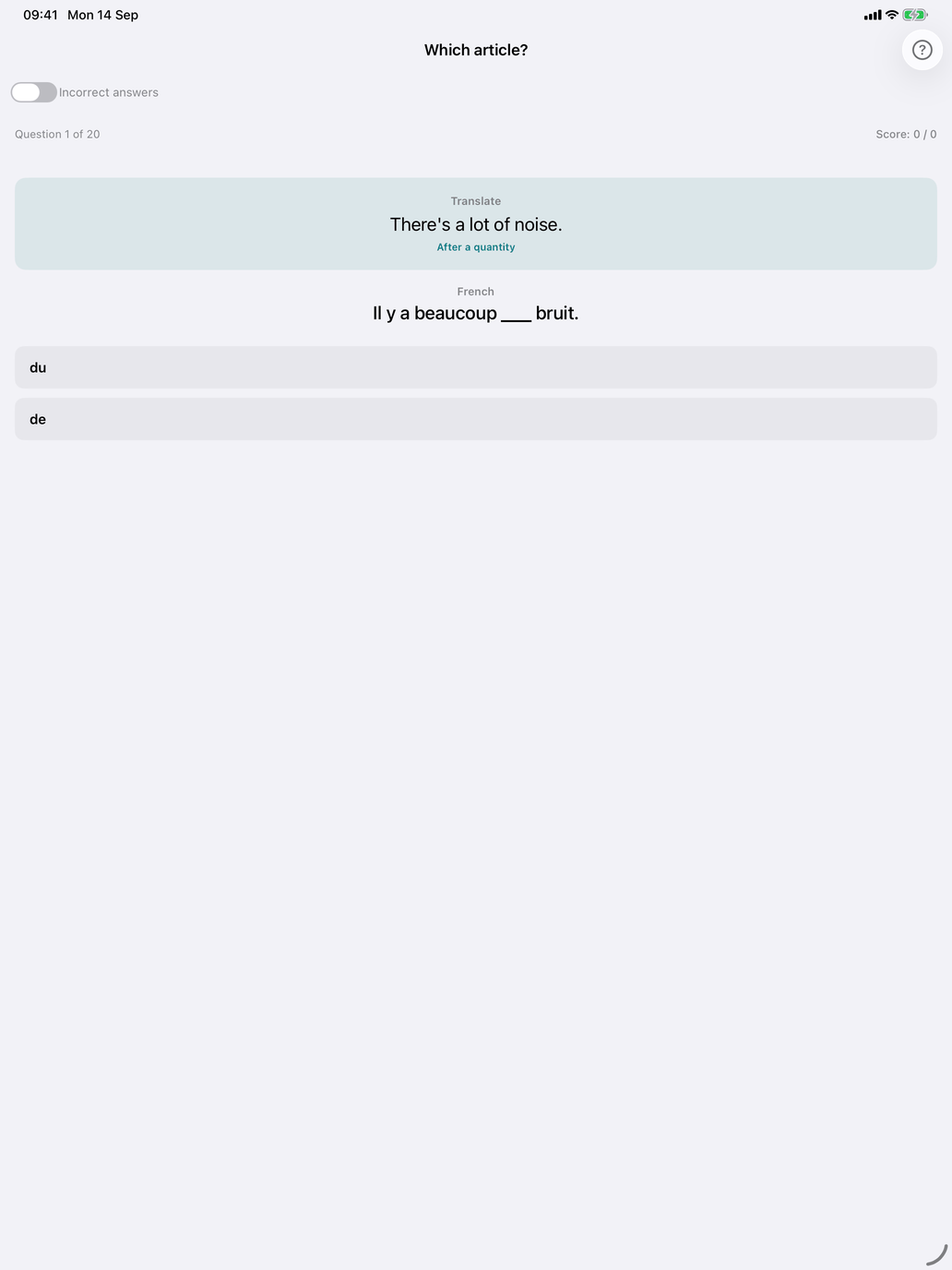
Which article? asks a different question from Pick the correct article. That drill asks which article a noun takes. This one asks which article a sentence needs — and the noun alone can't tell you: le café and du café are both correct French.
Each question shows an English sentence with a label naming the rule, and the French sentence with a gap. Tap one of two articles; the gap fills in, the right answer is marked, and a Why …? card explains the rule. Tap Next question to go on (See results after the last one).
The sentences cover six rules:
- After a negation — the partitive and the indefinite article become bare de: je ne mange pas de pain, nous n'avons pas d'enfants. After être they don't: ce n'est pas la réponse.
- After a quantity — beaucoup de, un kilo de, un peu de take bare de: un peu de lait, but ajoute du lait.
- The verb decides — verbs of liking take the definite article (j'aime le café); verbs of eating, drinking and buying take the partitive (je bois du café).
- Countable or not — j'ai mangé un gâteau (a whole cake) against j'ai mangé du gâteau (some cake).
- Plural — j'achète des pommes (some apples) against j'aime les pommes (apples in general).
- A specific thing — the definite article's ordinary job: ferme la porte, la France.
The drill has its own fixed set of sentences and ignores your noun selection. Your answers are recorded per rule, so the rule you miss most comes back more often. The session length follows Questions per session (with ∞, a session has at most 50 questions).
Singular / Plural
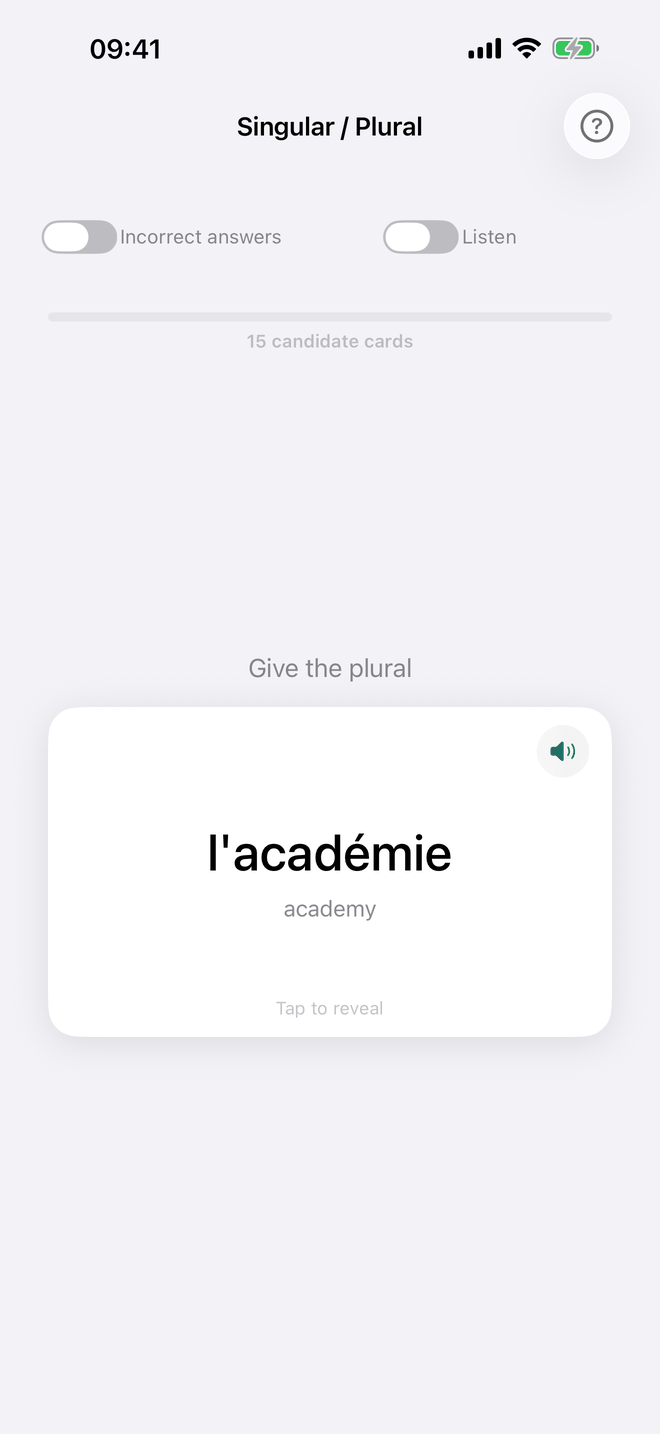
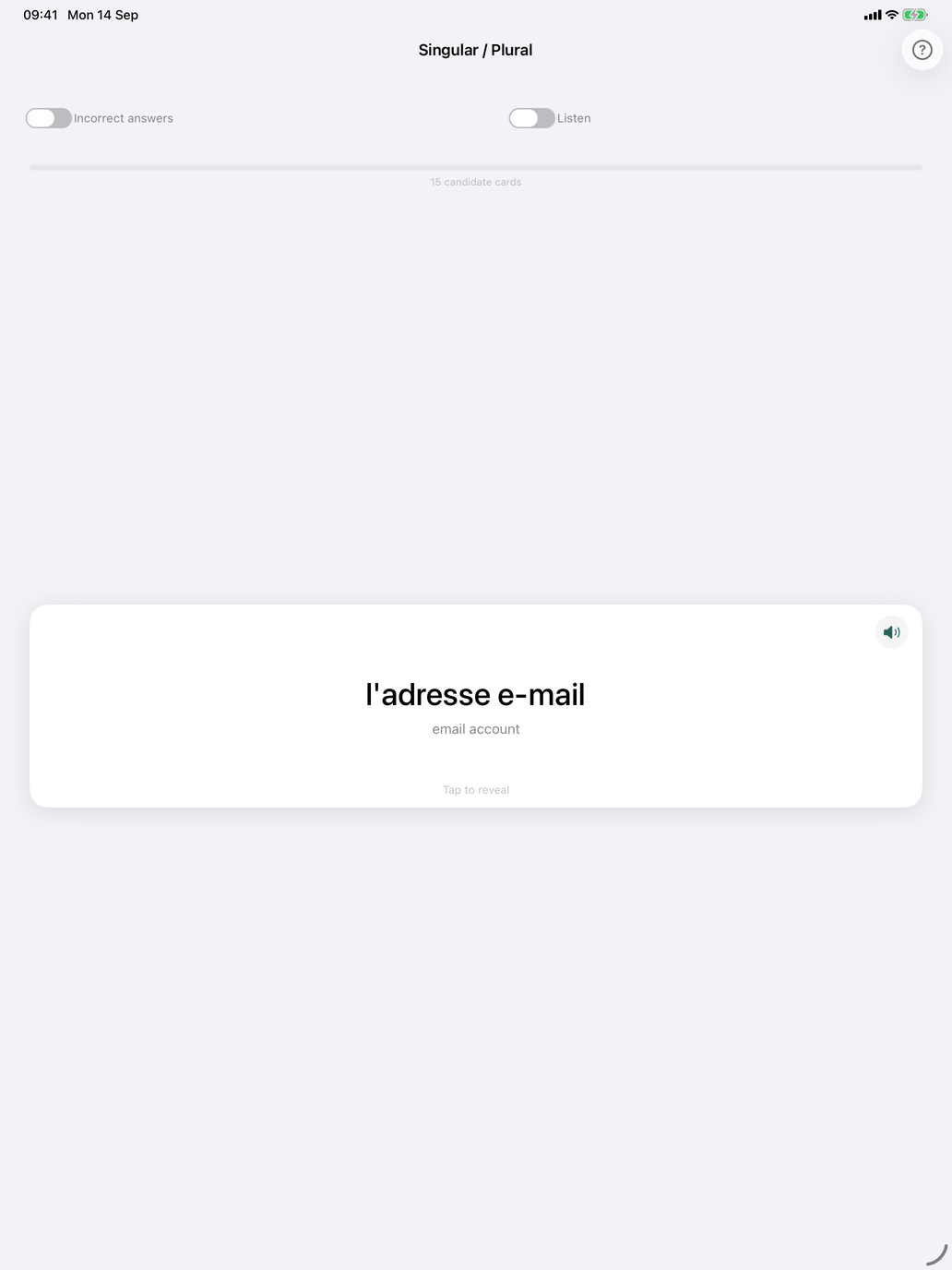
A flashcard drill for plurals. The card shows a noun with its article and translation, and asks Give the plural (le cheval → les chevaux) or Give the singular; the direction is chosen at random for each card. Turn the card, then mark yourself right or wrong as in Noun meaning.
The nouns come from your selection, but only nouns with a normal singular and plural are used: mass nouns, plurale tantum and invariable nouns are left out. If none are left, the drill says so and offers Select scope.
Alternate gender pairs
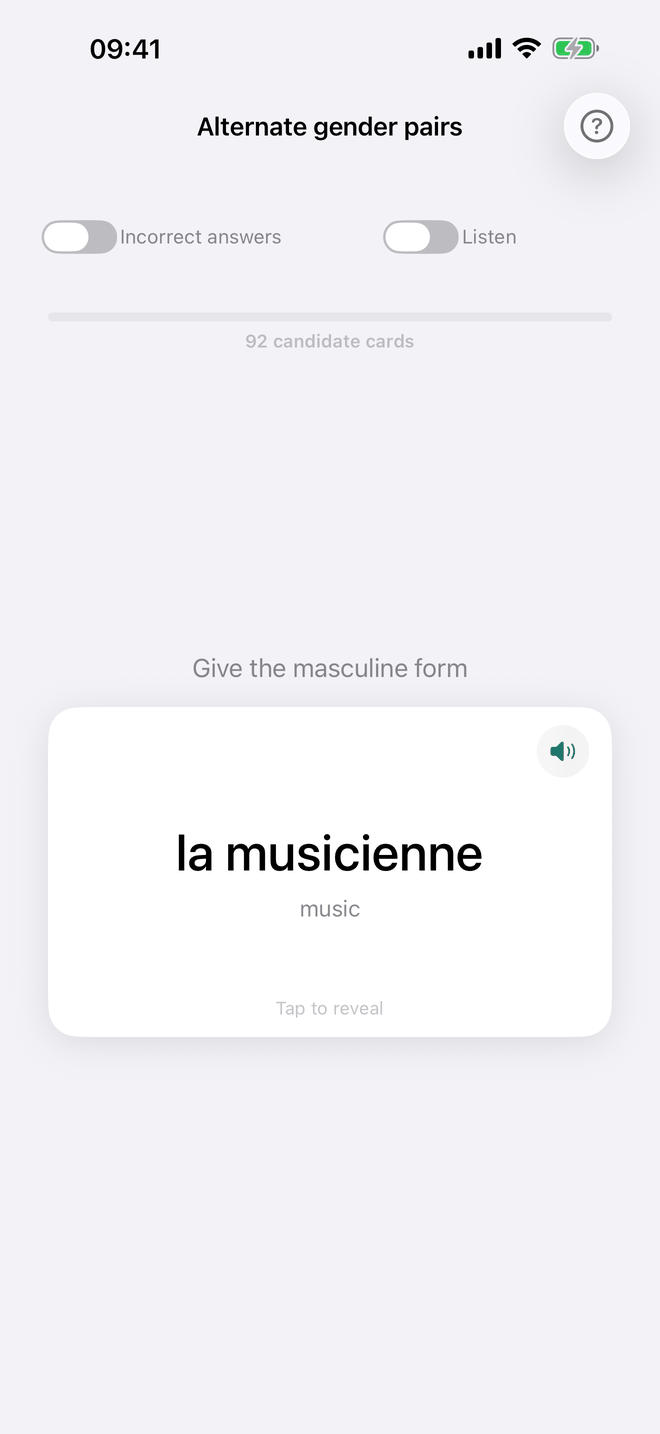
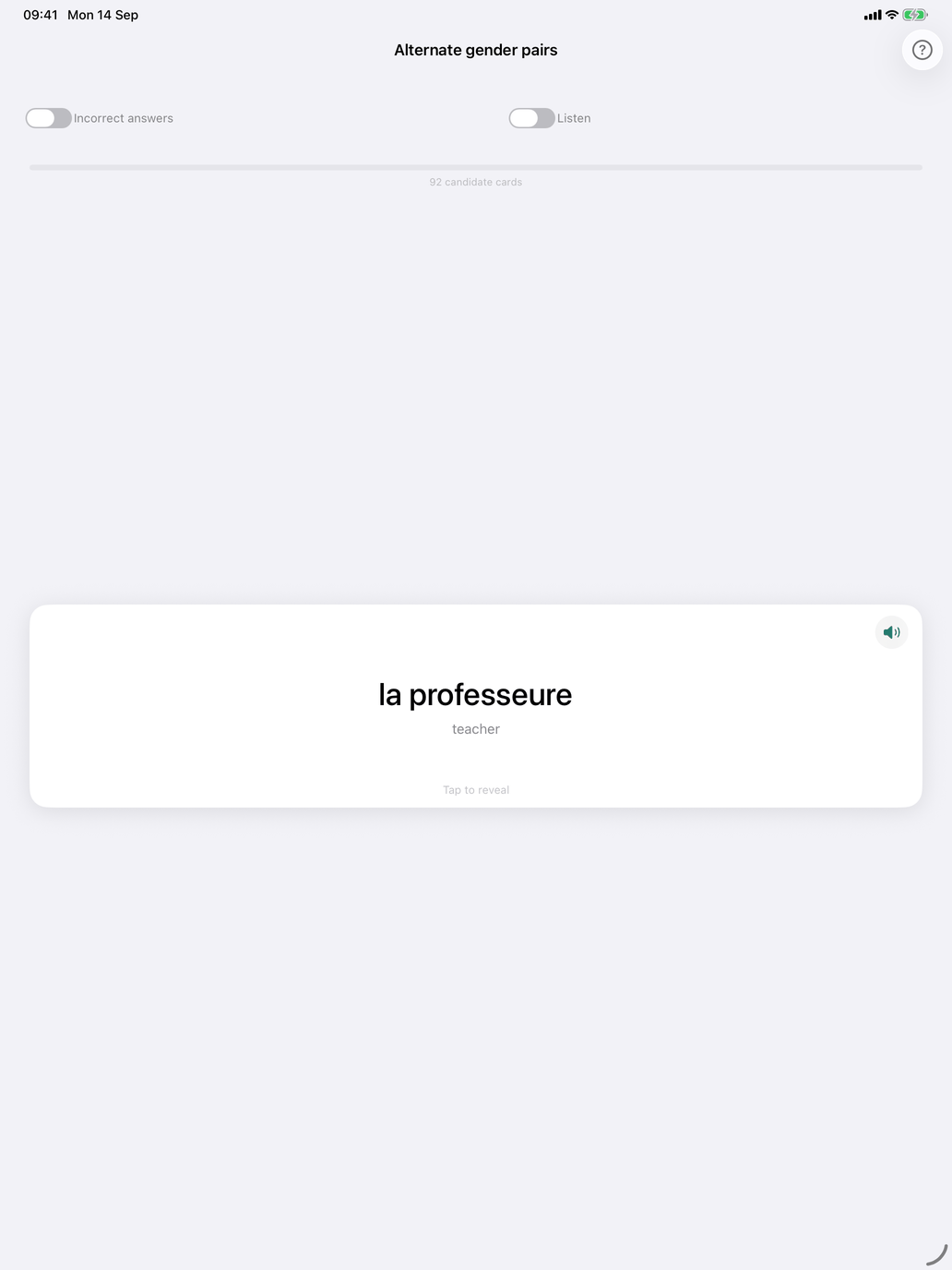
A flashcard drill for the nouns that have both a masculine and a feminine form. The card shows one form with its article and translation and asks Give the feminine form (le boulanger → la boulangère) or Give the masculine form. Turn the card and mark yourself as in Noun meaning.
The drill uses all such nouns — the M/F pairs and the nouns whose meaning changes with gender (le tour → la tour, where the translation on each side shows the change) — whatever you have selected. The article is elided where needed: l'ami → l'amie.