The Concordance Drill
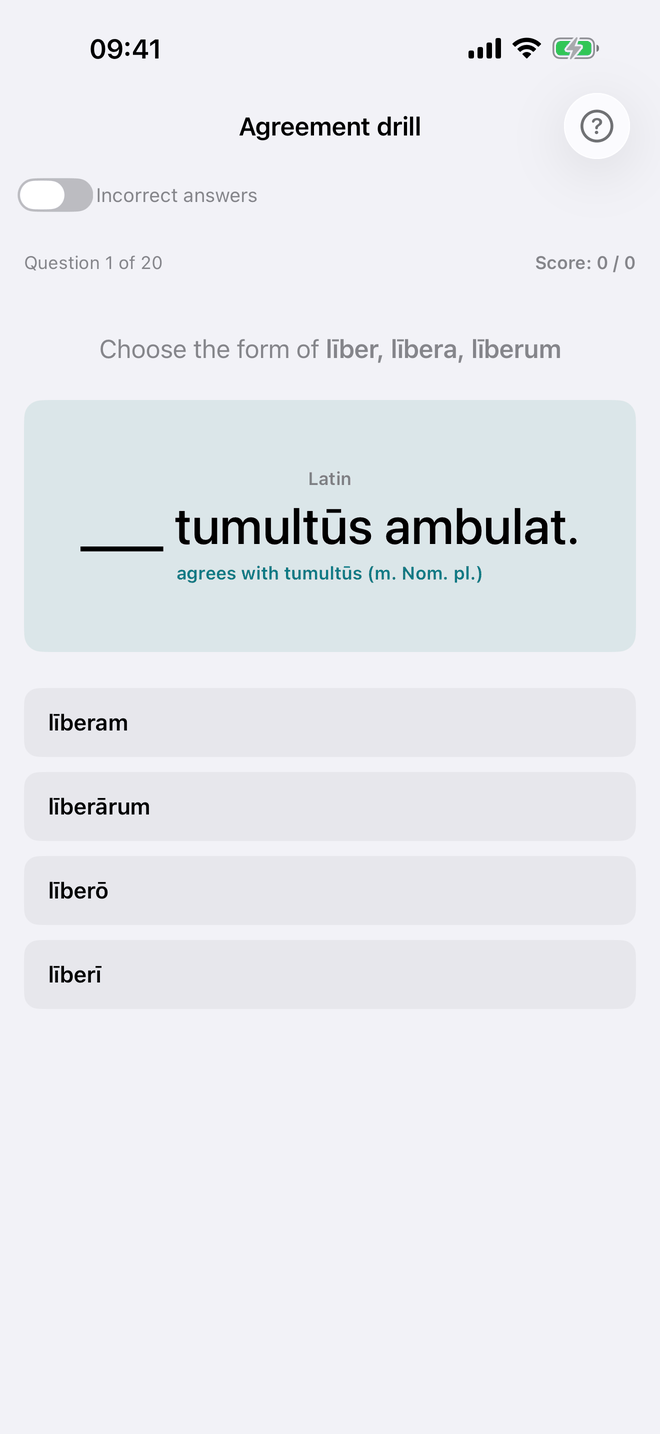
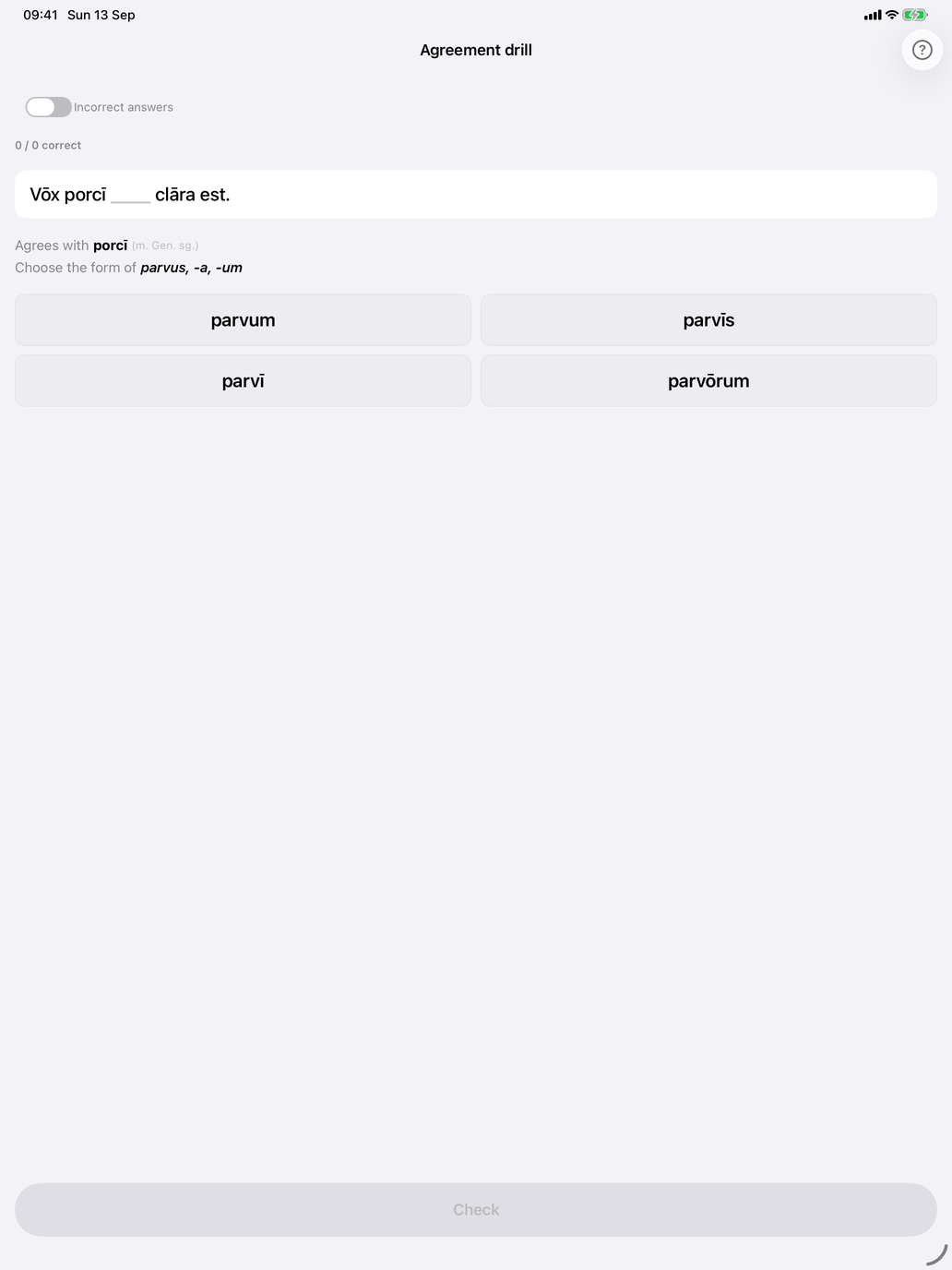
In the hub this drill is called Agreement drill. It shows a short Latin sentence with a blank where an adjective belongs. The noun is already in its inflected form. Your task is to pick the form of the adjective that agrees with the noun in case, number and gender. That agreement is the concordance the drill is named after.
What a question shows. Here is an example:
Choose the form of pulcher, pulchra, pulchrum
Latin
___ rosam amō.
agrees with rosam (f. Acc. sg.)
- pulcher
- pulchram
- pulchrārum
- pulchrīs
The instruction gives the adjective in its citation form. Under the sentence, a hint names the noun and its gender, case and number, so the task is to turn those three features into the right form of the adjective. There are always four options. One is correct, and the other three are different forms of the same adjective, picked at random from its paradigm.
Answering. A single tap answers. Your pick fills the blank, the correct option gets a green tick, and a wrong pick gets a red cross. An explanation card then gives the reason:
Why pulchram?
pulchram agrees with rosam (f. Acc. sg.).
The card shows the same text whether you picked right or wrong. It does not say which axis you missed. Tap Next question to continue, or See results after the last question.
Where the sentences come from. Each question combines a random noun from your noun selection, an adjective from your adjective selection, and a random case and number. The case is nominative, genitive, dative, accusative or ablative. The vocative is never asked. The app then picks a short sentence frame for that case from a small built-in set. Nominative frames put the noun in subject position (… cantat), genitive frames make it a possessor (Liber … in mēnsā est), dative frames make it an indirect object (… dōnum dō), accusative frames make it a direct object (… videō), and ablative frames use a preposition (Cum … ambulō). The frames don't change with number, so a plural noun can end up with a singular verb. That makes the sentence odd Latin, but the agreement being tested is still correct. In every frame the adjective sits right next to its noun, so the drill practises attributive agreement only.
Your pool. The drill draws on both Setup selections: Select noun groups in the Nouns hub and Select adjective groups in the Adjectives hub, each filtered by your word scope. To focus on one noun declension or one adjective pattern, narrow the matching selection. If either selection leaves nothing to draw from, the drill shows Nothing to drill and tells you which Setup rows to check.
Session and recording. The Incorrect answers toggle at the top limits the session to adjectives you have been getting wrong. The number of questions comes from Questions per session in Settings → Study. Each answer is recorded as right or wrong against the adjective, so it counts towards that adjective's progress. The noun in the sentence is not recorded.
When to use it. Use this drill once you can produce noun forms and adjective forms reliably on their own. It is the integration drill: it has you put the two together in a sentence.