Selecting Declensions
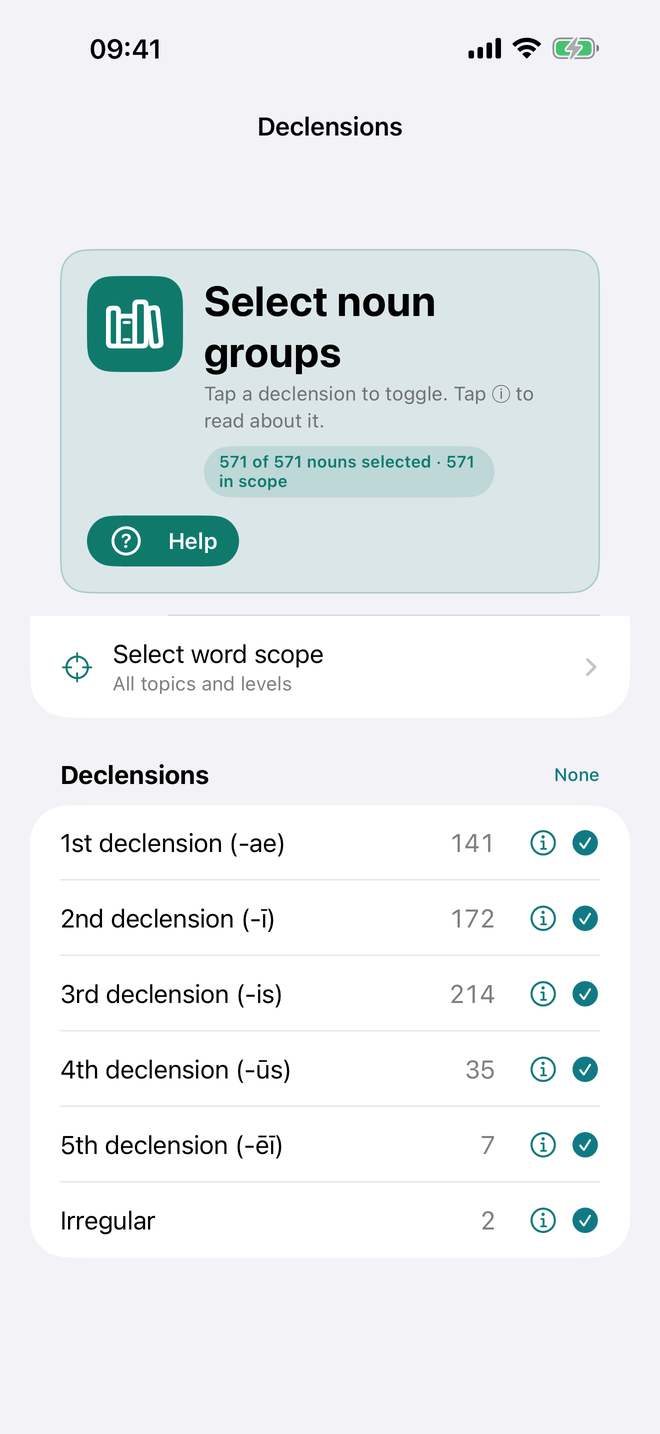
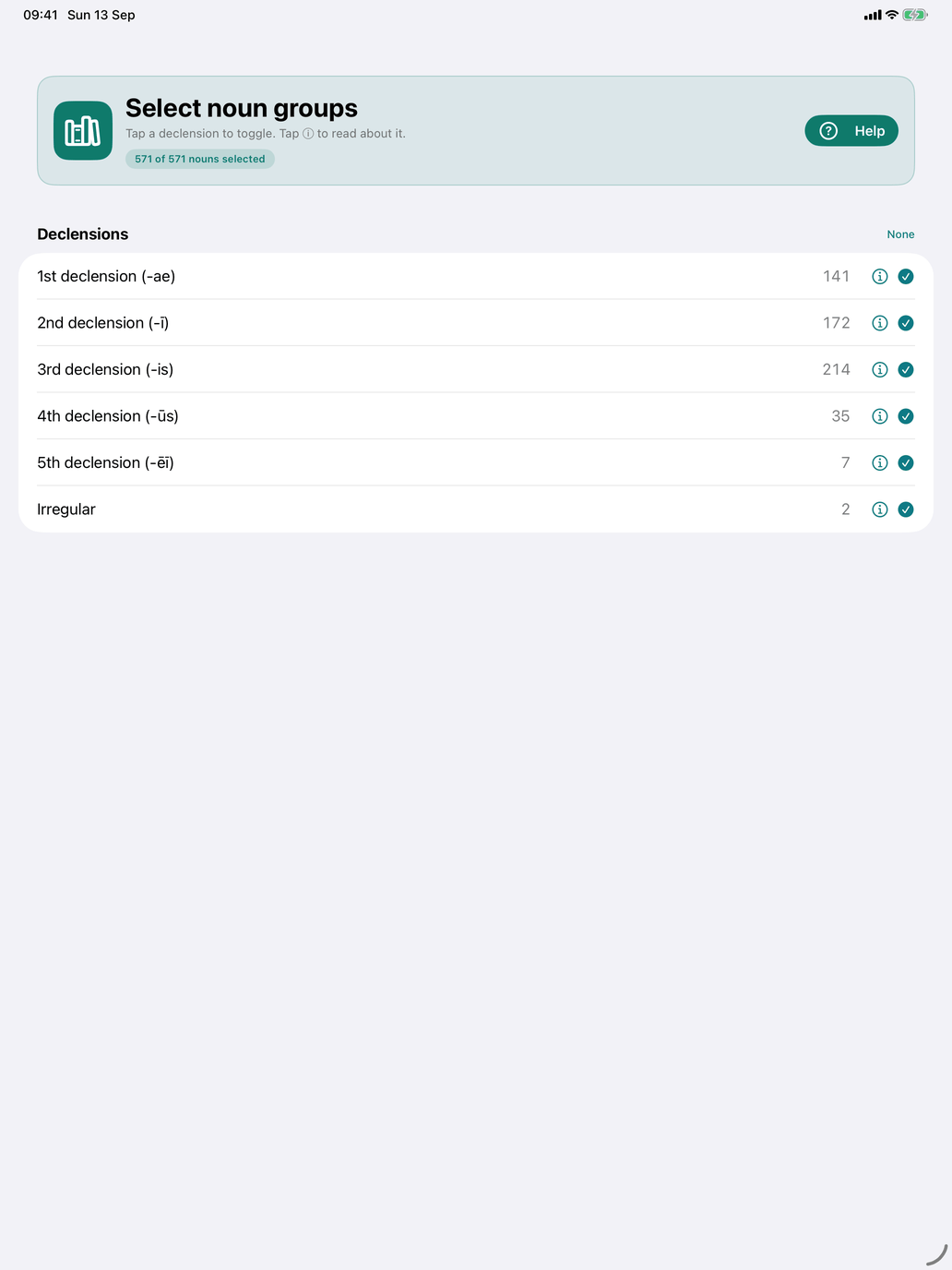
Select noun groups decides which nouns can appear in Noun reference, Noun meaning, Decline the noun and Recognise the form. Declension is the only axis on this screen — there is no gender, textbook-chapter or frequency filter here. CEFR level and topic are global, set in Self Study → Select word scope.
The screen has one section, Declensions, with six rows:
- 1st declension (-ae)
- 2nd declension (-ī)
- 3rd declension (-is)
- 4th declension (-ūs)
- 5th declension (-ēī)
- Irregular
Each row shows how many nouns it contains. Tap a row to include or exclude that declension. The All / None button in the section header selects or clears every row at once.
The ⓘ button on a row opens a sheet about that declension: a short description, then the list of Nouns in this declension. Tap a noun in the list to open its detail screen.
The line at the top counts your selection and says how many of those nouns fall inside your word scope (CEFR level and topics), for example "571 of 571 nouns selected · 571 in scope" when every row is on and the scope is open. The drills and Noun reference use the in-scope nouns. The Select word scope row below it opens the scope screen, and says either All topics and levels or Filtered by topic or level.
The Irregular row. It holds the two nouns whose paradigms are stored cell by cell rather than generated: vīs (force, strength) and Iuppiter (Jupiter). They are drilled like any other noun. The drills simply skip the cells these nouns don't have: vīs has no genitive or dative singular here, and Iuppiter has no plural.
Saving your selection. Your selection is saved when you leave the screen and stays until you change it. A fresh install starts with every row selected, Irregular included. If you clear every row, the drills show No nouns selected instead of a question until you select at least one declension.
Suggested starting sets.
- 1st and 2nd declension only — the bulk of high-frequency vocabulary, and where every textbook begins.
- Add the 3rd declension once you can produce 1st- and 2nd-declension forms reliably. It is the largest and most varied group, and it contains the i-stems (urbs, cīvis, mare) with their -ium genitive plural.
- 4th and 5th declension last — they are the smallest groups.