Indicative or subjunctive
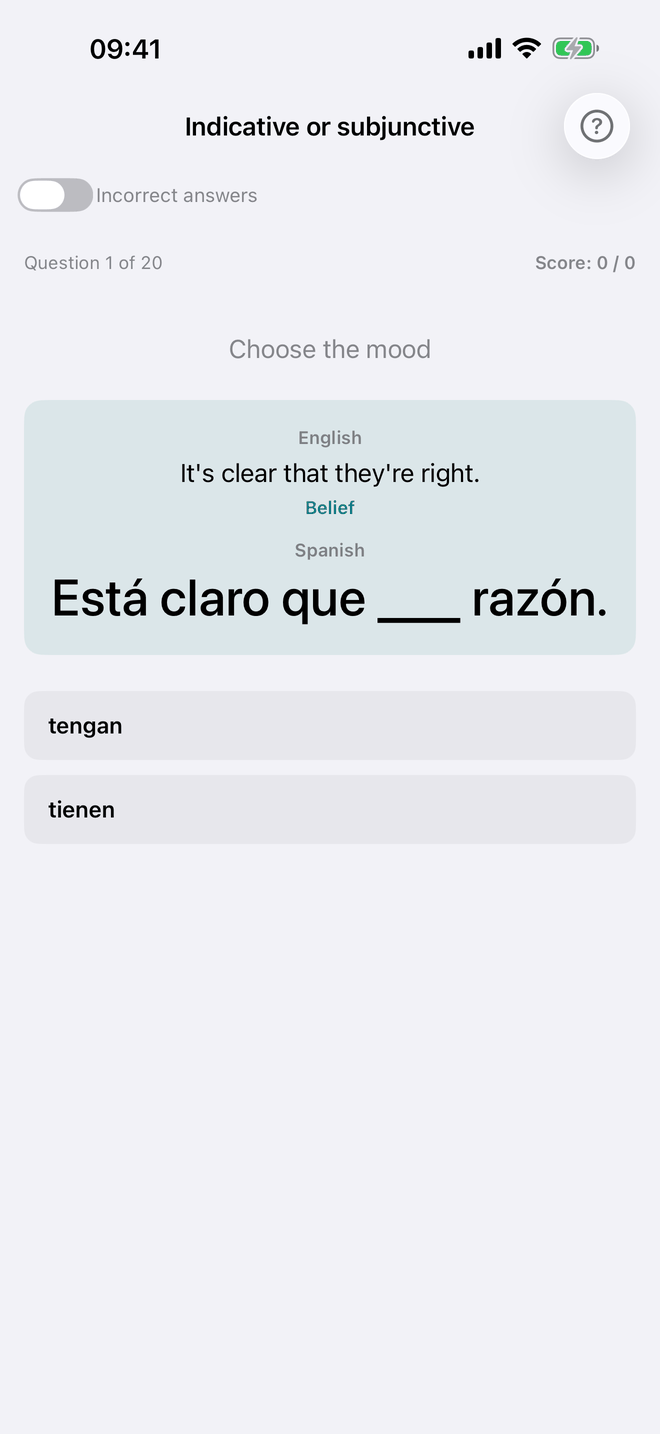
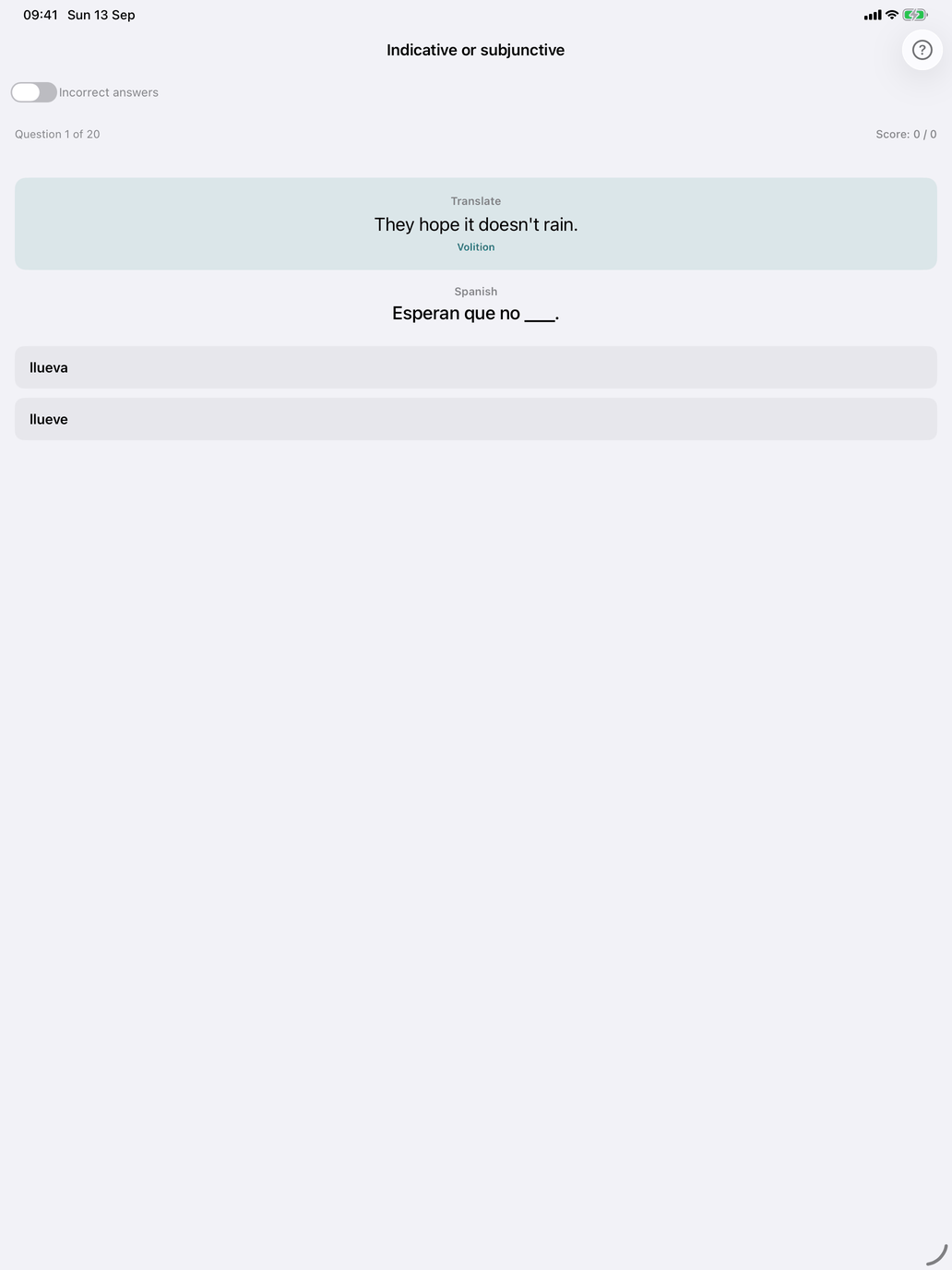
Spanish uses the subjunctive in many places where English does not. The app conjugates all four subjunctive tenses for over 1,100 verbs; this drill asks when one is needed. It works like the other choice drills (see The choice drills).
How a question looks. Under the instruction "Choose the mood", the card shows the sentence in your language. Under it is a badge naming the trigger at work (Belief, Doubt / denial, Volition, Emotion, Purpose…), and below them the Spanish sentence with a gap. The two options are the same verb in the indicative and in the subjunctive (viene / venga). After you answer, a card explains the choice.
A que is not a trigger. About a third of the answers in this drill are the indicative, on purpose. A drill where the answer is always the subjunctive only teaches you to spot que. The questions are built from minimal pairs: the same sentence with one thing changed, and a different mood.
| Indicative | Subjunctive |
|---|---|
| Creo que viene** | No creo que venga** |
| Es verdad que está** | No es verdad que esté** |
| Cuando llego, ceno | Cuando llegue, cenaré |
| Aunque es caro (I know it is) | Aunque sea caro (even if it is) |
| Busco el piso que tiene … | Busco un piso que tenga … |
What moves the mood is negation, the future, and whether the thing referred to is known.
The trigger classes.
- Always subjunctive: wanting and asking (quiero que, pide que), emotion (me alegro de que), doubt and denial (dudo que, no creo que), value judgements (es importante que), and the conjunctions para que, antes de que, sin que, a menos que.
- Always indicative: assertions — creo que, es verdad que, es evidente que, está claro que.
- It depends: cuando (has it happened, or is it still to come?), aunque (although it is, or even if it were?), and relative clauses (a known thing, or any thing that fits?).
Emotion is the tricky class. Me alegro de que estés aquí: you really are here, and it is still the subjunctive, because the clause is not being asserted but reacted to. A rule of thumb based on "uncertainty" breaks down here.
What's recorded. Each trigger class is recorded separately, so a class you keep missing comes back more often.