French
Over 900 verbs. Over 1,350 nouns. Sixteen tenses — the ones you use every day, plus the literary ones you need in order to read.
A complete French study system in its own right, marked with the same scheme as the other courses. Nothing here assumes you know Spanish or Latin.
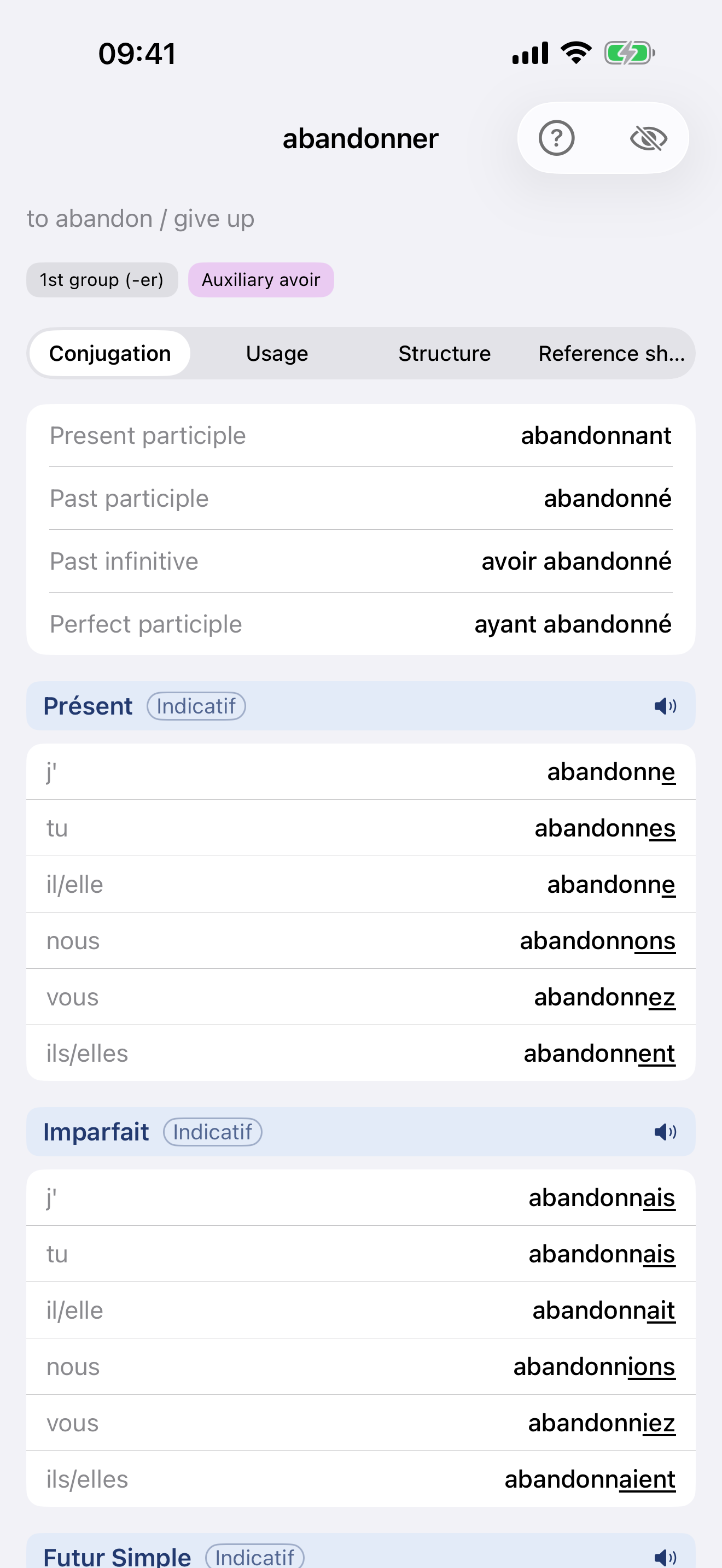 The verb, in full
Conjugation · Usage · Structure · Reference sheet — with the irregular parts marked where they depart from the verb's own group.
The catalogue
- over 900 verbs across the three groups
- over 1,350 nouns, with gender, plural and example sentences
- over 250 adjectives, with all four forms for agreement in gender and number
- adverbs, pronouns, numerals and prepositions, each with its own hub
- over 200 set phrases, plus the example sentences of the verbs and nouns
Verb grammar
Full conjugation for the three groups — 1st (-er, parler), 2nd (-ir with the -iss- infix, finir) and 3rd (everything else: aller, faire, prendre, venir).
Sixteen tenses, each switchable on its own in Select tenses — all four moods, including the literary tenses you will meet in reading.
Indicatif — simple
- Présent
- Imparfait
- Futur Simple
- Passé Simple — literary
Indicatif — compound
- Passé Composé
- Plus-que-parfait
- Futur Antérieur
- Passé Antérieur — literary (j'eus parlé), after quand, lorsque, dès que or après que
Conditionnel
- Conditionnel Présent
- Conditionnel Passé
Subjonctif
- Subjonctif Présent
- Subjonctif Passé
- Subjonctif Imparfait — literary
- Subjonctif Plus-que-parfait — literary (que j'eusse parlé)
Impératif
- Impératif Présent — tu / nous / vous only
- Impératif Passé — aie fini avant midi, the same three persons
The marking scheme. In the conjugation tables, red falls on just the part of a form that departs from the verb's group — the è of j'achète, the stem of je ferai — and a form that is red from end to end, such as je suis, has to be learned as a whole. An underline marks the ending the pattern predicts. In the compound tenses the past participle carries the mark, so pris and ouvert are red wherever they appear.
Verb groups. Fourteen groups in five sections, each tickable in Select verb groups: the three classic groups and the pronominal verbs; the spelling changes (mangeons, commençons, essaie); the stem changes (achète, préfère, appelle); the auxiliary (avoir or être); and the fully irregular verbs and the verbs with an irregular subjonctif.
The verb detail. Tap any verb for a tabbed screen — Conjugation · Usage · Structure · Reference sheet — with its translation in the header. Structure names the stem behind each tense, shows in amber the stems you have to memorise, and can hide the tenses that follow the pattern. Reference sheet is a printable one-page PDF of the verb in every tense.
Drills. Produce the conjugation and Recognise the conjugation, an Irregular verbs drill, and three choice drills that ask what a sentence needs: Passé composé or imparfait, Indicatif or subjonctif and Être or avoir. When you answer a conjugation question correctly, the feedback can show a translation of the exact form you gave; where the app has no translation of its own, devices with Apple Intelligence (iOS 26 and macOS 26) can supply one.
Grammar lessons. If you would rather follow a path, over fifty step-by-step lessons take you through the same ground in order.
Noun grammar
Gender (le / la) and plural formation across the catalogue: the regular -s; the -x after -eau, -au and -eu, and on the seven -ou nouns that take it (bijoux, genoux, …) while every other -ou noun takes -s; the -al → -aux pattern and some -ail nouns; and compound nouns. The gender groups cover masculine/feminine pairs (chien / chienne), nouns with one form for both genders (un / une élève), and the nouns whose meaning changes with gender (le tour / la tour).
Meaning flashcards show each noun with its article, so gender is drilled alongside meaning rather than after it. Pick the correct article drills le or la; Which article? asks which article a whole sentence needs — definite, indefinite, partitive or bare de. Singular / Plural and Alternate gender pairs complete the set.
Adjective and adverb grammar
Agreement across gender and number, sorted into seven agreement classes — including the irregular feminines -eux → -euse, -f → -ve and -er → -ère, the doubled consonants (bon → bonne) and the pairs to learn by heart (beau → belle). An Agreement drill asks for the form that goes with a given noun. The adverbs hub explains the -ment derivation and drills the meaning of derived, irregular and lexical adverbs.
Numerals include the counting-in-twenties pattern of soixante-dix, quatre-vingts and quatre-vingt-dix, with a drill on when vingt and cent take an -s. Prepositions have a contrast drill for the pairs learners confuse: pour / par, en / dans, à / de and depuis / pendant.
Speech and lookups
French forms are read aloud with the voices Apple provides on your device, in Standard, Enhanced and Premium quality, just as for Spanish. Verb and noun detail screens carry a Dictionaries row that looks the word up in Linguee, WordReference and Reverso — in a browser sheet inside the app on iPhone and iPad, and in your web browser on the Mac.
On Apple Watch, the companion app shows conjugation tables for a set of essential French verbs.
Try it
Every language is open for 21 days with every feature unlocked. After that, unlock French on its own or buy Unlock all languages — a one-time purchase, no subscription, no ads, no account. Your answers stay on your device.


One purchase, every device. The iPhone, iPad and Mac apps share a single App Store listing, so a language you unlock on one is unlocked on the others — same Apple ID, no second payment.