Adjectives
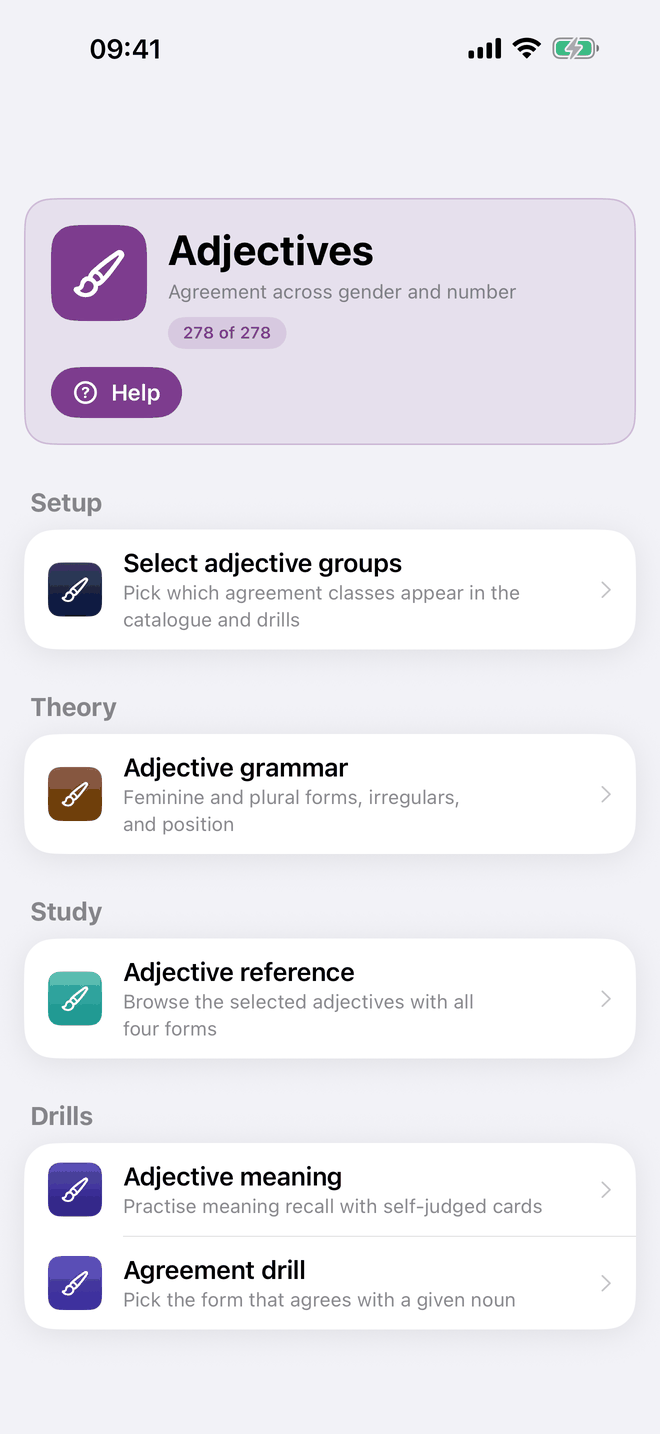
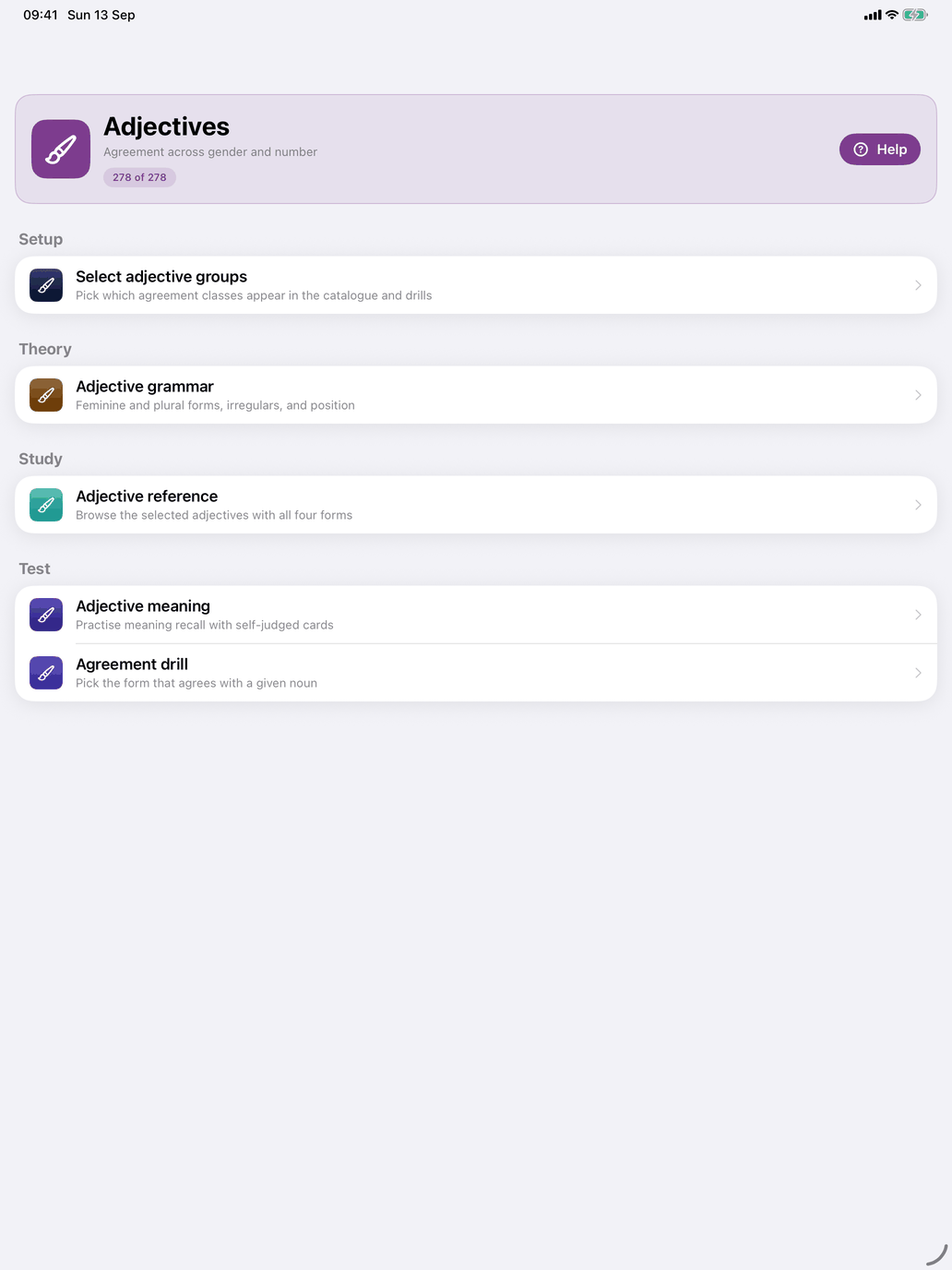
The Adjectives hub covers agreement in gender and number: every adjective has four forms (masculine and feminine, singular and plural). The catalogue has about 280 adjectives, each with its four forms, a translation, a level and a topic.
Open Self Study → Adjectives. The hub has:
- Setup — Select adjective groups: choose which agreement classes appear in the catalogue and the drills.
- Theory — Adjective grammar: feminine and plural forms, irregulars, and position.
- Study — Adjective reference: the selected adjectives with all four forms.
- Drills:
- Adjective meaning — flashcards for the meaning of the selected adjectives.
- Agreement drill — pick the form that agrees with a given noun.
The line under the hub title shows how many adjectives are in your selection, out of the whole catalogue; it turns red when there are none. The selection is the agreement classes you tick, narrowed by the level and topics in Self Study → Select word scope. The reference list, the meaning deck and the agreement drill all use this same selection.
A recommended workflow
- Tick all classes and limit Select word scope to A1.
- Run Adjective meaning until the meanings are familiar.
- Use the Agreement drill to fix the forms, one or two classes at a time — start with Regular (+e) and Invariable, then add the others.
Select adjective groups
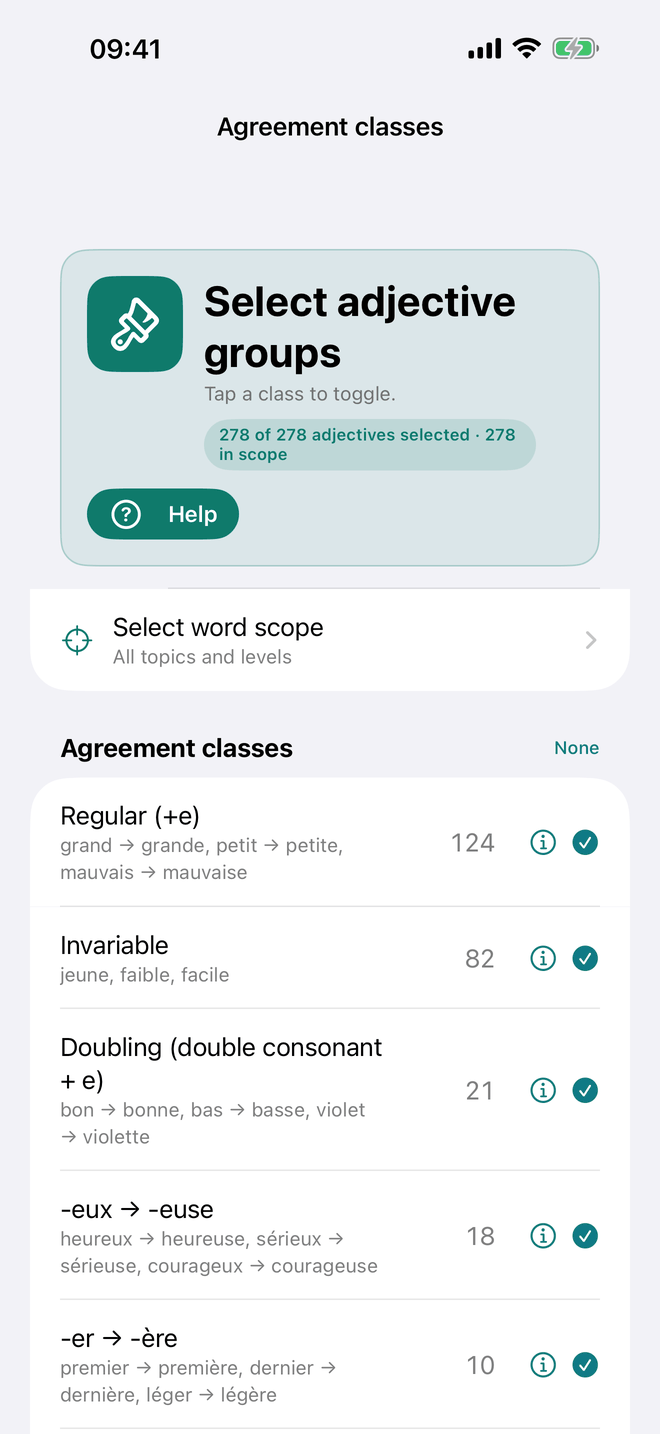
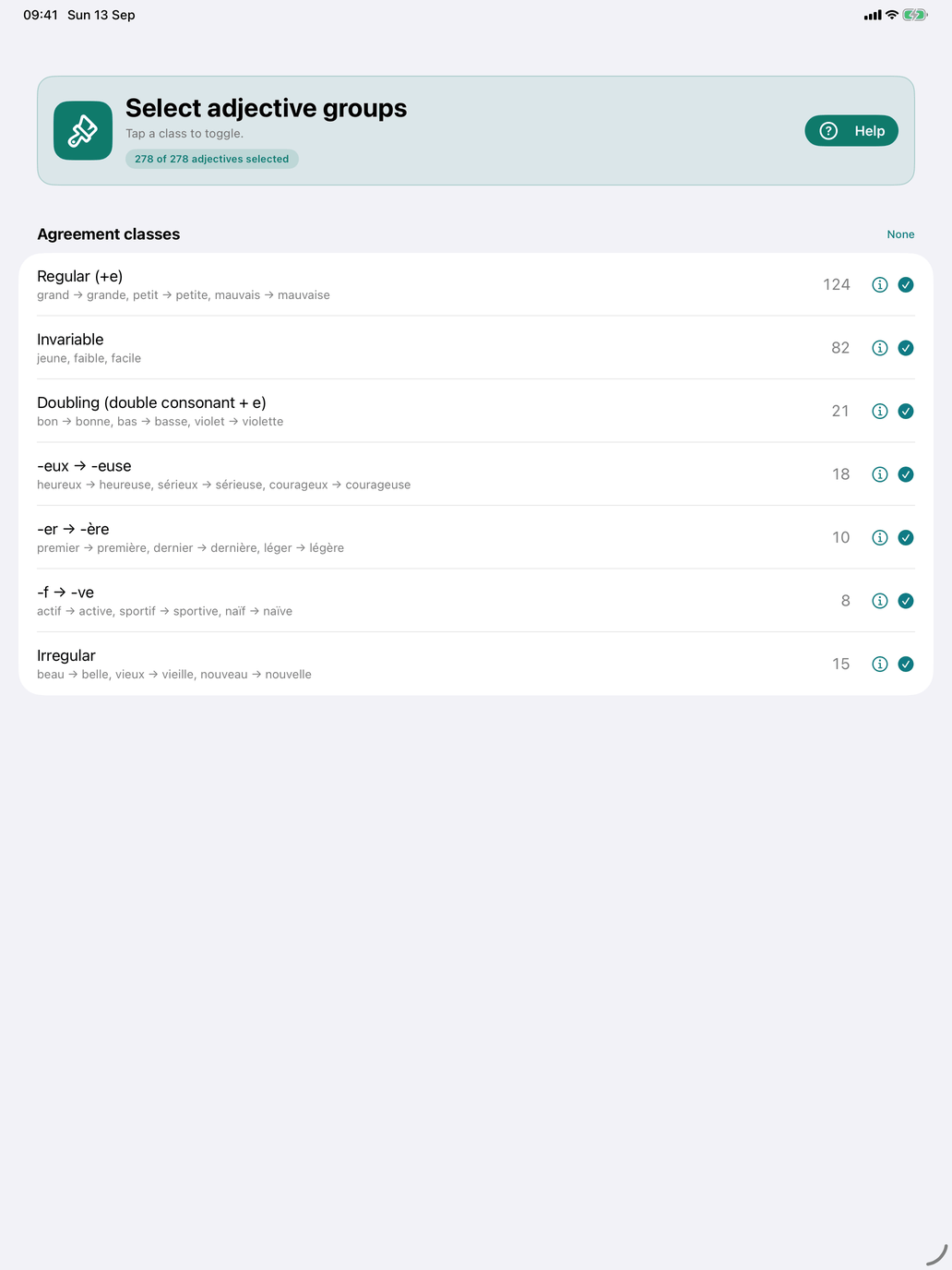
The adjectives are sorted into seven agreement classes, worked out from each adjective's own forms:
- Regular (+e) — add -e for the feminine: grand → grande, petit → petite, français → française. The largest class.
- Invariable — the masculine already ends in -e, so the feminine is the same word: jeune, rouge, facile. Only the plural changes.
- Doubling (double consonant + e) — bon → bonne, gentil → gentille, gros → grosse, ancien → ancienne.
- -eux → -euse — heureux → heureuse, sérieux → sérieuse.
- -er → -ère — premier → première, cher → chère, léger → légère.
- -f → -ve — neuf → neuve, actif → active, sportif → sportive.
- Irregular — pairs to learn by heart: beau → belle, vieux → vieille, blanc → blanche, long → longue, frais → fraîche, doux → douce.
Tap a class to switch it on or off; each row shows its size and a few examples. Tap ⓘ for an explanation of the class and a list of its adjectives (tap one to open it). The line at the top shows how many adjectives you selected and how many remain within your word scope; the Select word scope row below it takes you to the level and topic filters.
Adjective grammar
A reference page; nothing is recorded.
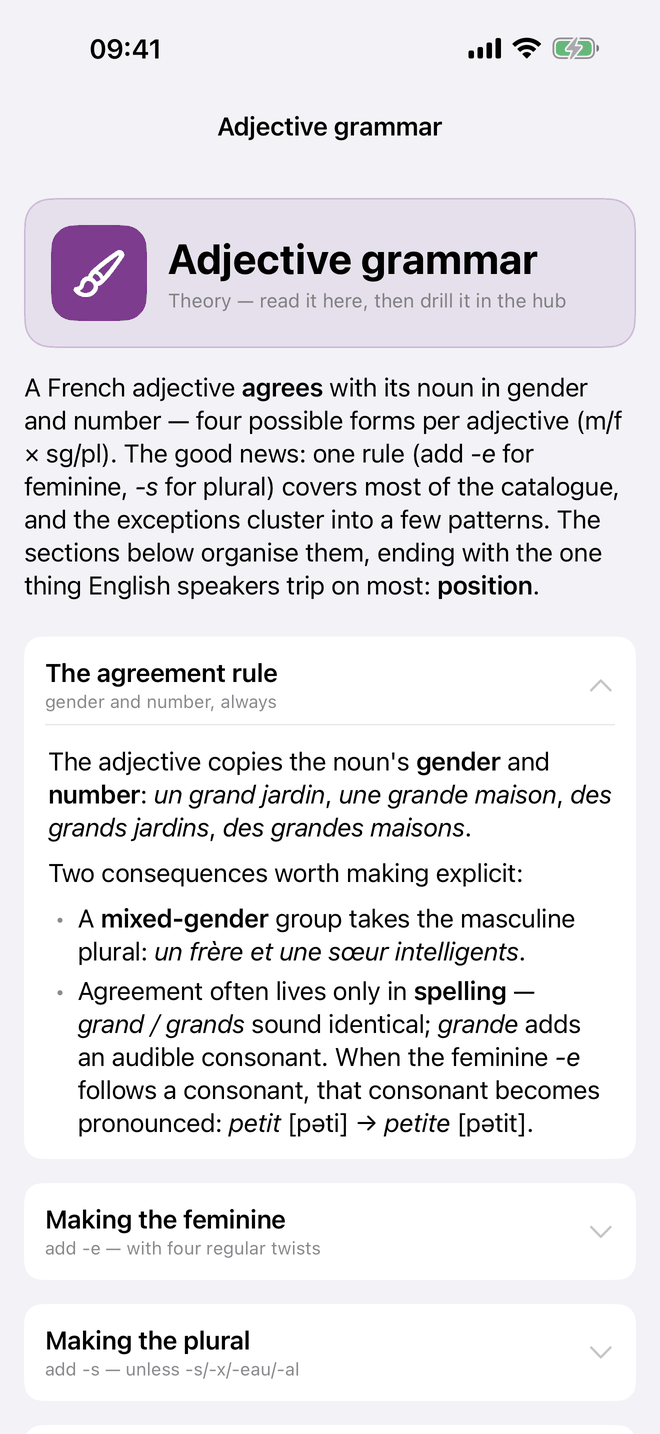
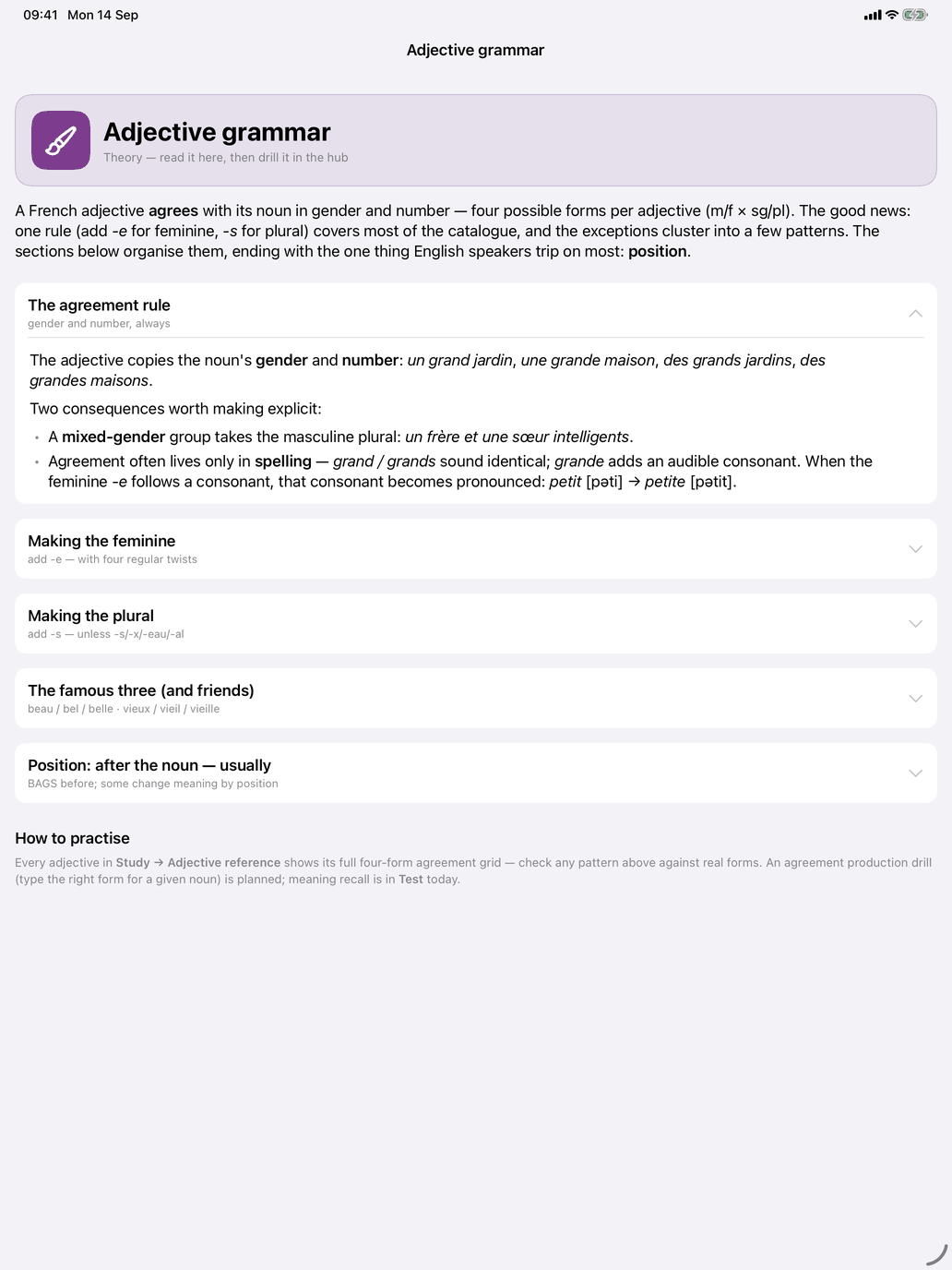
The agreement rule. An adjective takes the gender and number of its noun: un grand jardin, une grande maison, de grands jardins, de grandes maisons. A group of mixed gender takes the masculine plural: un frère et une sœur intelligents. Agreement often lives only in the spelling — grand and grands sound the same — but a feminine -e after a consonant makes that consonant heard: petit → petite.
Making the feminine. The default is to add -e (grand → grande, joli → jolie). An adjective that already ends in -e doesn't change (jeune, rouge, facile). Some double the final consonant (bon → bonne), some rewrite the ending (heureux → heureuse, actif → active, premier → première), and a few change the consonant altogether (blanc → blanche, long → longue, sec → sèche).
Making the plural. The default is to add -s to the singular of the right gender (grande → grandes). A masculine ending in -s or -x doesn't change (gris, heureux). -eau becomes -eaux (beau → beaux), and -al becomes -aux (principal → principaux), just as with nouns.
The famous three. Beau, nouveau and vieux have a third masculine form before a vowel or mute h: un bel homme, un nouvel ami, un vieil arbre (feminine belle, nouvelle, vieille). In the plural the extra form disappears: de beaux hommes.
Position. Most adjectives go after the noun: une voiture rouge, un livre intéressant. A small, frequent set goes before it — the BAGS adjectives: Beauty (beau, joli), Age (jeune, vieux, nouveau), Goodness (bon, mauvais) and Size (grand, petit, gros). A few change meaning with position: un homme grand (a tall man) against un grand homme (a great man); ma propre chambre (my own room) against ma chambre propre (my clean room); un ancien collègue (a former colleague) against une maison ancienne (an old house).
Adjective reference
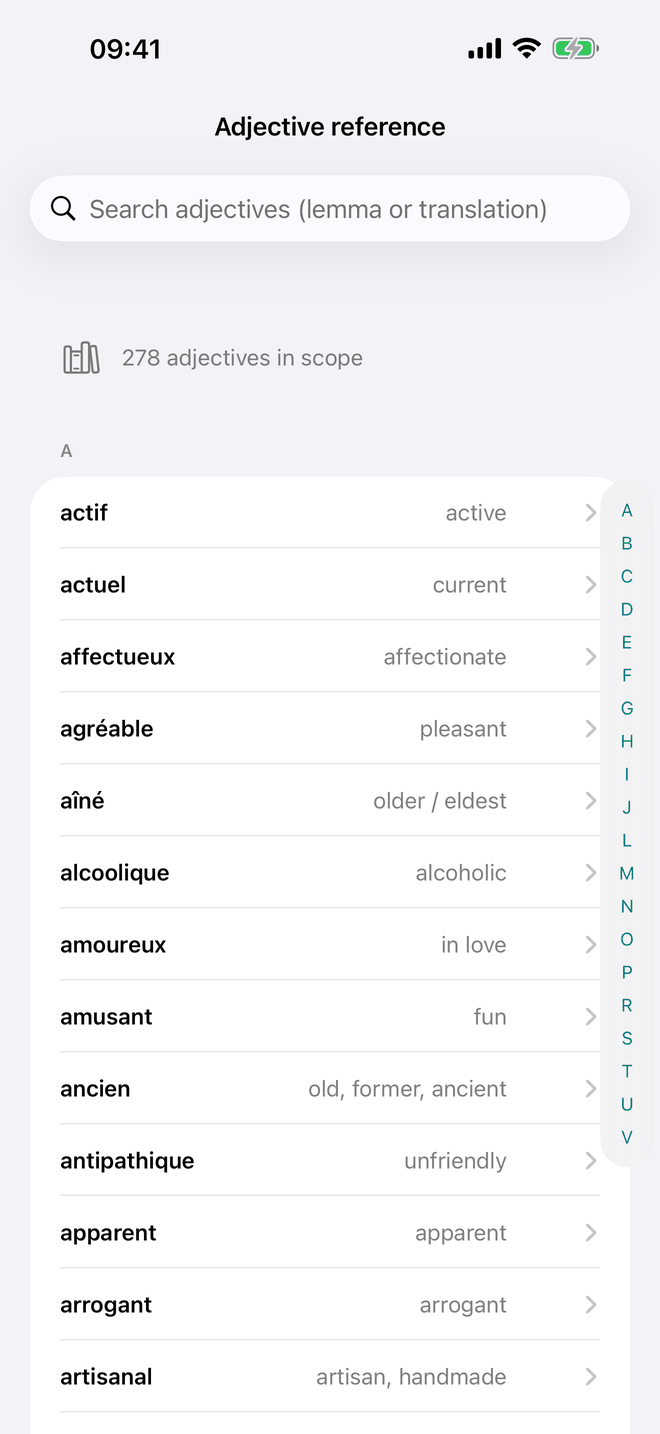
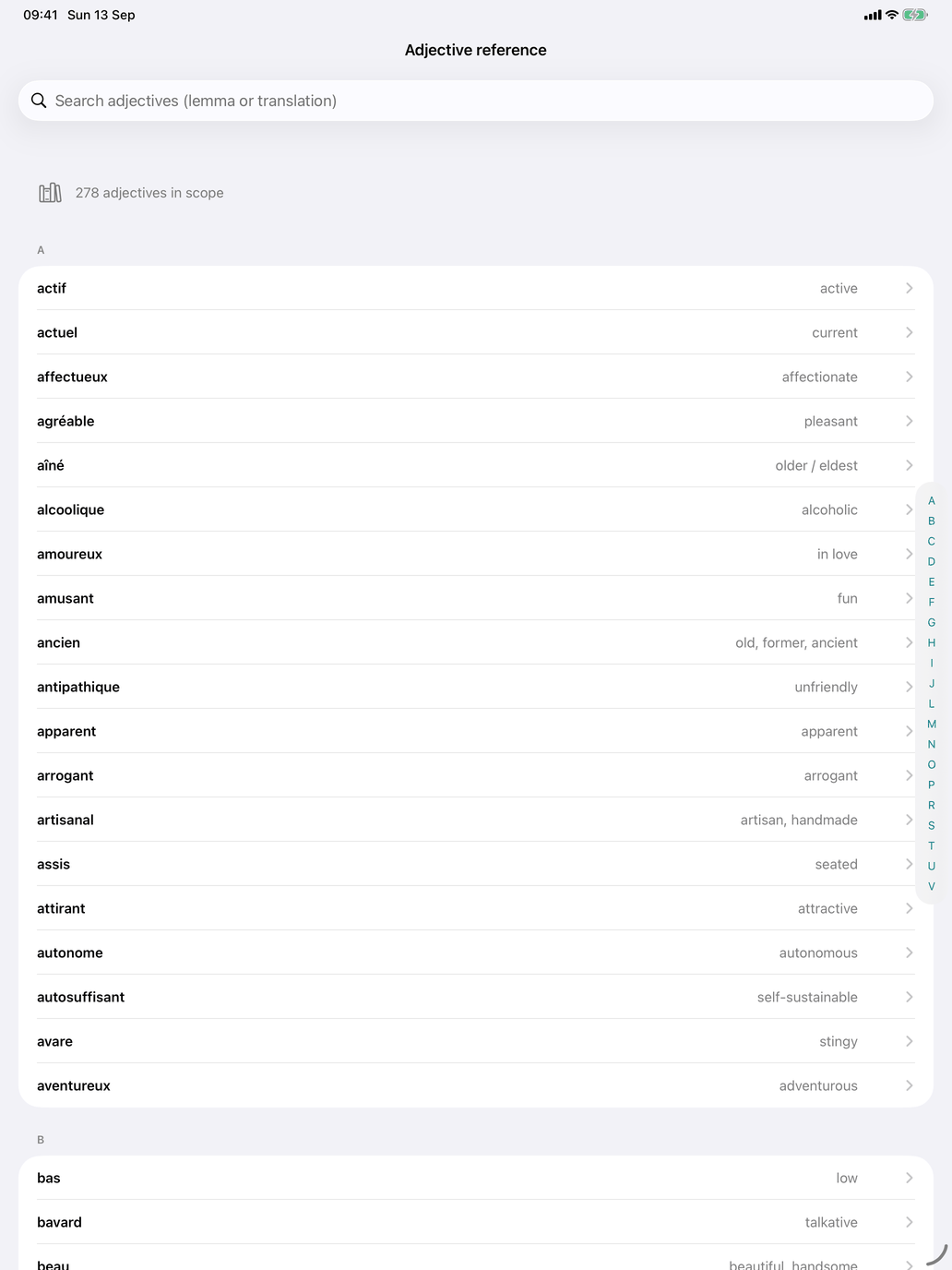
A browse-only list of the adjectives in your selection with their translations, in alphabetical order with a search field. Nothing is recorded.
Tap an adjective to open its page:
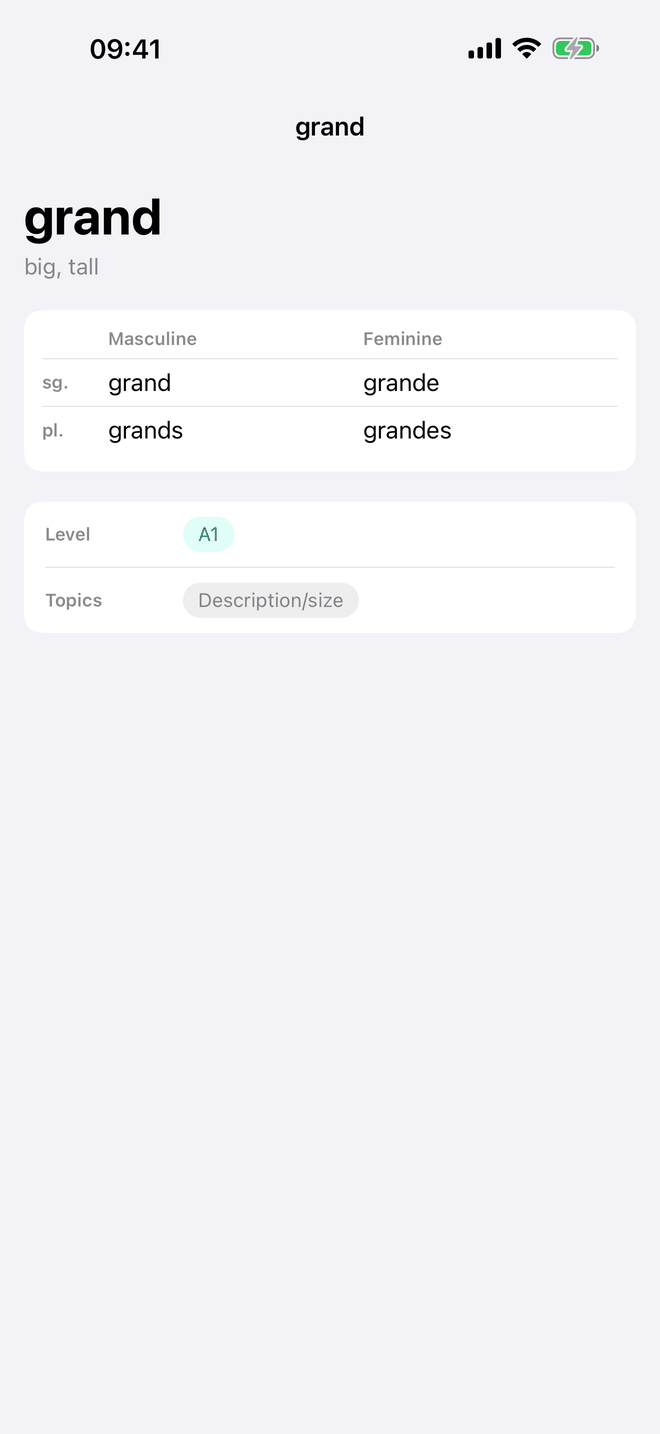
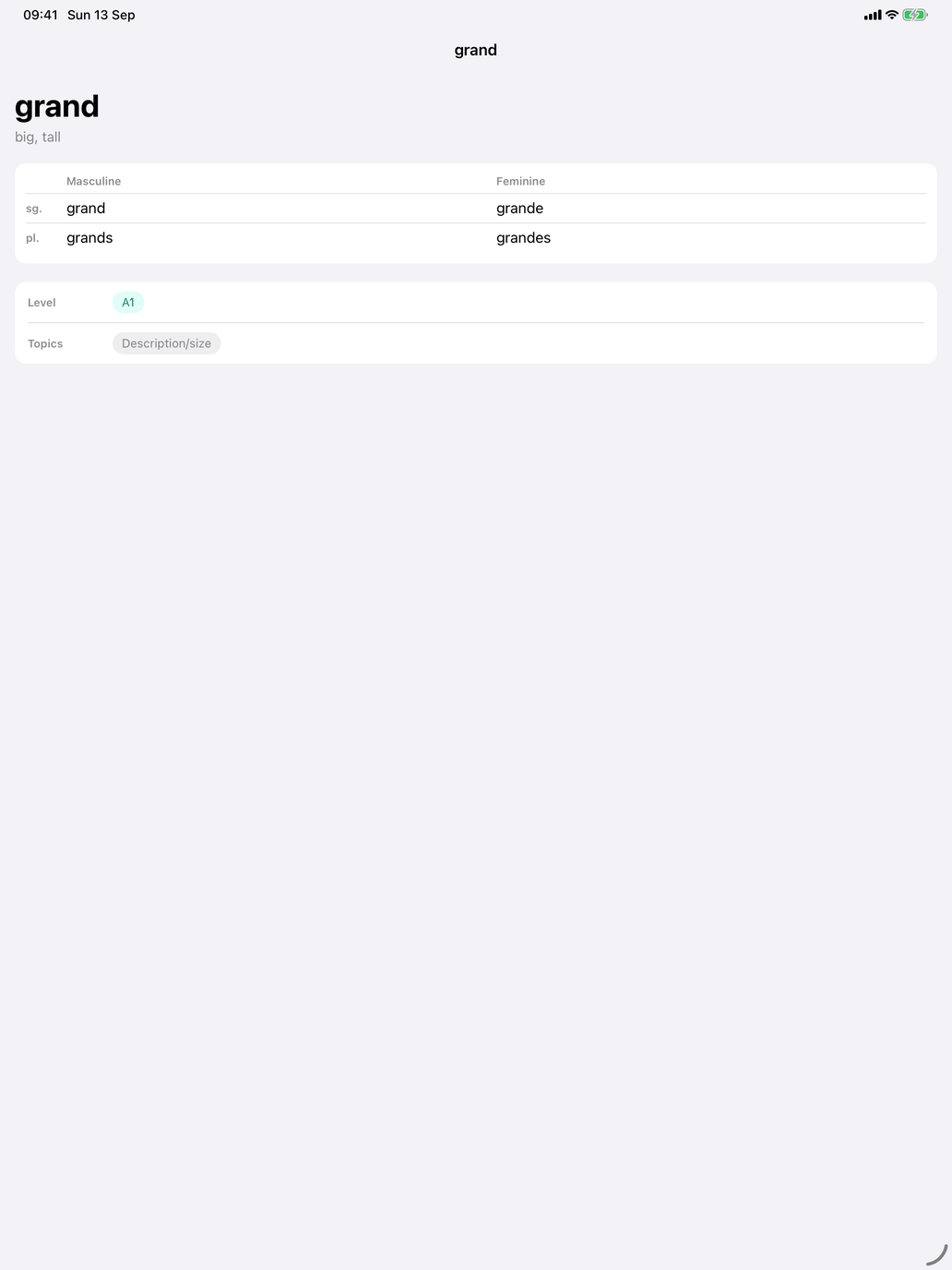
- the adjective and its translation
- its four forms in a grid (masculine and feminine, singular and plural)
- its Level and Topics
Adjective meaning
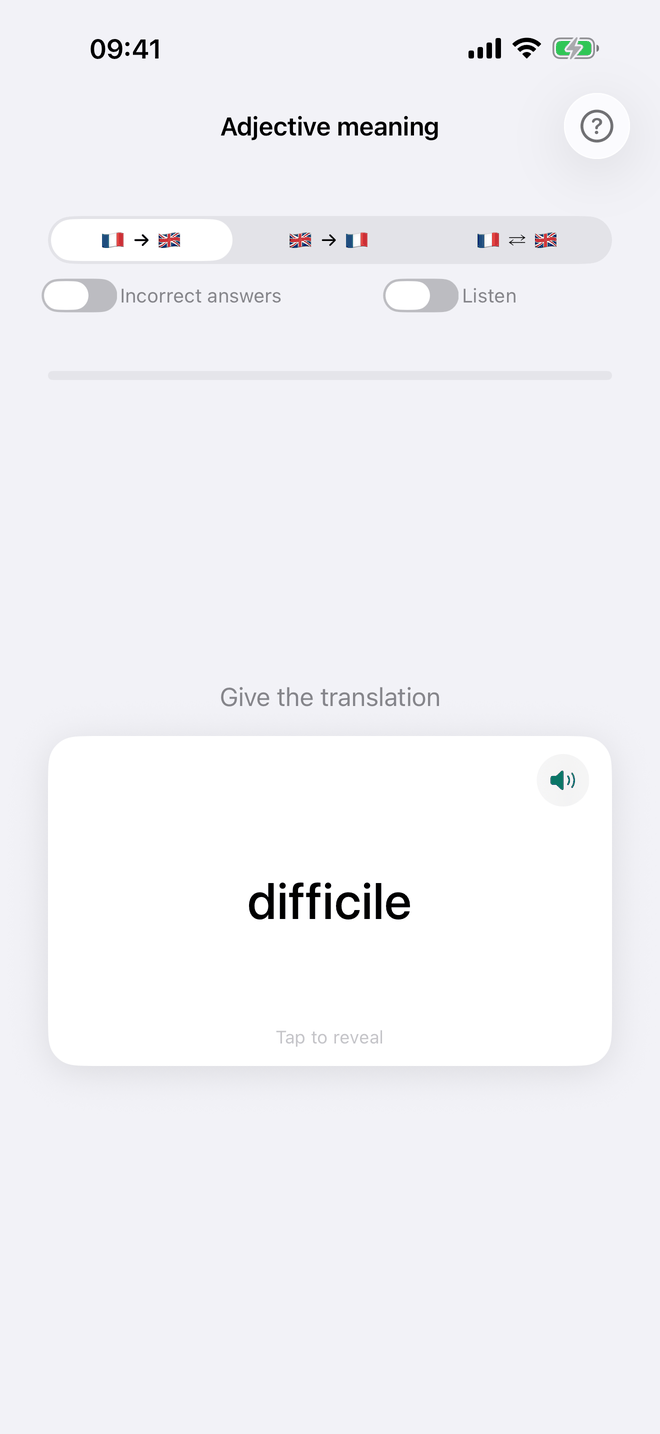
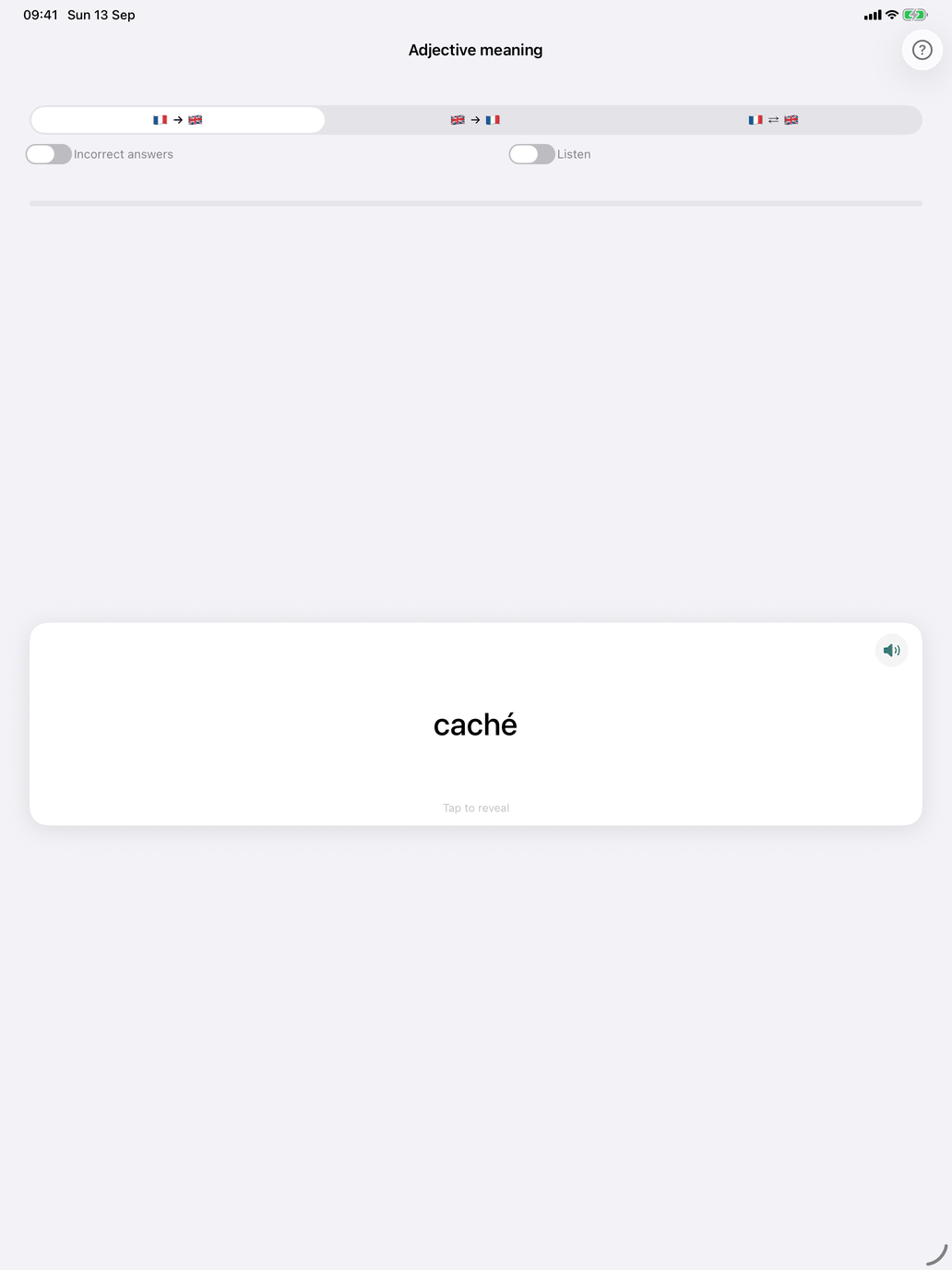
A flashcard deck for the meaning of the selected adjectives, in either direction. It works like Noun meaning. Every answer is recorded.
Agreement drill
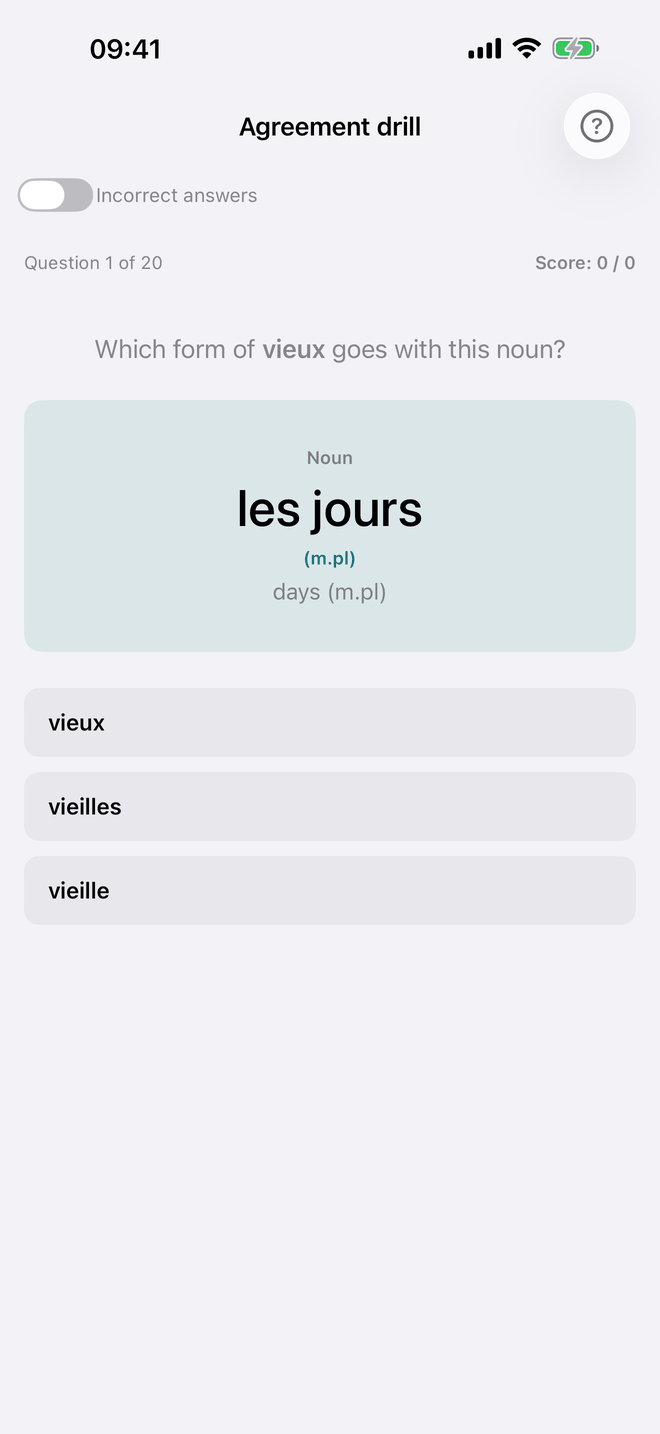
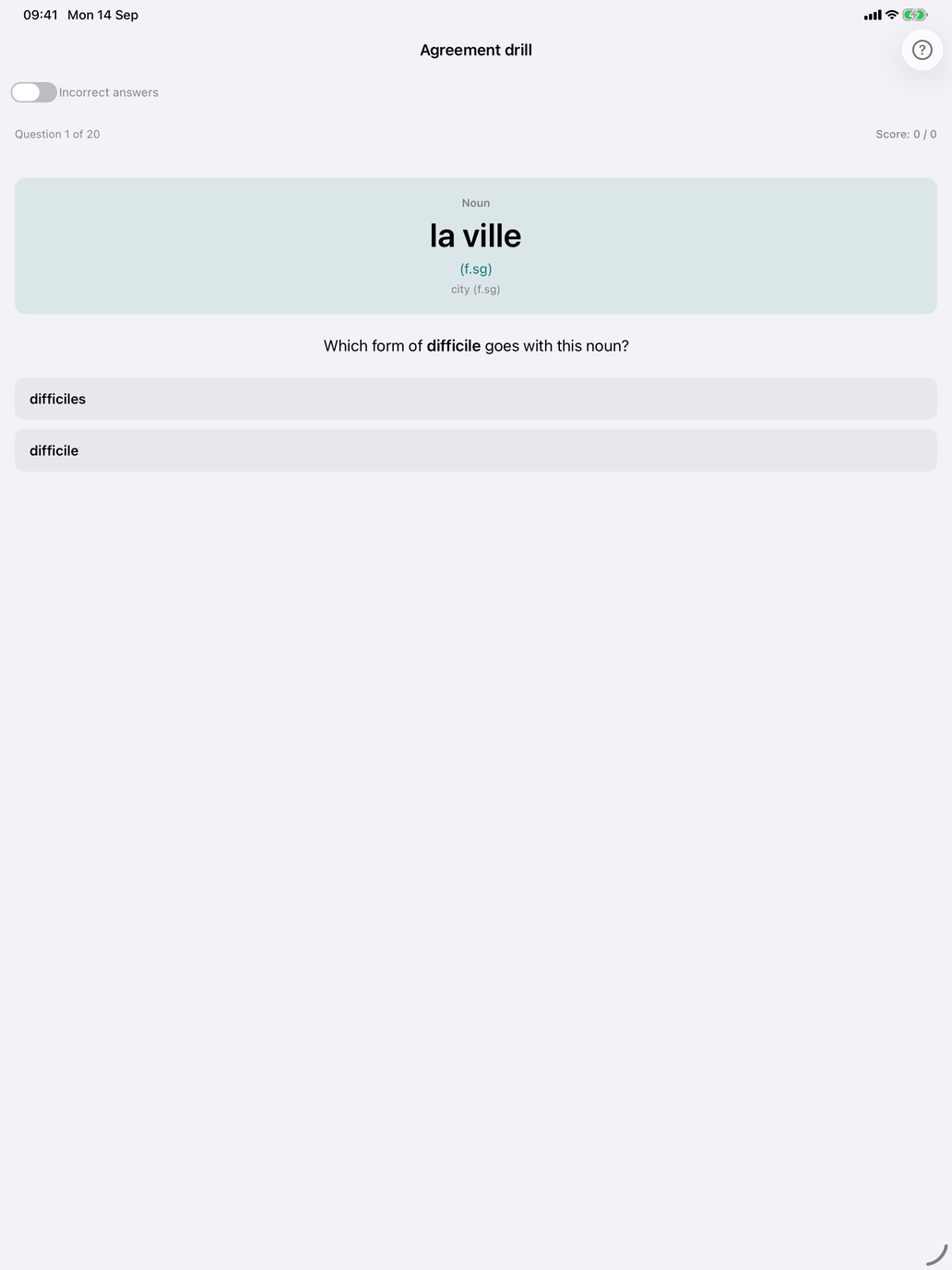
Each question shows a noun with its article, its gender and number, and its translation — for example la maison (f.sg), "house". Above it the app asks Which form of grand goes with this noun? Tap one of the adjective's forms (an invariable adjective offers fewer, because some forms are the same). The right answer is marked with a tick, a wrong choice with a cross; tap Next question to go on.
The adjectives come from your selection. Answers are recorded per adjective, so the ones you miss come back more often. The session length follows Questions per session (at most 50 with ∞).