Pronouns and numerals
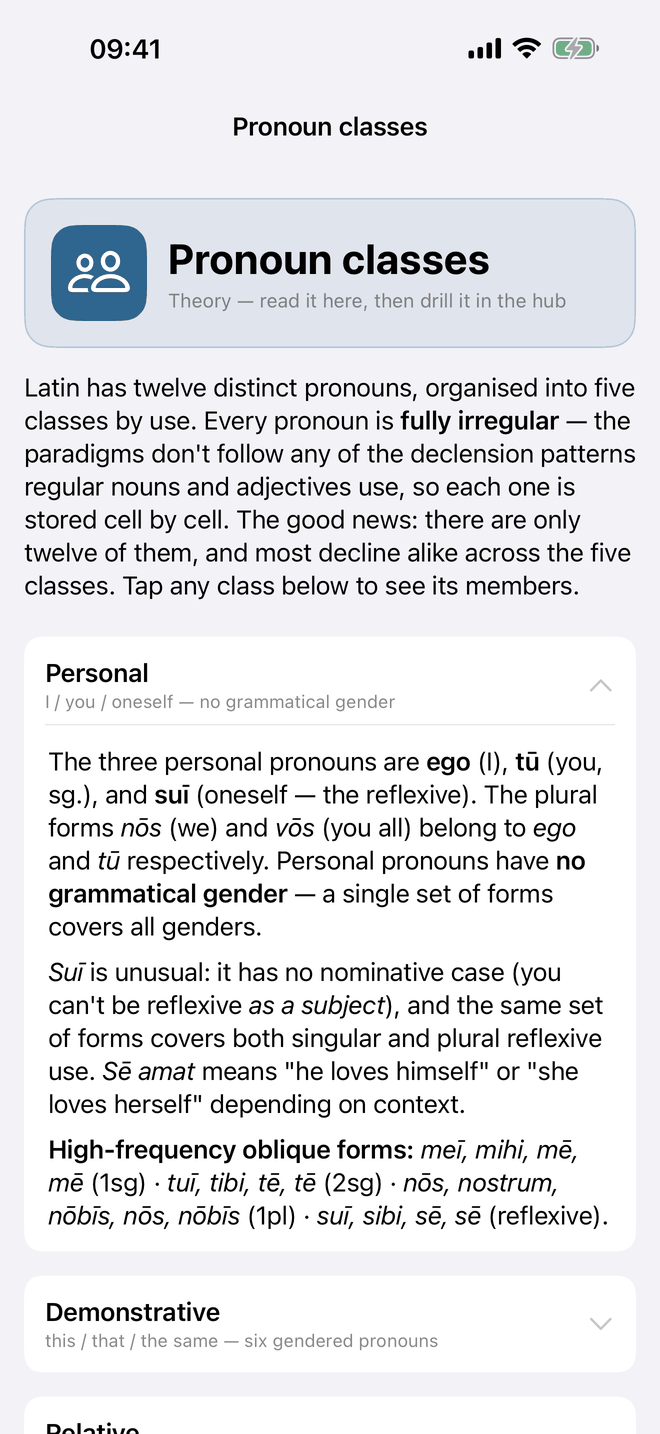
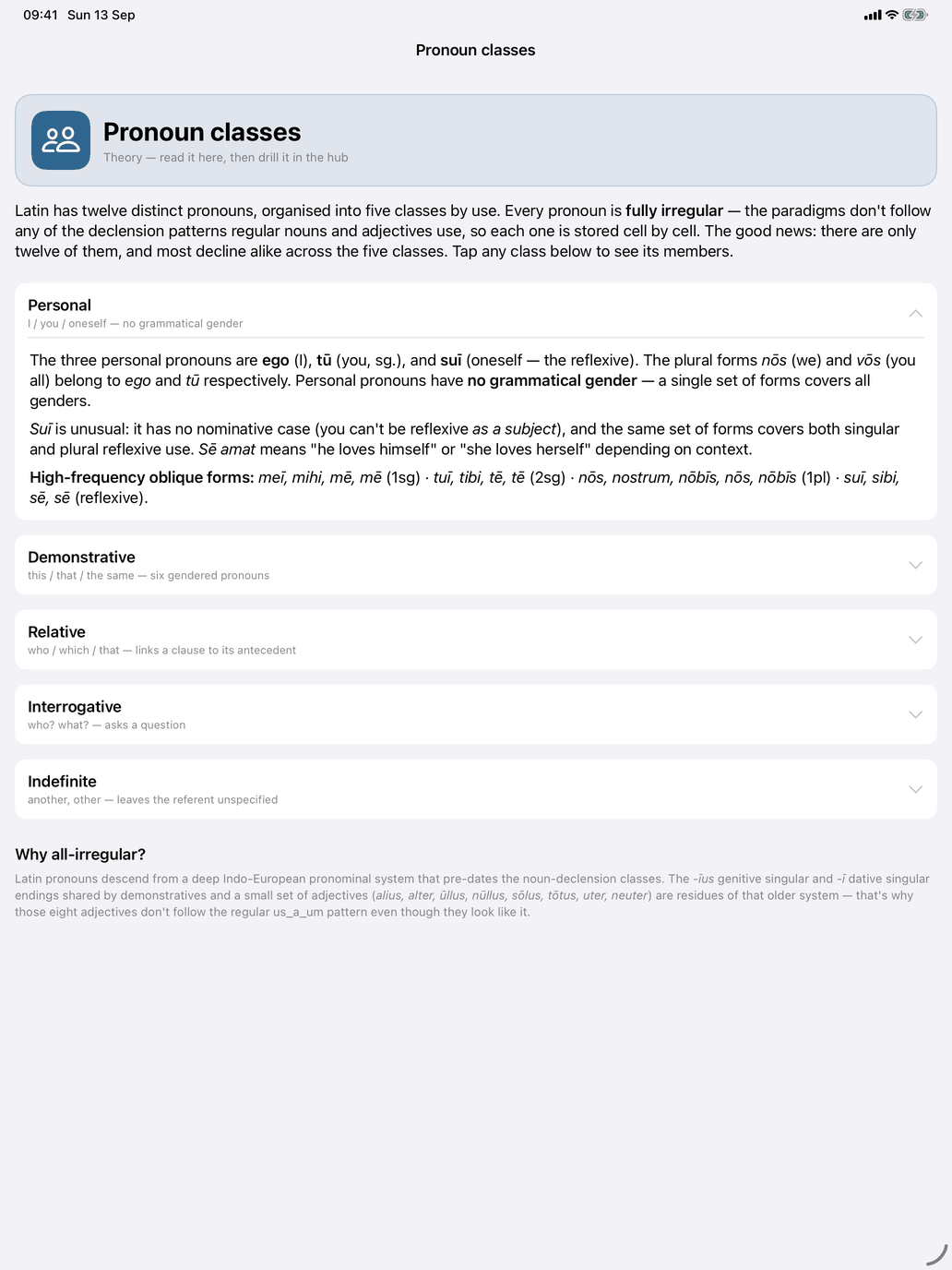
Pronouns and numerals each have their own tile on the Self Study screen, next to Verbs, Nouns and Adjectives. Each opens a hub with the usual Setup, Theory, Study and Drills sections.
Pronouns
Latin has twelve pronouns in five classes:
- Personal: ego, tū, suī (reflexive)
- Demonstrative: is, hic, ille, iste, ipse, īdem
- Relative: quī
- Interrogative: quis
- Indefinite: alius
Latin pronoun forms don't follow the regular declension patterns, so every form is stored individually rather than generated by the declension engine.
The Pronouns hub has these screens:
- Select pronoun groups (Setup): tick the classes you want to practise. Tap ⓘ on a class to read about it and see its pronouns. The hub shows how many of the twelve are selected.
- Pronoun classes (Theory): one card for each class, and a closing note on why the pronouns are irregular.
- Pronoun reference (Study): the selected pronouns, grouped by class. Tap one to see its full table of case, number and gender (case and number only for ego, tū and suī, which have no gender).
- Pronoun meaning (Drills): flashcards for the meaning of each pronoun.
- Form drill (Drills): you see a pronoun and a case, number and gender (Genitivus · Singularis · Masculinum), and choose the right form from four. The three wrong options are other forms of the same pronoun (eī, eius, eum), because those are the ones you are most likely to confuse. The vocative is never asked.
Numerals
Latin has 29 cardinal numbers: 1 to 20, the tens from 30 to 100, and mīlle. Ūnus, duo and trēs decline, and their detail screens show a full table. Ūnus has only singular columns, and duo and trēs only plural. The other 26 are indeclinable, and their detail screens show a card with the single form.
The Numerals hub has these screens:
- Select numeral groups (Setup): tick the ranges 1 – 10, 11 – 20, 21 – 100 and 1000 (mīlle). Tap ⓘ on a range to see its numerals.
- Numeral system (Theory): the declinable 1, 2 and 3, the indeclinable 4 to 100, mīlle and mīlia, and the ordinals (prīmus, secundus, tertius…, which decline like bonus). The ordinals are explained on this page but are not in the numeral list.
- Numeral reference (Study): the selected numerals in order of value. The three that decline are marked declined.
- Numeral meaning (Drills): flashcards with the number in figures on the front and the Latin on the back.