Declensions
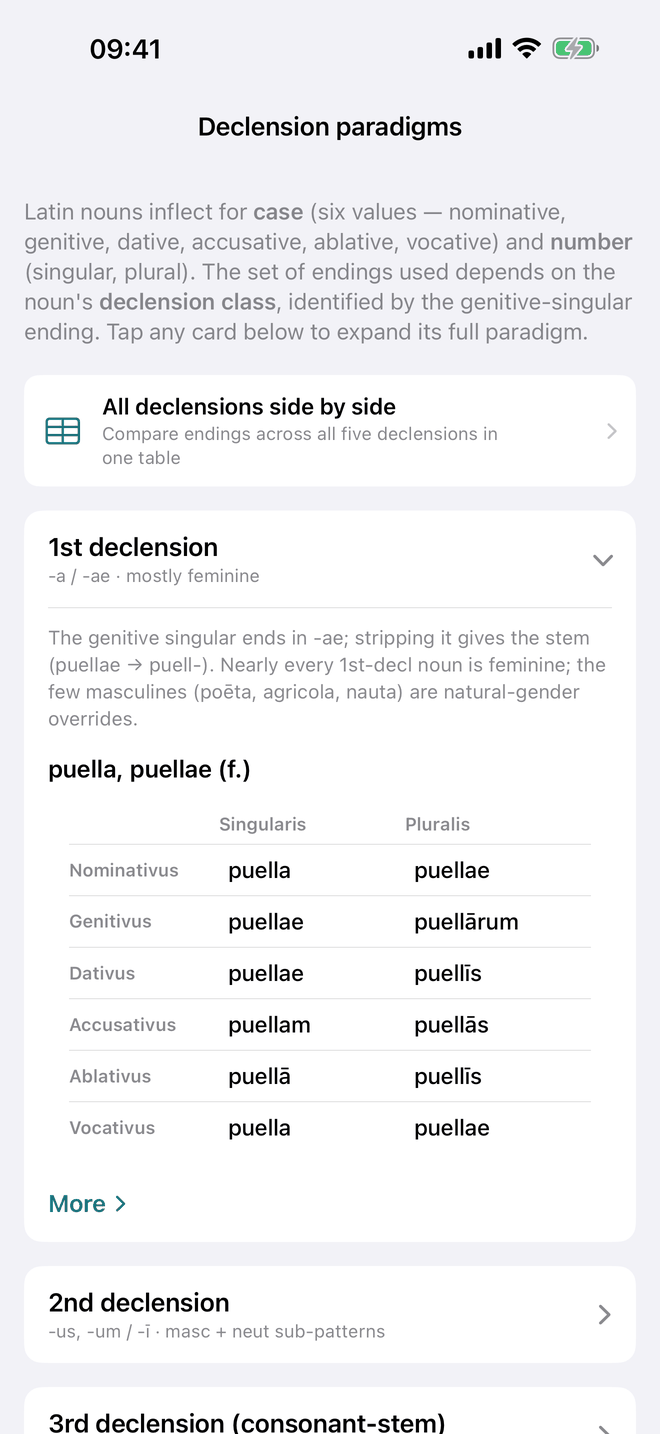
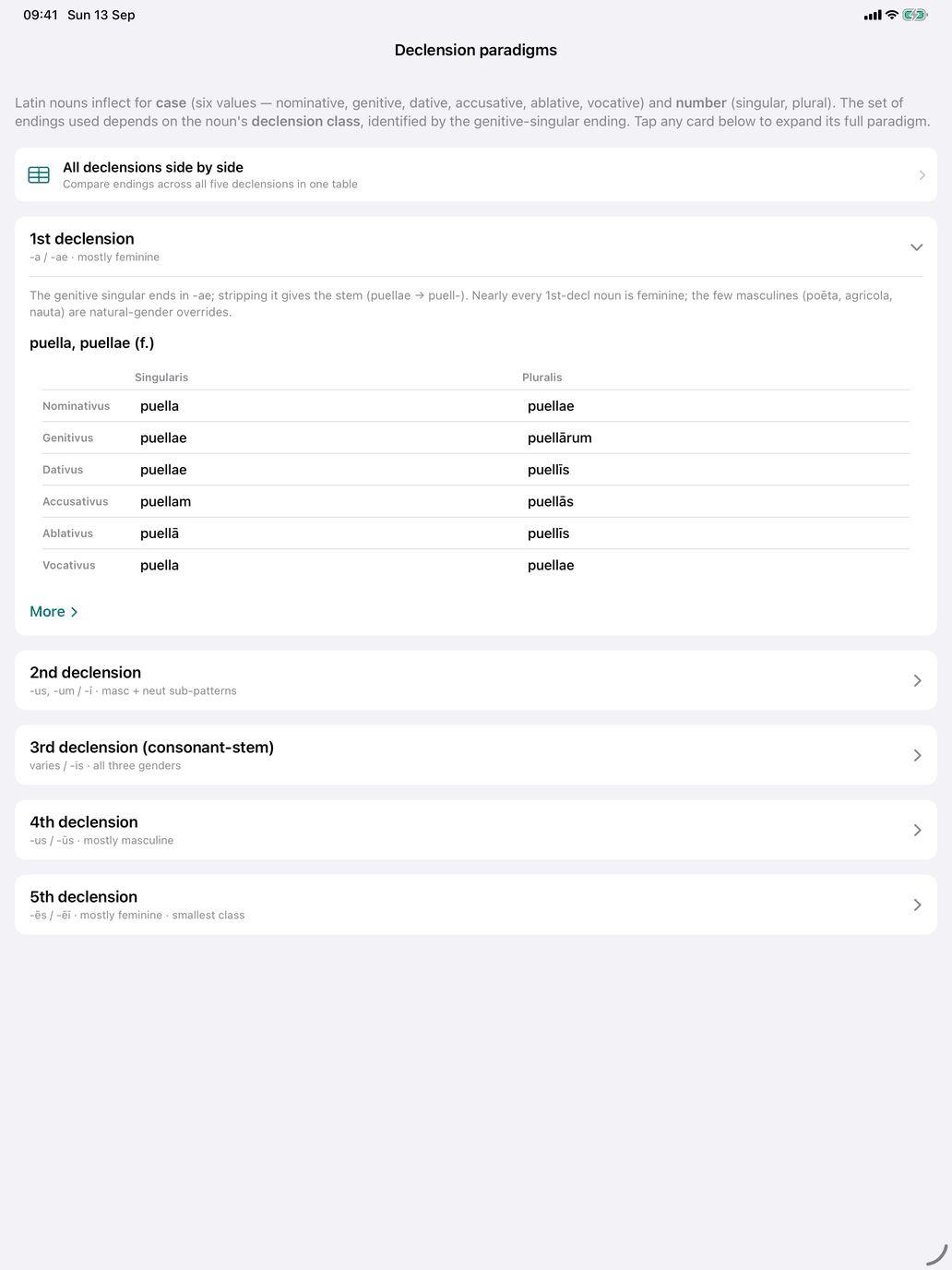
Every Latin noun belongs to one of five declensions, identified by the genitive singular ending. LinguaMorpha uses the declension as the main way to choose which nouns you practise.
| Declension | Gen. sg. | Typical gender | Examples | Nouns in the app |
|---|---|---|---|---|
| 1st | -ae | feminine (a few masculines: agricola, nauta, poēta) | rosa, puella, aqua | 141 |
| 2nd | -ī | masculine or neuter (with an -er sub-pattern) | servus, bellum, puer | 172 |
| 3rd | -is (the nominative varies) | all three genders | rēx, urbs, mare | 214 |
| 4th | -ūs | mostly masculine (manus, domus feminine; cornū, genū neuter) | exercitus, frūctus | 35 |
| 5th | -ēī (-eī after a consonant) | almost all feminine (diēs masculine) | diēs, rēs, fidēs | 7 |
Two further nouns, vīs and Iuppiter, have their own Irregular group (see Selecting Declensions). That makes 571 nouns in total.
The engine generates the forms of the regular nouns from the lemma, the genitive and the gender. That includes the i-stem variants of the 3rd declension (genitive plural -ium, as in urbium; neuter ablative singular -ī and plural -ia, as in marī, maria), the 2nd-declension -er nouns (puer, ager, magister), and the 4th-declension neuters (cornū, genū). Nouns with irregular cells, such as deus, domus and bōs, have those forms stored individually.
Open Self Study → Nouns to reach the nouns hub. It has four sections:
- Setup — Select noun groups: choose the declensions to practise. See Selecting Declensions.
- Theory — Declension paradigms: the five declensions with worked examples. See Declension Paradigms.
- Study — Noun reference: browse the nouns you have selected, with their translations, full paradigms and example sentences.
- Drills — Noun meaning (self-judged meaning flashcards), Decline the noun (production) and Recognise the form (recognition).
The line under the hub title shows how many nouns your current selection gives you, e.g. "141 of 571". It turns red when the selection is empty.