Numerals
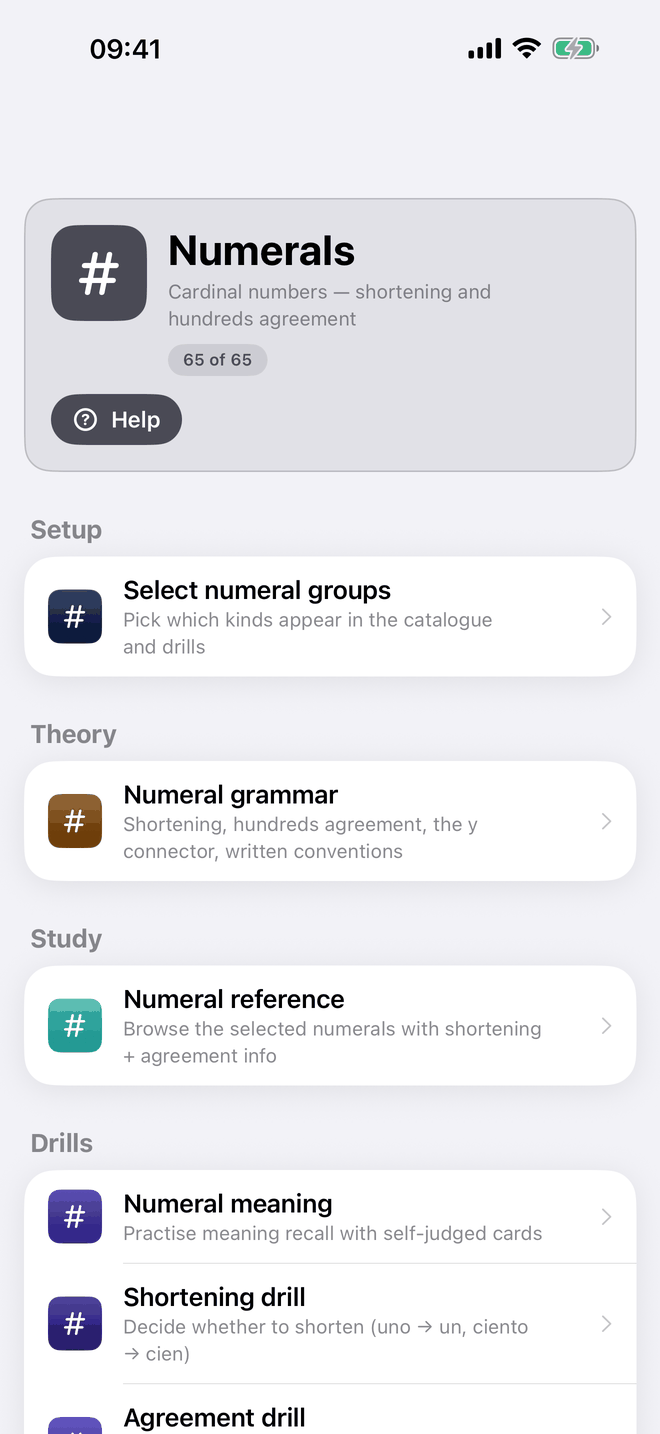
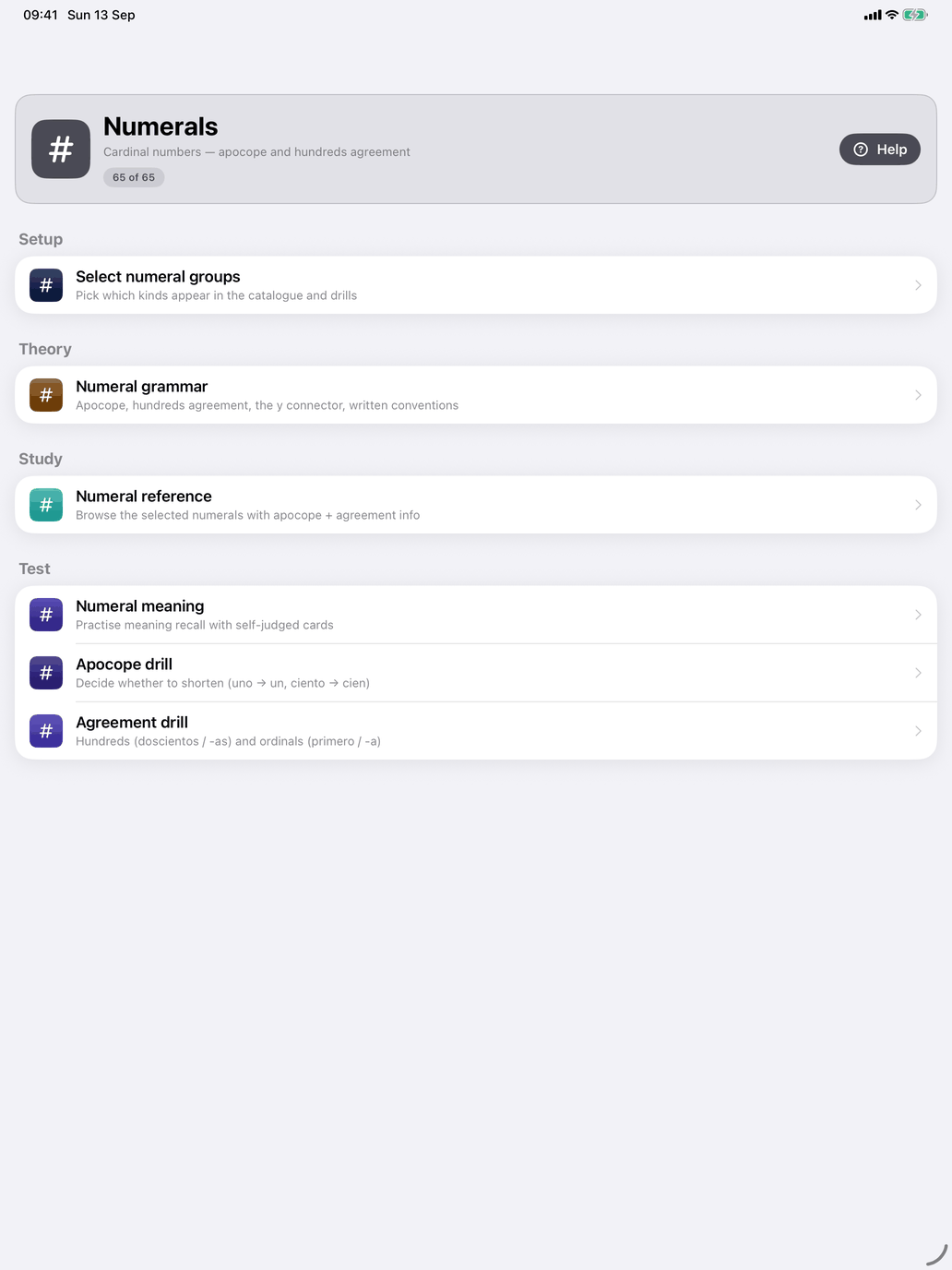
Open the Numerals hub from the Numerals tile on the Self Study screen. The Spanish catalogue has 65 numerals of five kinds:
| Kind | Examples | Numerals |
|---|---|---|
| Cardinal | uno, dos, tres … cien, mil, millón | 39 |
| Ordinal | primero … décimo | 10 |
| Collective | par, docena, decena, centena | 8 |
| Multiplicative | doble, triple, cuádruple | 4 |
| Fractional | medio, tercio, cuarto, quinto | 4 |
The badge under the title shows how many numerals your selected kinds contain. The level and topics in Select word scope do not narrow this hub.
The hub has these screens:
- Select numeral groups (Setup): tick the kinds you want. Tap ⓘ on a kind for an explanation and its numerals.
- Numeral grammar (Theory): the five kinds, then shortening, agreement of the hundreds, the y between tens and units, and how numbers are written.
- Numeral reference (Study): the selected numerals.
- Numeral meaning, Shortening drill and Agreement drill (Drills).
Numeral grammar
- Shortening (apocope): uno becomes un before a masculine noun (un libro), also at the end of a larger number (veintiún libros, treinta y un libros). The feminine keeps its full form: veintiuna casas. Ciento becomes cien before any noun (cien libros, cien casas) and before mil. Primero and tercero become primer and tercer before a masculine singular noun: el primer día, but la primera vez.
- Agreement of the hundreds: 200 to 900 change for gender: doscientos libros, doscientas casas. This also applies inside larger numbers: doscientas cincuenta casas. Ordinals change like adjectives: primero, primera, primeros, primeras.
- The y connector: y stands only between tens and units from 31 to 99: treinta y uno. 16 to 29 are written as one word (dieciséis, veintidós), and there is no y after the hundreds: doscientos cincuenta.
- Written conventions: Spanish writes a decimal comma (3,14) and uses a point or a space to group thousands. Dates are written 31 de diciembre de 2024.
The kinds each have their own section. Collectives take de: una docena de huevos. Fractions above ten use -avo: un onceavo. Medio changes for gender: media hora.
Numeral reference
The selected numerals, grouped by kind, with a search field. Tap a kind heading to open or close it. The search also finds a numeral by its value, so 12 finds doce. The picker at the top sorts By value or Alphabetical. A numeral with forms or a short form is shown with them, such as uno, -a, -os, -as (un). Tap a numeral to open its page. It shows the value and, where there is one, the short form used before a masculine singular noun.
Numeral meaning
Flashcards for the meaning of each numeral. The card shows the numeral as it appears in the reference, short form included, and you recall the translation (one, hundred). The speaker reads only the numeral itself. See Word meaning for how the flashcards work.
Shortening drill
This drill uses uno, veintiuno, primero and tercero. You see a noun with its gender and number, such as casa (house (f.sg)), and the task "Which form of uno goes with this noun?". Pick the right form from the numeral's forms (un, una, unos, unas). Ciento is not in this drill. See How the choice drills work under Adjectives.
Agreement drill
This drill uses the numerals that change for gender: the hundreds, the ordinals, uno and veintiuno. You see an English sentence, such as "There are 200 houses." or "It is the third page.", and a Spanish sentence with a gap: Hay ___ casas. or Es la ___ página. Choose the right form (doscientas, tercera). A Dutch display language gives the sentence in Dutch.
Recommended workflow
- Start with only the Cardinal kind.
- Run Numeral meaning until the number words are familiar.
- Add the Ordinal kind, then the Shortening drill and the Agreement drill.