Select verb groups
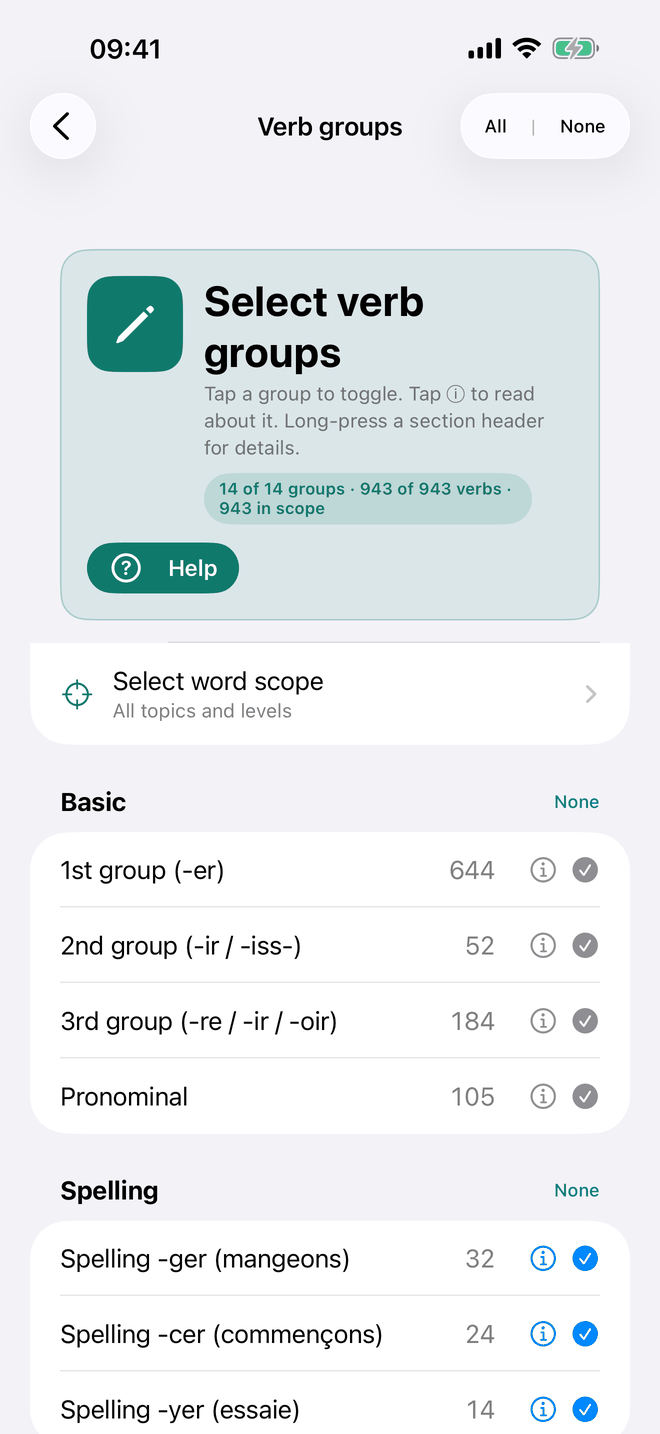
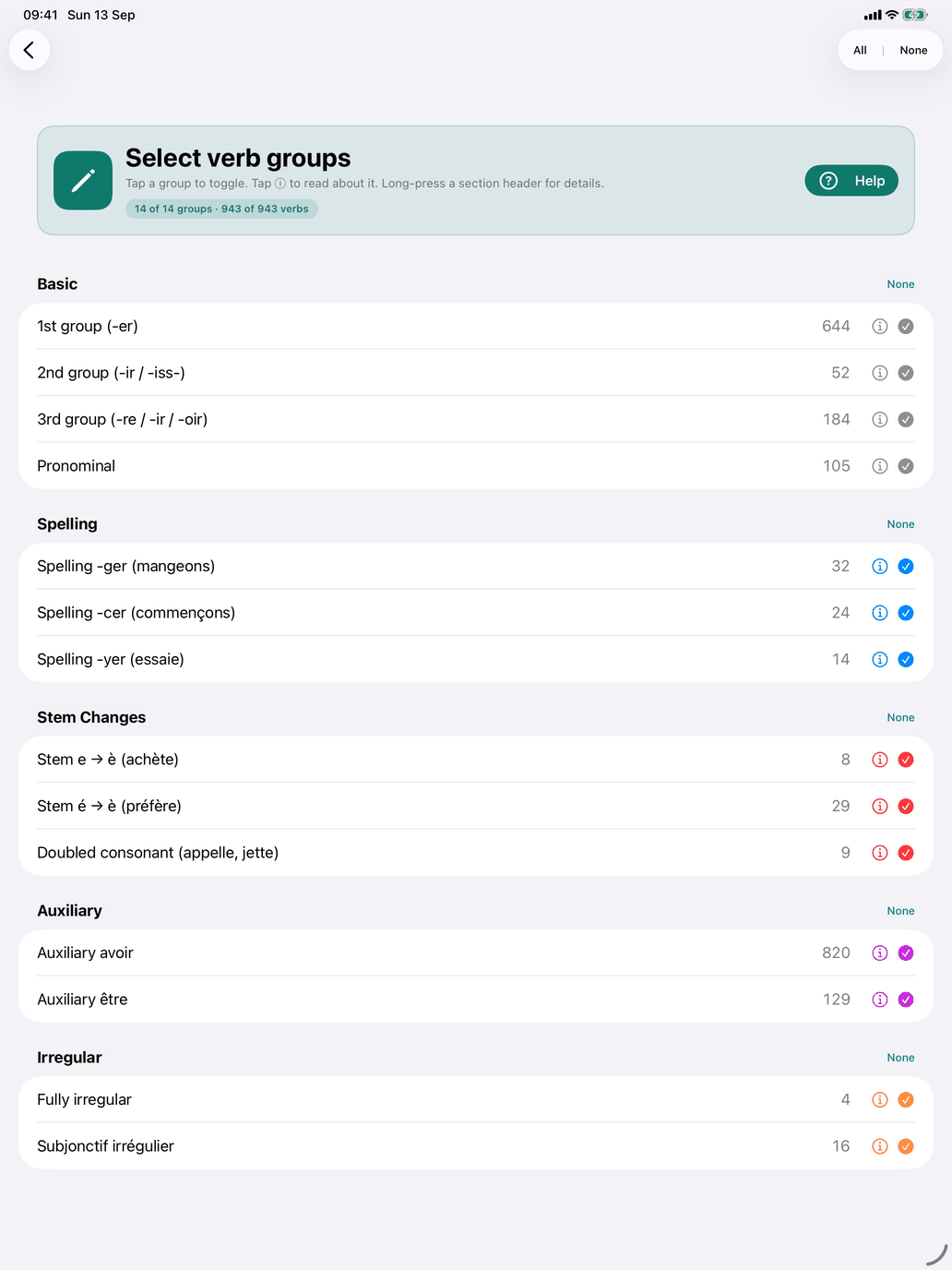
Select verb groups chooses which verbs you practise, by their grammatical character rather than one by one. The screen does not set level or topic: those are global, and the Select word scope row near the top takes you to them. Its second line says All topics and levels or Filtered by topic or level.
The card at the top keeps a running count of what you have chosen, e.g. "14 of 14 groups · … · 212 in scope", with the number of selected verbs in the middle: how many groups are ticked, how many verbs those groups cover in the whole catalogue, and how many of those are left once your word scope is applied. The last number is what the drills draw from.
Tap a row to tick or untick it. Each row shows how many verbs are in the group, and its ⓘ opens the group's card, with an explanation, a worked example and Browse all verbs. Each section header has an All / None button, and All | None at the top right ticks or clears every group at once.
If you leave the screen with nothing ticked, the app warns you ("No verb groups selected") and offers Stay and select or Go back anyway.
The groups
The 14 groups are listed under five sections:
| Section | Groups |
|---|---|
| Basic | 1st group (-er), 2nd group (-ir / -iss-), 3rd group (-re / -ir / -oir), Pronominal |
| Spelling | Spelling -ger (mangeons), Spelling -cer (commençons), Spelling -yer (essaie) |
| Stem Changes | Stem e → è (achète), Stem é → è (préfère), Doubled consonant (appelle, jette) |
| Auxiliary | Auxiliary avoir, Auxiliary être |
| Irregular | Fully irregular, Subjonctif irrégulier |
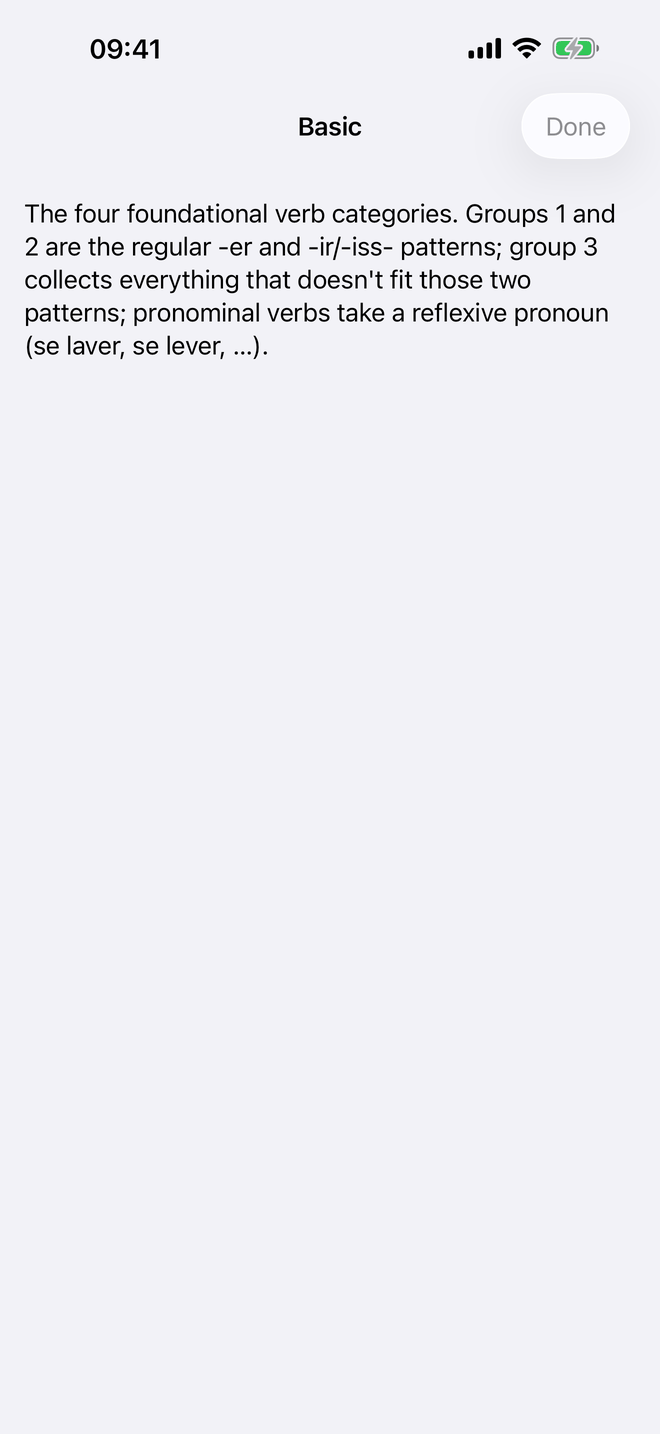
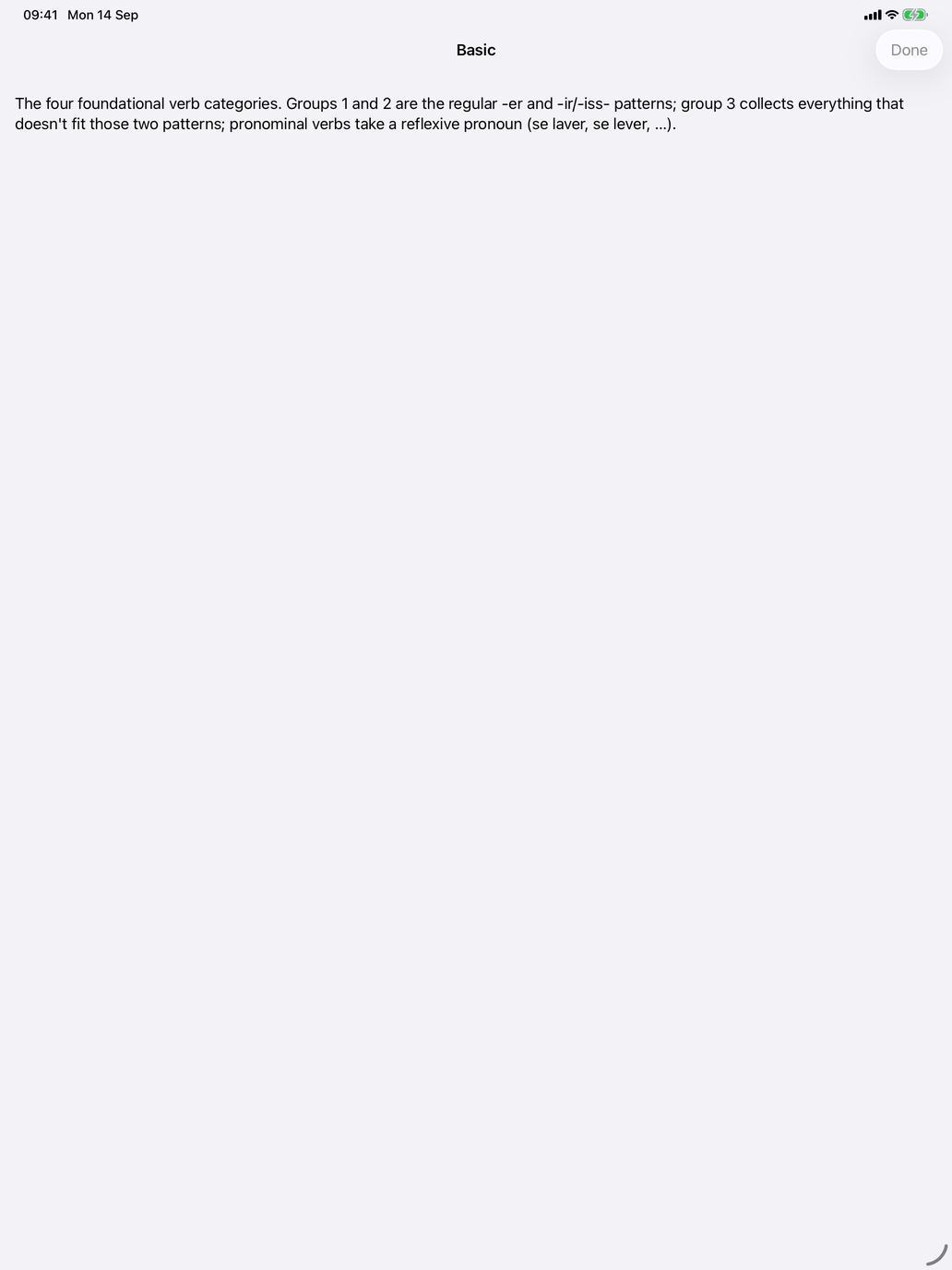
Long-press a section header (on the Mac, press and hold) for an explanation of the whole section.
Some things to know about the groups:
- 1st group (-er) and 2nd group (-ir / -iss-) hold the verbs that follow their group's pattern without stored exceptions. A 1st-group verb with a stem change, such as acheter, is in its stem-change group instead. A verb with only a spelling adjustment, such as manger, is in both 1st group (-er) and its spelling group.
- 3rd group (-re / -ir / -oir) holds every 3rd-group verb except the ones in Fully irregular.
- Pronominal holds the verbs listed with se (se lever, se souvenir).
- Auxiliary avoir and Auxiliary être sort verbs by the auxiliary they take in the compound tenses. Every verb is in at least one of them, and the few verbs that take either (monter, descendre, sortir, passer, retourner, ressortir) are in both.
- Subjonctif irrégulier holds the verbs whose subjonctif présent cannot be built from their present tense (aller → que j'aille).
A verb usually belongs to more than one group, and it is in your pool when any of its groups is ticked. Parler, for example, is in 1st group (-er) and in Auxiliary avoir. So ticking Auxiliary avoir on its own already selects almost the whole catalogue. To study one pattern, untick the two auxiliary groups.
Seeing which verbs you ended up with
This screen chooses patterns; it does not list the verbs they match. To see the resulting pool, open Verb reference on the verbs hub.