Passé composé or imparfait
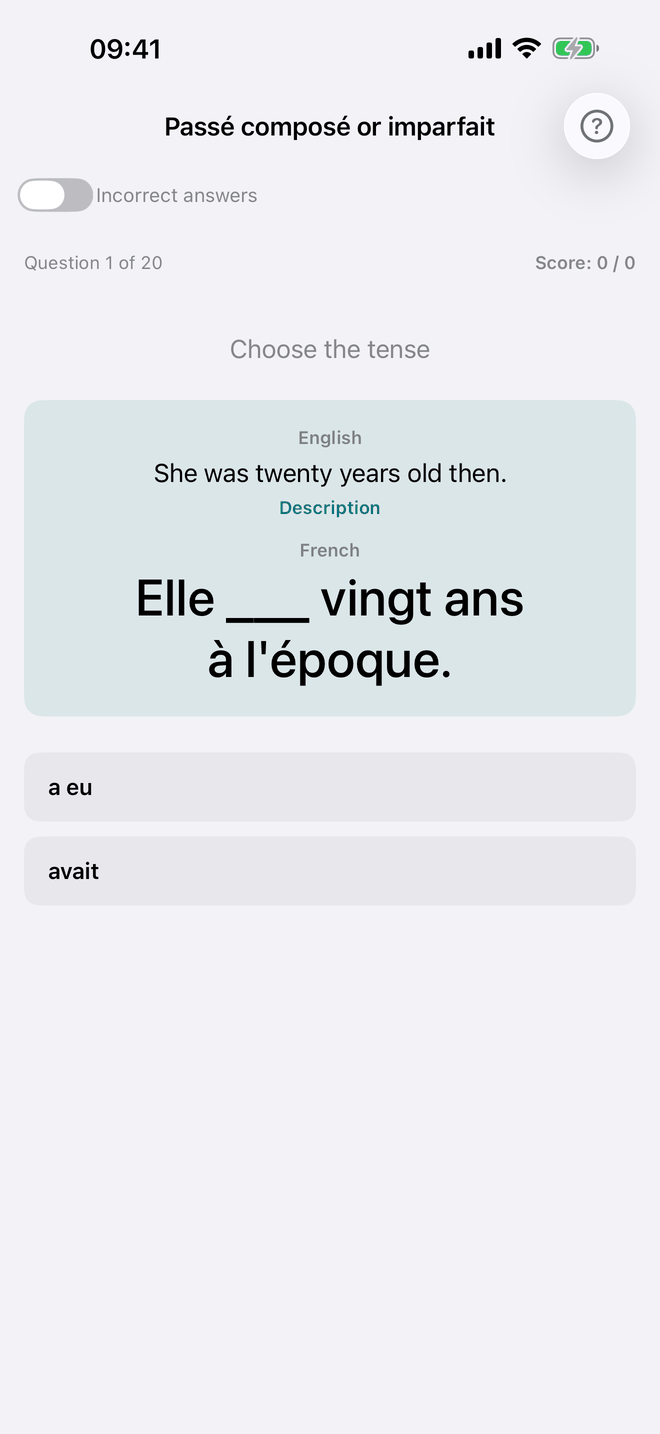
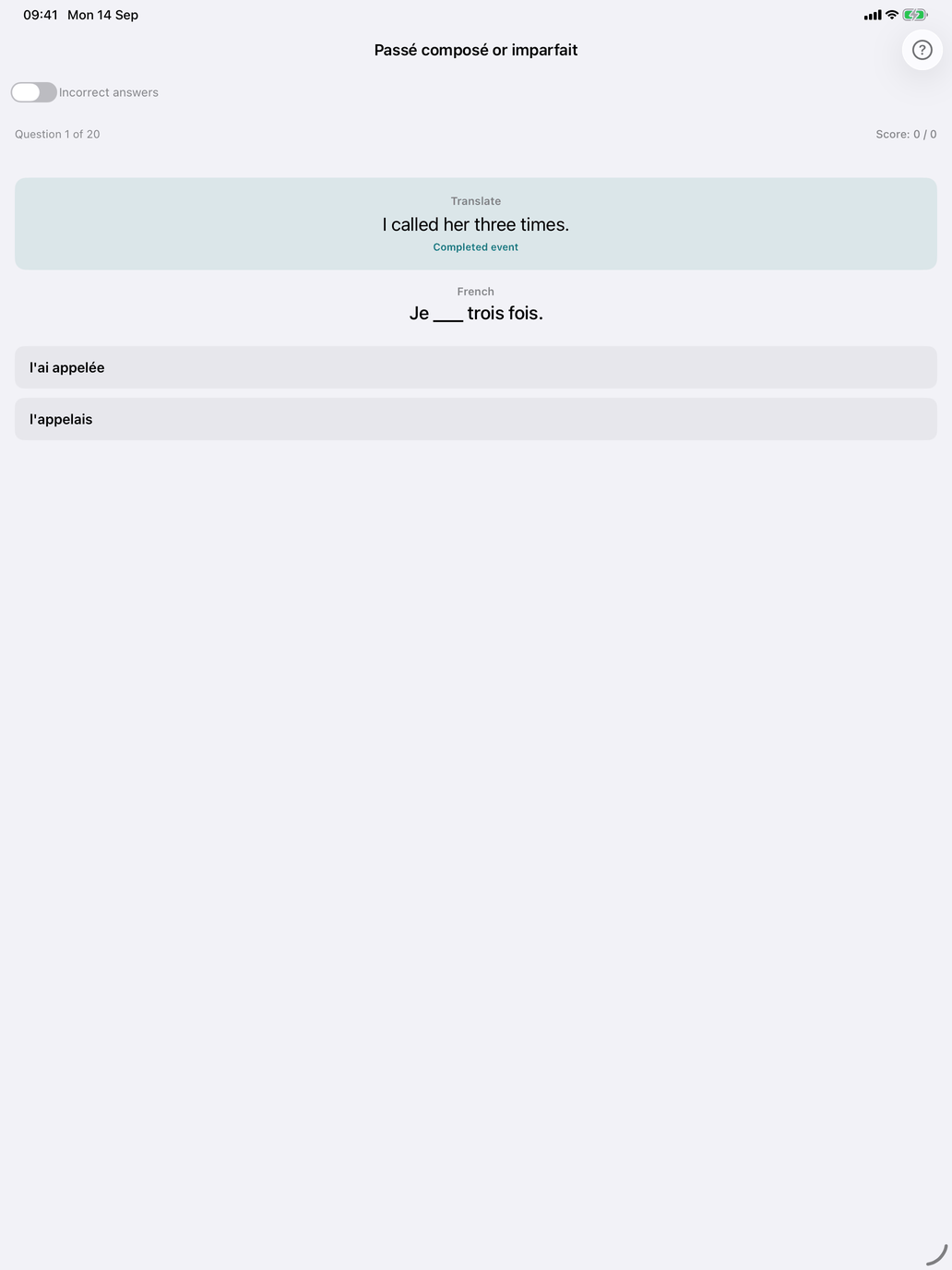

Spoken French has two everyday past tenses, the passé composé and the imparfait. The choice between them is not about when something happened but about how you look at it: as a completed event, or as something ongoing, habitual or in the background. The conjugation drills tell you which tense to use; this drill asks you to choose it.
How a question looks. Under the instruction "Choose the tense", the card shows the sentence in your language, with a badge naming the principle at work. Below it comes the French sentence with a gap:
While I was reading, the telephone rang. Interruption French: Pendant que je lisais, le téléphone ___.
The two options are the same verb in the two tenses (a sonné / sonnait). Tap one: it fills the gap, the right answer gets a tick, and a card explains the choice ("Why a sonné?"). Read it even when you were right. Then tap Next question; after the last one, See results.
The three kinds of question.
- A time marker points the way. Hier, l'été dernier, tout à coup and a counted number of times (trois fois) go with the passé composé (Completed event). Quand j'étais enfant, toujours, tous les matins and English "used to" go with the imparfait (Habitual / ongoing). Descriptions, the weather, clock time and age in the past take the imparfait (Description).
- A scene and an event. Pendant que je lisais, le téléphone a sonné. The imparfait sets the scene (Backdrop); the passé composé is the event that cuts into it (Interruption). A series of events is told in the passé composé (Chain of events). A period with clear limits is still a completed event: J'ai habité à Paris pendant trois ans (Closed duration).
- The verb changes meaning (Meaning changes). A few verbs mean something different in each tense. The French sentence is the same for both options, so the sentence in your language is your only clue:
| Passé composé | Imparfait |
|---|---|
| j'ai connu — I met | je connaissais — I knew |
| j'ai su — I found out | je savais — I knew |
| il a voulu — he tried | il voulait — he wanted |
| elle n'a pas voulu — she refused | elle ne voulait pas — she didn't want to |
| j'ai pu — I managed to | je pouvais — I was able to |
| j'ai dû — I had to (and did) | je devais — I was supposed to |
| j'ai eu — I got, received | j'avais — I had |
| il y a eu — there was (it happened) | il y avait — there was (it existed) |
What's recorded. Each principle is recorded separately, so a principle you keep missing, such as Backdrop, comes back more often. The Incorrect answers switch limits a session to the principles you have got wrong before.