Noun gender
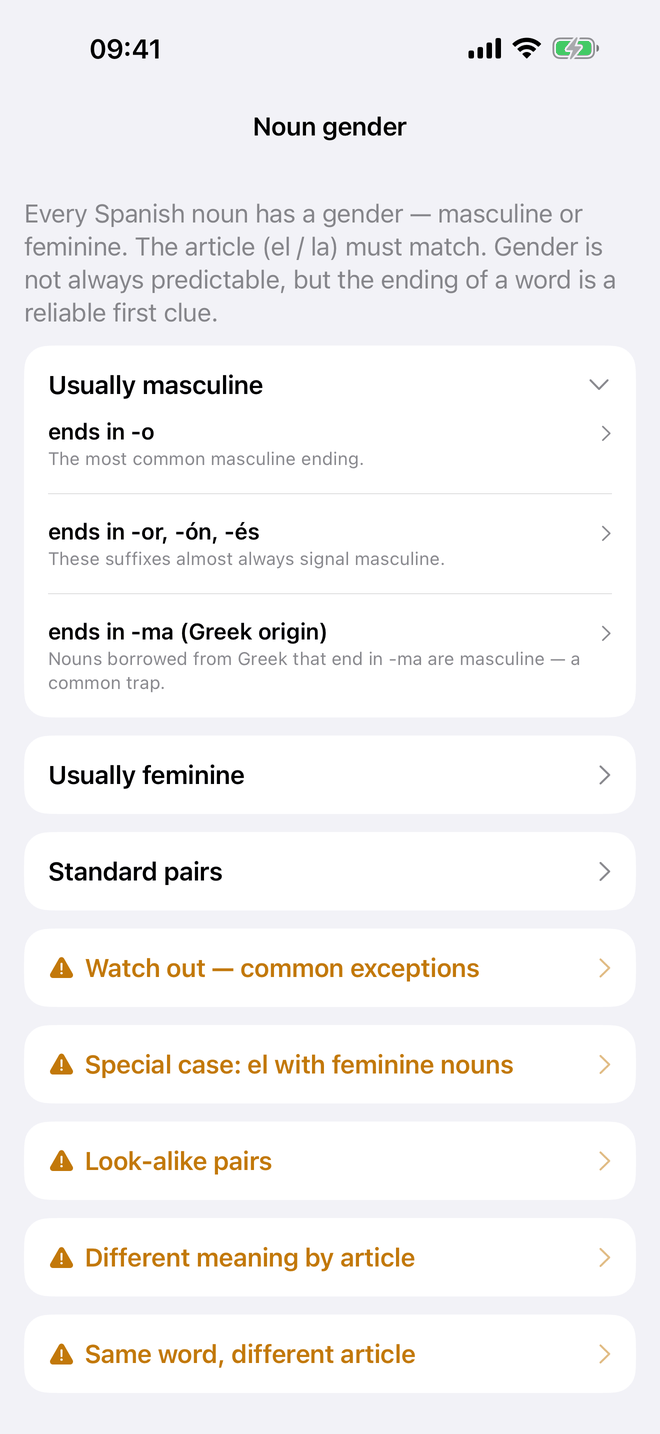
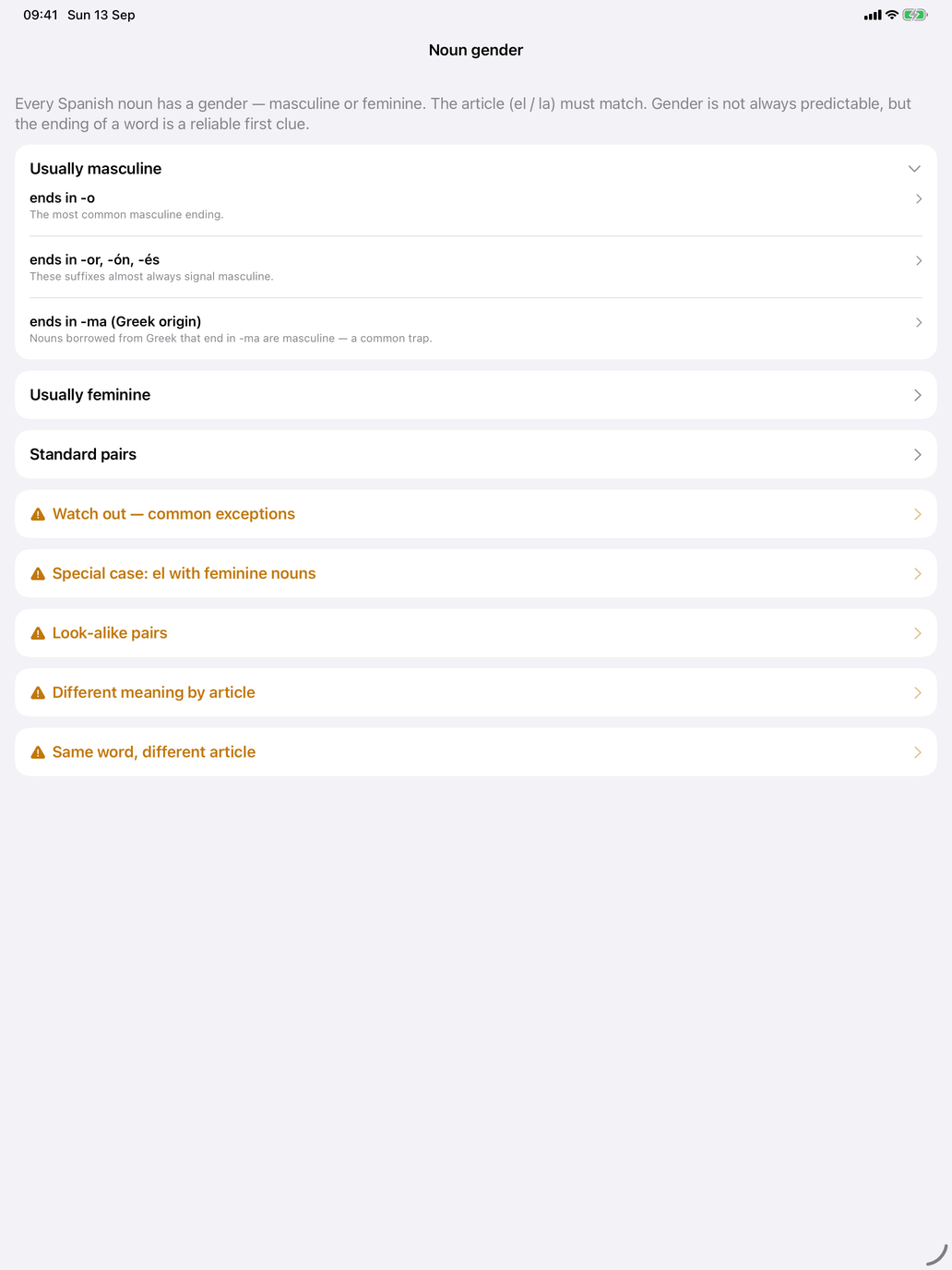
Every Spanish noun is masculine or feminine, and the article (el or la) must match. Gender cannot always be predicted, but the ending of a word is a reliable first clue. Noun gender (in the Theory section of the hub) sets out the rules, then the exceptions.
How the screen works. Each section is a card that opens and closes when you tap its heading. The first section is open when you arrive. Inside a section, tap a rule to show its examples. The examples come from the app's noun catalogue, most common first, with their translations. Only single-word nouns that take an article are used as examples.
The sections, in order
- Usually masculine — ends in -o (el libro); ends in -or, -ón, -és (el color, el avión); ends in -ma of Greek origin (el problema, el tema, el sistema).
- Usually feminine — ends in -a (la casa); ends in -ción / -sión (la canción, la decisión); ends in -dad / -tad / -tud (la ciudad, la libertad, la juventud); ends in -umbre (la costumbre).
- Standard pairs — a masculine and a feminine that are two forms of the same noun, usually differing in the final vowel: el tío · la tía.
- Watch out — common exceptions — -o nouns that are feminine (la mano, la foto, la radio) and -a nouns that are masculine (el día, el mapa, and the Greek -ma nouns such as el problema, el programa, el clima).
- Special case: el with feminine nouns — feminine nouns that begin with a stressed a- or ha- take el in the singular to avoid the clash of sounds with la: el agua → las aguas, el arma → las armas, el hacha → las hachas, el alma → las almas. They are still feminine, so adjectives agree in the feminine (el agua fría).
- Look-alike pairs — these are not gender pairs. They are two separate words that happen to differ only in the final vowel: el puerto (port) and la puerta (door). The -a word is not the feminine of the -o word.
- Different meaning by article — one word, two meanings, and only the article tells them apart (el capital / la capital). See Nouns whose meaning changes with the article.
- Same word, different article — nouns with one form for both genders and the same meaning, most often those ending in -ista or -nte: el / la artista, el / la estudiante.
When the rule isn't enough. For nouns where the ending does not decide the gender — mainly nouns ending in -e or in a consonant (el coche, la calle, el árbol, la flor) — you have to learn the article with the word. Noun meaning always shows a noun with its article, so the gender is part of what you learn from the start.