Spanish
Over 1,100 verbs. Over 1,400 nouns. Sixteen tenses, with the irregular part of every form marked down to the letter.
A complete Spanish study system in its own right. Nothing in this course assumes you know Latin or French — if Spanish is what you came for, you never need to open another language.
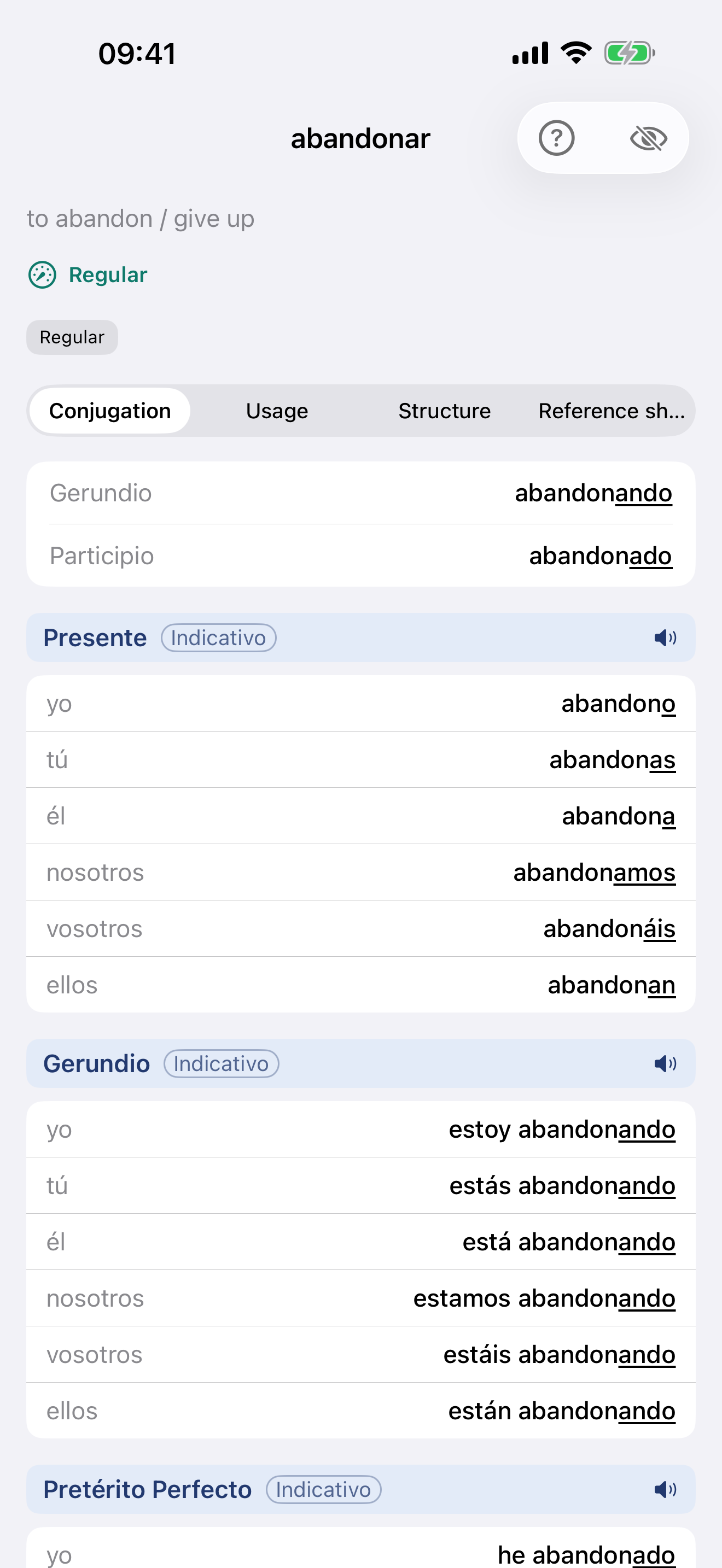 Irregulars marked, not just listed
Red falls only on the part of a form that departs from the regular pattern — so you see exactly where a verb is irregular, and by how much.
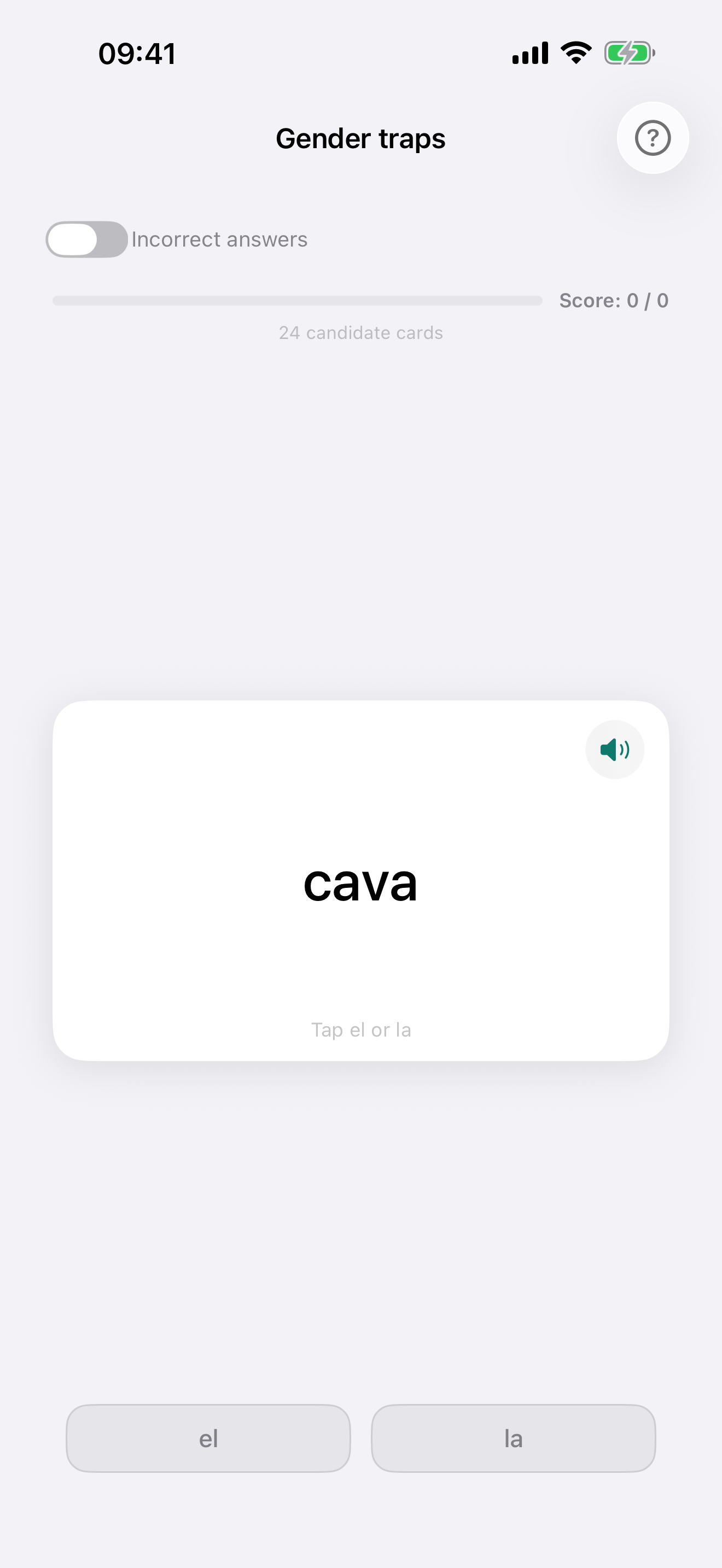 The traps, in their own decks
False friends, nouns whose ending points to the wrong gender, and more — small, closed decks that need no setup.
The catalogue
- over 1,100 verbs, filterable by CEFR level, topic and verb group
- over 1,400 nouns, each with its article, its plural and three example sentences
- over 240 set phrases, plus the example sentences of the verbs and nouns — thousands of sentences, each one drillable
- adjectives, adverbs, pronouns, numerals and prepositions, each with its own hub
What makes the patterns visible
The marking scheme. Conjugation tables use three marks. Red falls on just the part of a form that departs from the regular pattern — the changed vowel of puedo, the g of tengo, the shortened stem of tendré — while the rest stays in the normal colour. A form that is red from end to end (soy, voy, era) has to be learned as a whole. An underline marks the ending the pattern predicts, so even on an irregular form you can see which half follows the rule. Blue is used for one thing only: the endings of the strong preterite (-e, -iste, -o, -imos, -isteis, -ieron), whose stems are irregular but whose endings form a consistent set of their own.
The shape of the marking tells you what you are looking at: a red letter in the yo form alone points to a yo irregular such as tengo or conozco; a red stem vowel in every present form except nosotros and vosotros is a classic stem change.
Structure, tense by tense. Each verb's Structure tab gives every tense a verdict — from Regular to Irregular — shows in amber the stems you have to memorise, and can hide everything that follows the pattern.
Choice drills. Most drills ask for a form; these ask which form the sentence needs — ser or estar, preterite or imperfect, indicative or subjunctive, por or para. That is where knowing the forms stops being enough. An explanation follows every answer.
Traps. Closed decks of things that actively mislead: false friends (the deck follows your app language, because the traps for an English speaker are not the traps for a Dutch one), the eleven nouns whose meaning changes with the article (el capital / la capital), the gender traps whose ending points the wrong way, and the adjectives whose meaning shifts between ser and estar. Each deck brings its own words, so there is nothing to select first.
Verb grammar
Sixteen tenses, each switchable on its own in Select tenses — from the present to the pluperfect subjunctive.
Indicative — simple
- Presente
- Pretérito Imperfecto
- Pretérito Indefinido
- Futuro
- Condicional
Indicative — compound
- Pretérito Perfecto
- Pluscuamperfecto
- Futuro Perfecto
- Condicional Perfecto
Subjunctive
- Presente de Subjuntivo
- Imperfecto de Subjuntivo
- Pretérito Perfecto Subjuntivo
- Pluscuamperfecto Subjuntivo
Imperative
- Imperativo Afirmativo
- Imperativo Negativo
Progressive
- Gerundio — conjugated through all six persons (estoy hablando, estás hablando, …), not just the bare -ando / -iendo form
The past participle and the bare gerundio sit at the top of each verb's Conjugation tab, marked where they are irregular; the full six-person progressive appears among the tenses below them.
Verb groups
Most Spanish verbs are regular — but the irregular ones cluster into recognisable groups, and drilling them by group rather than one at a time is a fast way to internalise the pattern.
Twenty-three groups, each tickable on its own in Select verb groups, in five sections. Each section header has an All button, so one tap selects, for example, every stem change for a single focused session. A second view sorts the verbs by how many exceptions they have — none, one, two and so on.
Basic
- Regular — the predictable -ar / -er / -ir endings
Stem changes — the vowel changes where it carries the stress: in the present, every person but nosotros and vosotros
- e → ie — pensar, querer, preferir
- o → ue — poder, dormir
- e → i — pedir (-ir verbs only)
- u → ue — jugar
- i → ie — adquirir
- Accent shift í / ú — enviar → envío, actuar → actúo
Yo and spelling
- Irregular yo: -go — tener, poner, salir, hacer, decir
- Irregular yo: -zco — conocer → conozco
- Consonant + -cer / -cir: c → z — vencer → venzo
- Spelling shift -ger / -gir — escoger → escojo
- Verbs ending in -guir — seguir → sigo
- Verbs ending in -uir — construir → construyo
- Y-insertion — leer, creer, oír, caer, where the y appears between vowels (leyó)
- Spelling shift -car / -gar / -zar — buscar → busqué, llegar → llegué, empezar → empecé
Preterite and advanced
- Strong preterite — tener → tuve, hacer → hice, poder → pude, decir → dije
- Irregular participle — abrir → abierto, escribir → escrito, romper → roto: regular in every simple tense, with one participle to learn
- Irregular future stem — tener → tendré, poder → podré, decir → diré: one shortened stem carries both the future and the conditional
- Irregular — ser, ir, estar, dar, haber, ver: irregular in ways no other group names
How the verb is used — none of these changes an ending; they say how the verb is built into a sentence, so a verb here can be perfectly regular as well
- Reflexive — lavarse, vestirse
- Impersonal — llover, nevar, third person singular only
- Me gusta pattern — gustar, encantar, doler: the thing that pleases is the subject
- Stative — states rather than actions, so not normally used with estar + gerundio
Drills aimed at the weak spots
- Verb meaning — flashcards, Spanish ↔ your language, in either direction
- Produce the conjugation — give the form for a verb, tense and person, typed or picked
- Recognise the conjugation — given a form, identify verb, tense and person
- Irregular verbs — production limited to the verbs that are irregular in one tense
- Past participle — recall the participio, irregulars included
- Gerund — recall the gerundio
- Preterite — the yo and él forms of the indefinido, where the strong preterites show
- Ser or estar, Preterite or imperfect and Indicative or subjunctive — the choice drills
Setting up, and drilling
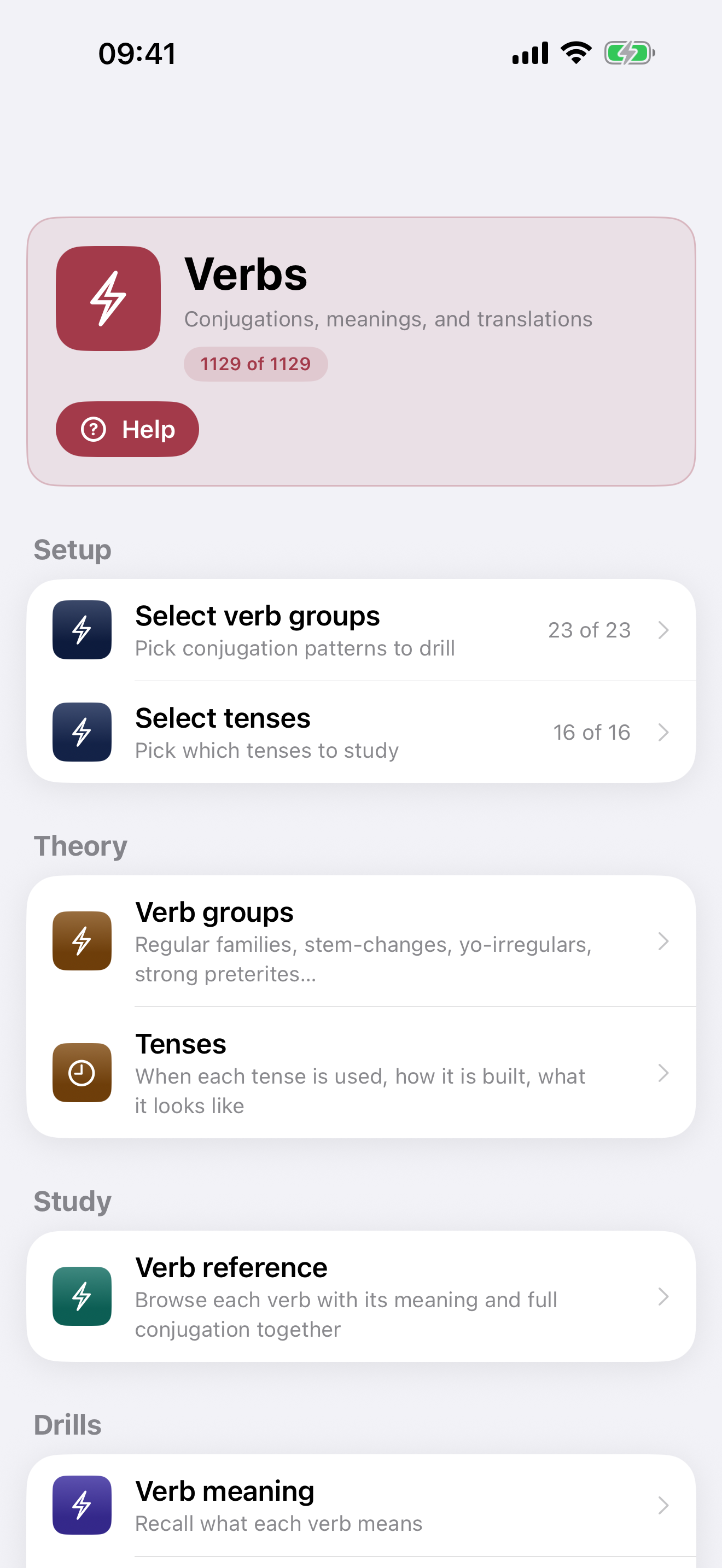 The Verbs hub
Setup, Theory, Study and Drills, all in one place.
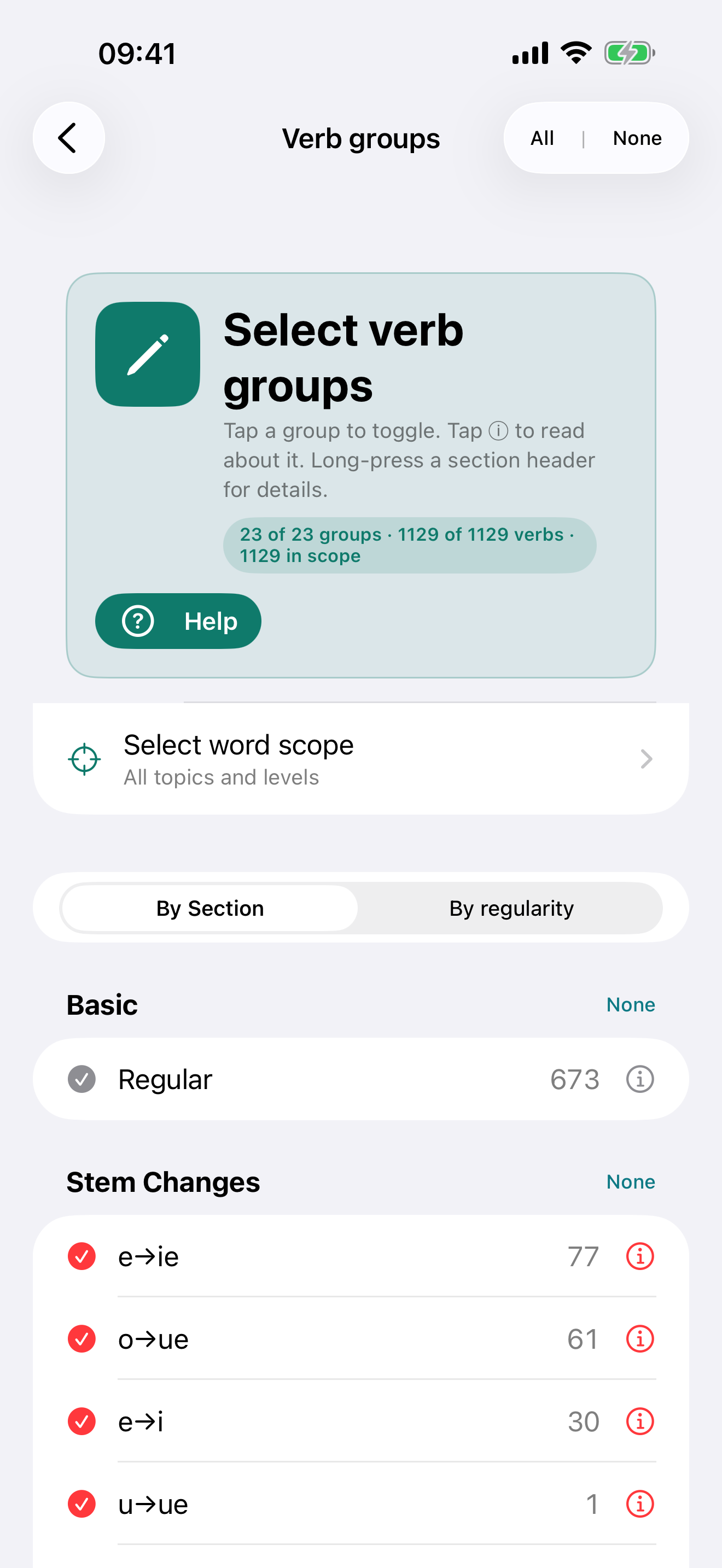 Select verb groups
Tick the patterns to drill — a whole section, such as every stem change, takes one tap.
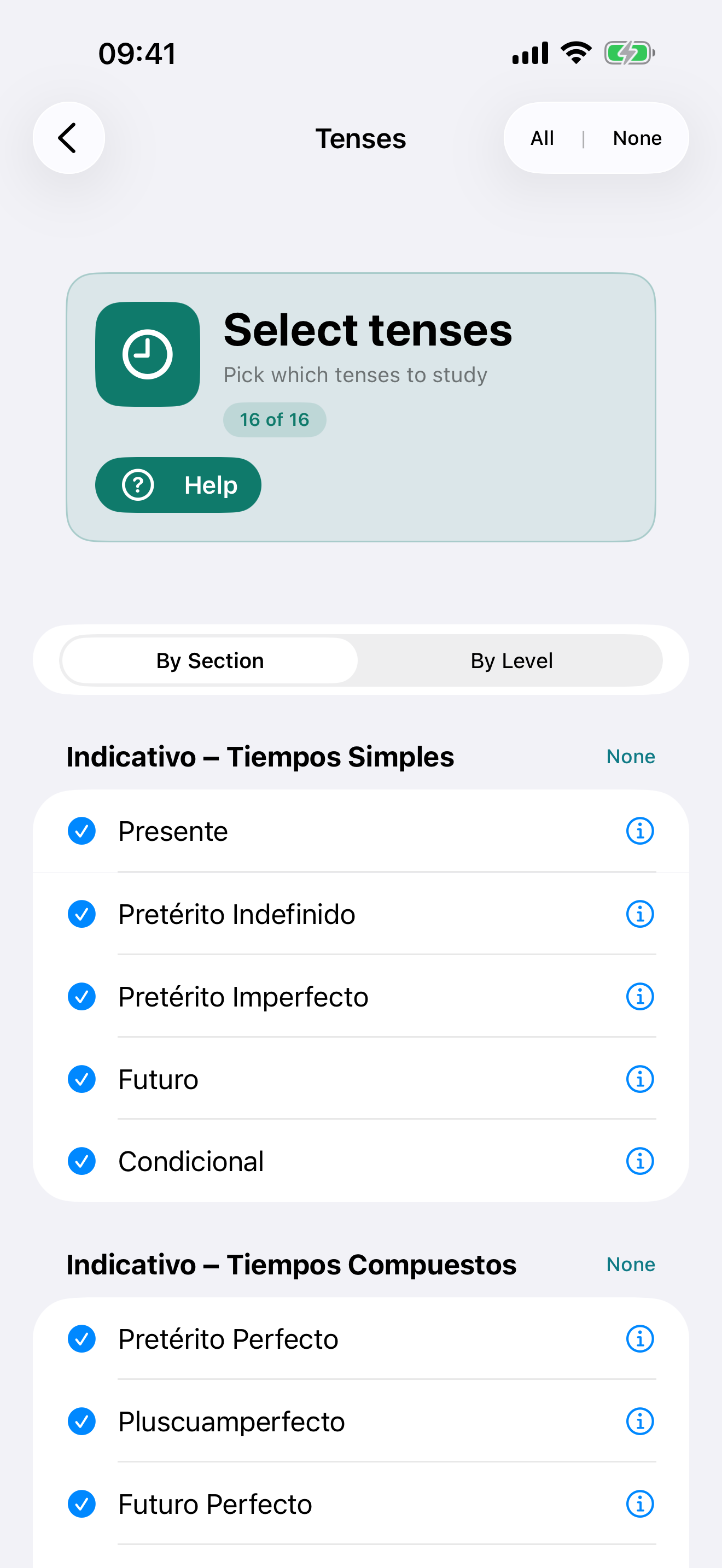 Select tenses
Switch tenses on and off by mood, or by CEFR level, from the present to the subjunctive.
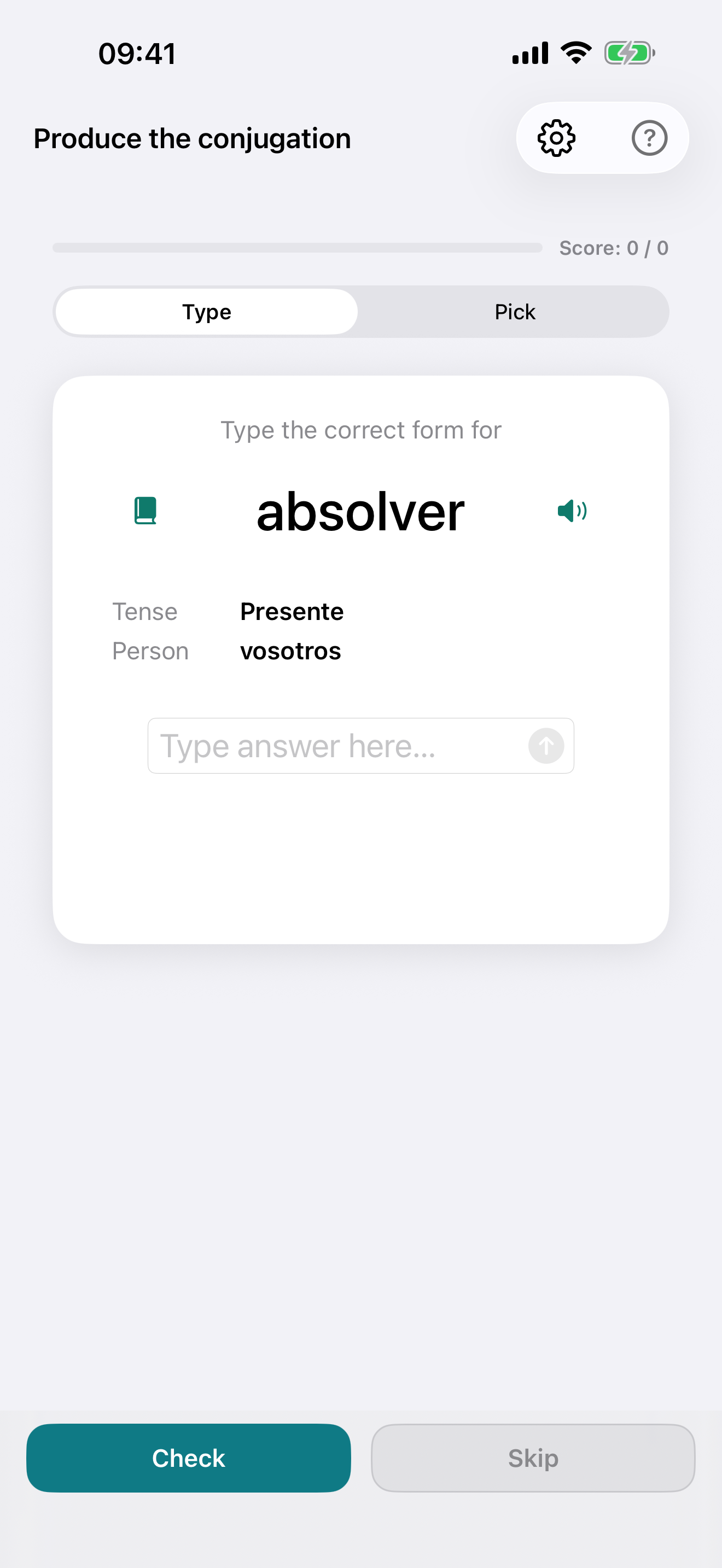 Produce the conjugation
Type the form, or pick it from a list of look-alike options.
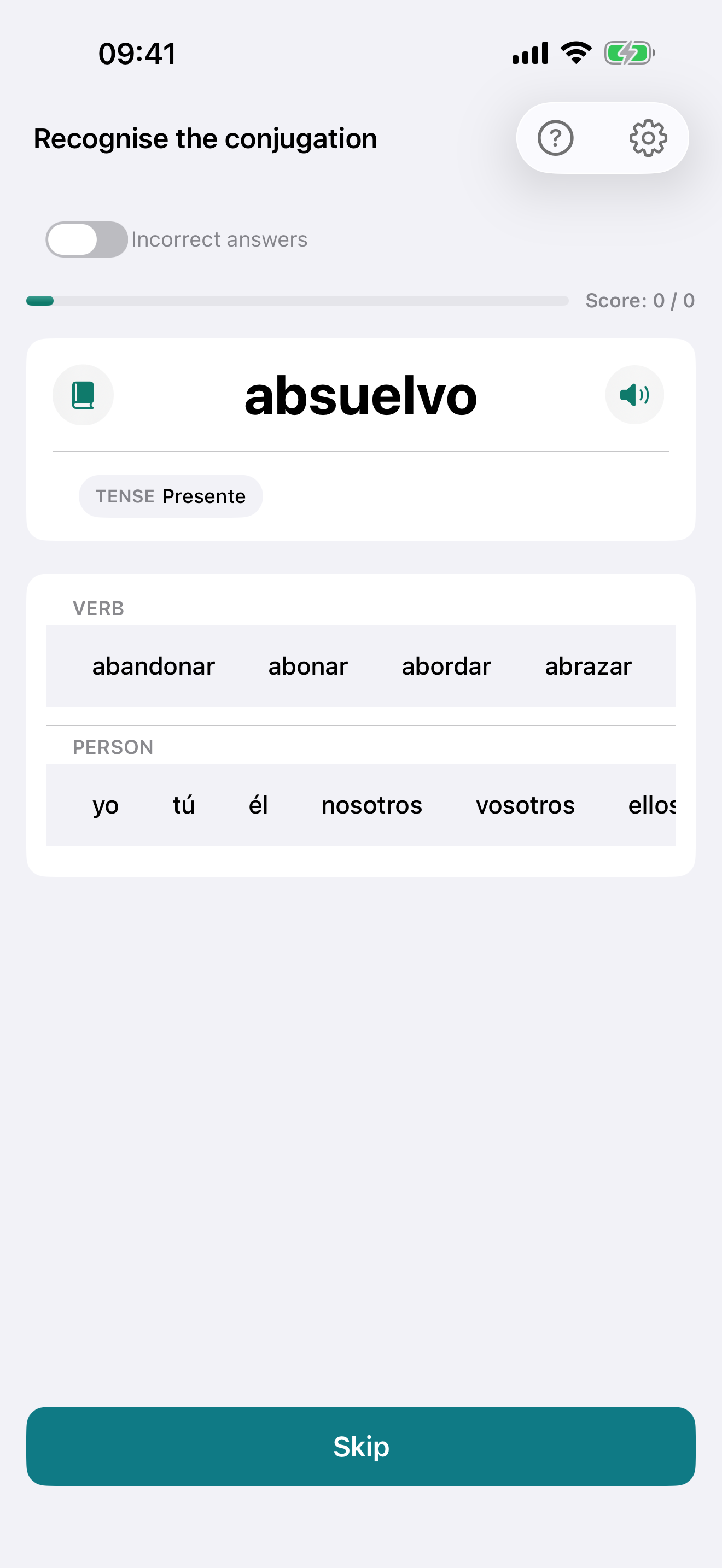 Recognise the conjugation
Given a conjugated form, pick the verb, tense and person. Any valid reading of an ambiguous form counts.
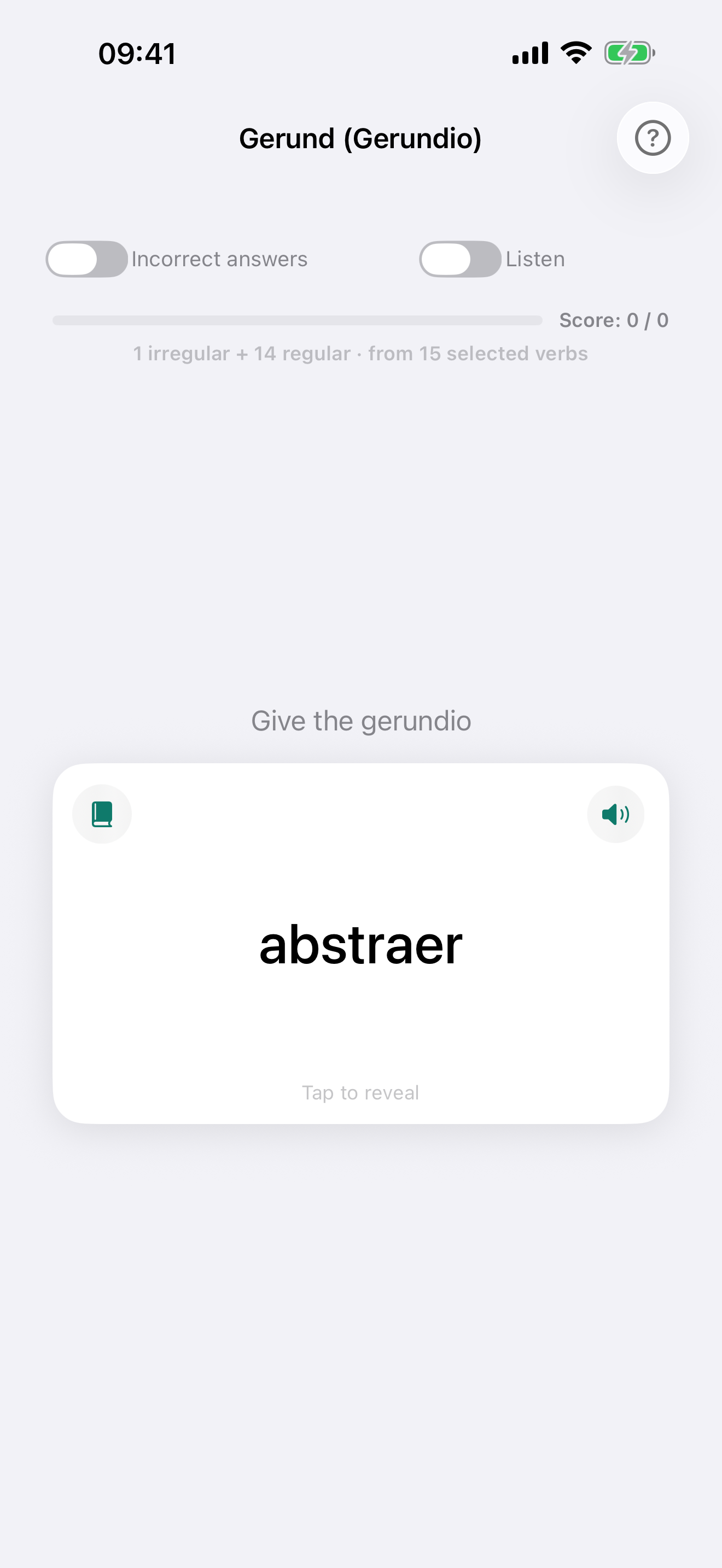 Gerund
Recall the gerundio, with the irregular part marked in red.
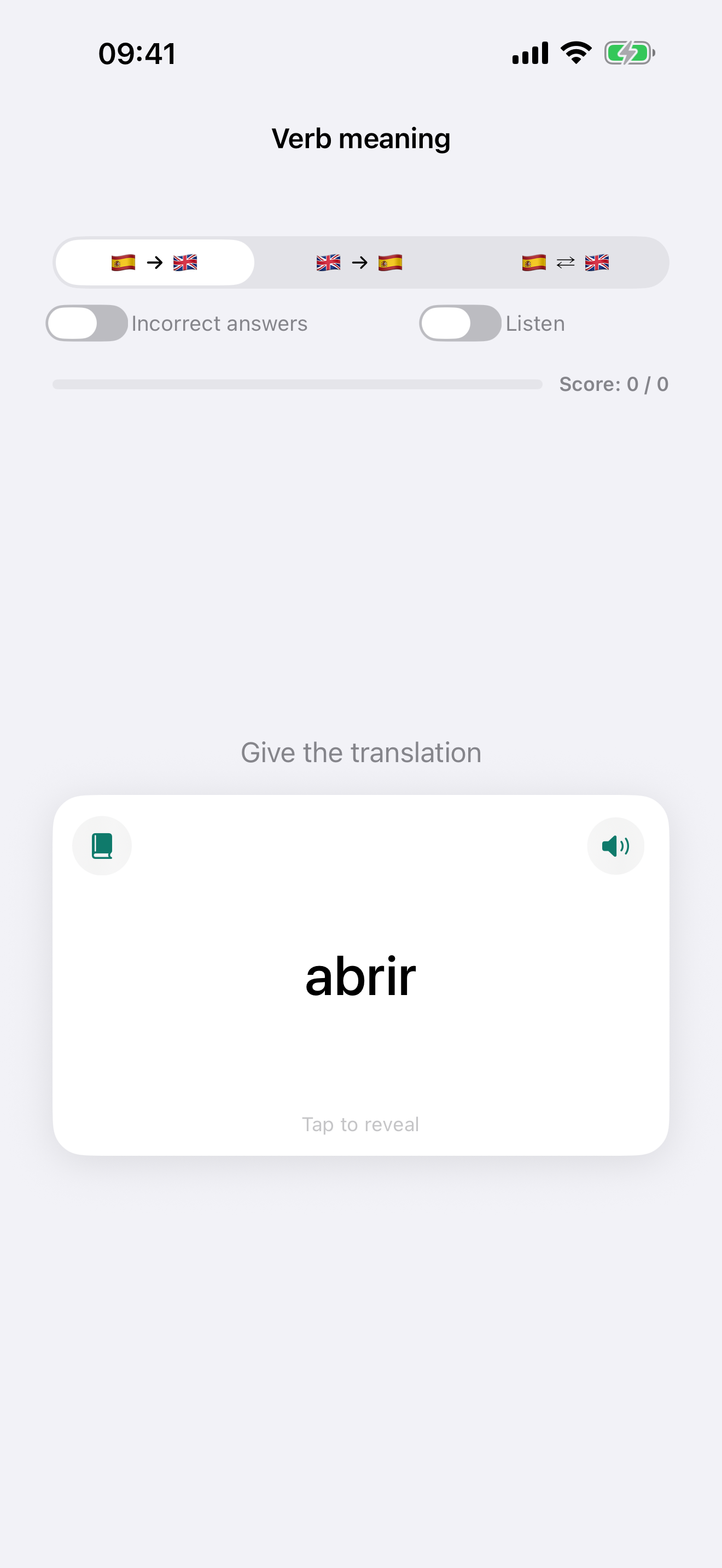 Verb meaning
Turn the card to reveal the translation; swipe right if you knew it, left if you didn't.
Noun grammar
Nouns are what learners most often try to brute-force, and where pattern recognition pays off most. The noun groups sort nouns by their grammatical character, and a noun can belong to several groups at once (canción has a predictable feminine suffix and loses its accent in the plural), so the group filter can target very specific patterns:
- Gender traps — mano and foto end in -o but are feminine; día and mapa end in -a but are masculine
- Greek -ma masculines — el problema, el idioma
- Predictable feminine suffixes — -a, -ción, -sión, -dad, -tad, -umbre
- Predictable masculine suffixes — -o, -or, -aje, -ón, -án, -ín
- Stressed-á feminines — el agua, las aguas: el in the singular, feminine all the same
- Different meaning by article — el capital (money) and la capital (city)
- Gender pairs — el tío / la tía, heteronymous pairs such as el padre / la madre, and one-form nouns such as el / la dentista
- Invariable plural — el lunes / los lunes
- Plurale tantum — los pantalones
- Plural formation — lápiz → lápices, canción → canciones, consonant + -es
- False cognates — words that look like a word in your own language but mean something else
Five drills: Noun meaning, Pick the correct article, Singular / Plural, Alternate gender pairs and Meaning changes with gender.
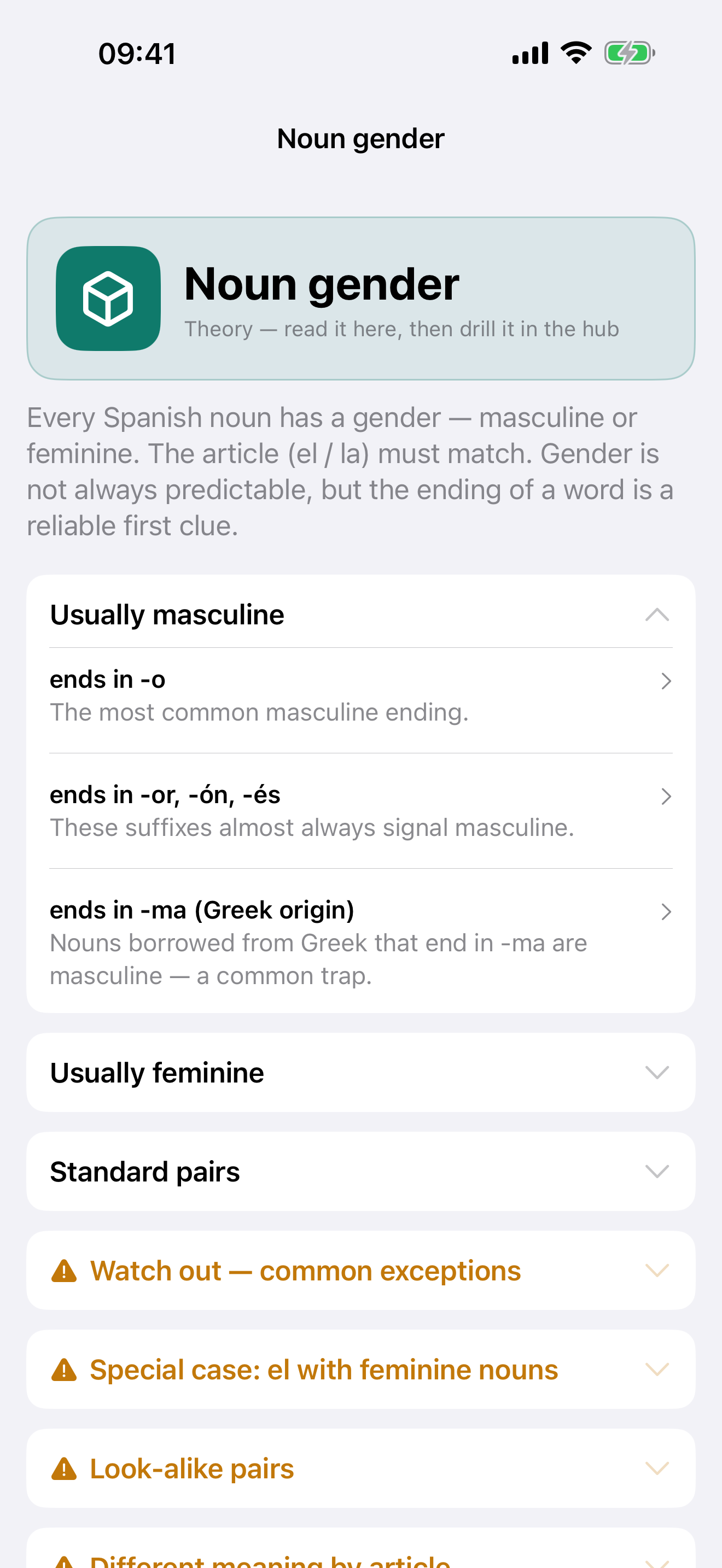 Gender rules, stated
The endings that predict gender, and the nouns that break the rule.
 Pick the correct article
el or la, drilled until the ending stops fooling you.
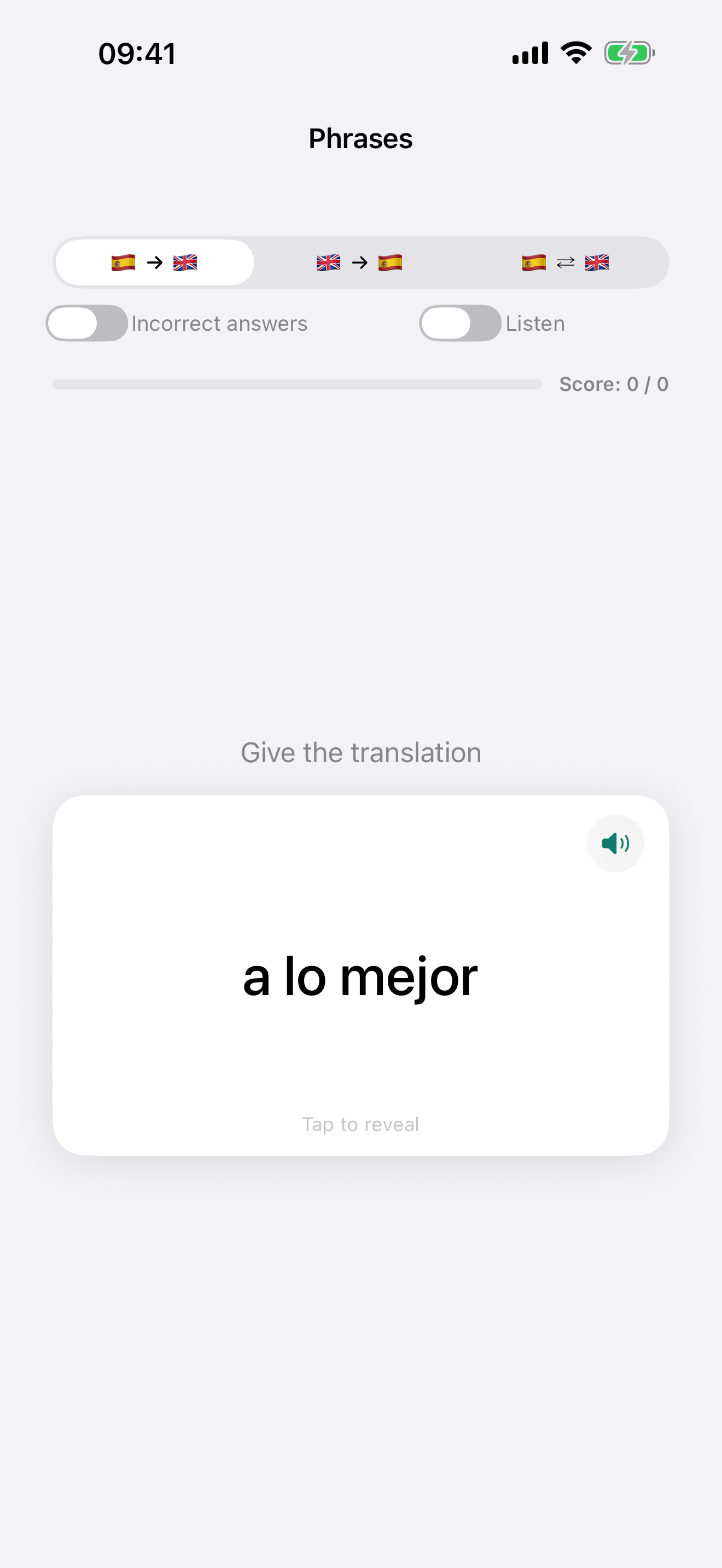 Phrases and example sentences
Set phrases plus the verb and noun example sentences, each drillable in its own right.
Speech and lookups
Spanish forms are read aloud with the voices Apple provides on your device, in Standard, Enhanced and Premium quality — the Enhanced and Premium voices are free to download and sound far more natural. A speed slider slows speech down for listening practice.
Verb and noun detail screens carry a Dictionaries row that looks the word up in Linguee, WordReference, Reverso and the RAE — in a browser sheet inside the app on iPhone and iPad, and in your web browser on the Mac. Choose which appear in Settings → Spanish → Dictionary services.
On Apple Watch, the companion app shows conjugation tables for a set of essential Spanish verbs.
Try it
Every language is open for 21 days with every feature unlocked. After that, unlock Spanish on its own or buy Unlock all languages — a one-time purchase, no subscription, no ads, no account. Your answers stay on your device.



One purchase, every device. The iPhone, iPad and Mac apps share a single App Store listing, so a language you unlock on one is unlocked on the others — same Apple ID, no second payment.