Numerals
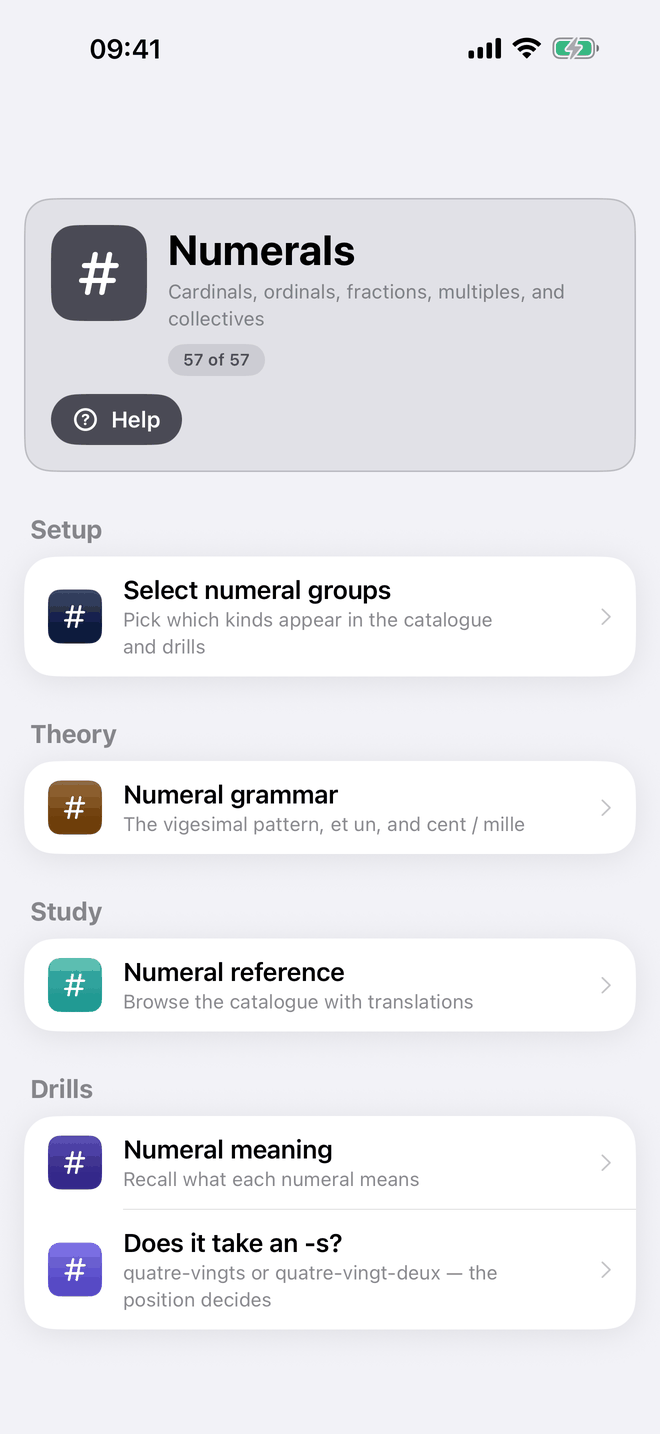
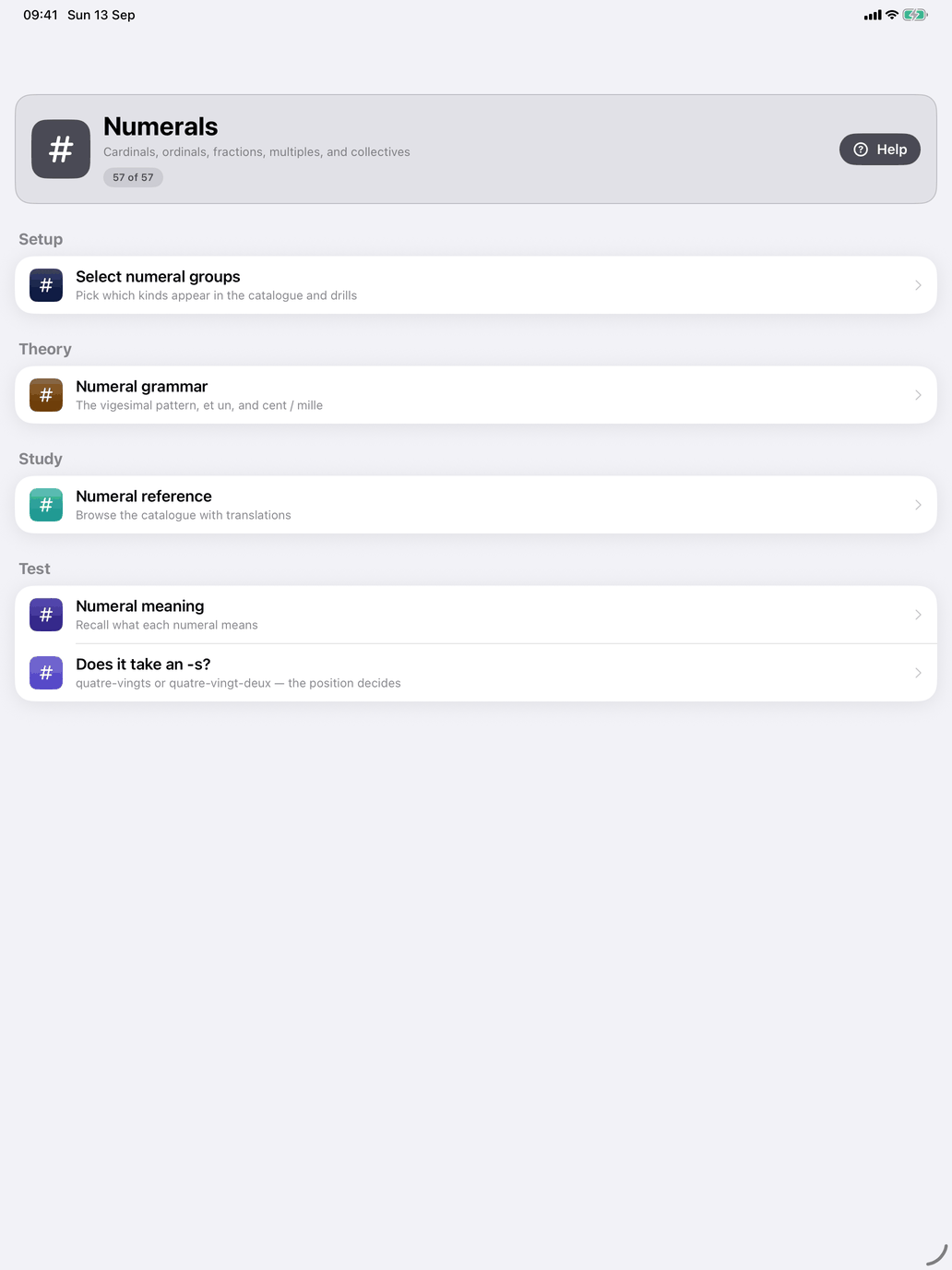
The Numerals hub covers French numbers of five kinds — cardinals, ordinals, fractionals, multiplicatives and collectives — with particular attention to the numbers from 70 to 99 and to the rules for the plural -s.
Open Self Study → Numerals. The hub has:
- Setup — Select numeral groups: choose which kinds appear.
- Theory — Numeral grammar: the counting system from 1 to 1000.
- Study — Numeral reference: the selected numerals with their translations.
- Drills:
- Numeral meaning — flashcards for the meaning of the selected numerals.
- Does it take an -s? — quatre-vingts or quatre-vingt-deux: the position decides.
The line under the hub title shows how many numerals your kind selection gives you, out of the whole catalogue. Only the kinds you tick decide the selection; the level and topic filters in Select word scope are not applied here.
A recommended workflow
- Tick Cardinal only and run Numeral meaning. Pay special attention to soixante-dix, quatre-vingts and quatre-vingt-dix.
- Use Does it take an -s? to fix the spelling rules.
- Add the other kinds.
Select numeral groups
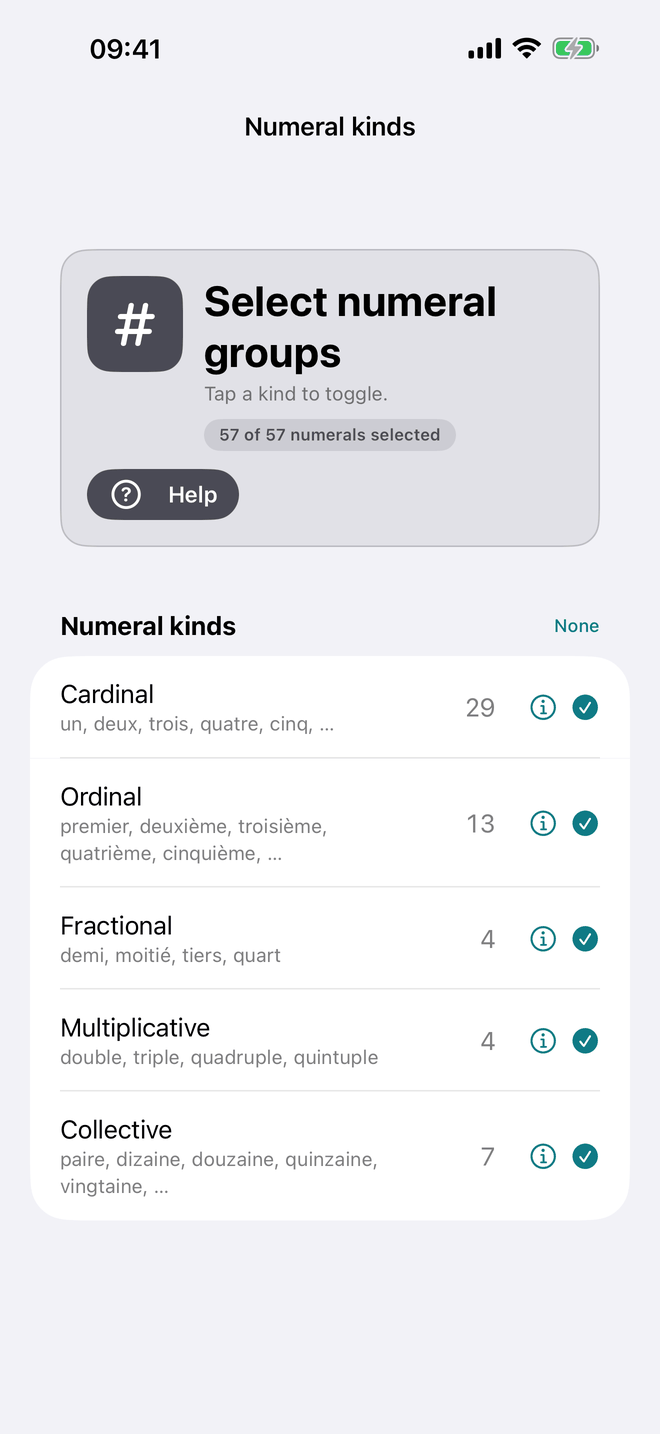
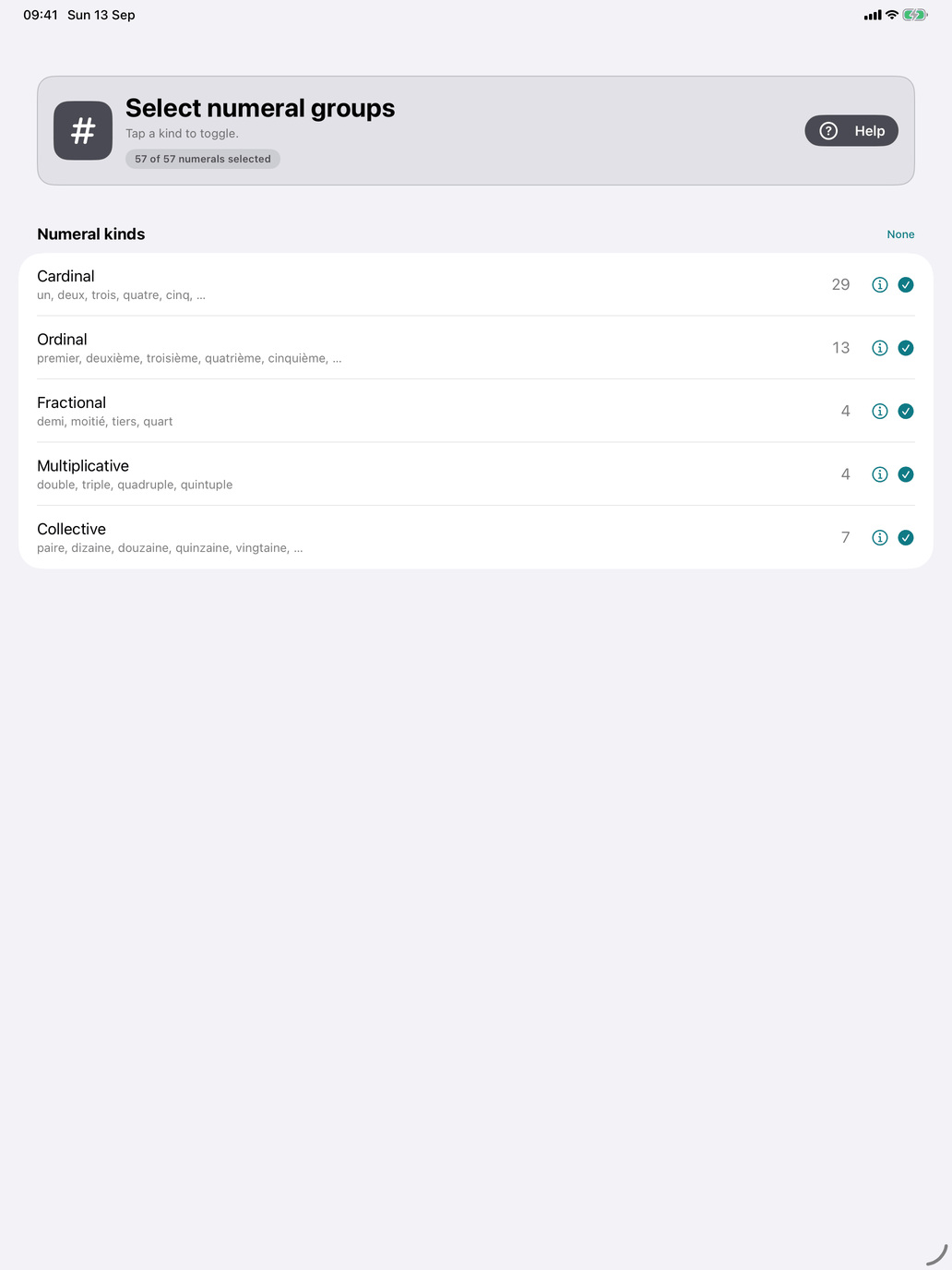
The five kinds:
- Cardinal — the counting numbers: un, deux, trois … vingt, trente … soixante-dix, quatre-vingts, quatre-vingt-dix, cent, mille.
- Ordinal — premier, deuxième, troisième … vingtième, centième, millième.
- Fractional — demi, moitié, tiers, quart.
- Multiplicative — double, triple, quadruple, quintuple.
- Collective — paire, dizaine, douzaine, quinzaine, vingtaine, centaine, millier.
Tap a kind to switch it on or off; each row shows its size and the first few numerals. Tap ⓘ for an explanation of the kind and its numerals:
- Ordinals add -ième to the cardinal, dropping a final -e (quatre → quatrième), with two spelling changes: cinq → cinquième, neuf → neuvième. Only premier / première and second / seconde agree in gender.
- Fractionals: demi doesn't change before its noun and takes a hyphen (une demi-heure), but agrees after it (une heure et demie). La moitié is the noun for half of something. From a fifth onwards the ordinal is used: un cinquième.
- Multiplicatives are adjectives (un double espresso) and nouns (le double de).
- Collectives are nouns — feminine, except millier — and take de: une douzaine d'œufs. Apart from douzaine and paire they mean "about": une vingtaine de personnes is twenty or so.
Numeral grammar
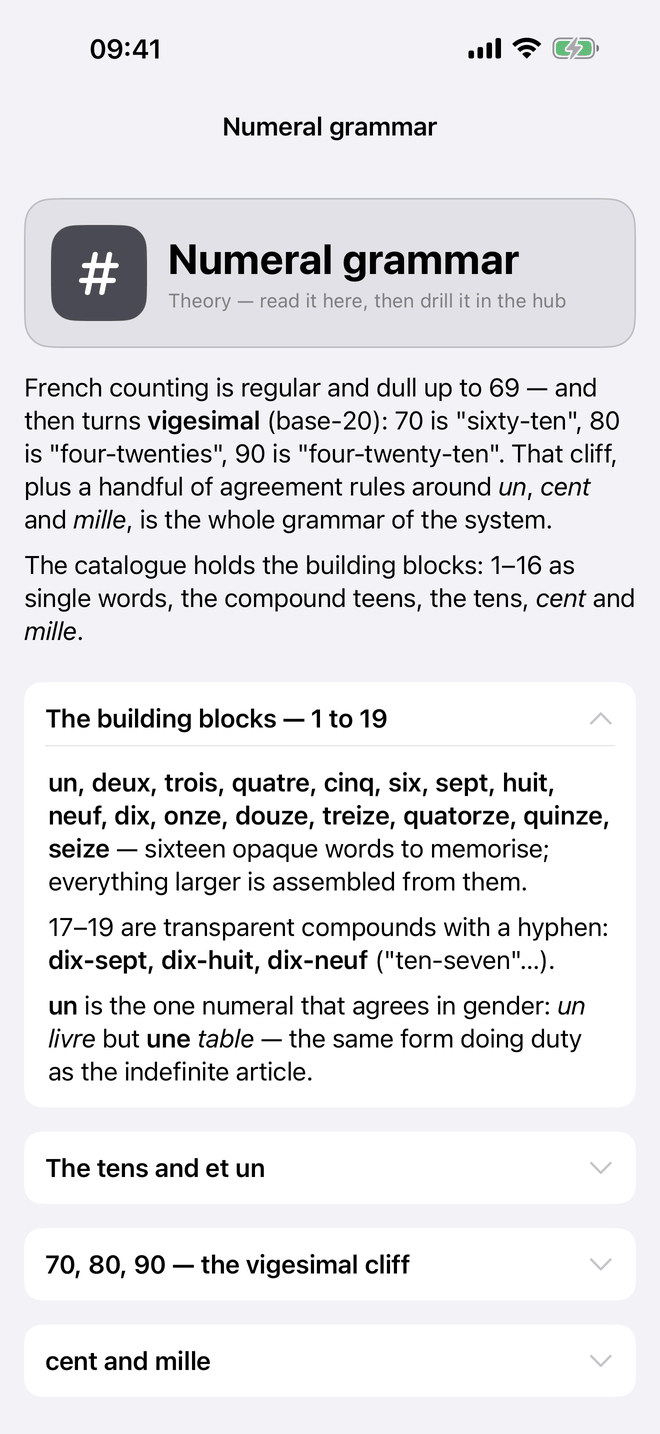
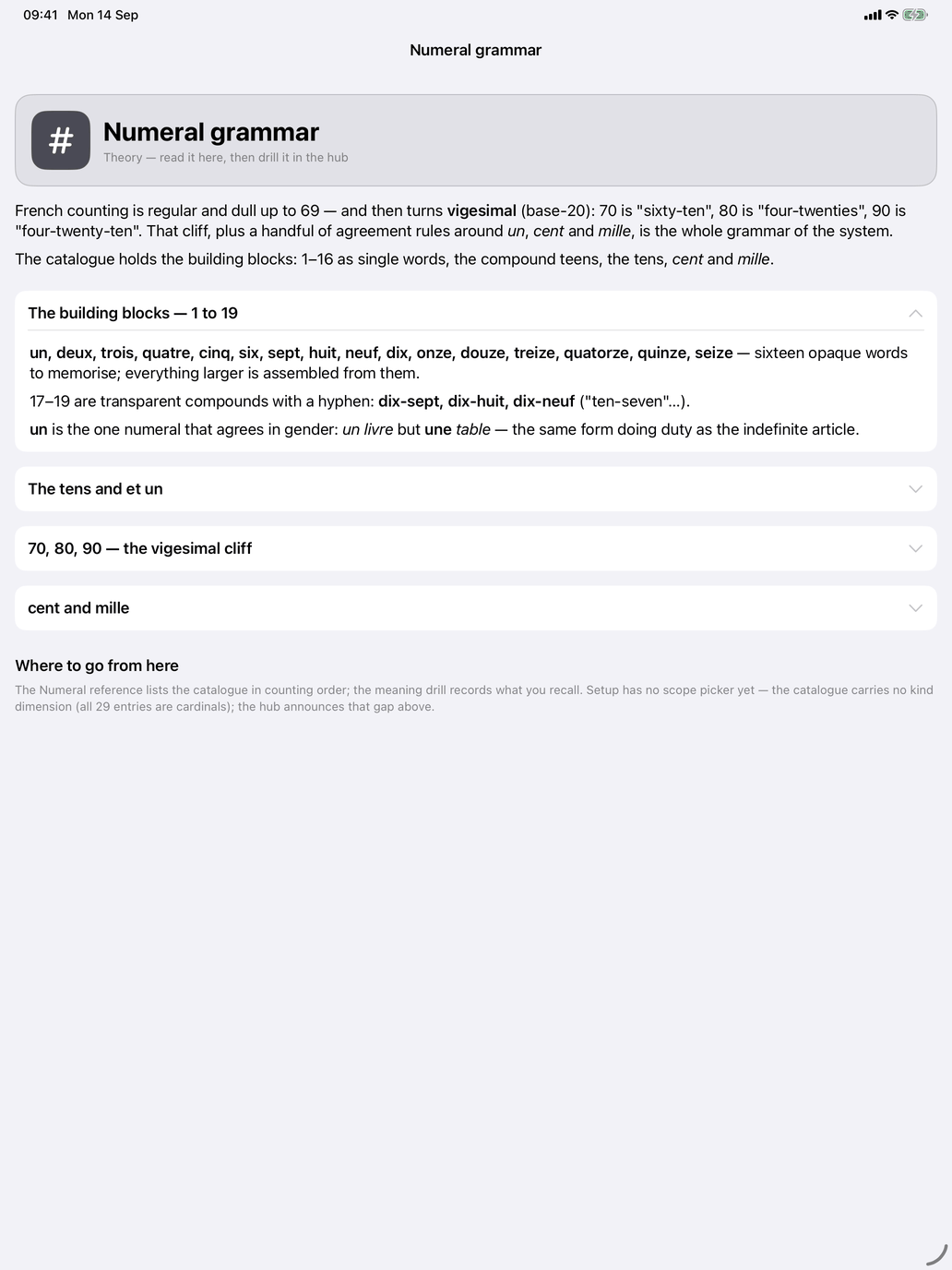
A reference page on the cardinal numbers; nothing is recorded.
1 to 19. Un, deux, trois, quatre, cinq, six, sept, huit, neuf, dix, onze, douze, treize, quatorze, quinze, seize are sixteen words to memorise. 17 to 19 are compounds with a hyphen: dix-sept, dix-huit, dix-neuf. Un is the only number that agrees in gender: un livre, une table.
The tens. Vingt, trente, quarante, cinquante, soixante. Units join with a hyphen (vingt-deux, trente-cinq), except the 1, which takes et: vingt et un, trente et un … soixante et un.
70, 80, 90. Above 69, French counts in twenties:
- soixante-dix = 60 + 10 → 70, continuing soixante et onze (71), soixante-douze (72) … soixante-dix-neuf (79).
- quatre-vingts = 4 × 20 → 80. The -s drops when another number follows: quatre-vingt-un (81) — with no et.
- quatre-vingt-dix = 4 × 20 + 10 → 90, continuing quatre-vingt-onze (91) … quatre-vingt-dix-neuf (99).
Belgium and Switzerland use septante (70) and nonante (90), and parts of Switzerland huitante (80). They are worth recognising, but the app teaches the forms used in France.
Cent and mille. Cent (100) and mille (1000) stand without un: cent euros. Cent takes an -s in round hundreds (deux cents) but not when a number follows (deux cent un). Mille never changes: deux mille.
Numeral reference
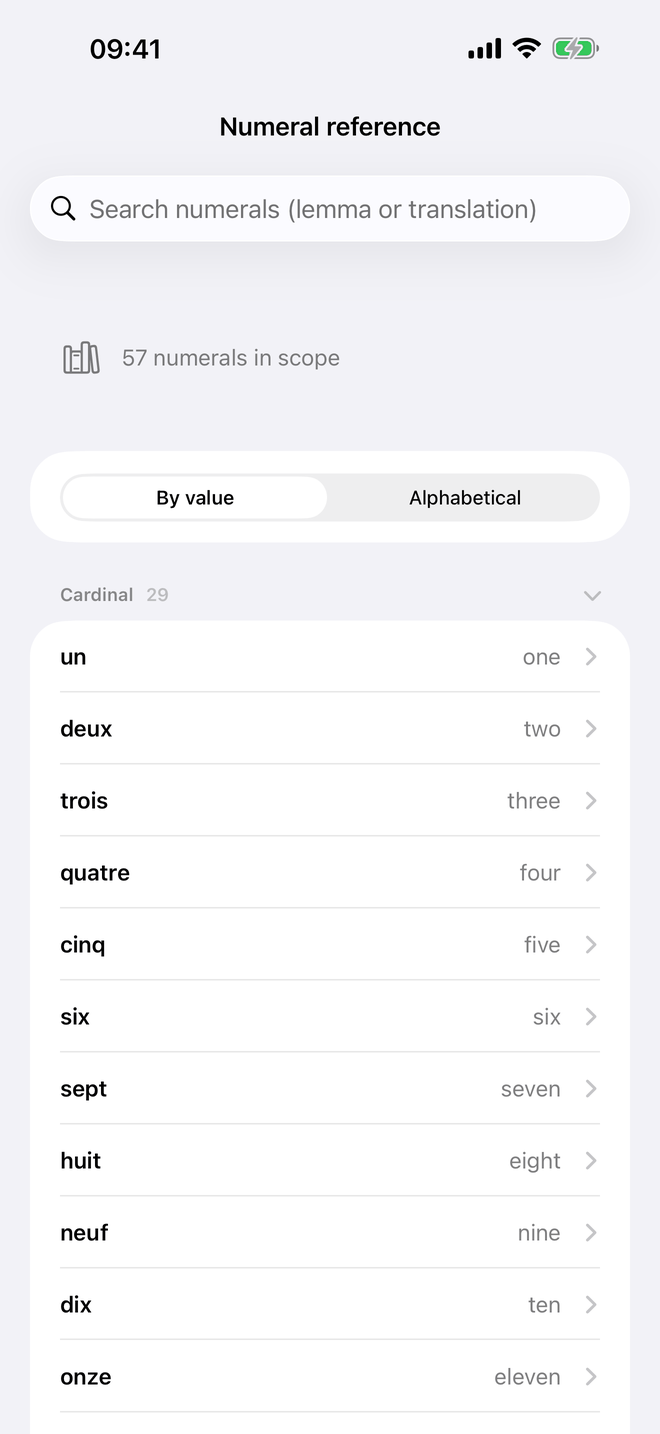
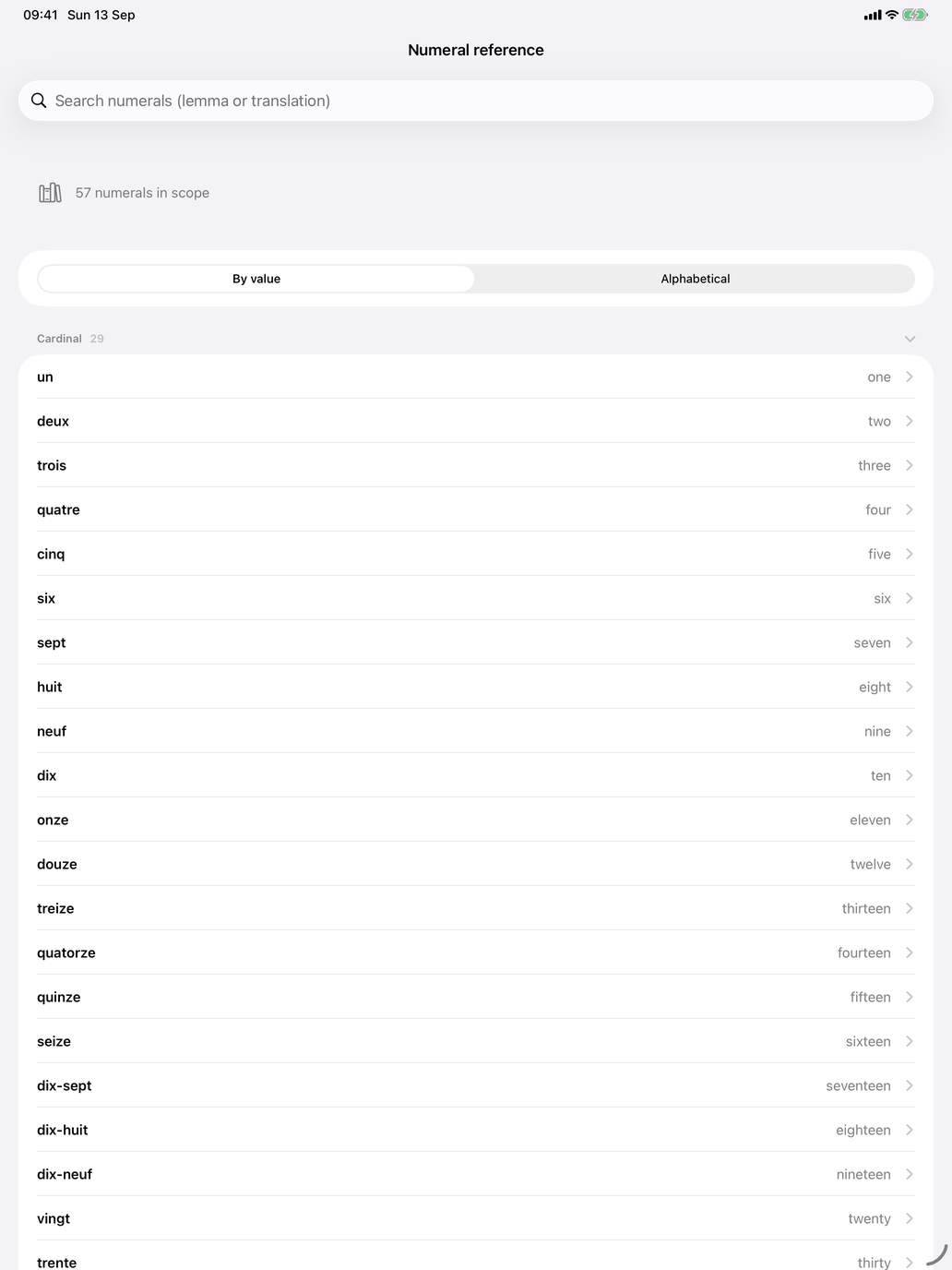
A browse-only list of the selected numerals with their translations, in sections by kind, with a search field. Search also finds a numeral by its value (80). Use the By value / Alphabetical switch at the top to change the order. Nothing is recorded.
Tap a numeral to open its page:
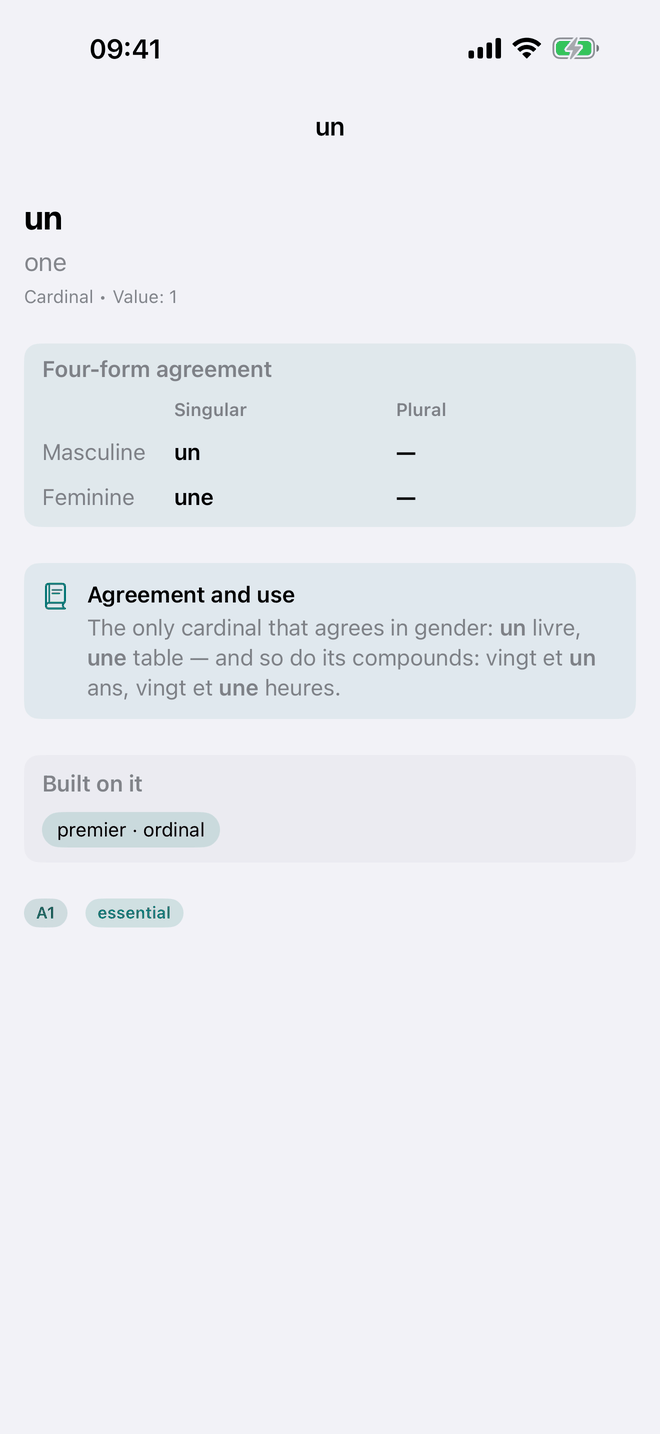
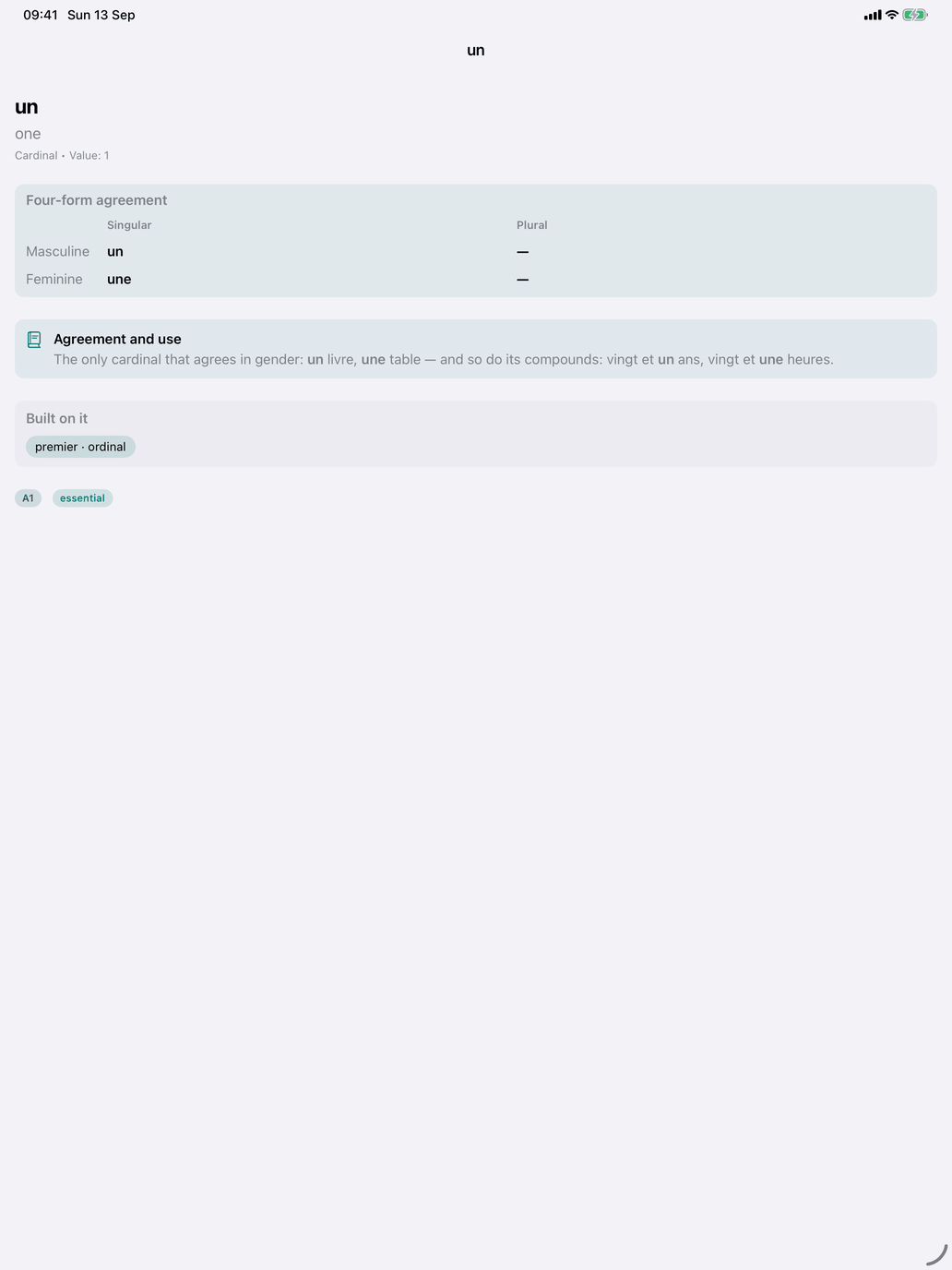
- the numeral and its translation, with its kind and value (Value: 80; a fraction shows as 1/4, a multiple as ×3)
- for some numerals, a note on Agreement and use — for example that vingt takes -s only when multiplied and final
- Built on, Built on it or Same family: chips linking an ordinal, fraction or collective to its cardinal and the other way round. Tap a chip to open that numeral.
- its level and frequency
Numeral meaning
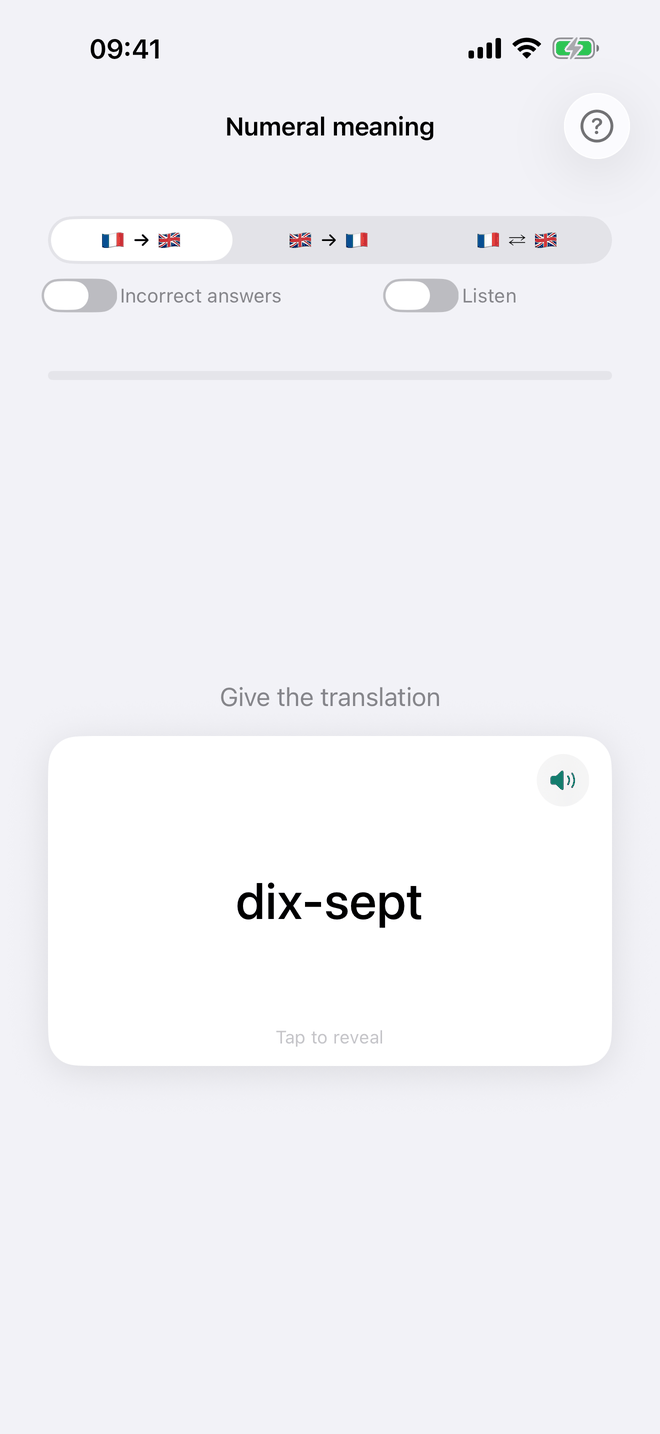
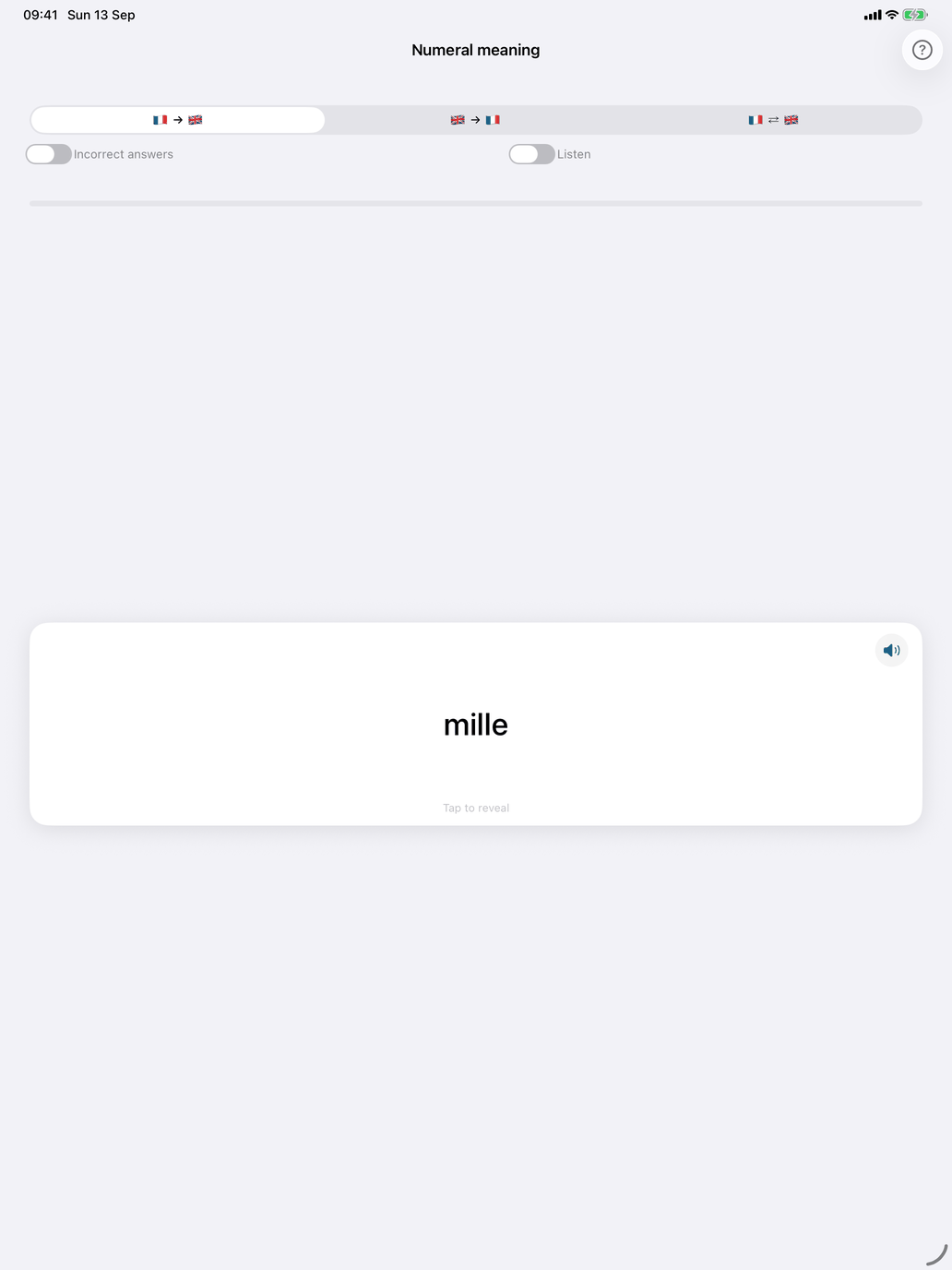
A flashcard deck for the meaning of the selected numerals, in either direction. It works like Noun meaning. Every answer is recorded.
Does it take an -s?
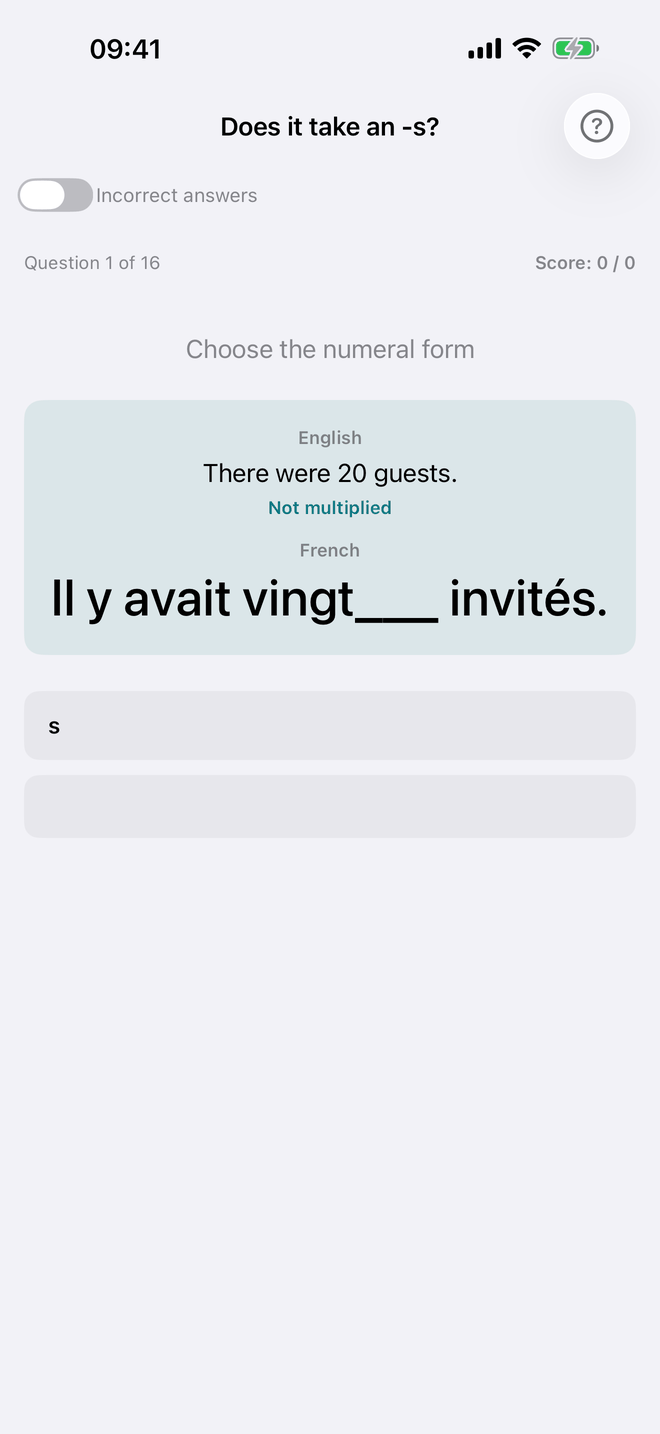
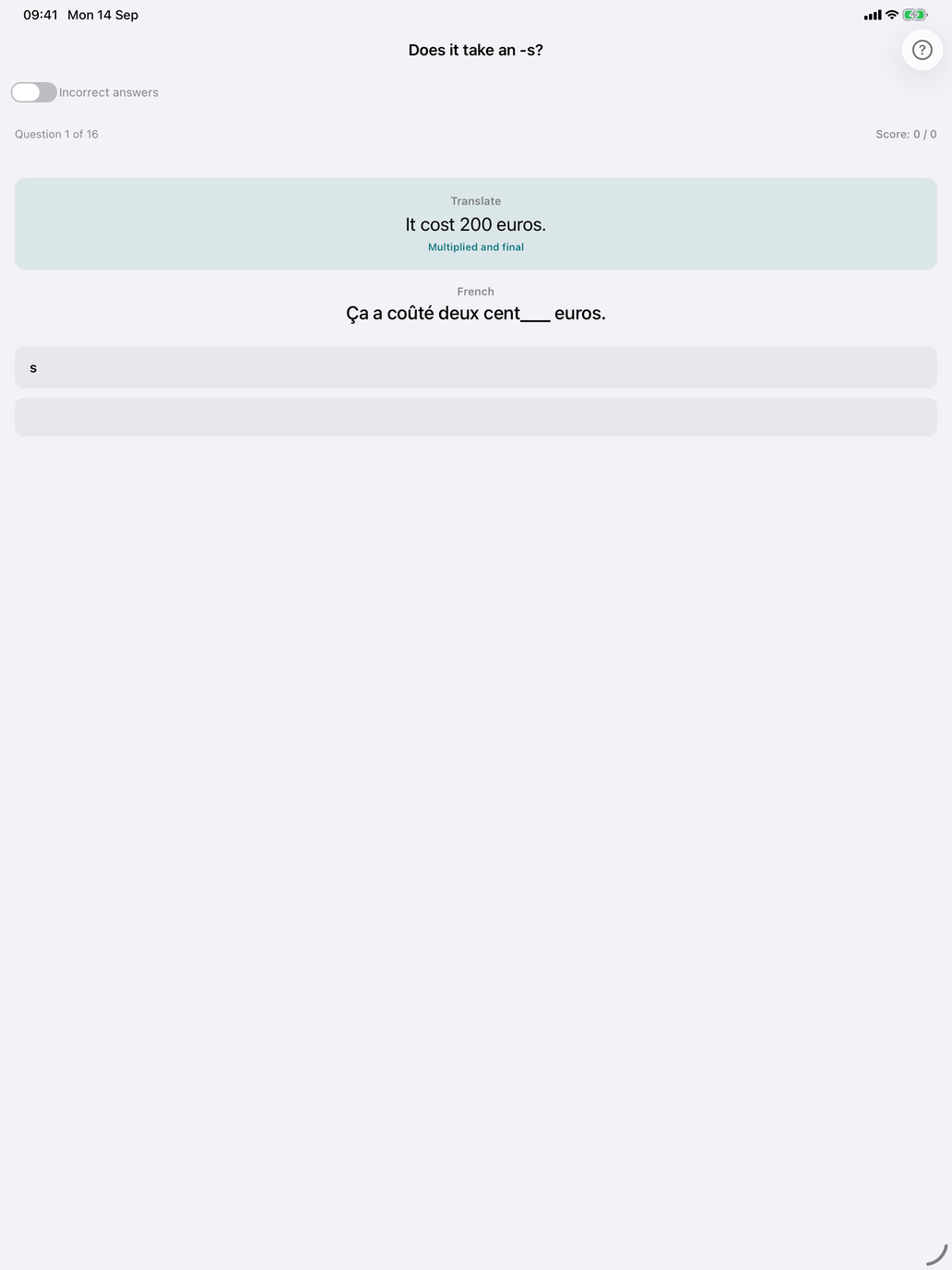
Each question shows an English sentence with the number in digits and a label naming the rule, and the French sentence with a gap at the end of the numeral: Il a quatre-vingt___ ans. ("He is 80 years old.") Tap the ending — usually s or the empty option for no ending. The gap fills in, the right answer is marked and a card explains the rule. Tap Next question to go on.
The sentences come in pairs, because each rule is only visible against its opposite:
- Multiplied and final — vingt and cent take -s: quatre-vingts ans, deux cents euros.
- Followed by another — another number follows, so the -s goes: quatre-vingt-deux ans, deux cent cinq euros.
- Not multiplied — a bare cent or vingt has no -s: cent ans, vingt invités.
- Invariable — mille never changes: deux mille euros.
- Counter noun — million and milliard are nouns: they take -s and are followed by de: deux millions d'habitants.
- Gender — un agrees with its noun, also inside a compound: vingt et une pages, trente et un jours.
The drill has its own fixed set of sentences and ignores your kind selection. Answers are recorded per rule.