Latin
Over 600 verbs. Over 550 nouns. All five declensions, all five adjective patterns, the classical tense system in both voices — every form stored with its macrons.
Latin is the deepest course in LinguaMorpha, because Latin has the richest morphology of the three languages. If you are here for Latin, you do not need Spanish or French: the course is complete on its own, and nothing in it assumes you have studied another language.
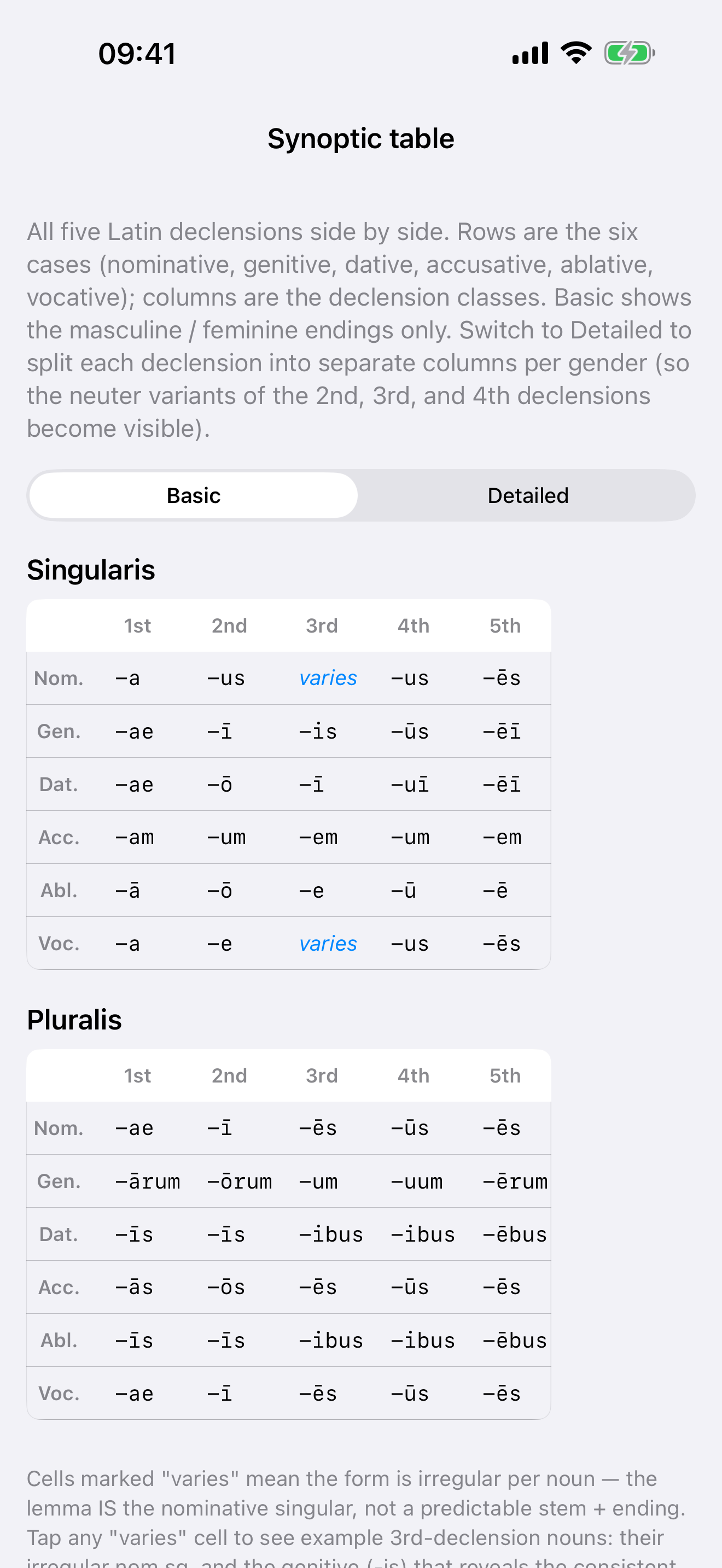 All five declensions, side by side
The endings of all five declensions in one grid, singular and plural. Switch to Detailed to add separate neuter columns for the 2nd, 3rd and 4th declensions.
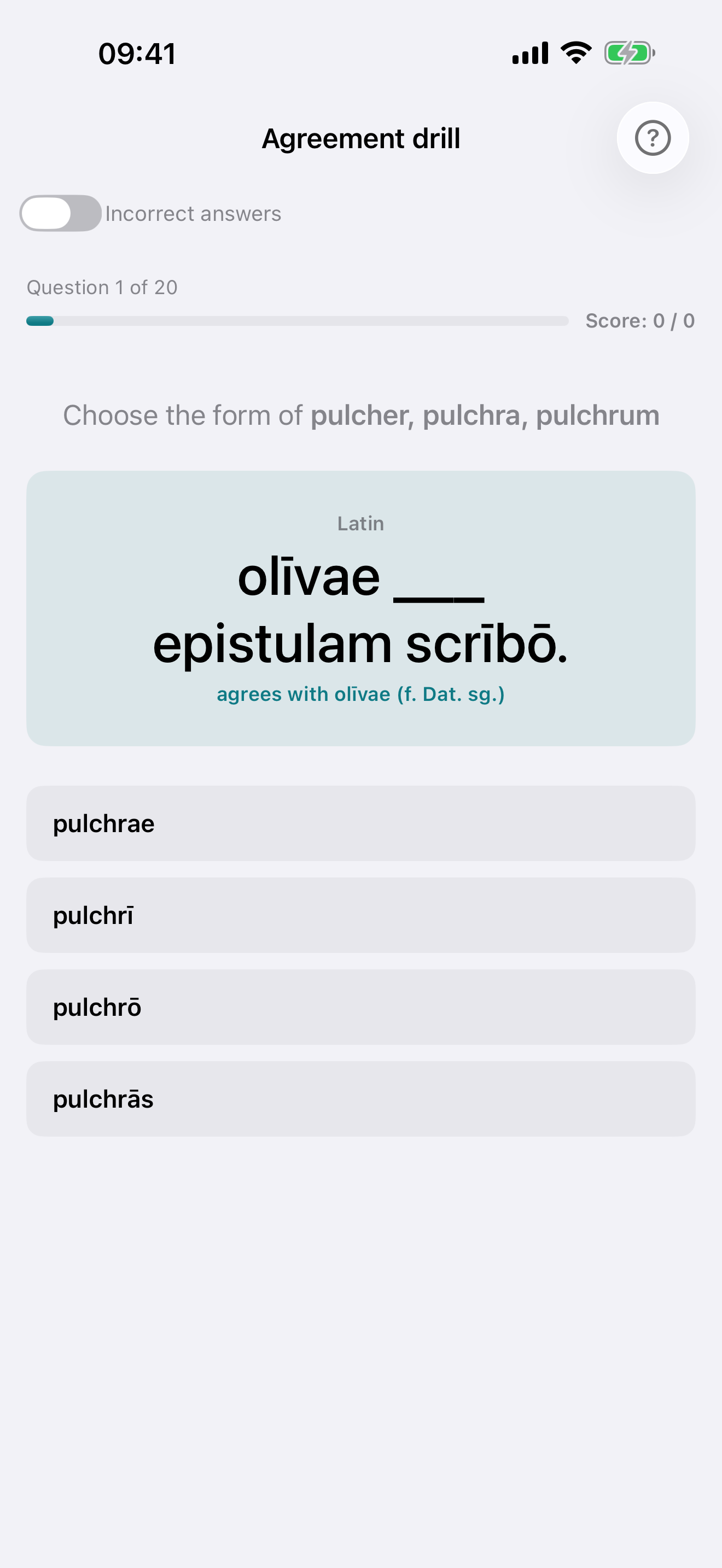 The agreement drill
The noun is already inflected and the adjective is missing. Pick the form that agrees; the explanation names the noun's gender, case and number.
The catalogue
- over 600 verbs in six verb groups: the five conjugations and the fully irregular verbs
- over 550 nouns across all five declensions, plus two irregular nouns
- over 330 adjectives across all five patterns
- the core pronouns — personal, demonstrative, relative, interrogative and indefinite — each with its full paradigm
- the cardinal numbers from 1 to 20, the tens up to 100, and mīlle
- prepositions, adverbs, conjunctions, interjections and set phrases, each with its own hub
What only the Latin course has
Macron-aware answer checking. Every form in the app is stored with its macrons. In the typed noun and adjective drills, the check is lenient by default: typing rosis when rosīs is right still counts as correct, and the feedback reads Correct — watch the macron and shows where the long vowel goes. Turn on Strict macrons (Settings, Latin tab, under Grading) and a missing macron counts as wrong — for when you want vowel length to count.
A sentence parser. Open Self Study → Look up and switch from Word to Sentence. Type or paste a Latin sentence — a line of Caesar, a Vulgate verse, your homework — and tap Parse. Every word becomes a chip showing the lemma of its most likely reading, with a badge when there are more. Tap a chip to see every possible parse with its lemma, form and translation; nouns, adjectives and verbs open their full entry, with the matching form highlighted. The parser ignores macrons and capitals, strips punctuation and splits enclitics such as -que and -cum. A literal word-by-word gloss can be copied, and on devices with Apple Intelligence a Translate button asks for a machine translation. The parser draws on more than 2,000 lemmas at the level of an introductory course, so a sentence from a beginner's textbook usually parses; words outside the catalogue are marked unknown.
Annotated reading texts. Ten short passages, from a beginner's story through the Vulgate, Catullus and Phaedrus to unaltered Caesar and Cicero. Almost every word can be tapped for its parses, every line has an English and a Dutch translation, and some lines carry a teacher's note on a construction worth noticing.
The agreement drill. A short Latin sentence appears with a blank where an adjective belongs. The noun is already inflected, and you pick the form of the adjective that agrees with it in case, number and gender. After each answer, a card explains the choice: pulchram agrees with rosam (f. Acc. sg.). It is the drill that puts noun and adjective forms together.
Example sentences. Nouns carry example sentences — over 1,700 in total — each with a translation and a label naming the case and number the noun takes in that sentence. Adjectives show short example sentences generated by the app, with the adjective in bold, agreeing with a noun. Many verbs add tense examples and a list of their separate senses.
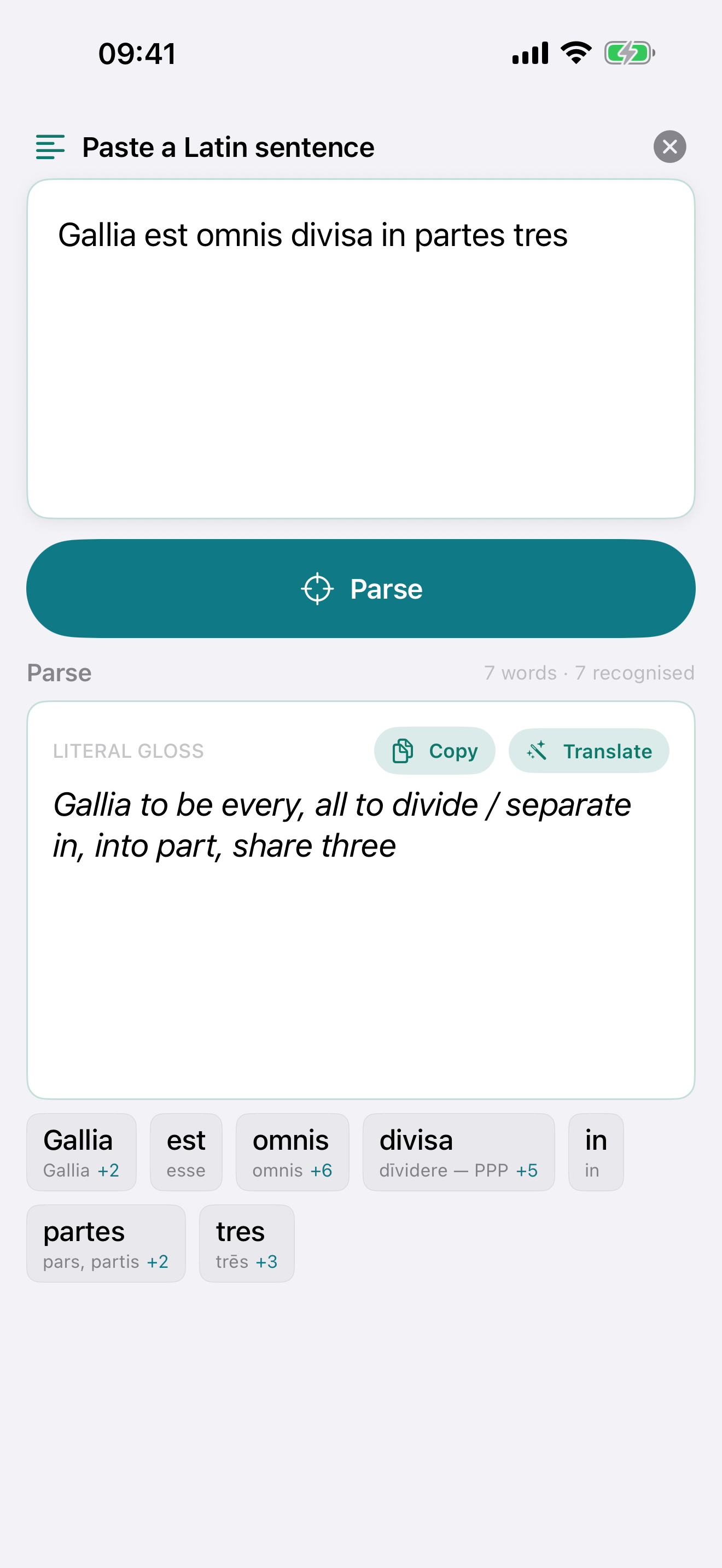 Sentence parser
Paste a Latin sentence; every word the catalogue knows comes back parsed, with a literal gloss you can copy.
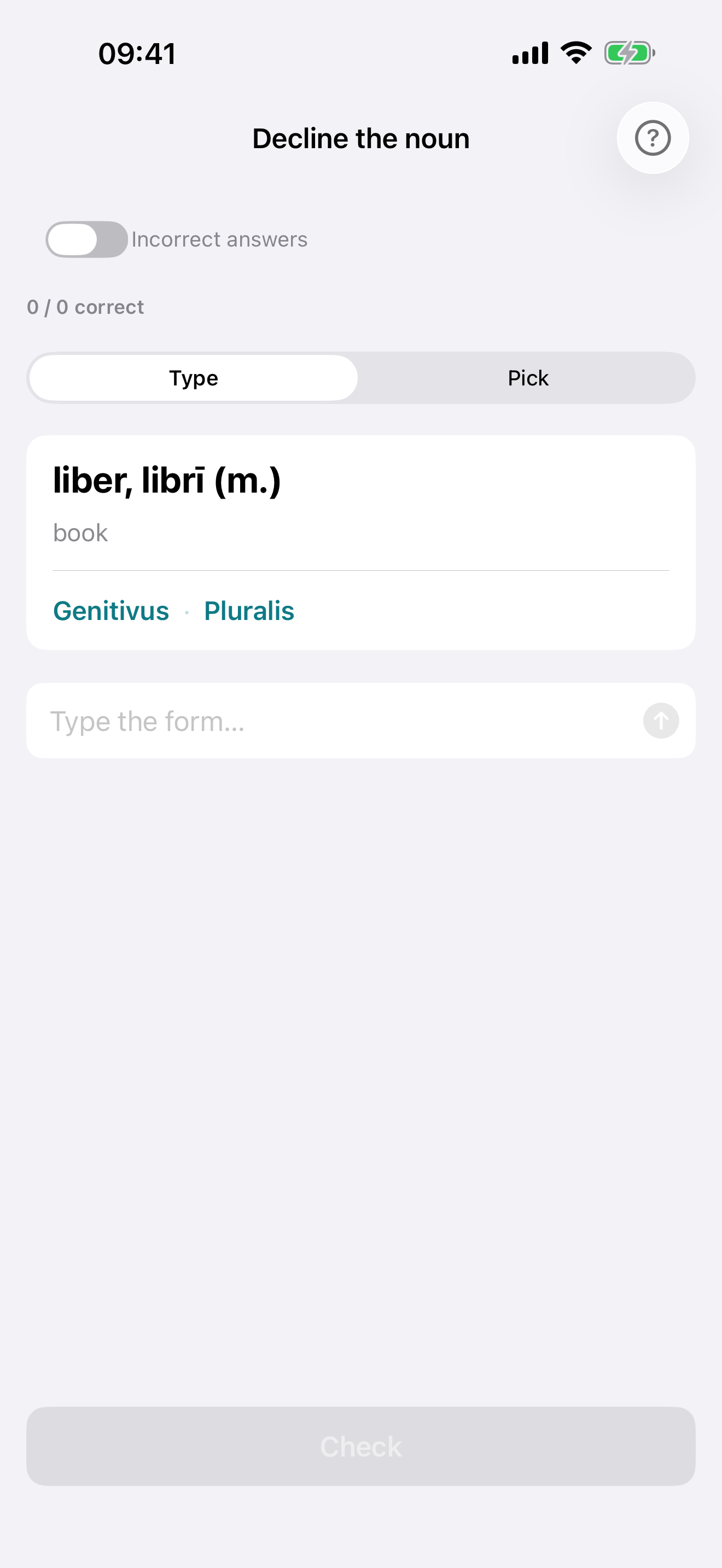 Decline the noun
Produce the form that the case and number ask for — type it, or pick it from a list — with macron checking as lenient or as strict as you choose.
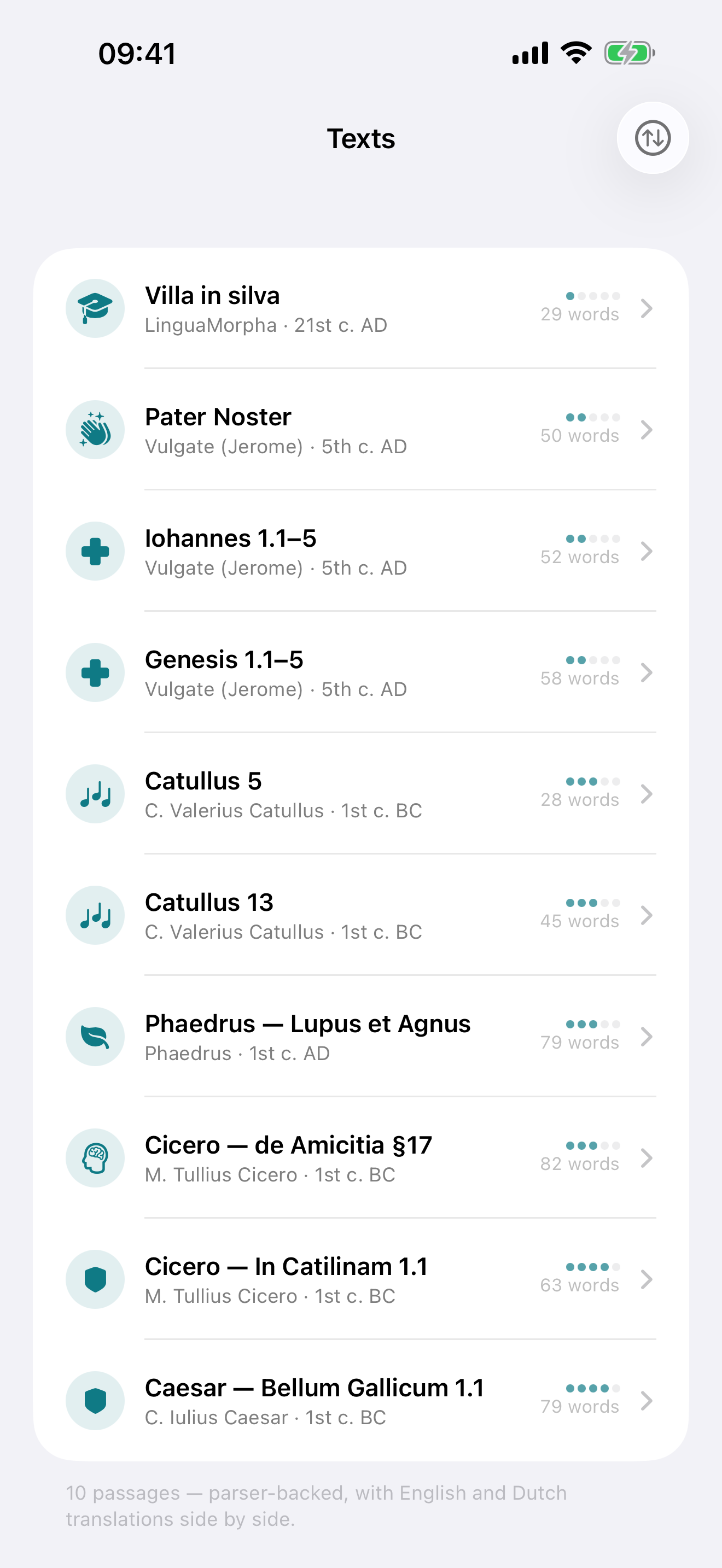 Annotated readings
Ten passages, sorted by difficulty, with a translation under every line and a parse behind almost every word.
Verb grammar
The full classical tense system: indicative, subjunctive and imperative, active and passive, plus the non-finite forms. Each tense can be switched on or off in Select tenses.
Indicative — present system (active and passive)
- Praesens
- Imperfectum
- Futurum
Indicative — perfect system (active and passive — the passive built with the perfect participle and esse)
- Perfectum
- Plūsquamperfectum
- Futūrum Exactum
Subjunctive — four tenses (active and passive)
- Subjunctivus Praesens
- Subjunctivus Imperfectum
- Subjunctivus Perfectum
- Subjunctivus Plūsquamperfectum
Imperative
- Present (the everyday "do this!")
- Future (formal register — laws, prayers, maxims)
- Their passive forms
Non-finite forms
- Six infinitives (three tenses × two voices)
- All four participles: present active, perfect passive, future active, and the future passive or gerundive
- Gerund (the verbal noun)
- Supine (accusative in -um for purpose, ablative in -ū for respect)
Verb groups. The verbs are filed in six groups: the 1st (-āre), 2nd (-ēre), 3rd (-ere), 3rd-iō and 4th (-īre) conjugations, and the fully irregular verbs (sum, possum, eō, fīō and their compounds). Ferō, volō, nōlō and mālō sit in the 3rd conjugation with their irregular forms stored one by one.
The verb detail. Tap any verb for a tabbed screen — Conjugation · Usage · Structure · Reference sheet — headed by its four principal parts. Conjugation can be filtered by mood, tense, stem and voice. Structure goes through the verb tense by tense, names the stem each tense is built on, shows in amber the stems you have to memorise, and can hide everything that follows the pattern. Reference sheet is a printable one-page PDF of the active voice.
Drills. Produce a form or recognise one — every analysis of an ambiguous form counts — and two choice drills, Perfectum or imperfectum and Indicativus or coniunctivus, that ask which tense or mood a sentence needs.
Noun grammar
All five declensions:
- First (gen. -ae, almost all feminine): puella, aqua, rosa
- Second (gen. -ī, masculine -us or neuter -um, plus the -er nouns): servus, bellum, puer
- Third (gen. -is, all genders) — including the i-stems (urbs, cīvis, mare) and nouns in -or, usually masculine, with feminine exceptions such as arbor
- Fourth (gen. -ūs, mostly masculine, with the feminines manus and domus and the neuters cornū and genū): exercitus, frūctus
- Fifth (gen. -ēī or -eī, almost all feminine, with diēs usually masculine): diēs, rēs
Choosing what to practise. Select noun groups narrows the drills to the declensions you want. The two nouns whose paradigms are stored form by form rather than generated, vīs and Iuppiter, have an Irregular row of their own and are drilled like any other noun. Drill a noun both ways: Decline the noun asks for a form, Recognise the form asks what a form is.
Adjective grammar
All five textbook patterns:
- 1st/2nd-declension (-us / -a / -um): bonus, magnus
- 1st/2nd-declension -er (-er / -a / -um): pulcher, miser, sacer — the same endings, but the masculine nominative singular ends in -er
- 3rd-declension two-ending (fortis / forte): masculine and feminine share a form, the neuter has its own
- 3rd-declension one-ending (ingēns, gen. ingentis): one nominative for all three genders, with the stem shown by the genitive
- 3rd-declension three-ending (ācer / ācris / ācre): three different nominative singulars
Comparative and superlative are derived for every adjective (-ior / -ius, then -issimus, with -rimus for -er adjectives and -limus for facilis and its family). The irregulars — bonus → melior → optimus, magnus → maior → maximus, malus → peior → pessimus, parvus → minor → minimus — are stored explicitly.
Pronouns and numerals
Pronouns — every form stored individually, grouped by class: personal (ego, tū, reflexive suī), demonstrative (is, hic, ille, iste, ipse, īdem), relative (quī), interrogative (quis) and indefinite (alius). The form drill asks for a case, number and gender and offers the same pronoun's other forms as the wrong options.
Numerals — the cardinal numbers. Ūnus, duo and trēs decline and get a full table; the others, from quattuor to centum and mīlle, are indeclinable and show a card with their single form.
Try it
Every language is open for 21 days with every feature unlocked. After that, unlock Latin on its own or buy Unlock all languages — a one-time purchase, no subscription, no ads, no account. Your answers stay on your device.



One purchase, every device. The iPhone, iPad and Mac apps share a single App Store listing, so a language you unlock on one is unlocked on the others — same Apple ID, no second payment.