Verb groups

Verb groups, under Theory on the verbs hub, is reference reading: nothing is recorded. Read it before you choose groups, because Select verb groups is only as useful as your sense of what the groups are.
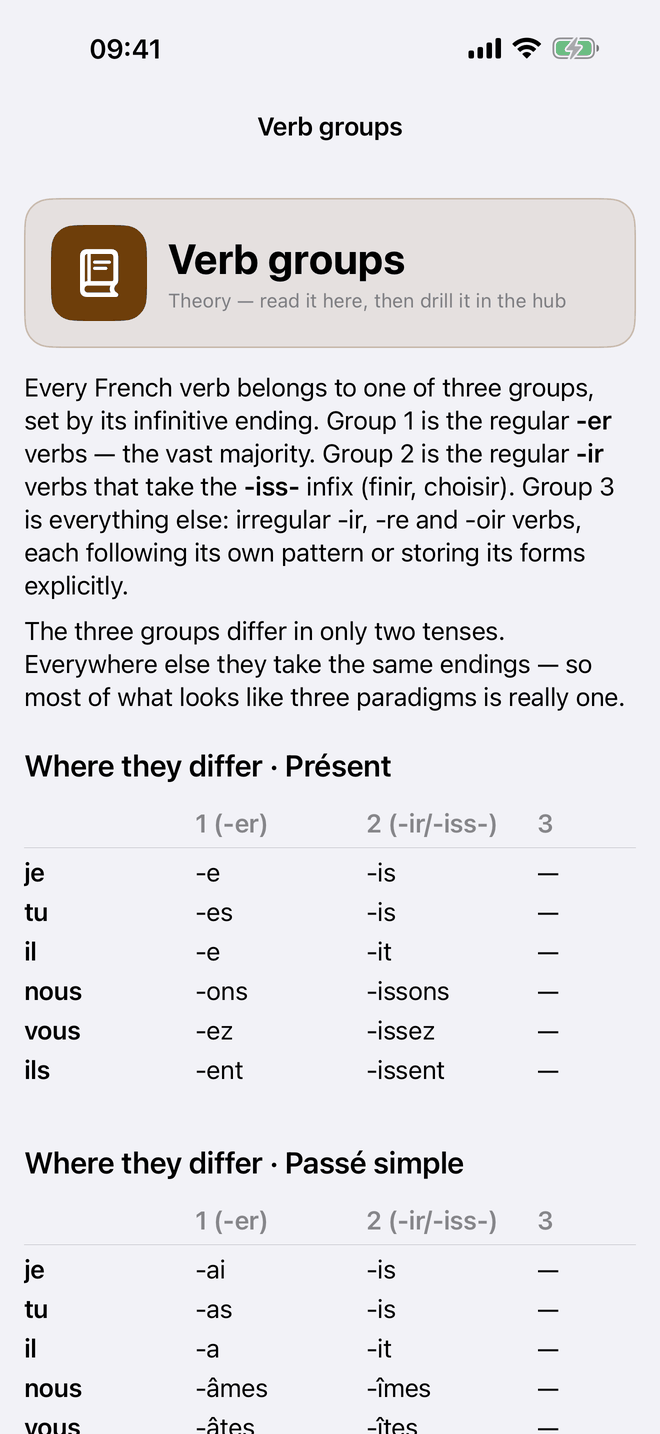
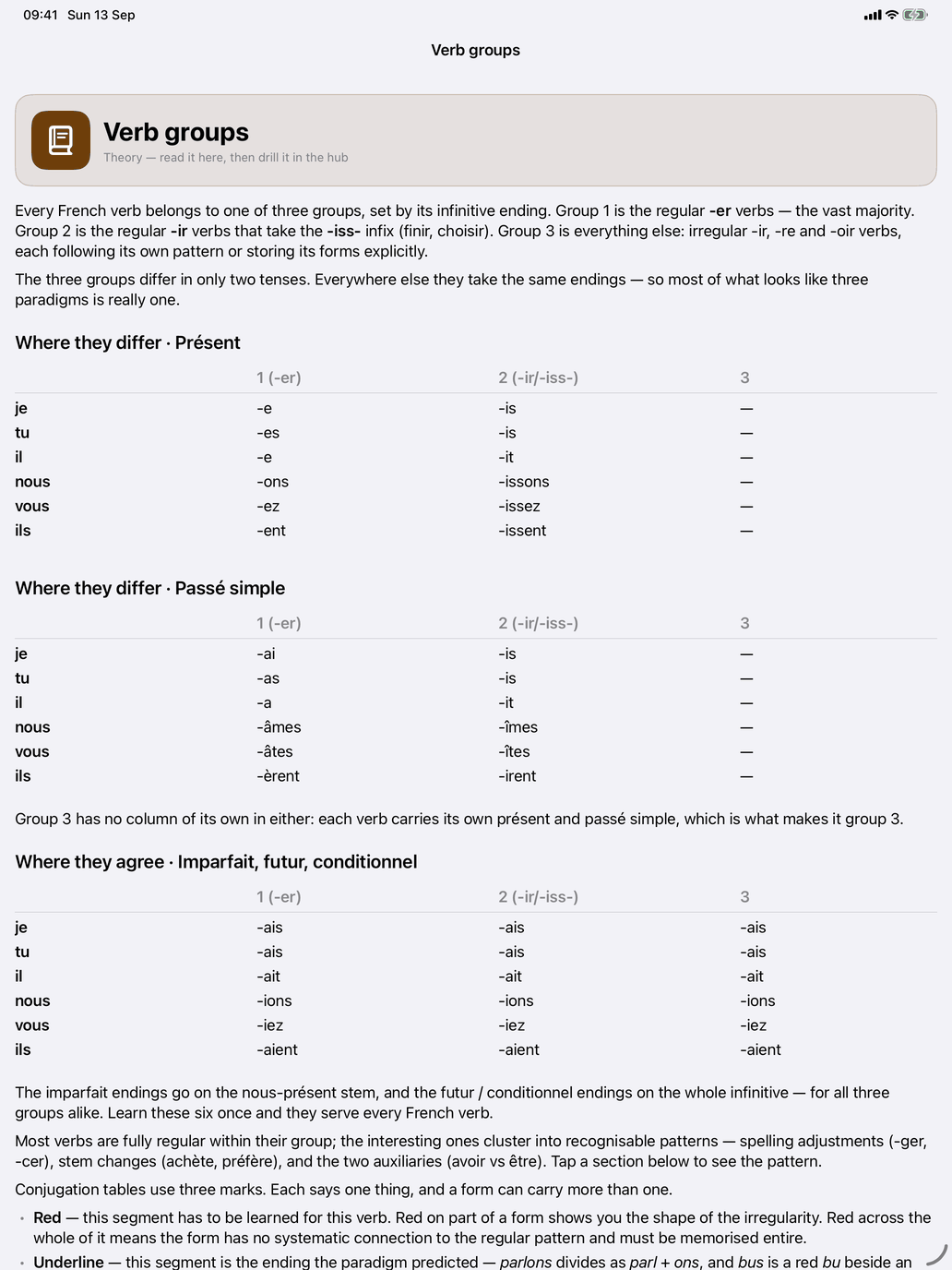
The page opens with the three French groups side by side. The tables show the only two tenses where their endings differ, the présent and the passé simple, and then the endings all three share in the imparfait, futur and conditionnel:
| présent 1 (-er) | présent 2 (-ir / -iss-) | shared imparfait | |
|---|---|---|---|
| je | -e | -is | -ais |
| tu | -es | -is | -ais |
| il | -e | -it | -ait |
| nous | -ons | -issons | -ions |
| vous | -ez | -issez | -iez |
| ils | -ent | -issent | -aient |
The 3rd group has no column of its own in the présent or passé simple: each of its verbs has its own forms there. The imparfait endings go on the stem of the nous form of the present (nous parlons → je parlais). The futur and conditionnel endings go on the whole infinitive (parler → je parlerai). The intro ends with an explanation of the three marks used in the conjugation tables (see The conjugation colour code (French)).
Below the intro, the groups are listed under their five sections (Basic, Spelling, Stem Changes, Auxiliary, Irregular), which fold open. Each group has a card with a short description. Open it for the full explanation, with endings tables for the group where it has its own pattern, and a worked example. These are the same cards the ⓘ buttons on Select verb groups and the group badges on a verb's page open.