Phrases
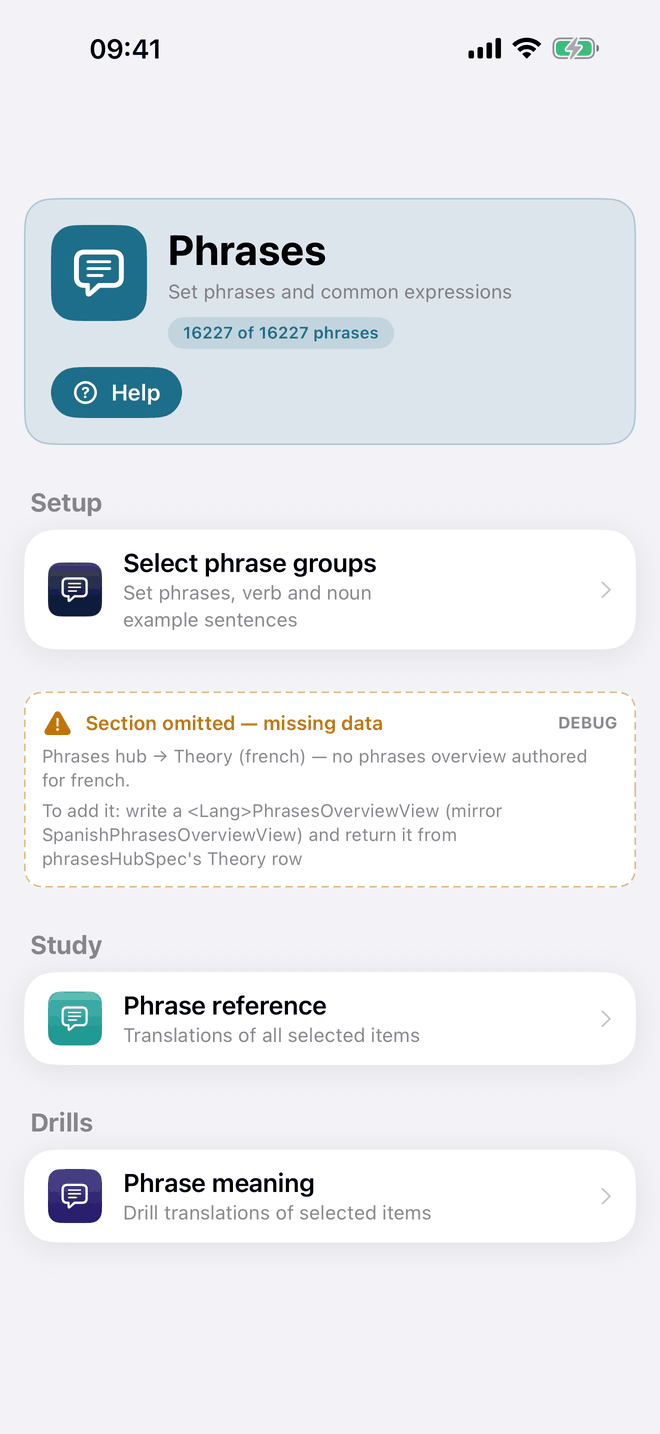
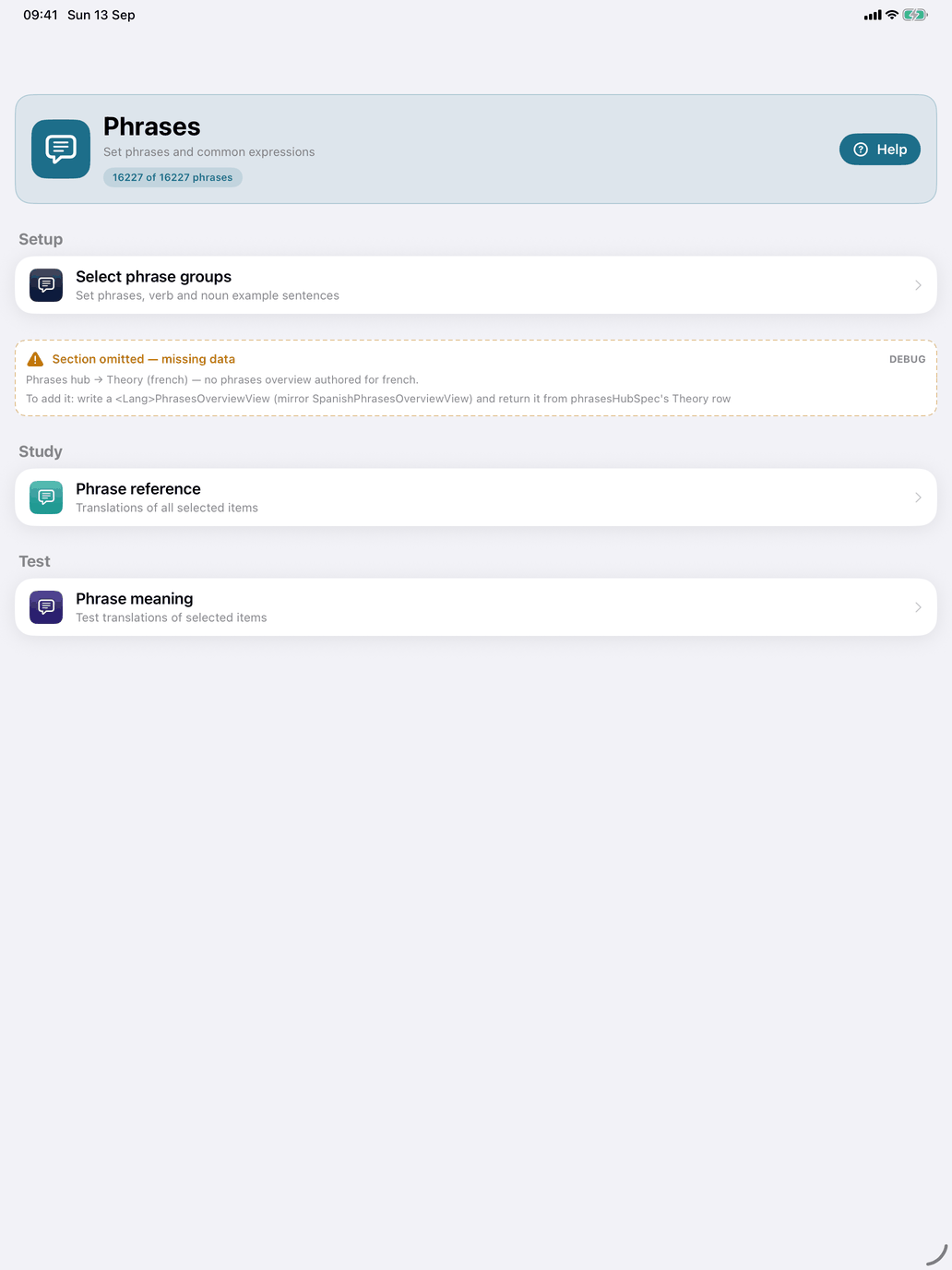
Open the Phrases hub from the Phrases tile on the Self Study screen. The line under the title ("… of … phrases") shows how many phrases your selection leaves. The phrases come in three groups:
- Set phrases — about 240 fixed expressions to learn as a whole: greetings and social phrases (s'il vous plaît, de rien, à bientôt), time expressions (tout de suite, à tout à l'heure) and connecting phrases (à cause de, bien sûr, tout à fait). Some are built around a verb (avoir faim, avoir besoin de, faire attention).
- Verb example sentences — the tense examples of the verbs, each practised as a phrase: Tu abandonnes toujours tes projets à mi-chemin. A sentence is only included when its tense is switched on in Select tenses.
- Noun example sentences — the example sentences of the nouns: Le chien dort dans le jardin.
The hub has these screens:
- Select phrase groups (Setup) — choose which groups count.
- Phrase reference (Study) — the selected phrases.
- Phrase meaning (Drills) — flashcards.
There is no Theory page for French phrases. Phrases work best alongside the Verbs and Nouns hubs, not instead of them. For single words that have no hub, see Other Vocabulary.
Select phrase groups. Tap Set phrases, Verb example sentences or Noun example sentences to switch the group on or off. Each row shows its size and a few samples; tap ⓘ for a short explanation with more examples. The line at the top shows how many phrases you selected and how many are left after the rest of your scope. The pool is also narrowed by:
- Select word scope — the level and topics. An example sentence takes the topic of its verb or noun; a verb's tense example has its own level.
- Select tenses — a verb example only counts when its tense is selected.
Set phrases alone is a small, focused pool; with both example groups on, many thousands of sentences are included. Learn set phrases as a whole: don't translate tout de suite word by word.
Phrase reference. A list of the phrases in your selection with their translations, with a search field that matches the phrase or its translation. Nothing is recorded here.
- Touch and hold a row to hear the phrase.
- The toolbar button hides or shows the translations (Hide translation / Show translation), so you can test yourself on the list.
- Tap a phrase to open its page: the phrase, its translation and type (Expression or Verbal expression), its Level, Frequency and Topics, and the Dictionaries row. An example sentence also has an Illustrates card that names the verb or noun it belongs to.
Phrase meaning. A flashcard deck for the meaning of the selected phrases. It works like Noun meaning: the phrase is on the card and you recall its translation, or the other way round. On a card for a verb example sentence, the verb appears as a chip on the French side; tap it to open that verb. The speaker button is especially useful here — hearing a whole phrase helps you remember its rhythm.