Pronouns
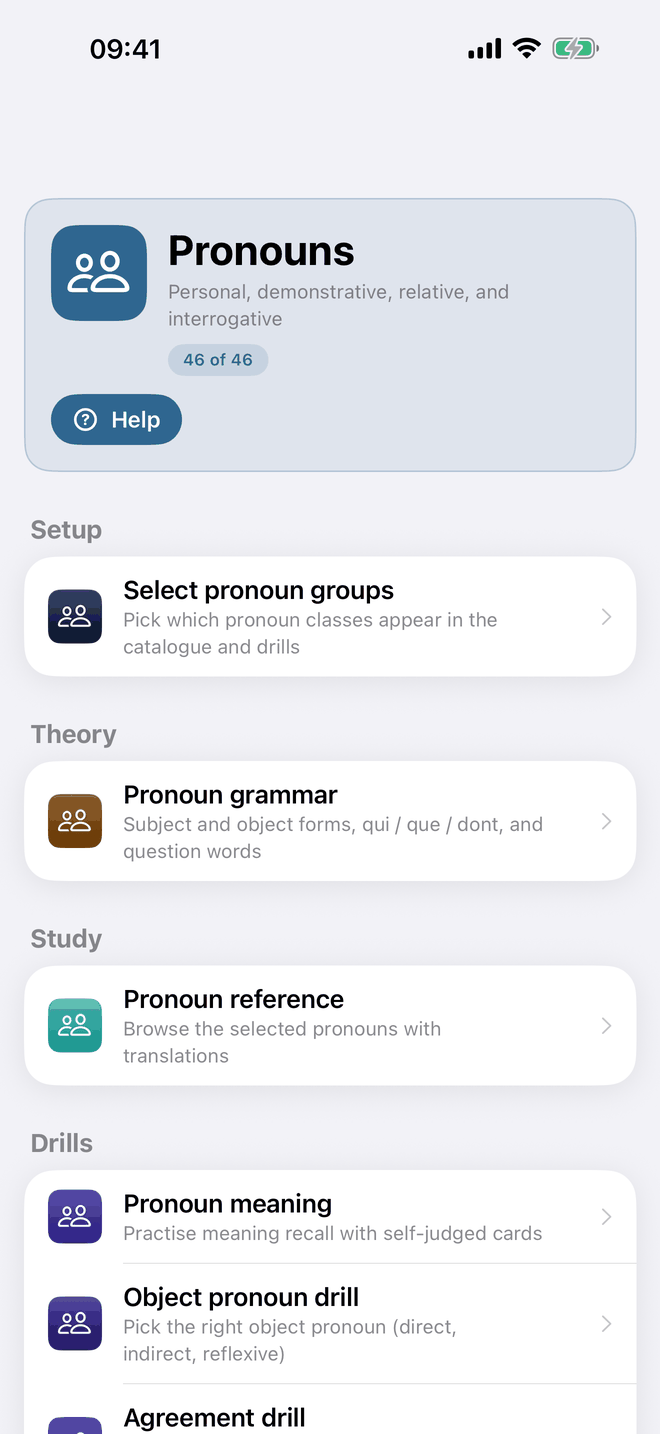
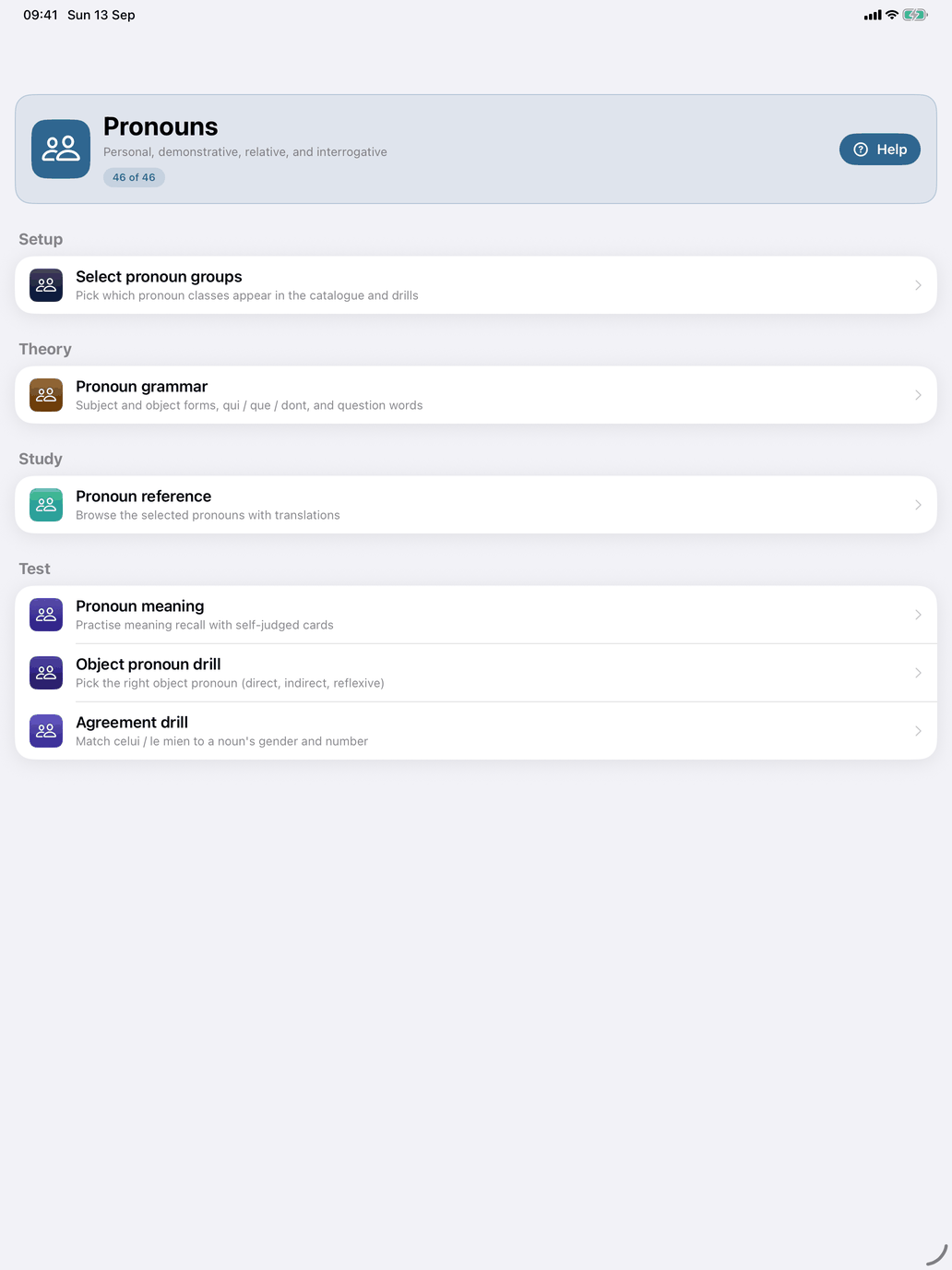
The Pronouns hub covers the French pronoun catalogue in six classes: personal, demonstrative, possessive, indefinite, relative and interrogative.
Open Self Study → Pronouns. The hub has:
- Setup — Select pronoun groups: choose which classes appear in the catalogue and the meaning deck.
- Theory — Pronoun grammar: subject and object forms, qui / que / dont, and question words.
- Study — Pronoun reference: the selected pronouns with translations.
- Drills:
- Pronoun meaning — flashcards for the meaning of the selected pronouns.
- Object pronoun drill — pick the right object pronoun: direct object, indirect object or reflexive.
- Agreement drill — match celui, le mien and similar pronouns to a noun's gender and number.
The line under the hub title shows how many pronouns your class selection gives you, out of the whole catalogue. Only the classes you tick decide the selection; the level and topic filters in Select word scope are not applied here.
A recommended workflow
- Start with the Personal class and run Pronoun meaning.
- Add the Object pronoun drill — le or lui, les or leur is where most mistakes are.
- Add Demonstrative and Possessive and use the Agreement drill.
Select pronoun groups
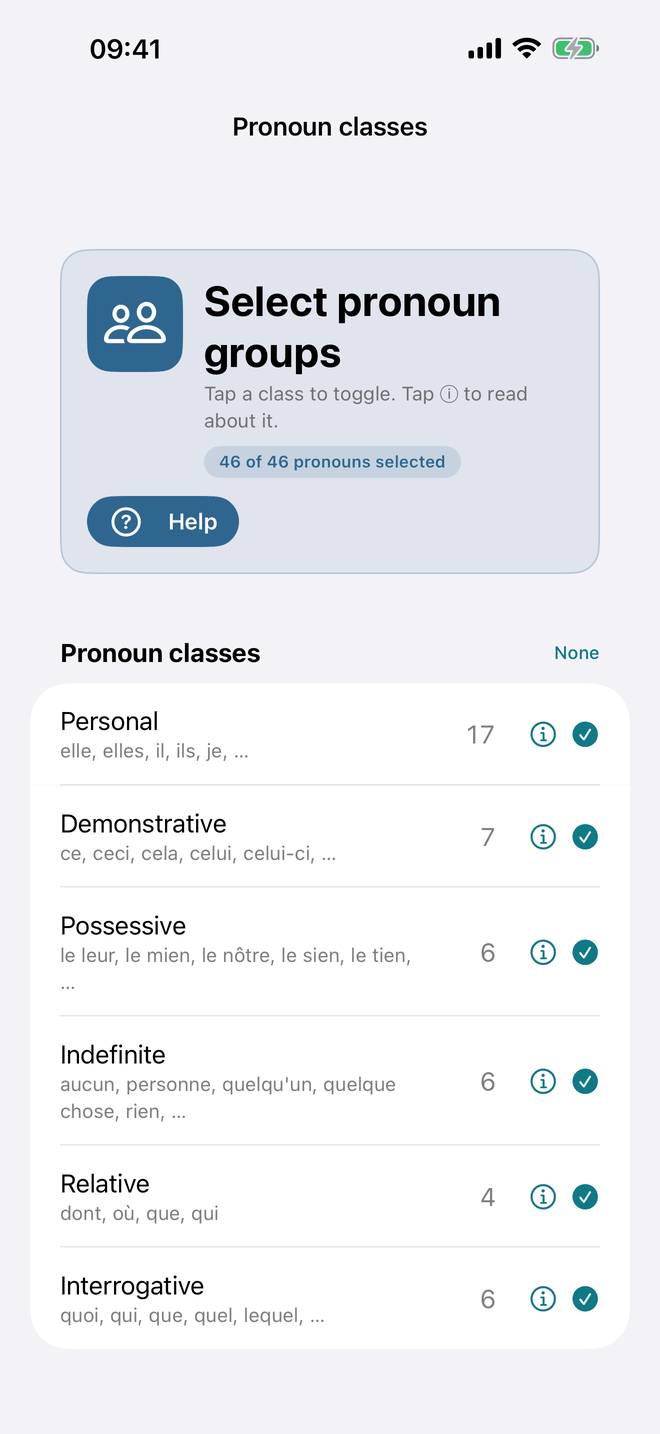
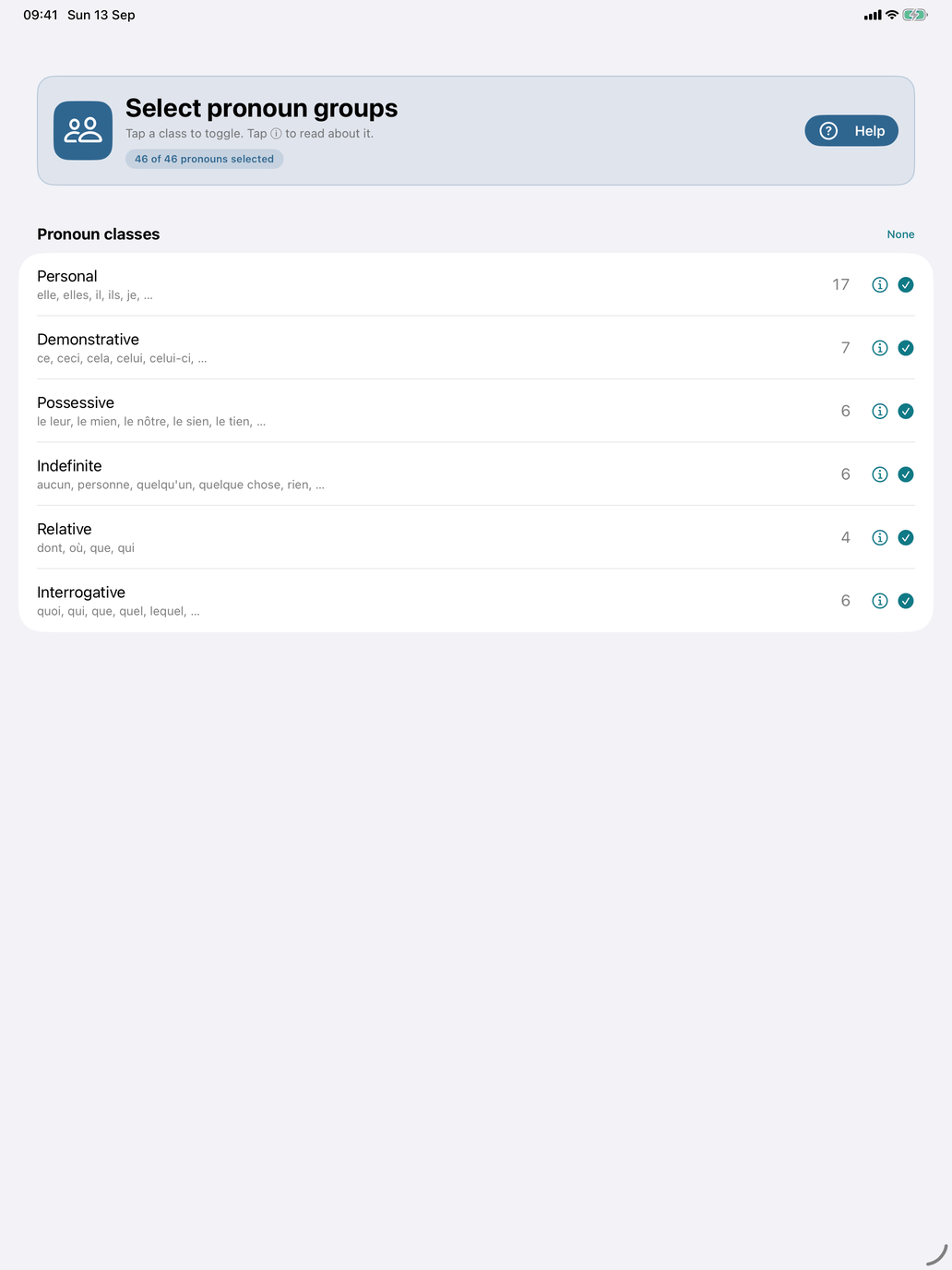
The six classes:
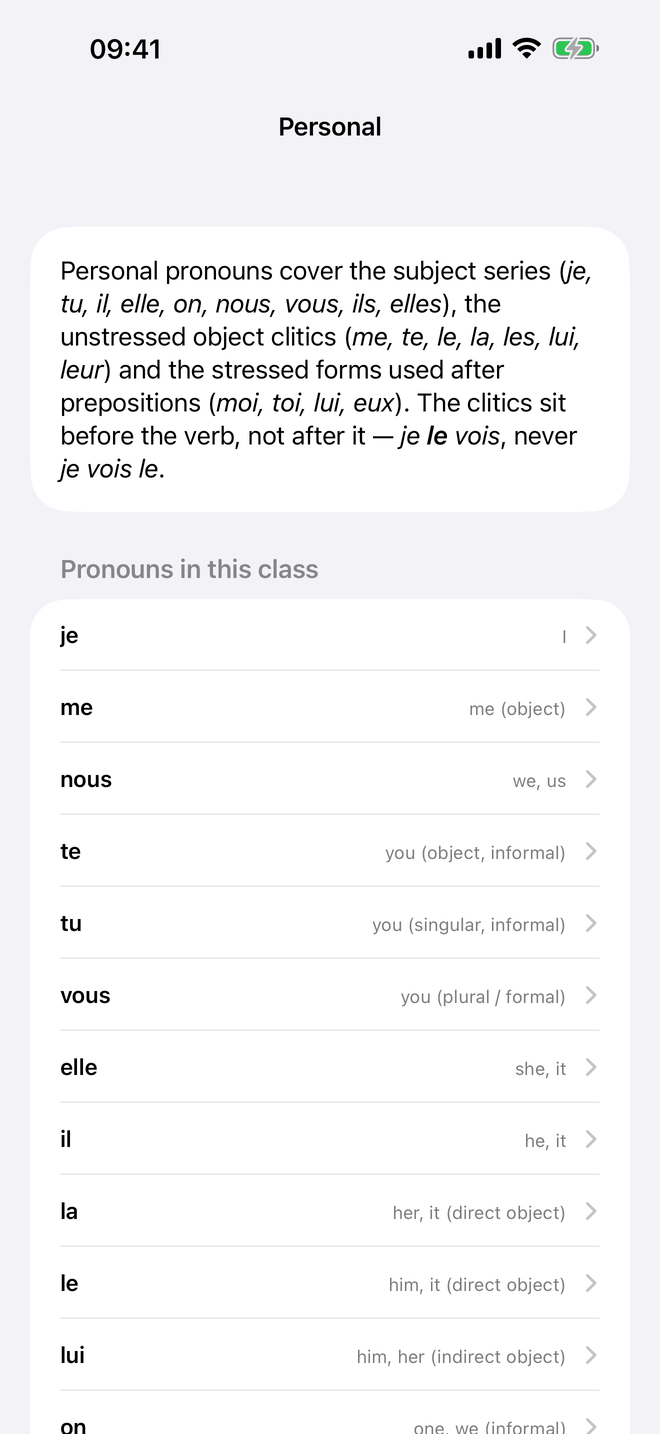
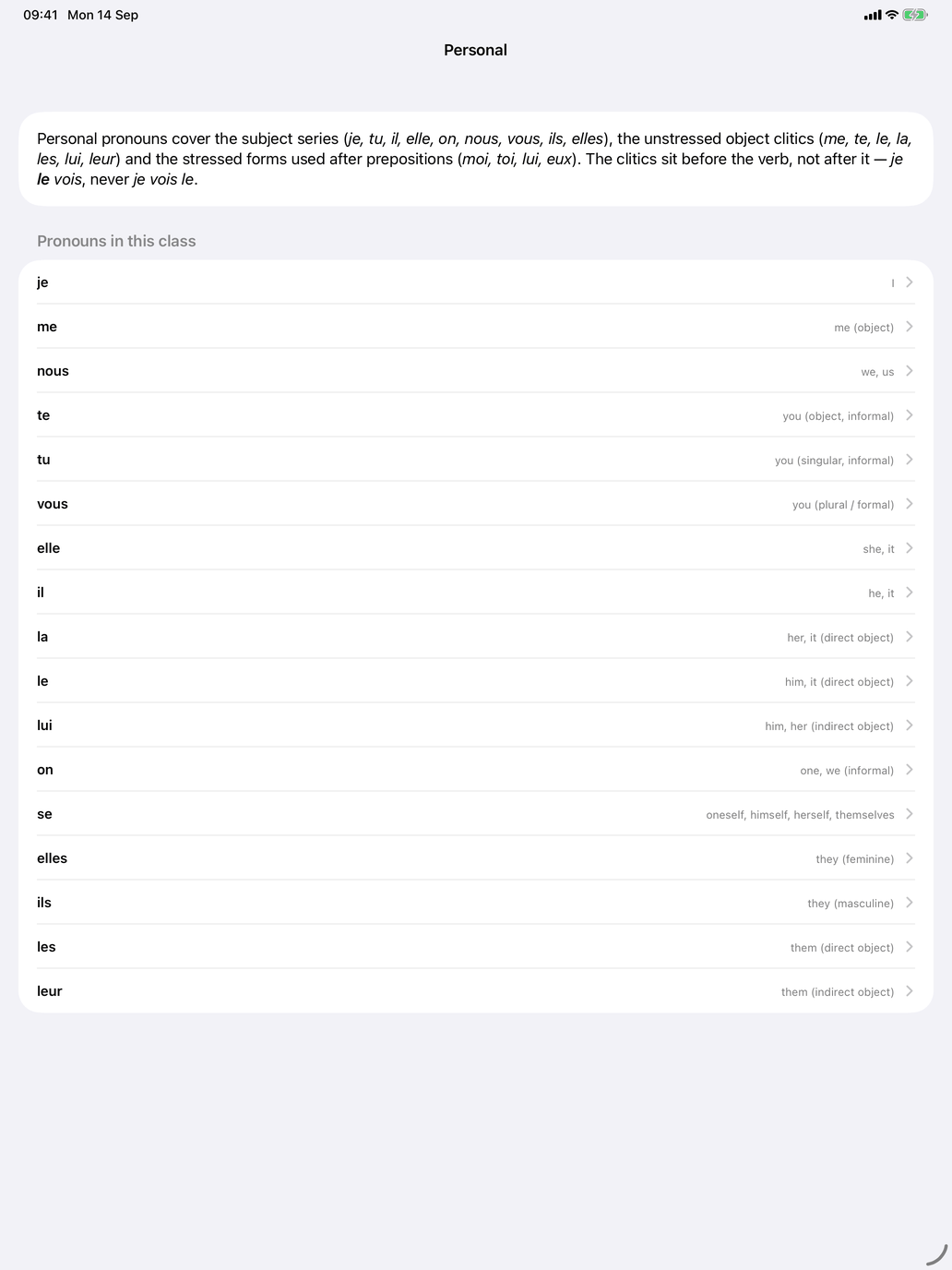
- Personal — the subject pronouns je, tu, il, elle, on, nous, vous, ils, elles, the object pronouns me, te, le, la, les, lui, leur and the reflexive se.
- Demonstrative — ce, ceci, cela, ça and celui with its -ci and -là forms.
- Possessive — le mien, le tien, le sien, le nôtre, le vôtre, le leur.
- Indefinite — quelqu'un, quelque chose, personne, rien, tout, aucun.
- Relative — qui, que, dont, où.
- Interrogative — qui, que, quoi, quel, lequel, où.
Tap a class to switch it on or off; each row shows its size and the first few pronouns. Tap ⓘ to read about the class and see all its pronouns; tap one to open it.
Pronoun grammar
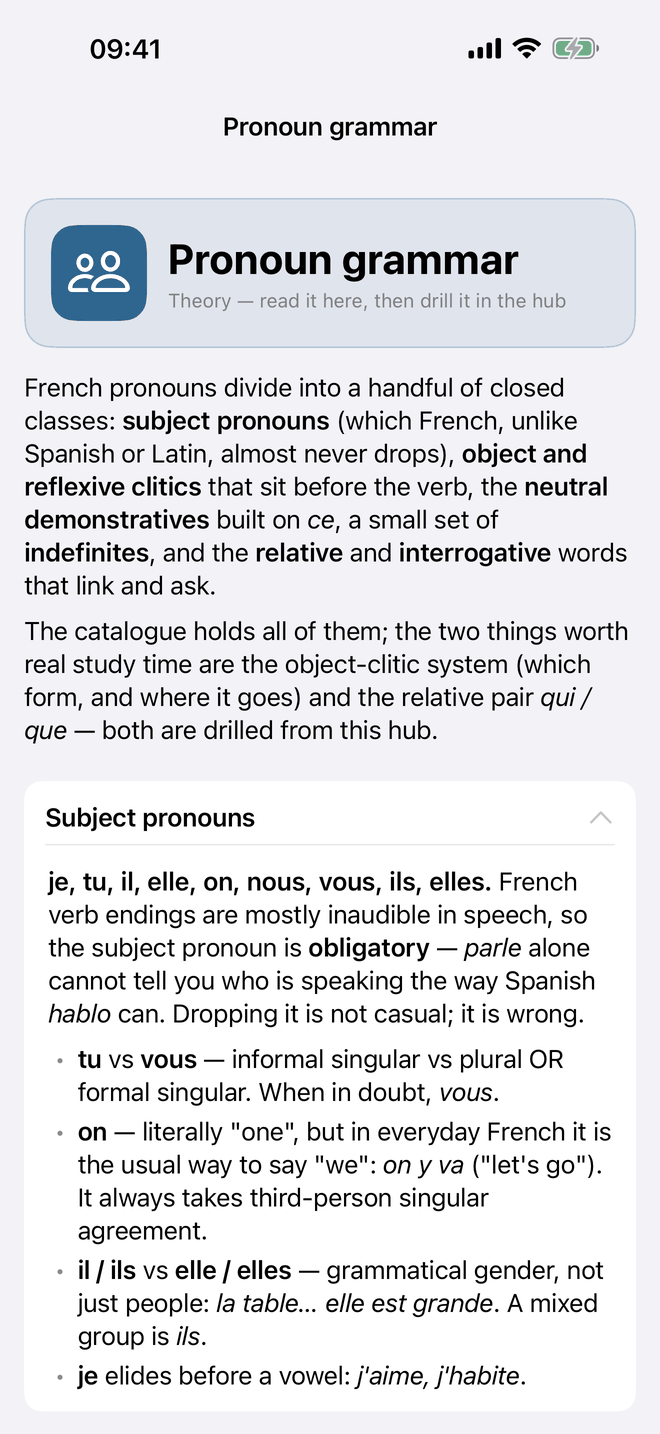
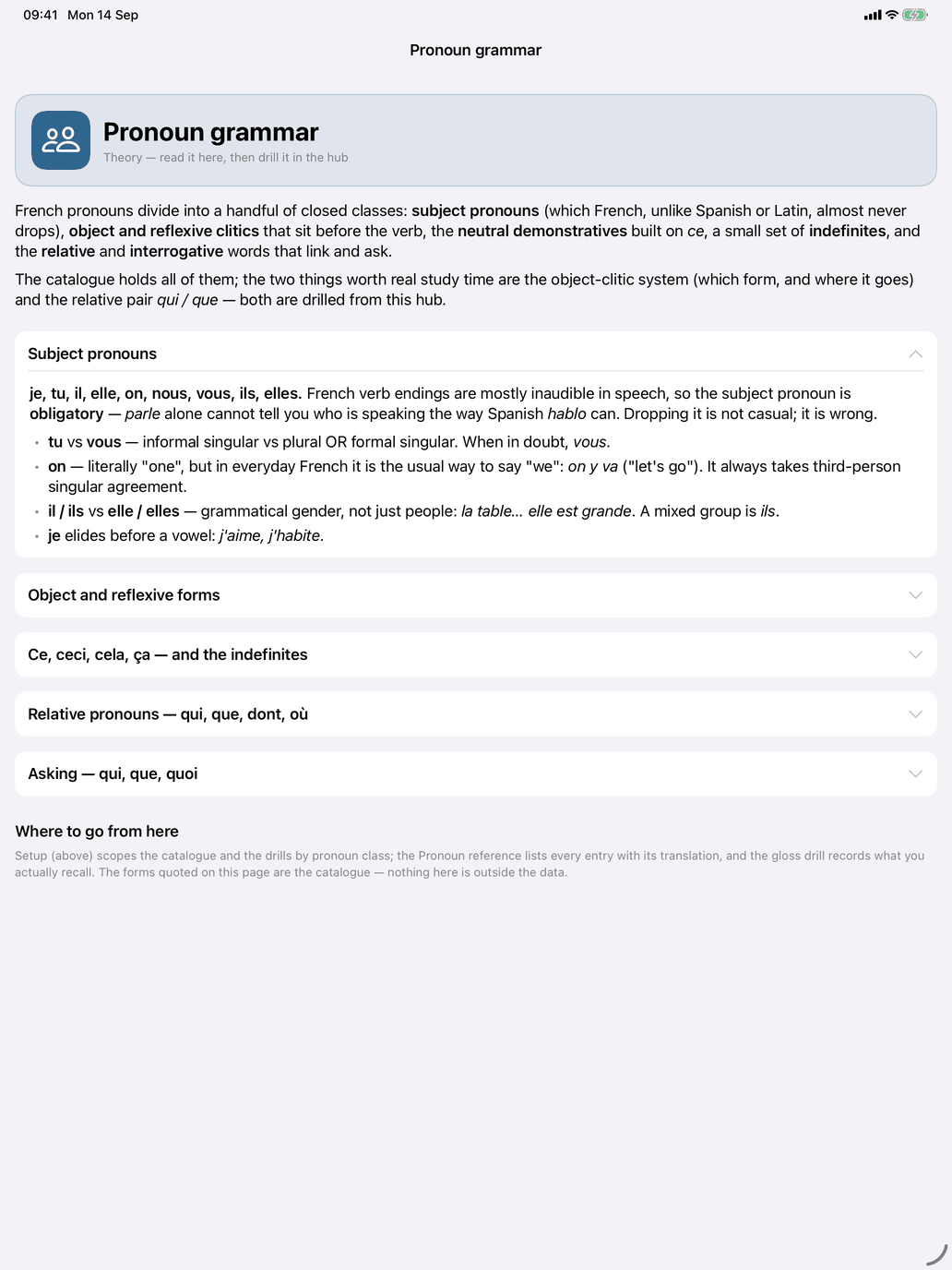
A reference page; nothing is recorded.
Subject pronouns — je, tu, il, elle, on, nous, vous, ils, elles. French verb endings are mostly silent, so the subject pronoun is required: parle on its own doesn't say who is speaking.
- tu is informal singular; vous is plural, or formal singular. When in doubt, use vous.
- on literally means "one", but in everyday French it usually means "we": on y va ("let's go"). It always takes a third-person singular verb.
- il / ils and elle / elles follow grammatical gender, not only people: la table… elle est grande. A mixed group is ils.
- je becomes j' before a vowel: j'aime.
Object and reflexive pronouns go before the conjugated verb: je le vois, elle me parle.
- Direct object: me, te, le, la, nous, vous, les. Le and la become l' before a vowel: je l'aime.
- Indirect object ("to …"): me, te, lui, nous, vous, leur. Lui means both "to him" and "to her".
- Reflexive: me, te, se, nous, vous, se — se serves every third person: il se lave, elles se lavent.
Watch out: le, la, les are also articles and leur is also a possessive. Before a verb they are pronouns (je les vois); before a noun they are not (les livres, leur maison).
Ce, ceci, cela, ça. Ce is the neutral pronoun of c'est / ce sont. Ceci and cela point at an idea or a situation; ça is the everyday spoken form of cela (ça va ?). Celui, celle, ceux, celles replace a noun already mentioned and agree with it; they never stand alone but take -ci, -là, de or a relative clause: celui de mon frère.
Indefinites. quelqu'un / personne (someone / no one), quelque chose / rien (something / nothing), tout (everything). Personne and rien go with ne: je ne vois personne. In a short answer they stand alone: Qui est là ? — Personne.
Possessive pronouns replace a noun and carry the article: le mien, la tienne, les nôtres. They agree with the thing owned, not with the owner. Don't confuse them with the possessive determiners mon / ma / mes, which go with a noun.
Relative pronouns. The choice between qui and que depends on the pronoun's role, not on people or things:
- qui is the subject of the relative clause: le livre qui est sur la table.
- que is the object: le livre que je lis. It becomes qu' before a vowel.
- dont replaces de + something: l'ami dont je parle, le livre dont j'ai besoin (from avoir besoin de).
- où covers place and time: la ville où j'habite, le jour où il est arrivé.
Asking. Qui asks about people (Qui vient ?), que about things (Que fais-tu ?), and quoi is used after a preposition or on its own (De quoi parles-tu ?). Quel agrees with its noun (quelle heure) and lequel replaces one (laquelle préfères-tu ?). Everyday French often uses est-ce que: Qu'est-ce que tu fais ?
Pronoun reference
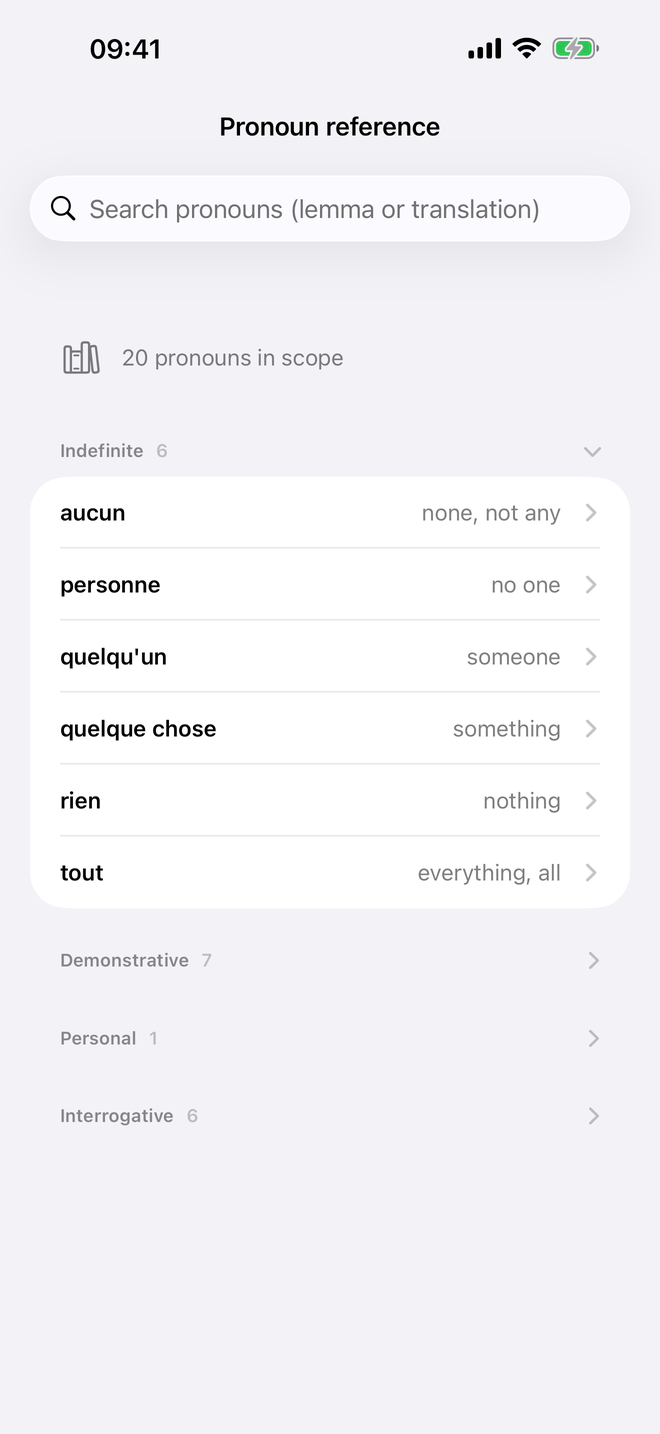
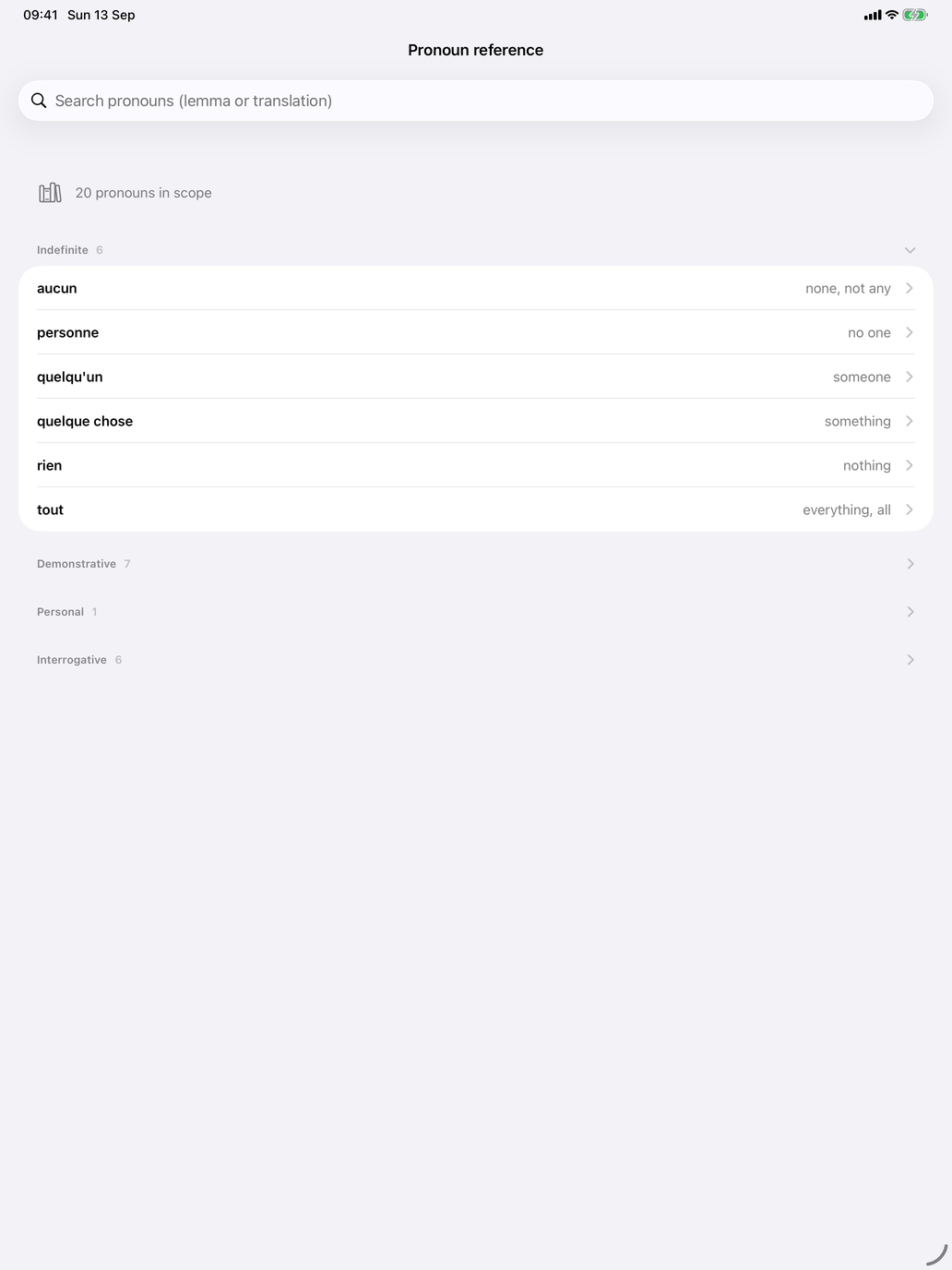
A browse-only list of the selected pronouns with their translations, in sections by class, with a search field. Nothing is recorded.
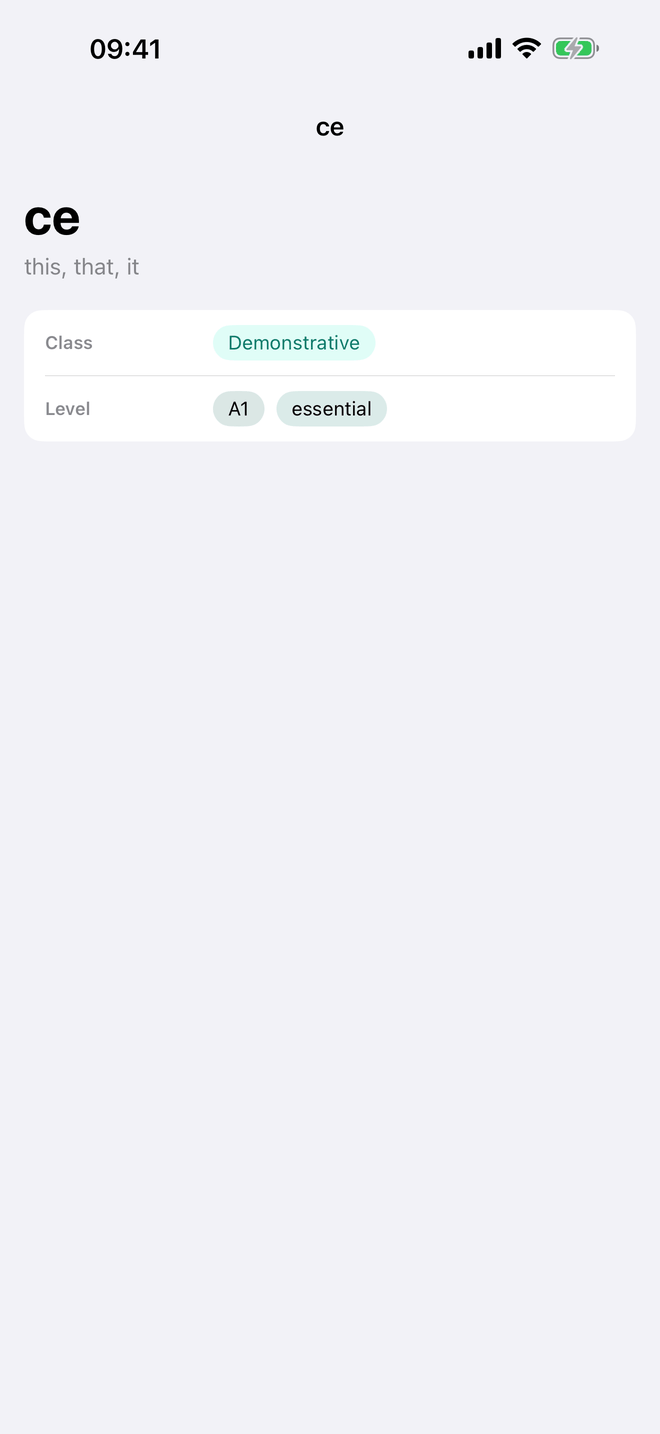
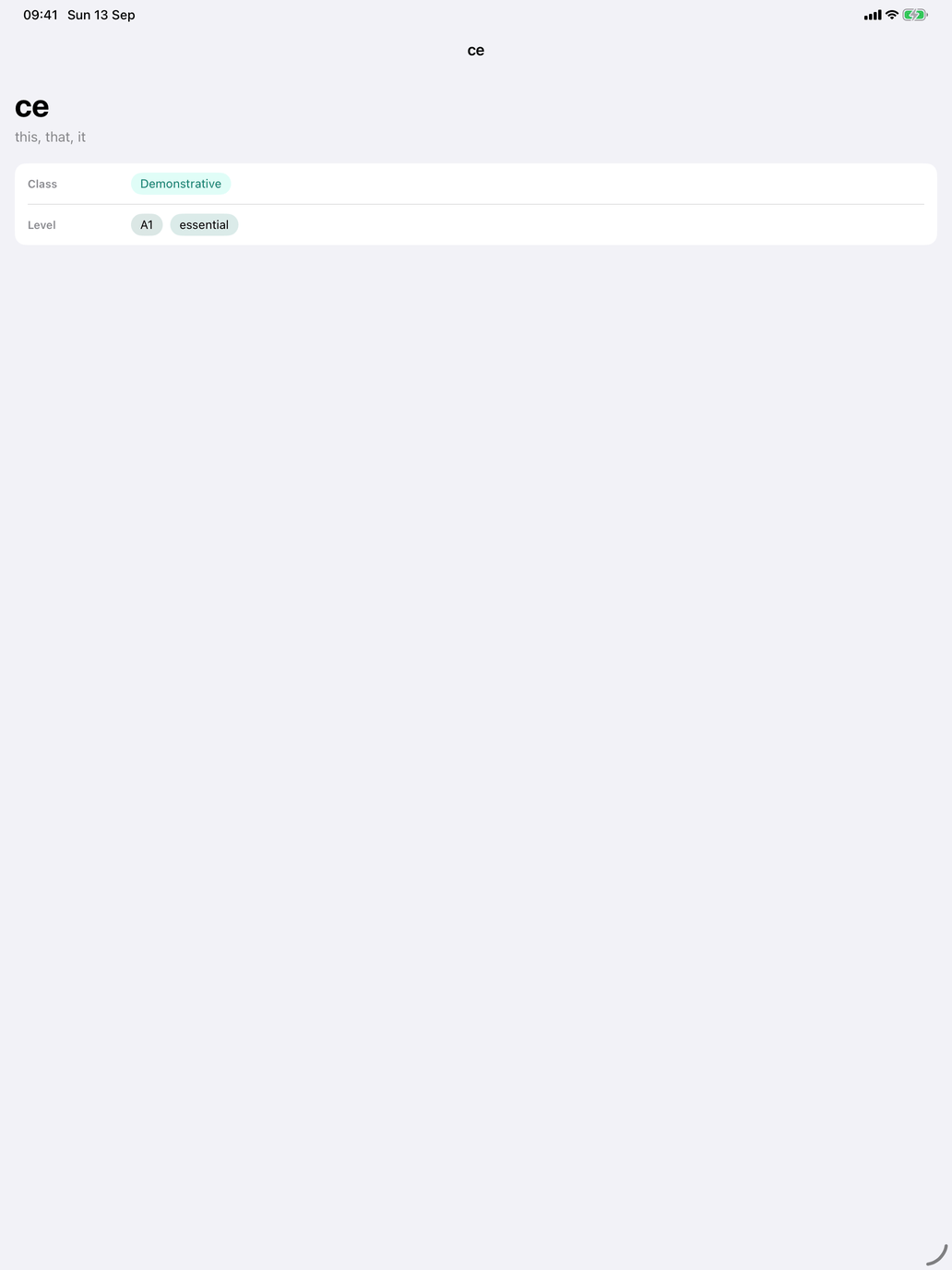
Tap a pronoun to open its page: the pronoun and its translation, its Class, and its Level (with its frequency).
Pronoun meaning
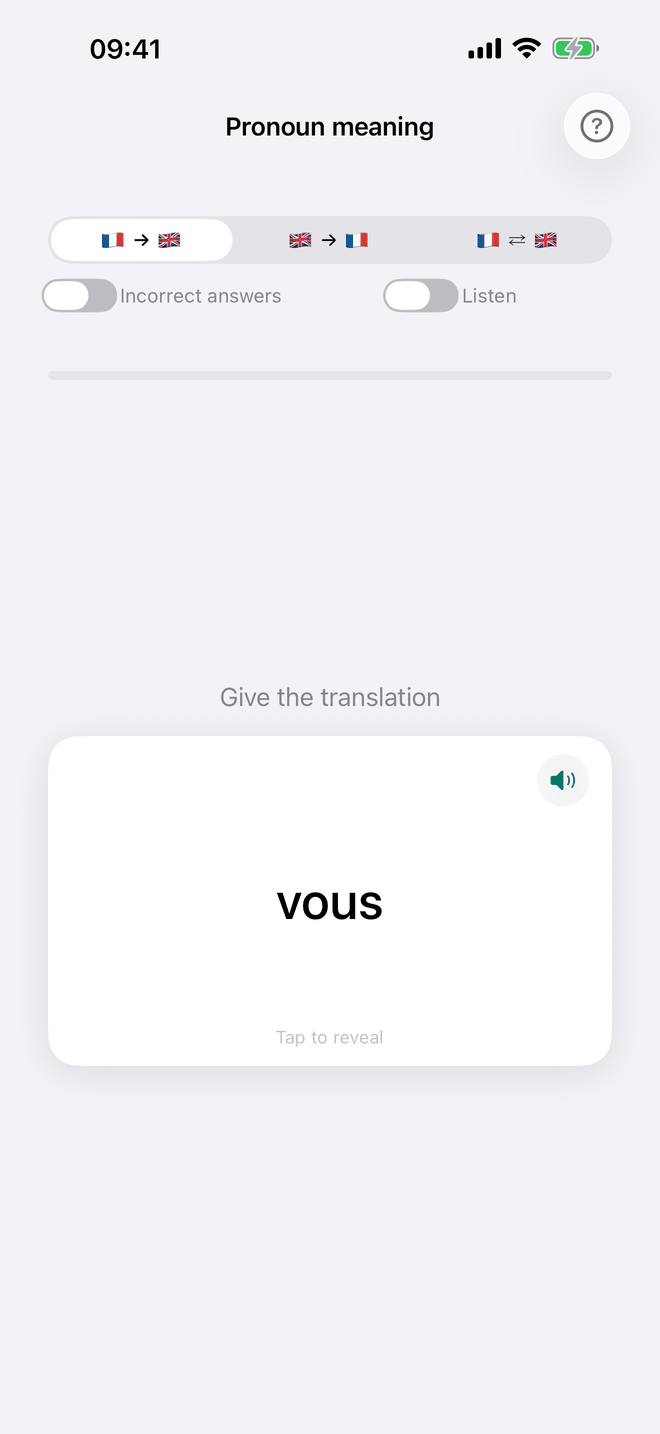
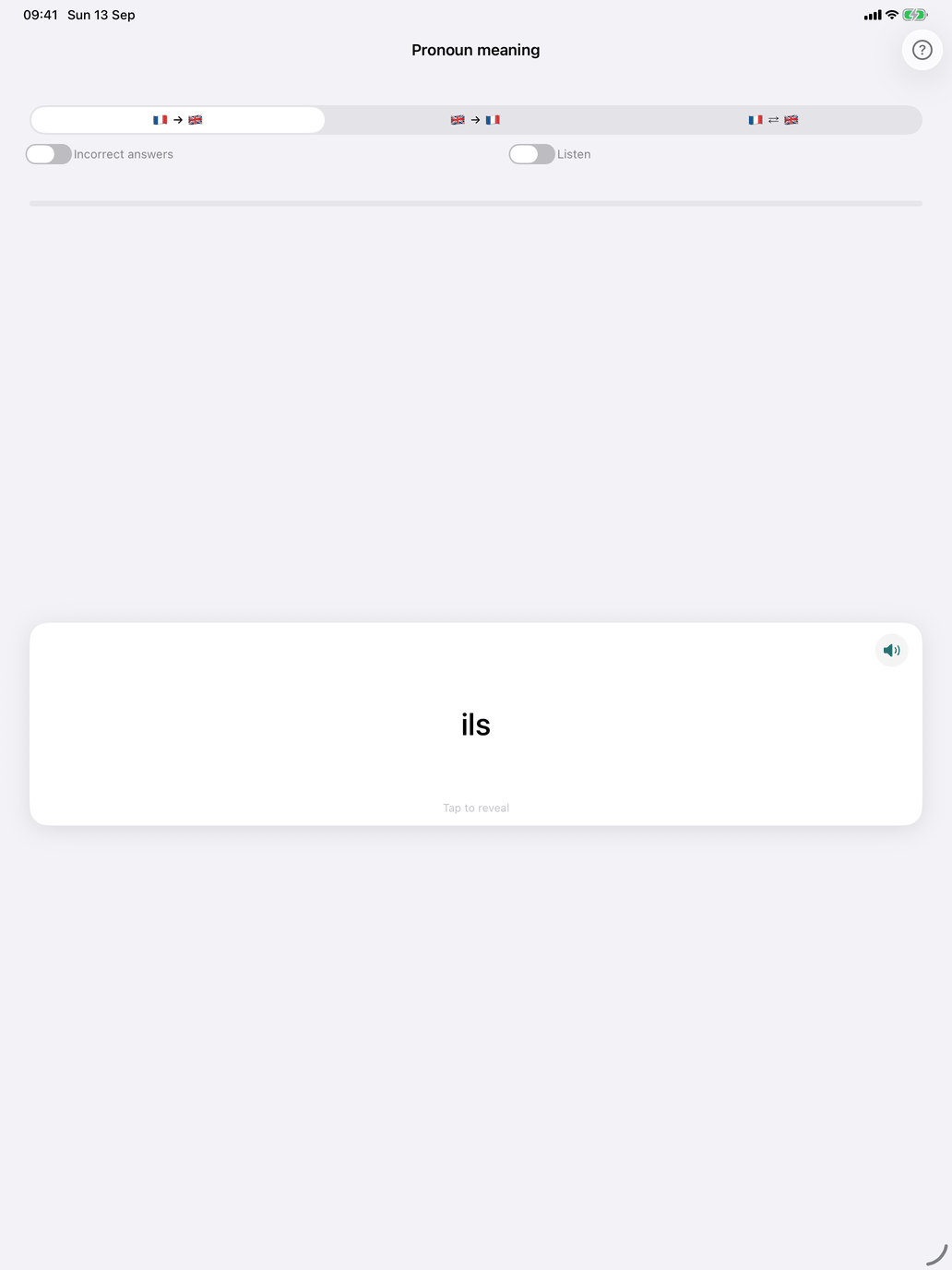
A flashcard deck for the meaning of the selected pronouns, in either direction. It works like Noun meaning. Every answer is recorded.
Object pronoun drill
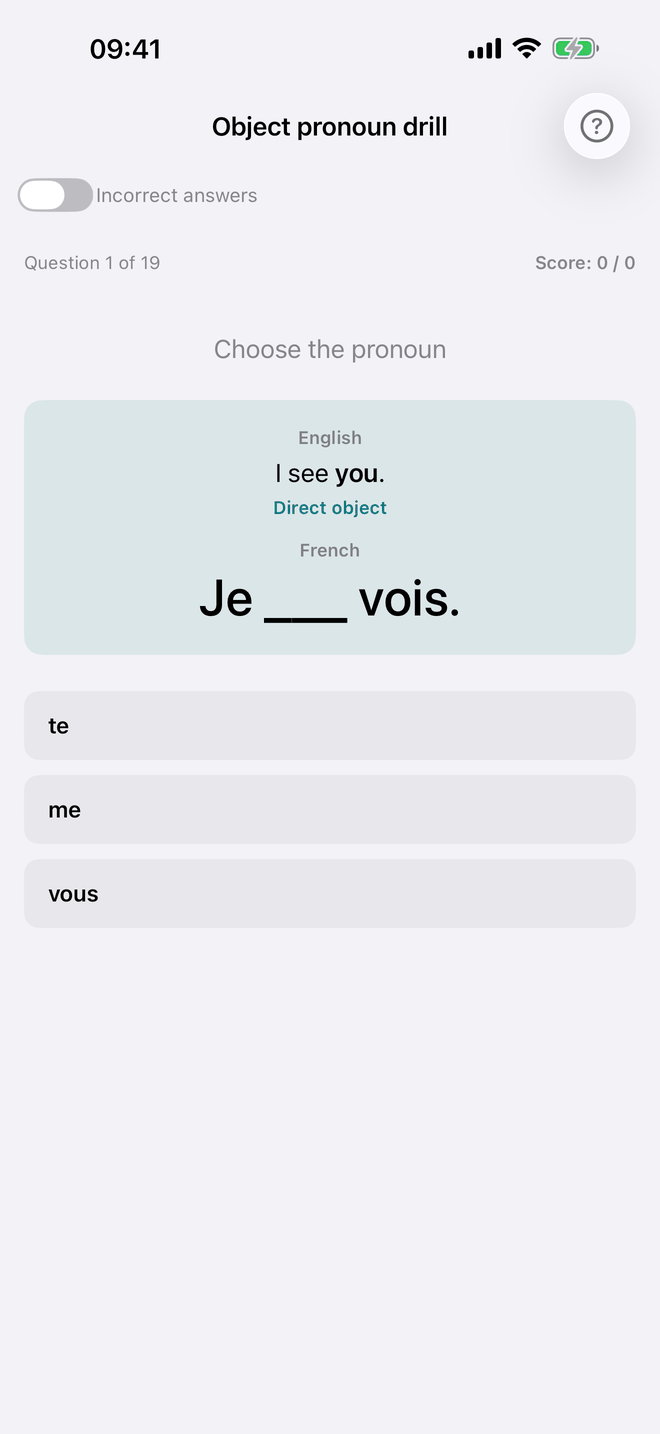
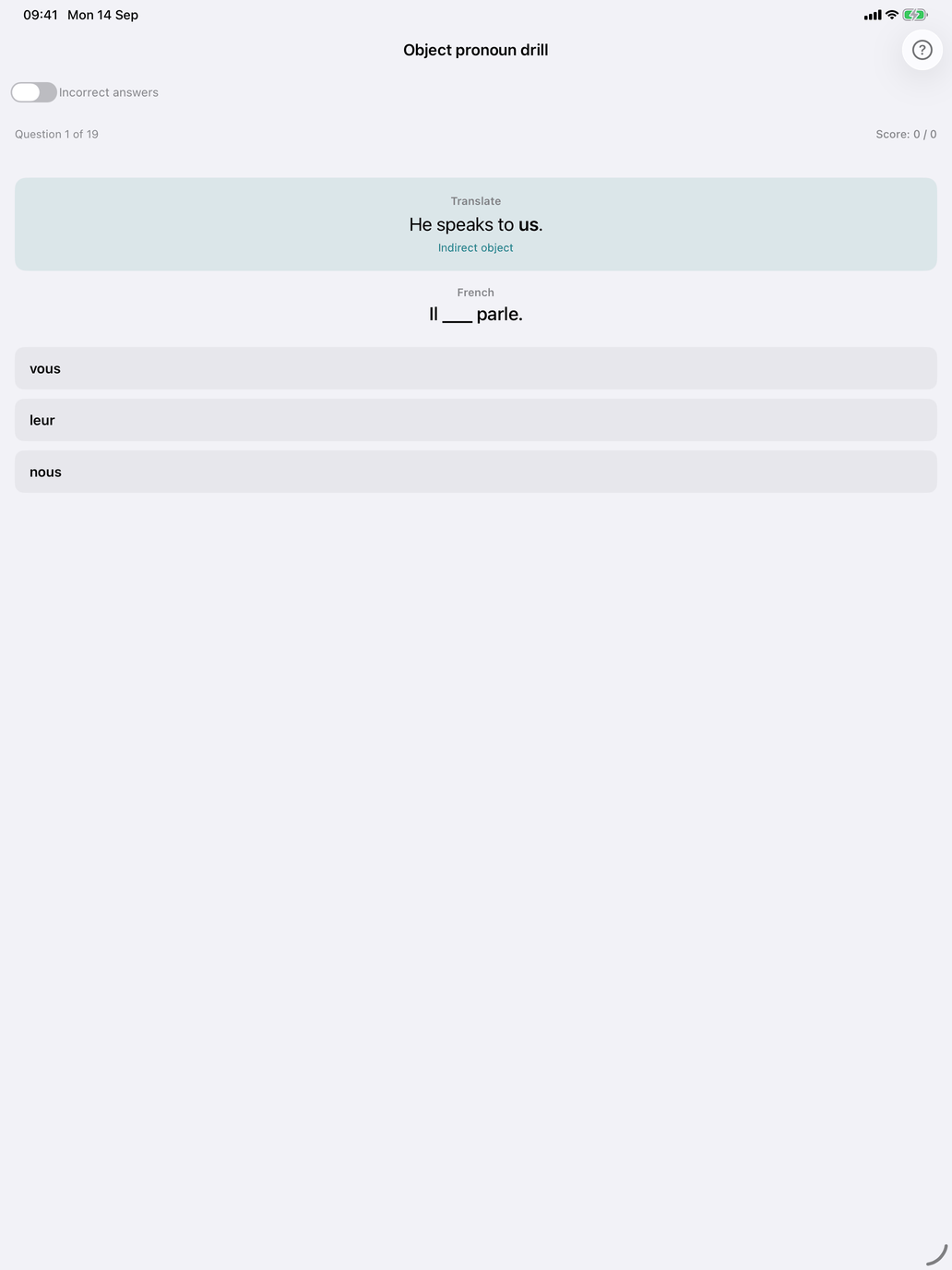
Each question shows an English sentence with the pronoun in bold and a label — Direct object, Indirect object or Reflexive — and the French sentence with a gap before the verb. Tap one of three pronouns:
- Elle ___ voit. — "She sees me." → me
- Elle ___ donne un cadeau. — "She gives him a gift." → lui
- Nous ___ donnons les clés. — "We give them the keys." → leur
- Ils ___ lavent. — "They wash themselves." → se
After you answer, the right pronoun is marked and a card explains why — for example that téléphoner à quelqu'un takes an indirect object, so "I telephone her" is je lui téléphone. Tap Next question to go on.
Every sentence has a single pronoun before a verb that starts with a consonant, so you never have to elide in the gap; the explanations mention m', t', l' and s' where they apply. Answers are recorded per slot and person, so the combinations you miss come back more often. The drill needs the Personal class to be ticked in Setup; without it the drill tells you to add it.
Agreement drill
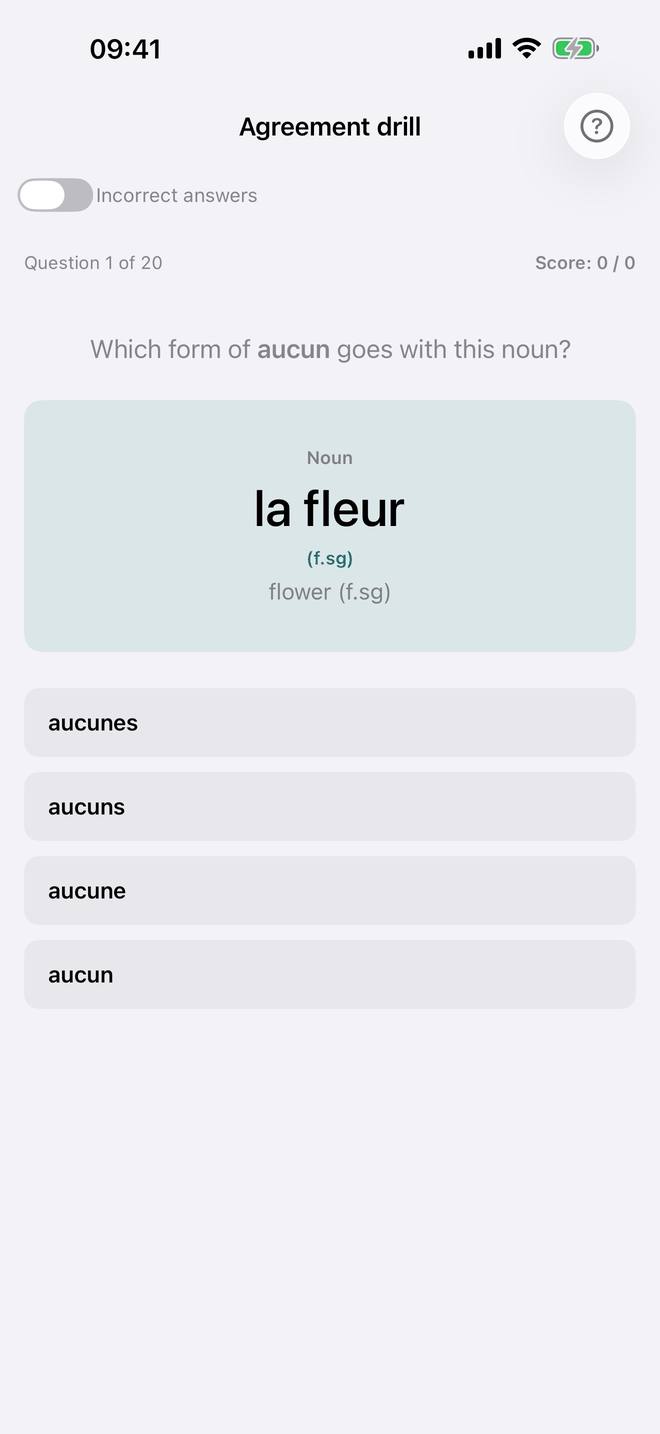
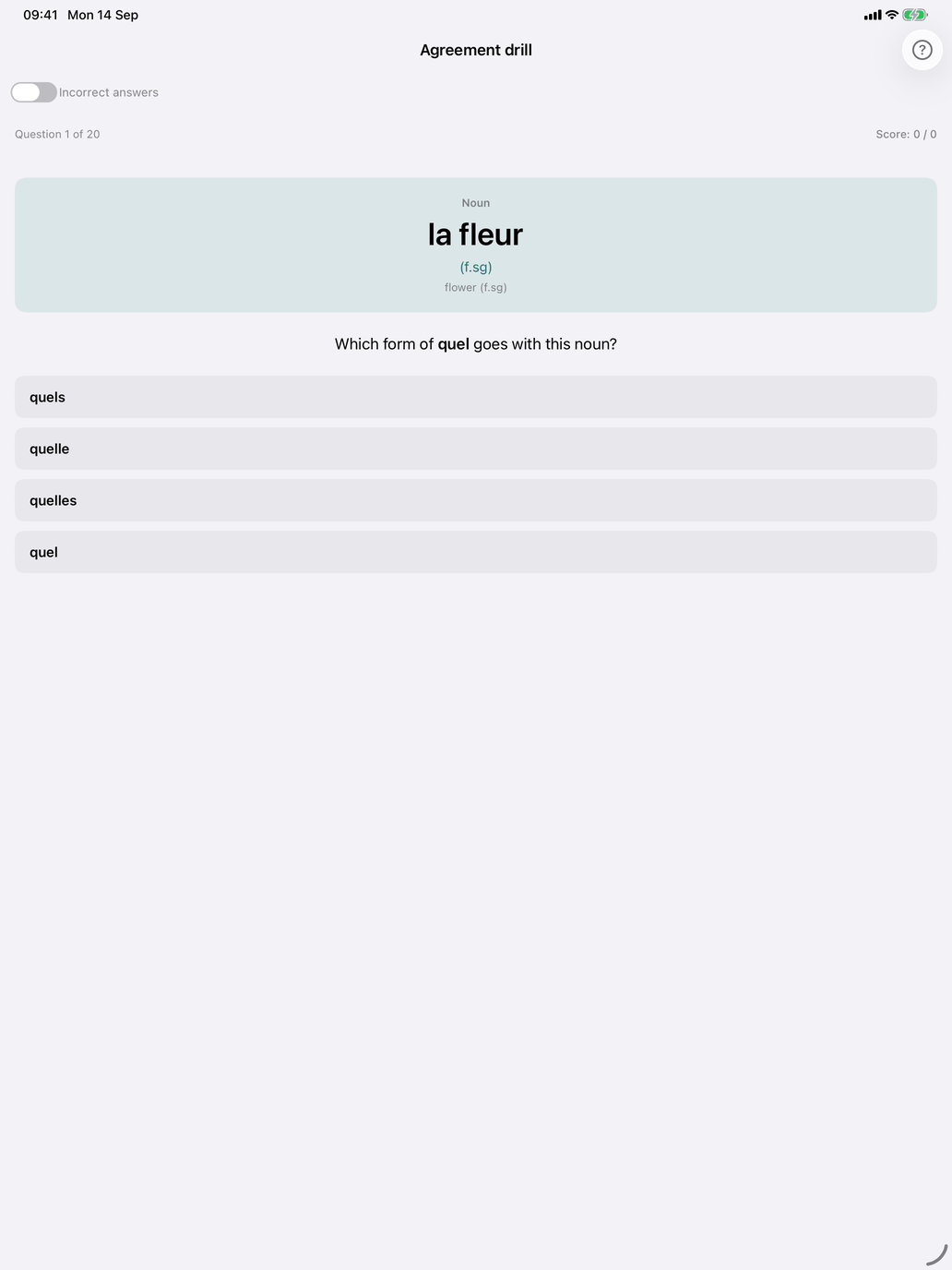
Each question shows a noun with its article, its gender and number, and its translation — for example les voitures (f.pl), "cars" — and asks Which form of celui goes with this noun? Tap the form that agrees: here celles. The pronouns drilled are the ones that change for gender and number: celui, celui-ci, celui-là, the six possessives (le mien … le leur), quel, lequel and aucun. Where two forms are the same, as in les nôtres, the drill shows the form once. Aucun is only asked with a singular noun.
This drill uses all of these pronouns, whatever classes you have ticked in Setup. Answers are recorded per pronoun.