Tenses
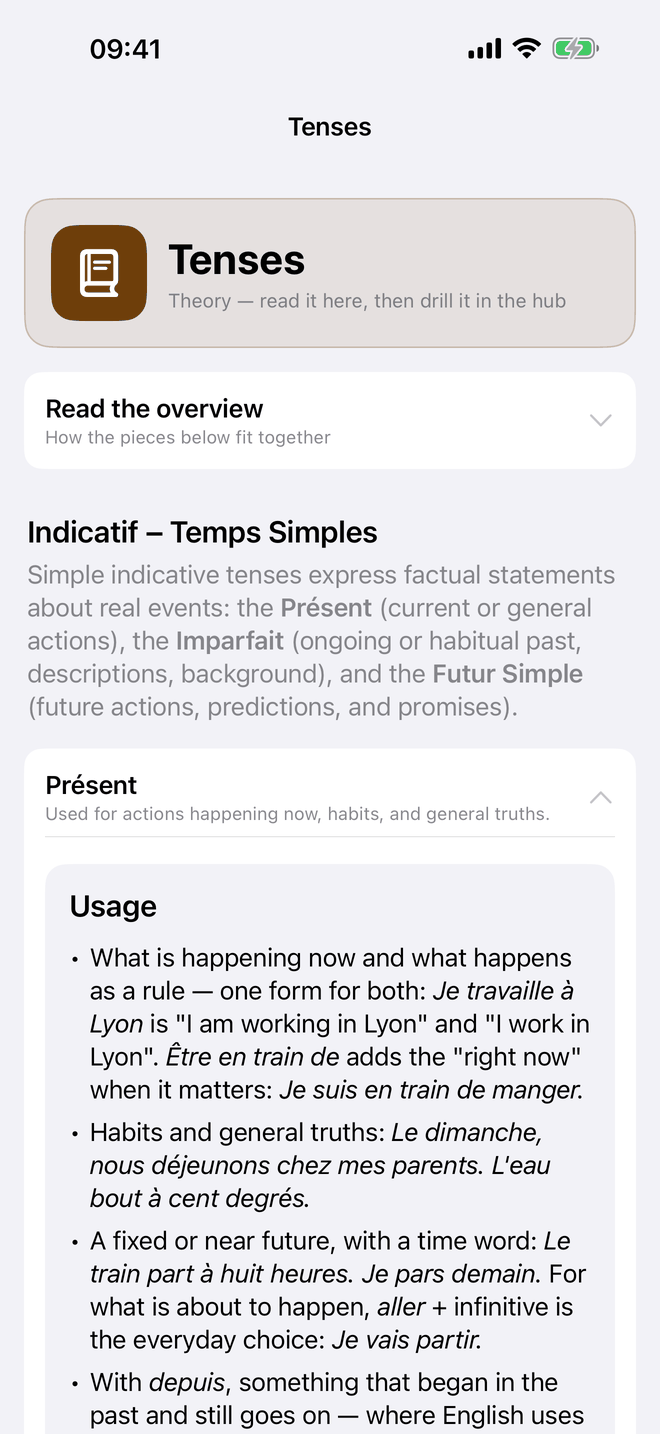
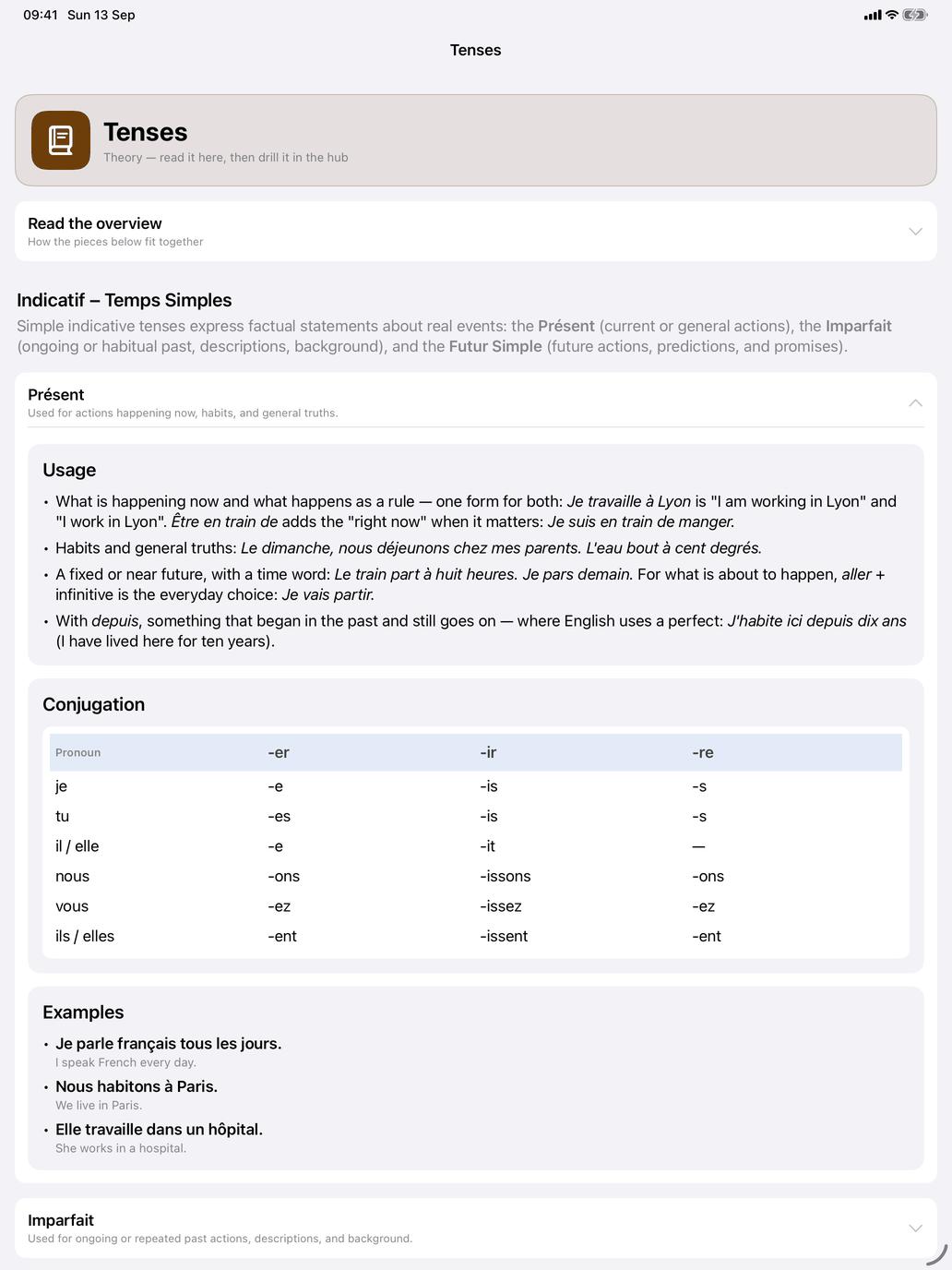
Tenses, under Theory on the verbs hub, explains how the French tenses divide the work between them. Nothing is recorded. The introduction is folded away when the page opens, so the tenses come first.
The tenses are listed under the same headings as Select tenses: Indicatif – Temps Simples, Indicatif – Passé Simple, Indicatif – Temps Composés, Conditionnel, Impératif and Subjonctif. Each tense has a card that opens to show when it is used, an example conjugation, example sentences and how it is formed. The card is the same as the one behind the tense's ⓘ on Select tenses.
A few points worth knowing before you choose tenses:
- The Passé Simple is the literary past. You meet it in novels and history books, but spoken French uses the Passé Composé in its place. The Passé Antérieur and the Subjonctif Imparfait and Plus-que-parfait are literary too.
- Every compound tense is an auxiliary (avoir or être) in a simple tense plus the past participle: j'ai parlé, j'avais parlé, j'aurai parlé, j'eus parlé, j'aurais parlé, que j'aie parlé, que j'eusse parlé, aie parlé.
- The two imperatives have only the tu, nous and vous forms.
- In the conjugation tables, every subjunctive form is shown after que (que je parle, qu'il parle).