Prepositions
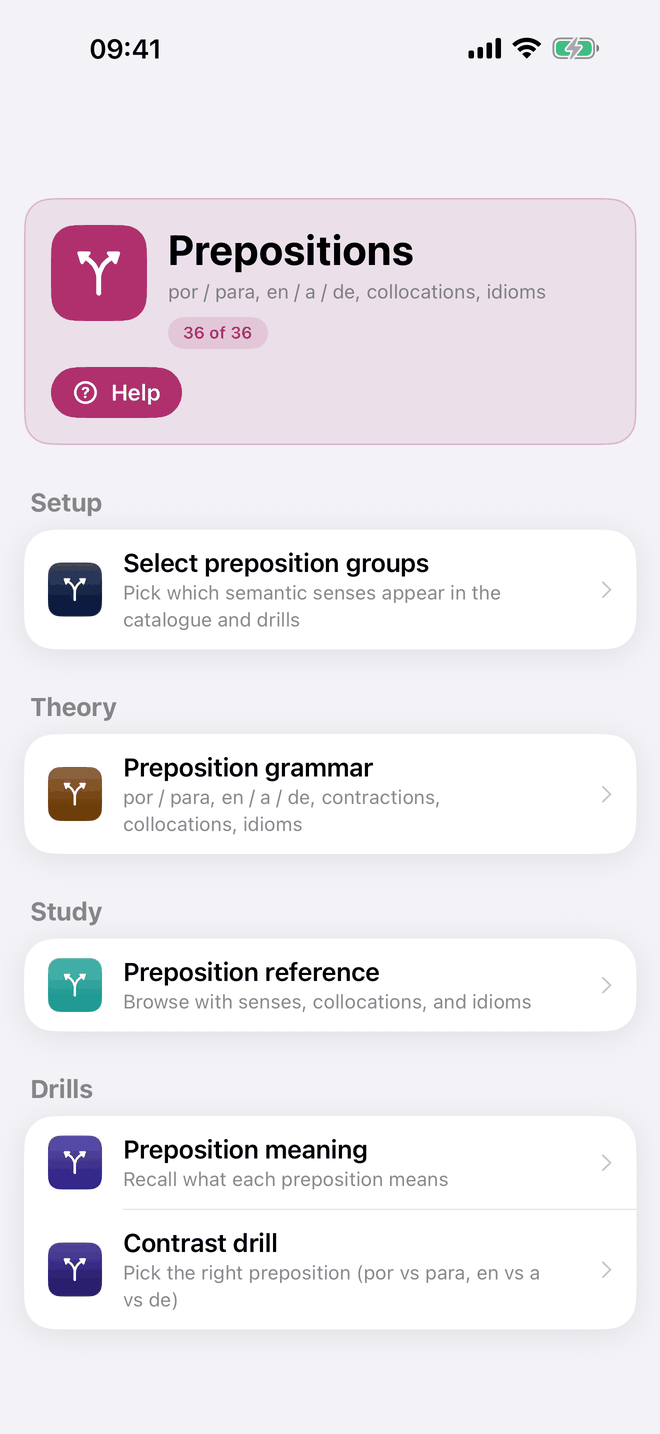
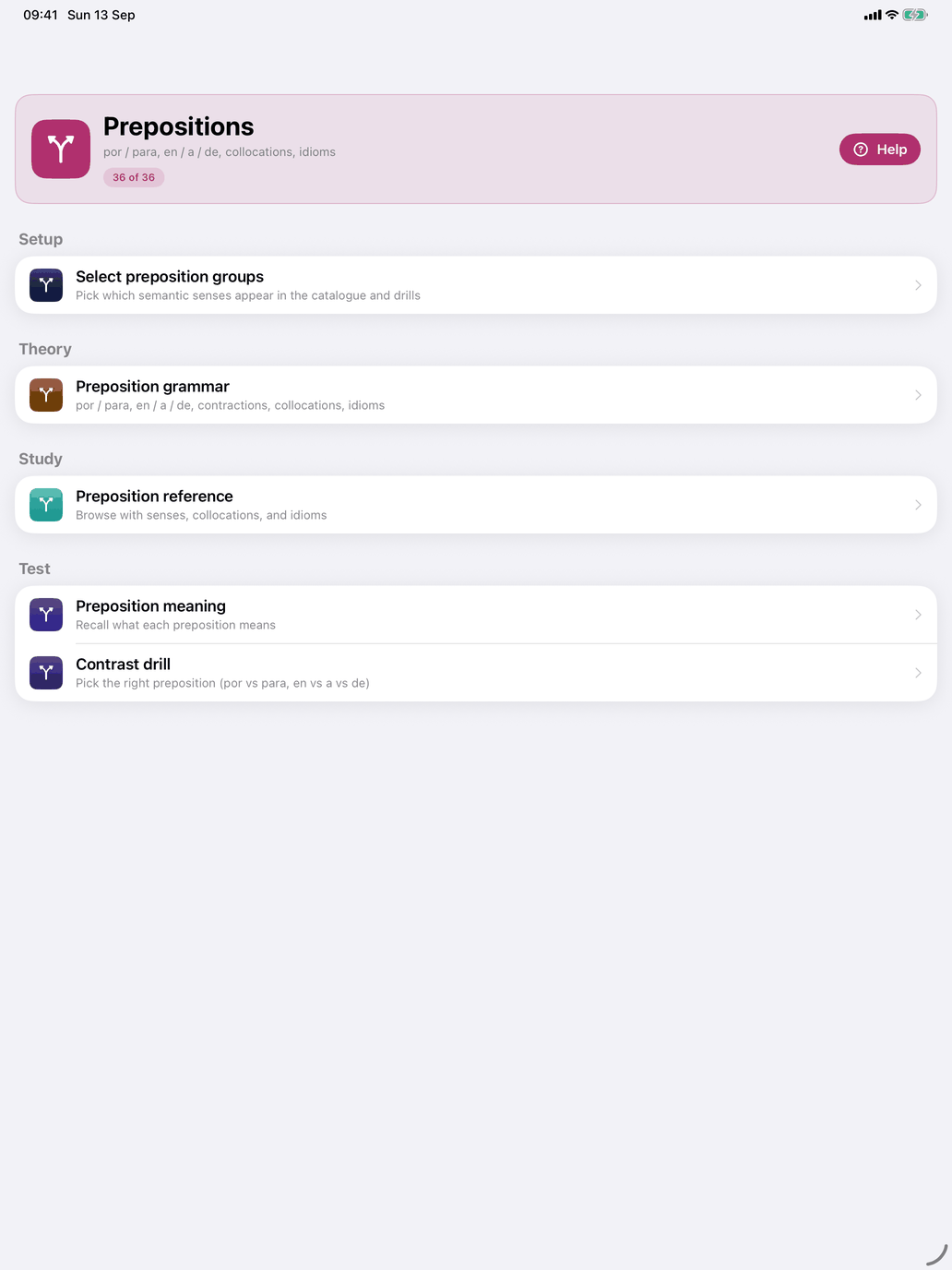
Open the Prepositions hub from the Prepositions tile on the Self Study screen. Prepositions do not change form, so this hub is about use: por or para, en, a or de, and the fixed combinations prepositions appear in. The Spanish catalogue has 36 prepositions: 18 simple ones (a, de, en, por) and 18 compound ones (a causa de, cerca de, delante de).
The badge under the title shows how many prepositions your selected senses contain. The level and topics in Select word scope do not narrow this hub.
The hub has these screens:
- Select preposition groups (Setup): tick the senses you want.
- Preposition grammar (Theory).
- Preposition reference (Study): the selected prepositions.
- Preposition meaning and Contrast drill (Drills).
Select preposition groups
Every preposition has one or more of seven senses: Location, Motion, Time, Cause, Purpose, Manner and Topic. Most have several: por is both cause and motion. A preposition is included when at least one of its senses is ticked. Tap ⓘ on a sense for an explanation and its prepositions.
Preposition grammar
- por vs para: both often translate as "for". Por looks back at a cause: reason (lo hago por ti), duration (por dos horas), exchange (por diez euros), the agent of a passive (escrito por García Márquez) and movement through a place (por el parque). Para looks forward to a goal: purpose (para aprender), recipient (es para ti), deadline (para mañana), destination (salgo para Madrid) and opinion (para mí).
- en / a / de: en for where something is, a for where something goes, de for where something comes from.
- Contractions: del, al: a + el becomes al and de + el becomes del. This does not happen with él (de él) or with El in a name (a El Salvador).
- Verb + preposition collocations: verbs that take a fixed preposition, such as pensar en, soñar con and acordarse de.
- Idiomatic prep phrases: fixed expressions such as a pesar de and por lo tanto.
Preposition reference
The selected prepositions in two sections, Simple and Compound, with a search field. Tap a heading to open or close it. Tap a preposition to open its page, with the cards Senses, Often confused with, Verb collocations and Idiomatic phrases.
Preposition meaning
Flashcards for the meaning of each preposition. See Word meaning for how the flashcards work.
Contrast drill
You see an English sentence, a label for the sense being tested (such as Duration or Recipient), and a Spanish sentence with a gap: "I studied for two hours." and Estudié ___ dos horas. Choose the preposition. The options are por and para, or en, a and de, sometimes with con. Most questions are about por and para. Many sentences change a word each time (another object, price or city), so the same question does not always look the same.
After you answer, a card explains Why por?, and for por, para, en, a and de a Read more in Theory link opens the matching section of Preposition grammar. Your results are recorded per preposition and sense, so por for a cause and por for a duration are tracked separately. The drill only asks about por, para, en, a and de, and only when they are in your selection. See How the choice drills work under Adjectives.
Recommended workflow
- Tick the senses you want to work on.
- Run Preposition meaning to learn the prepositions.
- Spend most of your time on the Contrast drill. The por / para split is where most of the difficulty is.