Conjugation tables
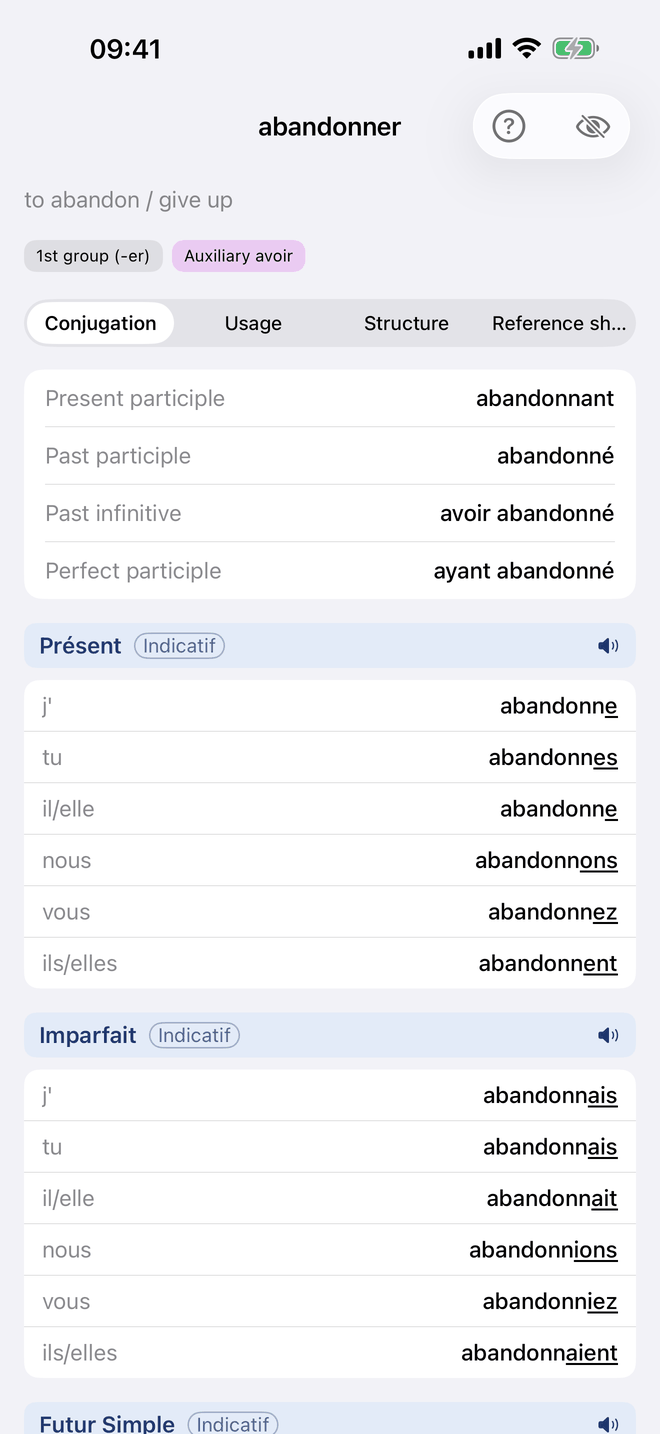
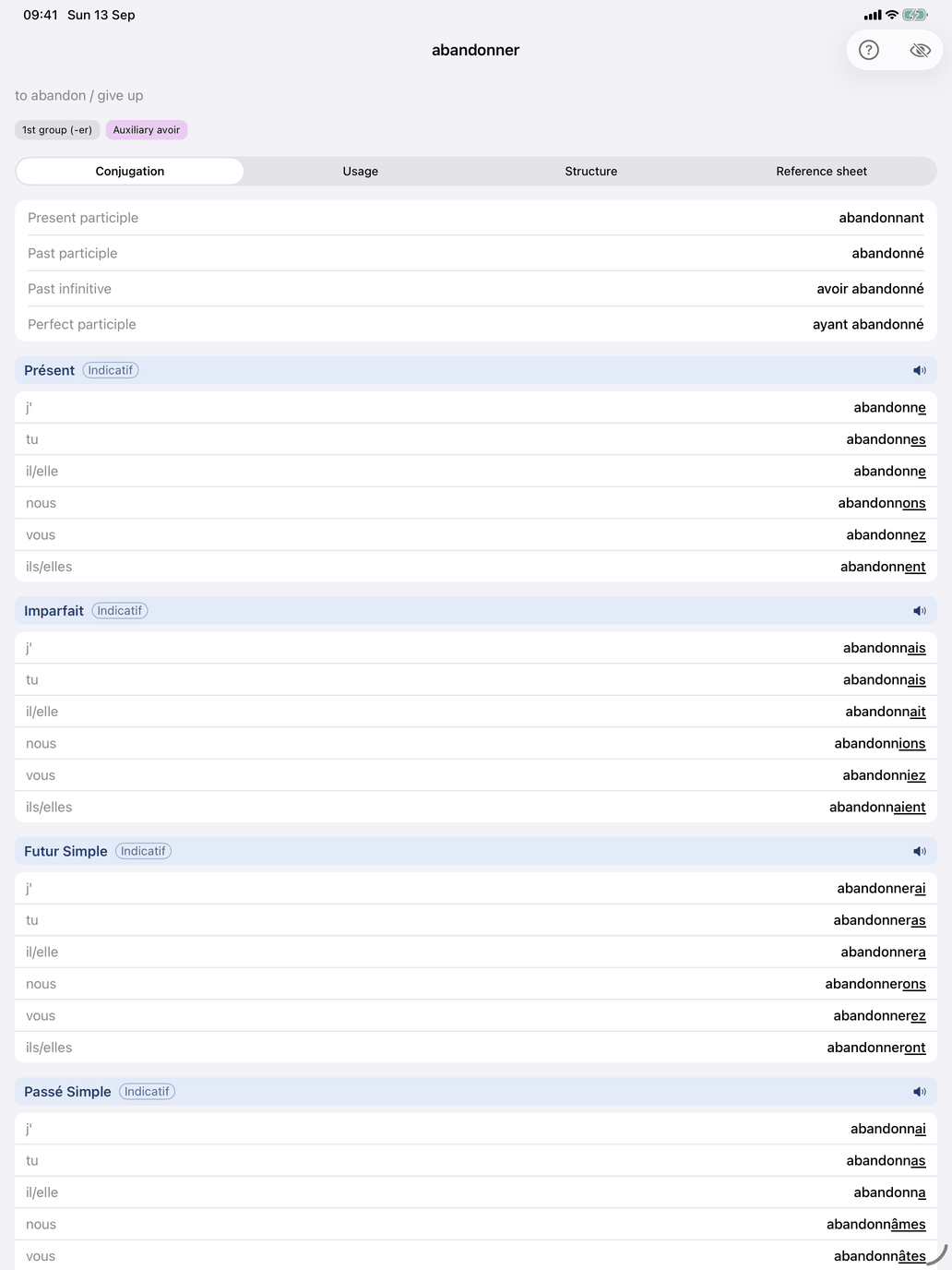
Tap any verb in Verb reference to open its page. The same page opens from a verb group's Browse all verbs list and from Look up. The verb's infinitive is the title.
The header
Above the tabs you see what the verb means and what kind of verb it is:
- the translation of the infinitive (on the Mac, beside the infinitive in the title bar);
- the group badges: the verb groups it belongs to, such as 1st group (-er), Stem e → è (achète) or Auxiliary être. They are coloured by section: grey for Basic, blue for Spelling, red for Stem Changes, purple for Auxiliary, orange for Fully irregular and mint for Subjonctif irrégulier. Tap a badge to open the group's card, with its explanation, a worked example and Browse all verbs with the number of verbs in the group.
Below that are four tabs: Conjugation · Usage · Structure · Reference sheet. The page opens on Conjugation.
Conjugation
The Conjugation tab starts with a card of the non-finite forms: Present participle, Past participle, Past infinitive and Perfect participle (parlant, parlé, avoir parlé, ayant parlé). Below it comes one table per tense, only for the tenses you have selected in Select tenses. If none are selected, the tab tells you so. Each table is headed by its tense and mood, lists the persons with their forms, and has a speaker button that reads the whole tense aloud. The forms are marked as described in The conjugation colour code (French).
Pronominal verbs are shown with their pronoun (je me lève). In the affirmative impératif the pronoun follows the verb (lève-toi). Impersonal verbs such as falloir and pleuvoir are conjugated only in the il form.
The eye button in the toolbar shows a translation under every conjugated form. French has written translations for almost every verb. For verbs with a second meaning, a second button switches all the translations on the page to that meaning.
Usage
The Usage tab shows the verb in use:
- Extended meaning — for verbs with several distinct senses, a numbered list of them.
- Tense Examples — one example sentence per tense you have selected, each with its tense, its translation and a speaker button. The first three are shown; Show more tenses reveals the rest. Tap a tense name to see that tense's conjugation in a sheet.
- Details — folded away: the verb's Auxiliary (avoir, être, or avoir / être with the note "with a direct object → avoir"), its Level, Form (pronominal, for verbs with se) and Topics.
- Dictionaries — buttons that look the verb up in online dictionaries.
Structure
Structure reads the same verb tense by tense: which tenses it forms predictably, and where it departs from the pattern. Every tense has a coloured dot and a verdict: Regular, Regular endings, Partly irregular, Irregular, No regular pattern or Not used. Under a partly irregular tense, the persons that depart are listed.
Under each tense is the stem it is built on. A stem you have to learn, such as viendr- for the future of venir, is in amber. So is a single form that carries a whole tense, such as the participle pris for the compound tenses of prendre. That is why those compound tenses read Regular endings: the auxiliary is regular, and the participle is the thing to learn. The two colours answer different questions. Amber on Structure names a whole stem or form to memorise; red on Conjugation marks the letters of one form that departed.
The filter button in the toolbar hides the tenses that ask nothing of you. That turns a long set of tables into a short list of things worth memorising. For a fully regular verb, the tab says there is nothing to single out. Tap a tense to see its expected and actual forms side by side.
Reference sheet
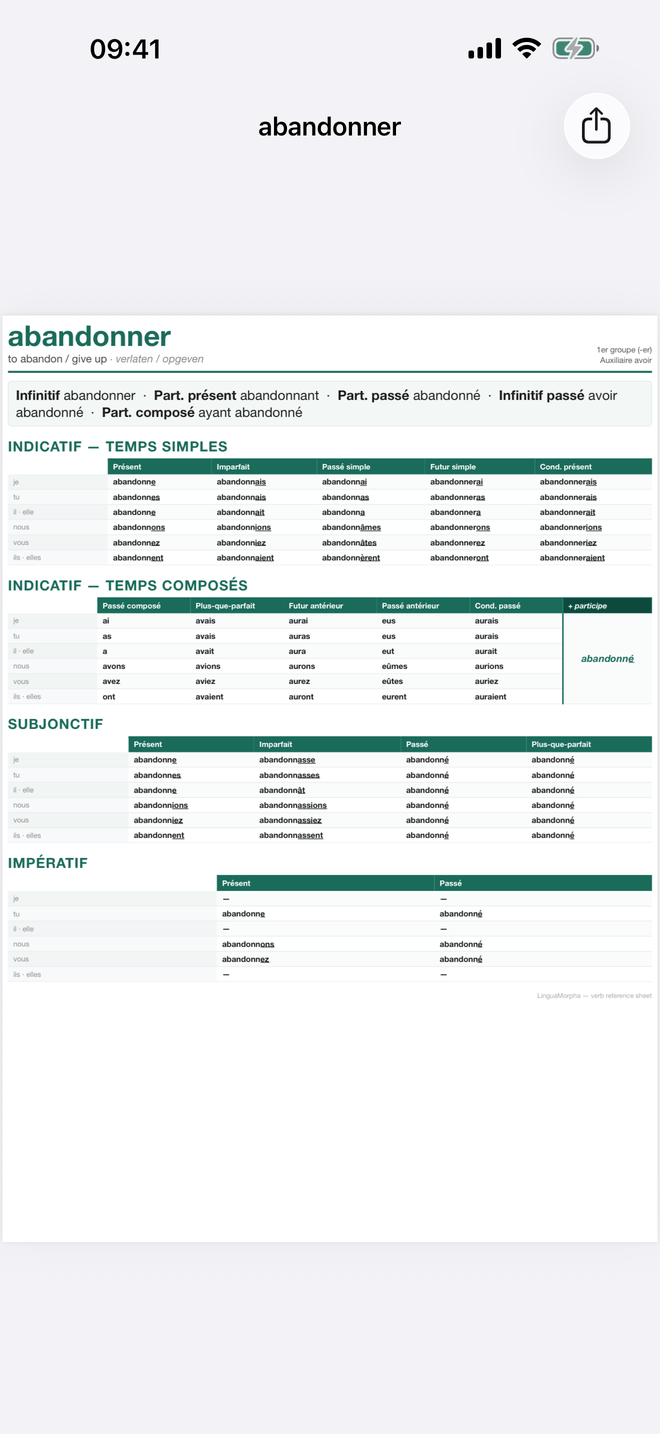
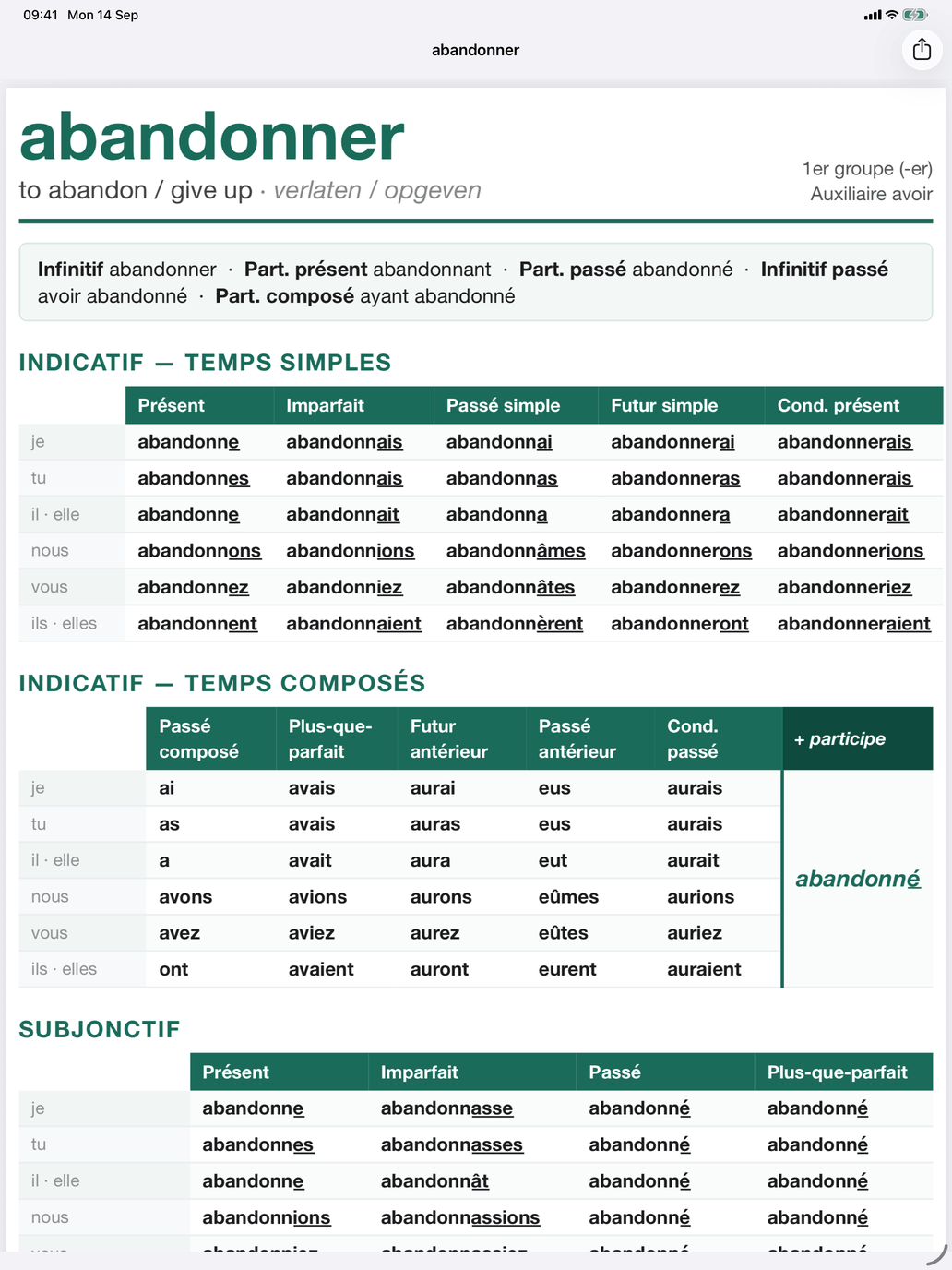
Reference sheet is a printable one-page PDF of the verb in every tense, whatever you have selected, with the same marks as the tables. Its header gives the verb's group and auxiliary. The sheet lists the non-finite forms, the simple and compound tenses of the indicatif, and the subjonctif and impératif side by side. The compound tenses show the auxiliary's forms with the participle once beside them. On iPhone and iPad, the share button sends, saves or prints the sheet; on the Mac, the toolbar menu offers Copy and Save as….
Tip: In Produce the conjugation and Recognise the conjugation, the book icon on the card shows the verb's table for the tense being asked. This is useful right after a wrong answer.