Indicatif or subjonctif
French uses the subjonctif after certain words and in certain kinds of clause. The conjugation drills give you the mood; this drill asks you when it is needed.
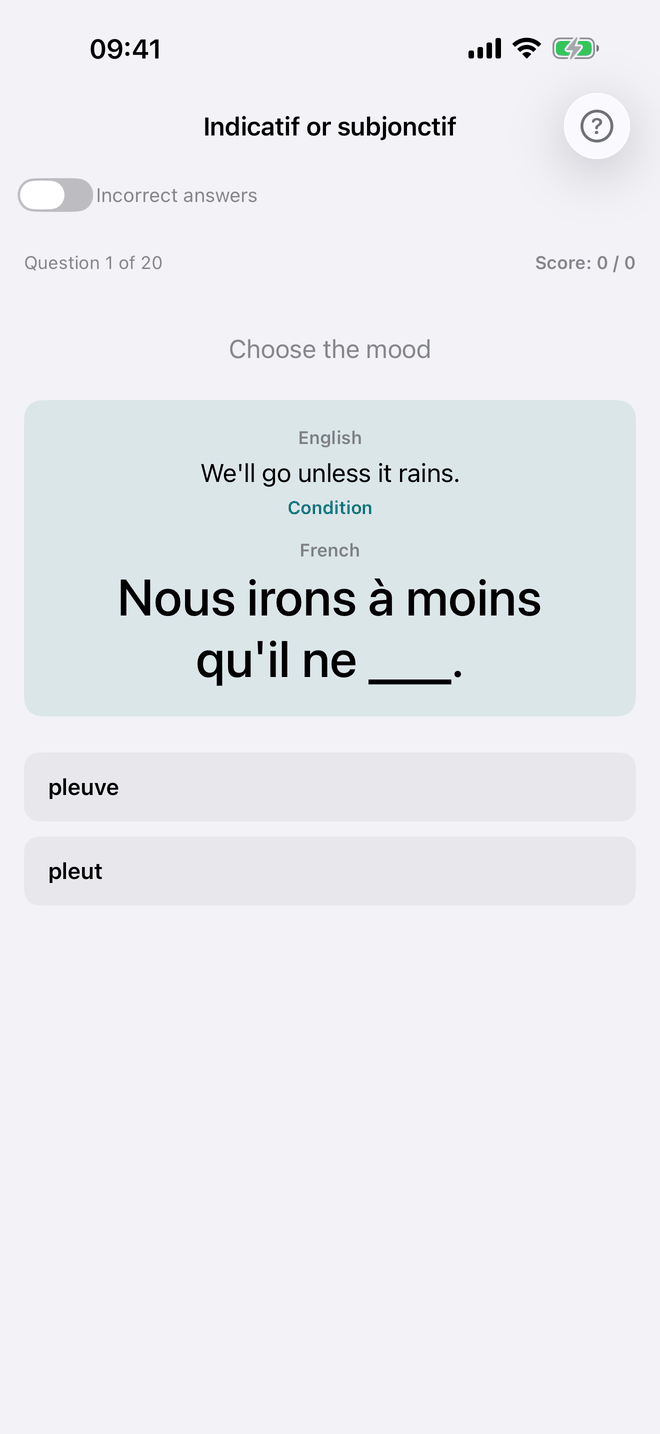
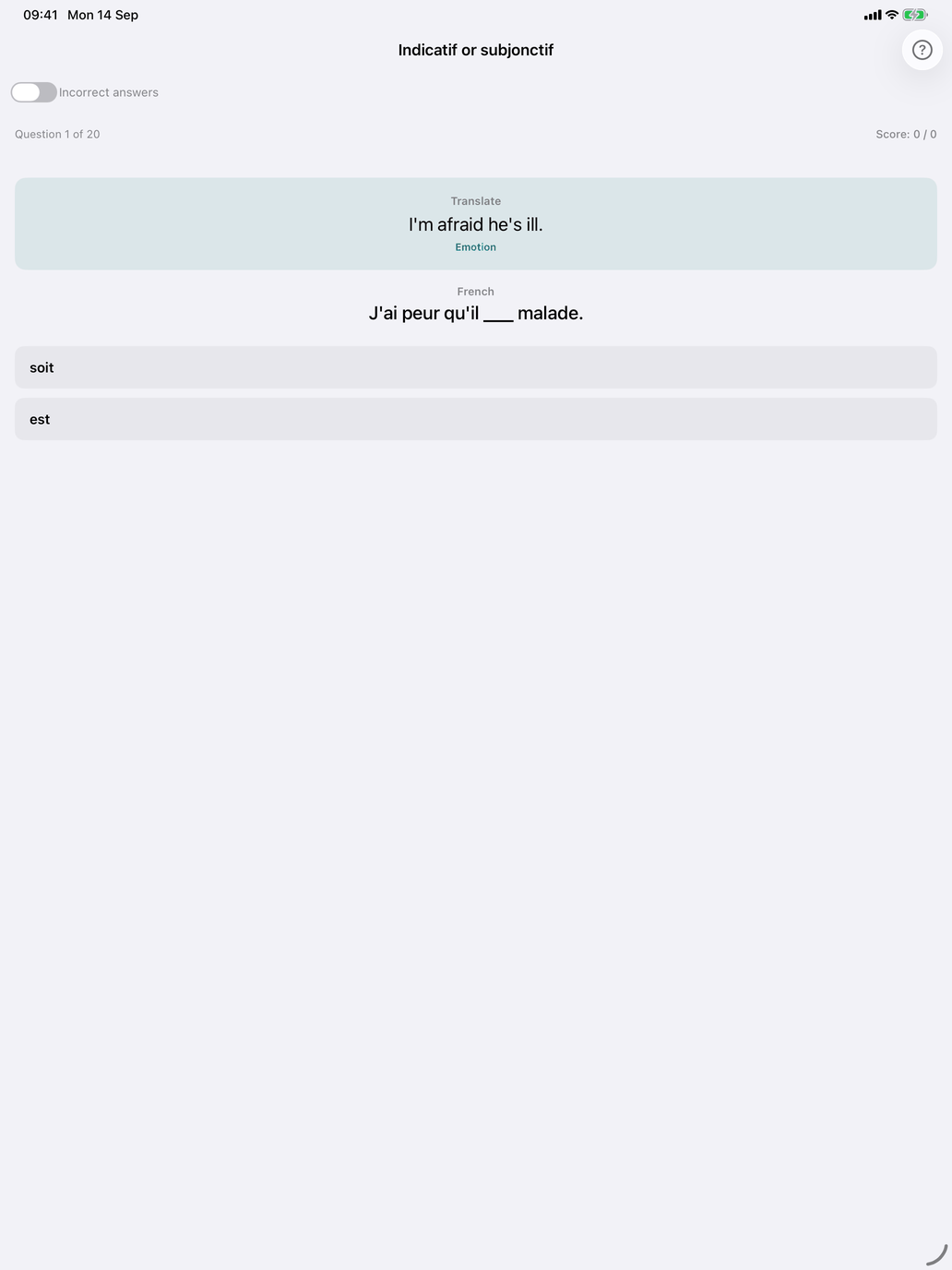
How a question looks. Under the instruction "Choose the mood", the card shows the sentence in your language, with a badge naming the trigger at work (Belief, Doubt / denial, Volition, Emotion, …). Below it comes the French sentence with a gap. The two options are the same verb in the indicatif and in the subjonctif (vient / vienne). Tap one to answer; a card then explains the choice.
A que is not a trigger. About a third of the answers in this drill are the indicatif, on purpose. A drill where the answer is always the subjonctif only teaches you to spot que. The questions are built from minimal pairs: the same sentence with one thing changed, and a different mood.
| Indicatif | Subjonctif |
|---|---|
| Je pense qu'il vient** | Je ne pense pas qu'il vienne** |
| Il est vrai qu'elle est malade | Il n'est pas vrai qu'elle soit malade |
| Parce qu'il est tard | Bien qu'il soit tard |
| Il est probable qu'il le sait** | Il est possible qu'il le sache** |
| Je cherche l'homme qui sait le russe | Je cherche un homme qui sache le russe |
What moves the mood is negation, the kind of judgement, and whether the thing referred to is known.
The trigger classes.
- Always subjonctif: wanting (je veux que, elle voudrait que), emotion (je suis content que, j'ai peur que, c'est dommage que), doubt and denial (je doute que, je ne pense pas que), necessity (il faut que), and the conjunctions bien que, pour que, avant que and à moins que. A superlative takes it too: c'est le meilleur film que je connaisse.
- Indicatif: statements of belief and fact, such as je pense que, il est vrai que, and j'espère que: French espérer takes the indicatif.
- It depends: impersonal expressions split (il est possible que + subjonctif, but il est probable que and il paraît que + indicatif), and so do relative clauses (a known thing takes the indicatif, any thing that fits takes the subjonctif).
A future event does not bring the subjonctif. Quand takes the indicatif, with the future for a future event: Appelle-moi quand tu partiras. Avant que takes the subjonctif whatever the time: Appelle-moi avant que tu partes. In the same way, a condition with si takes the indicatif (S'il pleut, nous resterons), while à moins que takes the subjonctif (Nous irons à moins qu'il ne pleuve).
What's recorded. Each trigger class is recorded separately, so a class you keep missing comes back more often.