Other Vocabulary
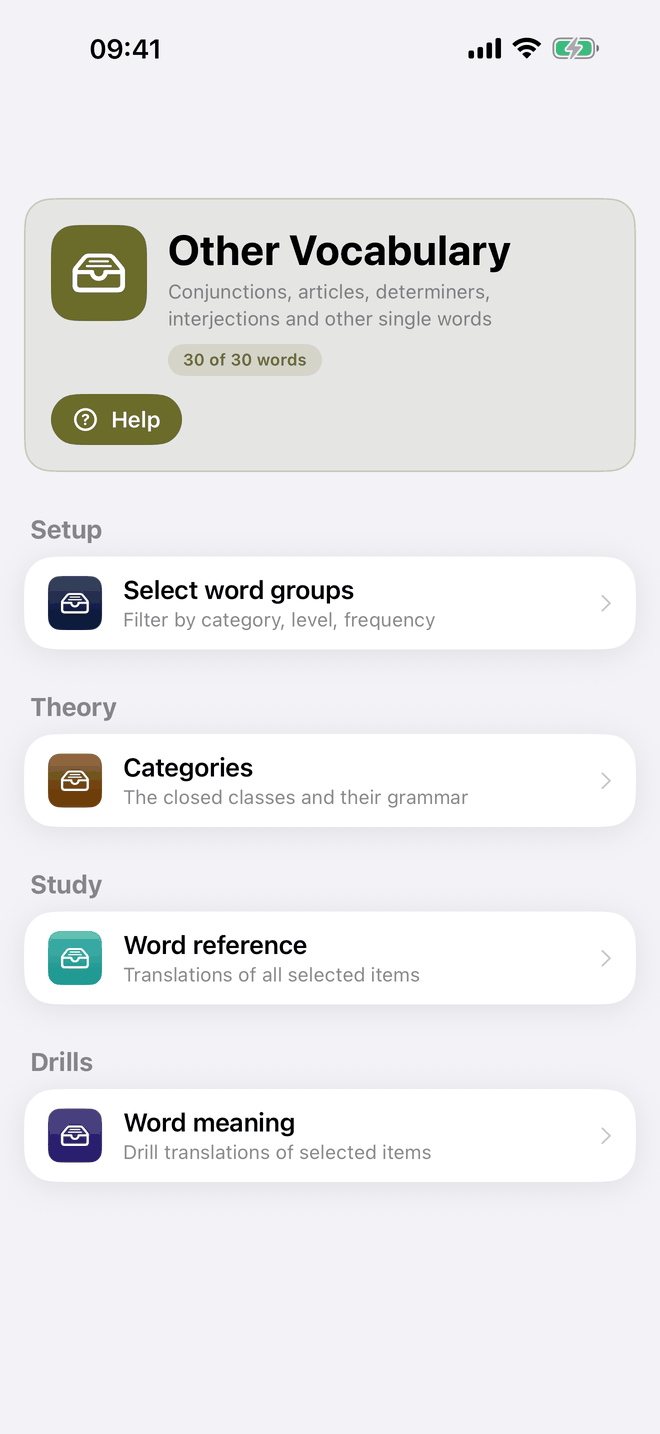
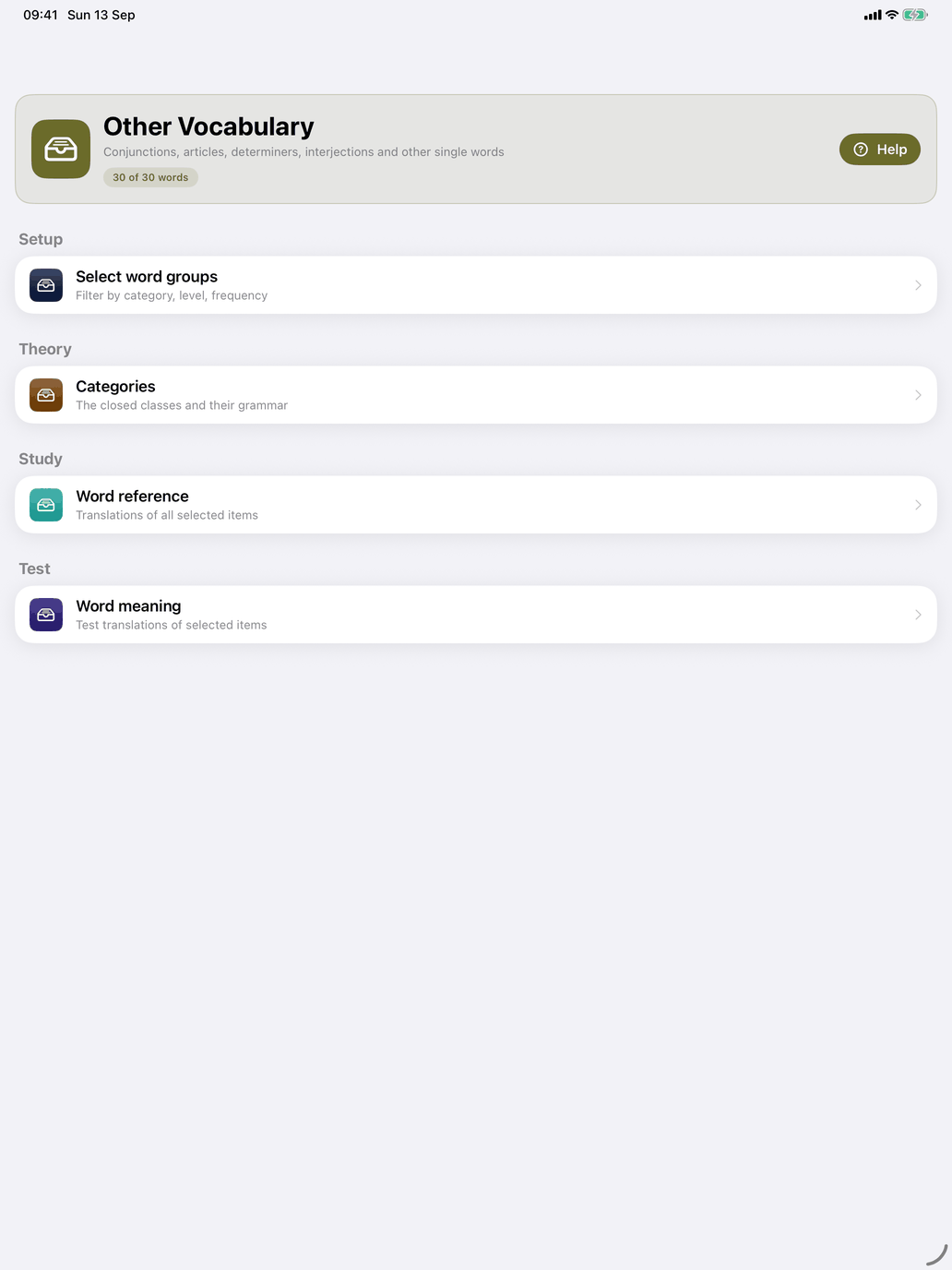
Open this hub from the Other Vocabulary tile on the Self Study screen. It holds the small single words that have no hub of their own. In Spanish there are 30:
- Articles (9): el, la, los, las, un, una, unos, unas, lo
- Determiners (6): este, ese, cada, todo, mucho, algún
- Conjunctions (10): y, o, pero, porque, aunque, cuando, mientras, como, si, sino
- Interjections (5): hola, adiós, ¡enhorabuena!, ¡felicidades!, ¡increíble!
Adjectives, adverbs, pronouns, prepositions and numerals have their own hubs. For expressions of several words, such as buenos días, see Phrases.
The hub has these screens:
- Select word groups (Setup): choose the categories.
- Categories (Theory): the four categories and their grammar.
- Word reference (Study): the selected words.
- Word meaning (Drills): flashcards.
The Categories page. It explains the four categories:
- Articles: the article agrees with the noun, so it is the best clue to a noun's gender. Learn nouns with their article: la mesa, not mesa. The neuter lo turns an adjective into an idea: lo importante (the important thing). A feminine noun that starts with a stressed a- takes el in the singular, but stays feminine: el agua fría, las aguas.
- Determiners: este (this, near me), ese (that, near you) and aquel (that, far away) agree with the noun. Cada never changes. Todo and mucho agree: mucha gente. Algún is the short form of alguno before a masculine singular noun.
- Conjunctions: y becomes e before a word starting with the sound i (padre e hijo), and o becomes u before a word starting with o or ho (siete u ocho). Pero means "but"; sino means "but rather" after a negative: No es caro sino barato. Don't confuse porque (because), por qué (why?) and el porqué (the reason).
- Interjections: standalone words. Spanish opens an exclamation with ¡ and a question with ¿.