Ser or estar
Spanish has two verbs for to be, ser and estar, where English and Dutch have one. The conjugation is soon automatic; the choice stays hard for years. This drill asks only which of the two a sentence needs. It works like the other choice drills (see The choice drills).
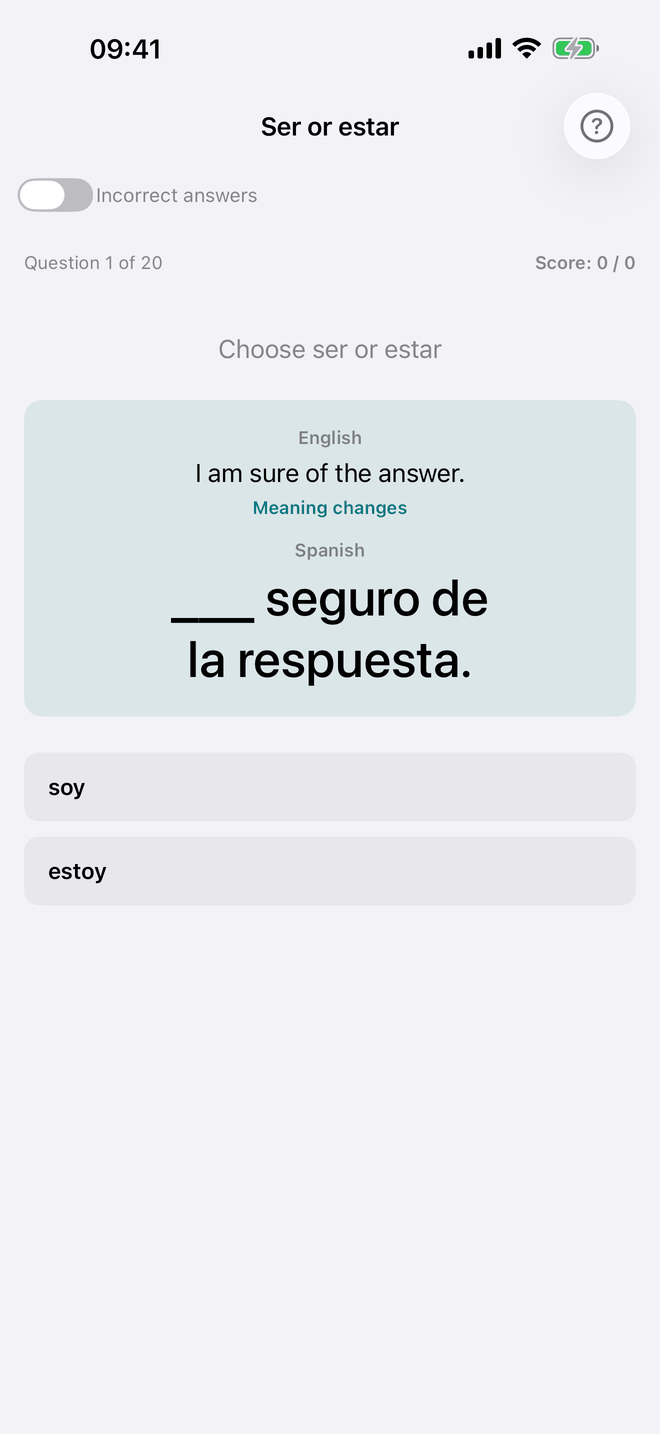
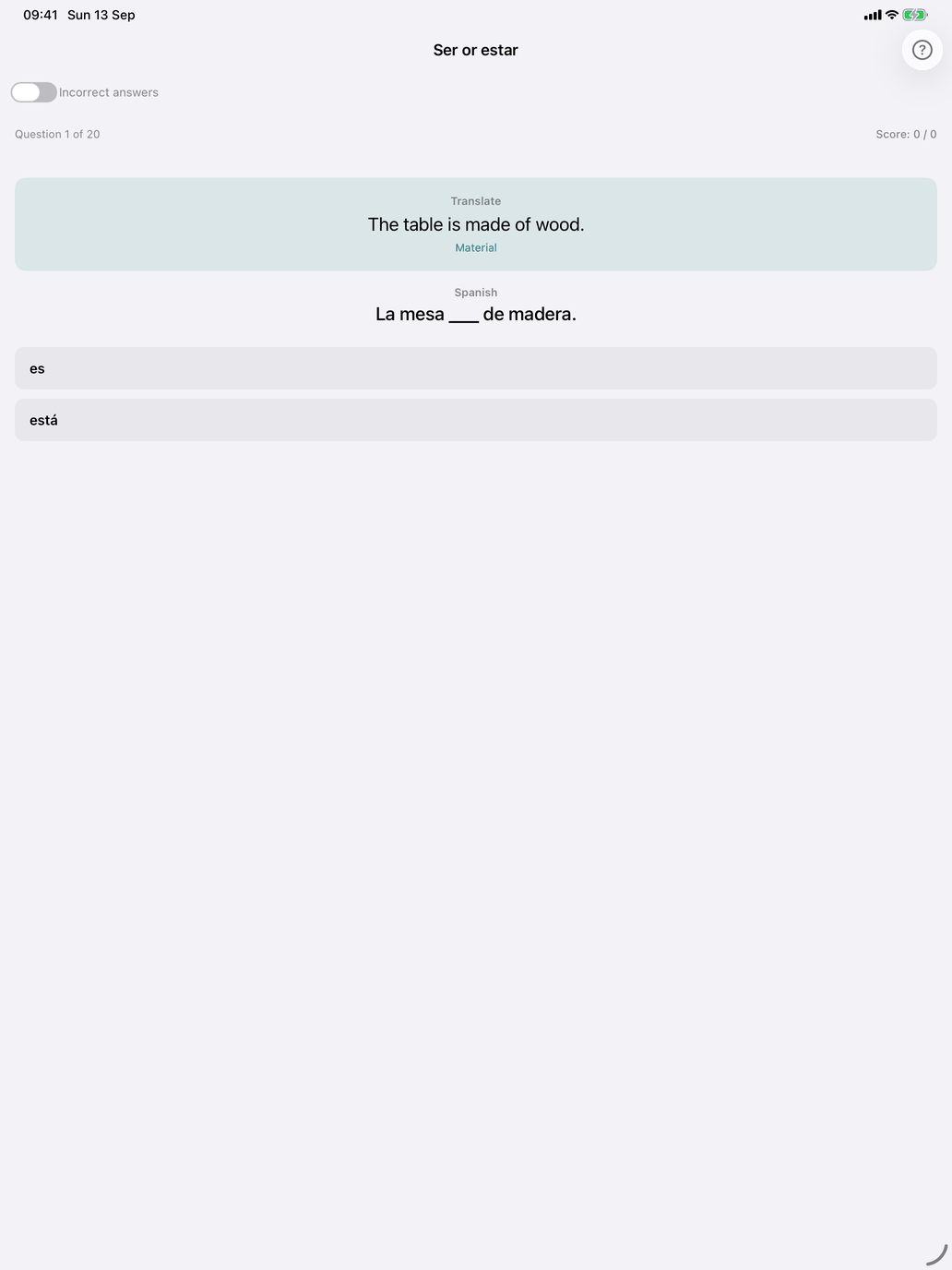
How a question looks. Under the instruction "Choose ser or estar", the card shows the sentence in your language. Under that sentence is a badge naming the rule at work, such as Identity, Location, Condition or Meaning changes. Below them comes the Spanish sentence with a gap:
My mother is tired. Condition Spanish: Mi madre ___ cansada.
The two options are already conjugated in the person and tense the sentence needs — es / está, soy / estoy, son / están, era / estaba — so you also have to recognise the forms. The option you tap fills the gap. After you answer, a card explains why ("Why está?"); read it even when you were right.
The rules in the deck.
- Ser — identity and profession (Mi hermana es médica), origin (Soy neerlandés), material and possession (La mesa es de madera, Ese libro es mío), time and dates (Son las tres, Hoy es lunes), and impersonal expressions (Es importante estudiar).
- Estar — where a person or thing is (Las llaves están en la mesa), a passing condition (La sopa está fría), the result of a change (La ventana está abierta, and also Mi abuelo está muerto), and fixed expressions (Estoy de acuerdo).
- The location of an event — events take ser even for "where": La fiesta es en mi casa, but La casa está en la calle Mayor. If you could say "takes place" instead of "is", use ser.
- Meaning changes — adjectives whose meaning depends on the verb. The Spanish sentence is the same for both, so the sentence in your language is your only clue: es aburrido (boring) / está aburrido (bored), es listo (clever) / está listo (ready), es rico (wealthy) / está rico (delicious), es verde (green) / está verde (unripe), es malo (wicked) / está malo (ill), and also vivo, abierto, bueno, despierto, atento, seguro and interesado.
- In the past — the same choice with era and estaba: the rule doesn't change with the tense.
What's recorded. Each rule is recorded separately (ser for identity is one entry, ser for events another), so a rule you keep missing comes back more often.
The Ser or estar deck under Traps is this same drill, limited to the Meaning changes sentences.