Select tenses
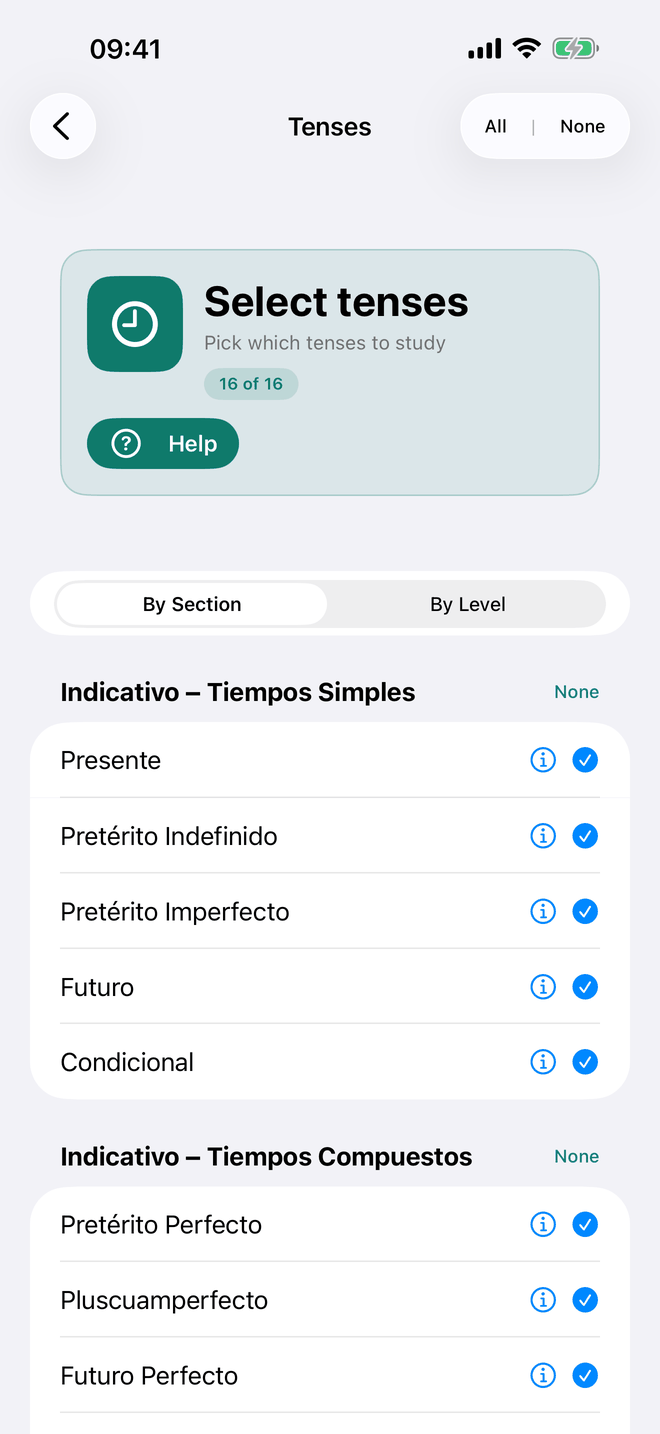
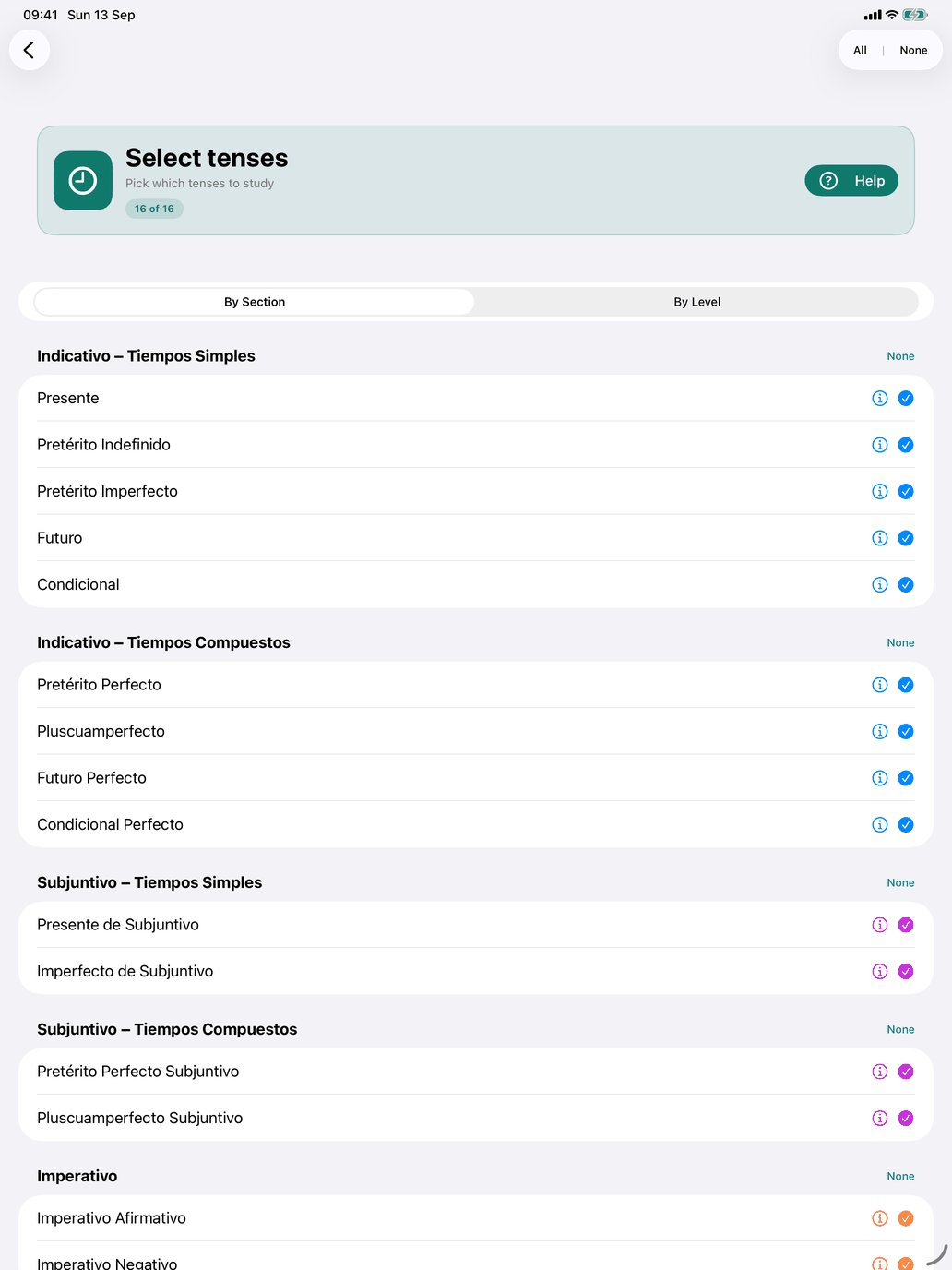
Select tenses chooses which of the sixteen tenses you study. The choice applies everywhere verbs are practised: the conjugation tables show only the selected tenses, the example sentence under each tense on a verb's page follows it, and the conjugation drills ask only about those tenses.
The banner shows how many tenses are active, e.g. "16 of 16". Tap a row to include or exclude that tense. Each section header has an All / None button, and All | None at the top right selects or clears every tense at once. If you leave the screen with nothing selected, the app warns you — "No tenses selected".
By Section
The tenses are grouped by mood:
- Indicativo – Tiempos Simples — Presente, Pretérito Indefinido, Pretérito Imperfecto, Futuro, Condicional.
- Indicativo – Tiempos Compuestos — Pretérito Perfecto, Pluscuamperfecto, Futuro Perfecto, Condicional Perfecto.
- Subjuntivo – Tiempos Simples — Presente de Subjuntivo, Imperfecto de Subjuntivo.
- Subjuntivo – Tiempos Compuestos — Pretérito Perfecto Subjuntivo, Pluscuamperfecto Subjuntivo.
- Imperativo — Imperativo Afirmativo, Imperativo Negativo.
- Formas no Personales — Gerundio. (The infinitive and the past participle appear on every verb, but the gerundio is the only one you select here.)
Long-press a section header (on the Mac, click and hold) to read what that group of tenses is for.
By Level
The second view groups the same tenses by the level at which each first appears in the scheme you use:
| Level | Tenses |
|---|---|
| A1 | Presente |
| A2 | Pretérito Perfecto, Pretérito Indefinido, Pretérito Imperfecto, Gerundio, Imperativo Afirmativo |
| B1 | Futuro, Condicional, Pluscuamperfecto, Presente de Subjuntivo, Imperativo Negativo |
| B2 | Futuro Perfecto, Condicional Perfecto, Imperfecto de Subjuntivo, Pretérito Perfecto Subjuntivo, Pluscuamperfecto Subjuntivo |
The ⓘ on each tense
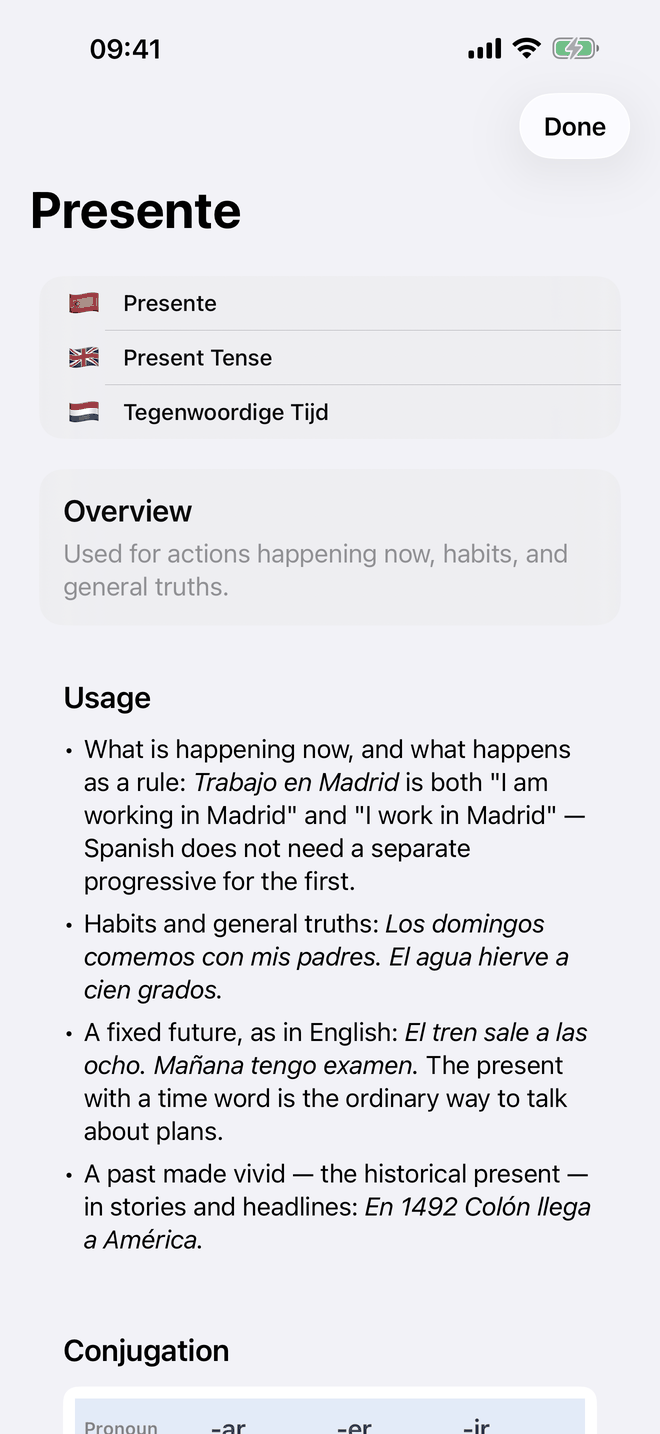
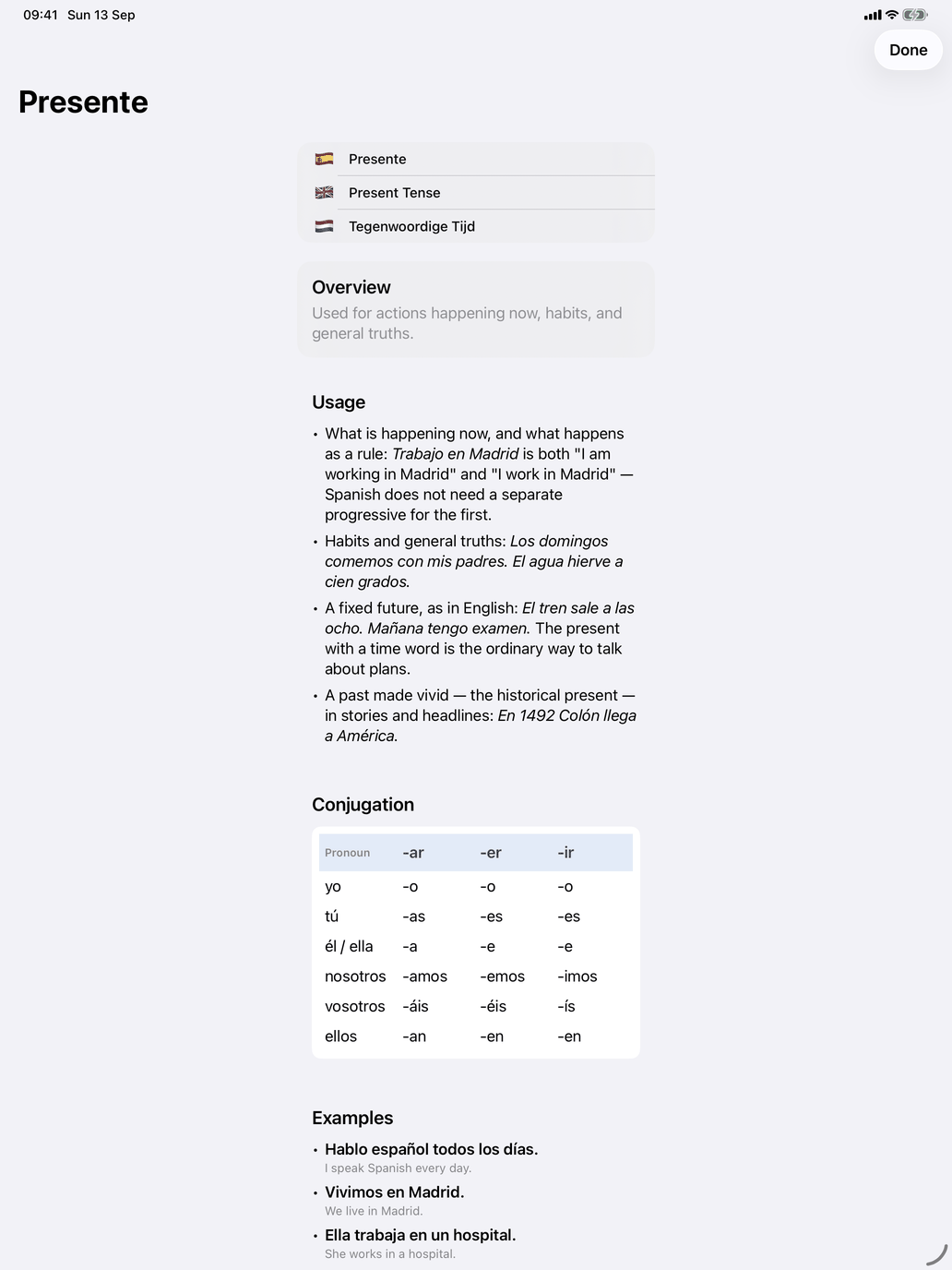
Every tense row has an ⓘ. It opens the Tenses page — the same page as Tenses under Theory on the verbs hub — at that tense, with its card open. The other tenses are one tap away. On iPhone and iPad the page opens with a back button. On the Mac it opens in a window of its own, which can stay open beside the list; tap another ⓘ and the window moves to that tense. The same ⓘ is beside the tenses of a lesson, in the tense picker of your own practice set, and on a word's page.
The tense's card has:
- an overview and when the tense is used;
- the endings, with an example conjugation;
- Formation: how the tense is built, and where its irregular forms come from. The point is that the irregularity is smaller than it looks: a handful of patterns and a few verbs of their own. Each pattern is a sentence and a short table in aligned columns — infinitive, then the form or stem it produces — so the change can be read down a column: tener · tendr- · tendré. A table headed yo shows the yo form;
- example sentences;
- Irregular verbs (N), which opens the tense's irregular verbs grouped by those same patterns (see Irregularity by tense).
Tip: Start with Presente alone, or with the simple indicative tenses. Add the others one at a time — Pretérito Indefinido is usually the next one worth learning.