Irregularity by tense
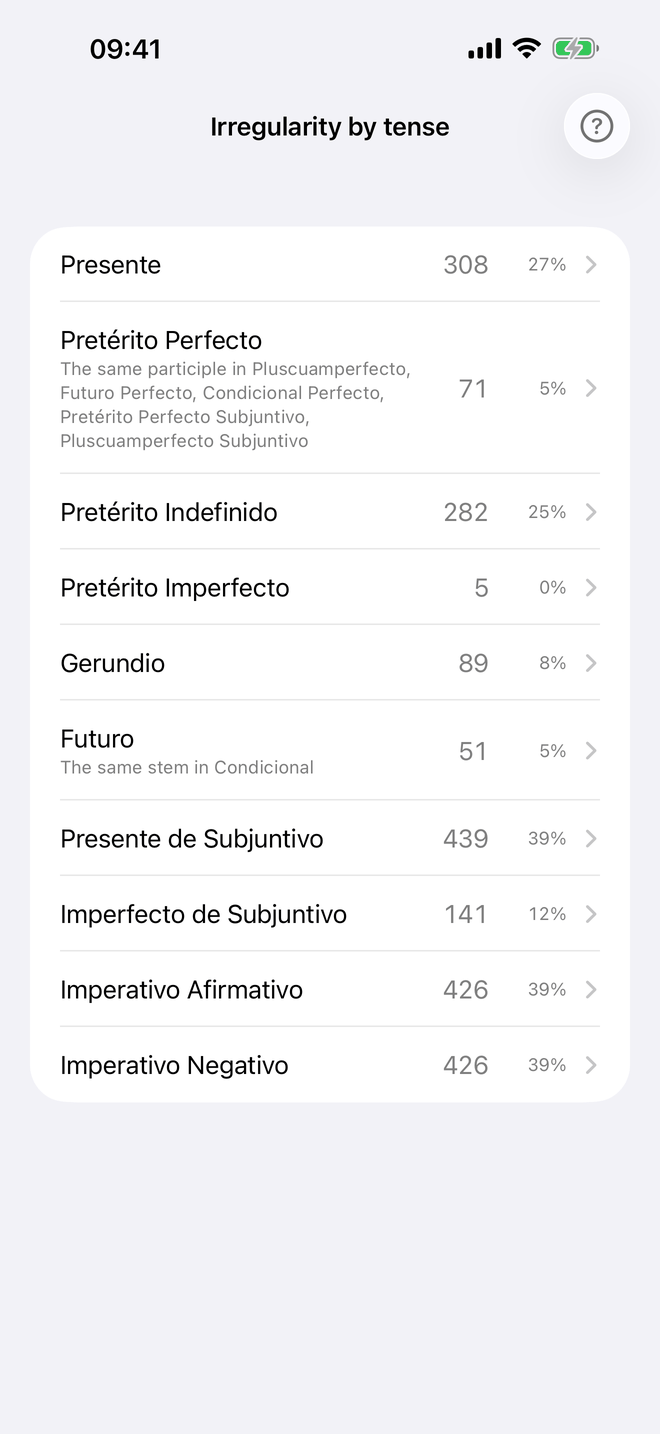
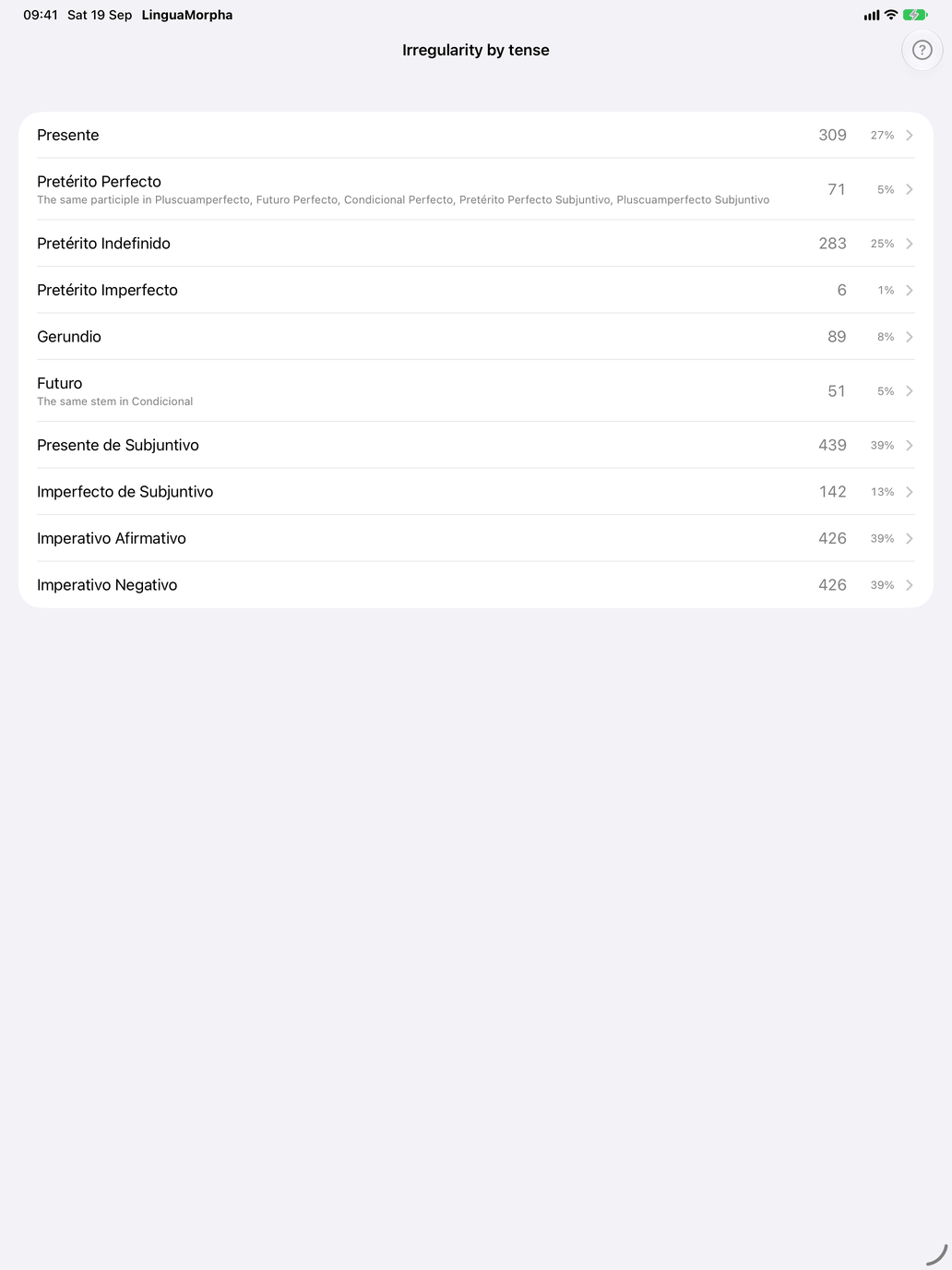
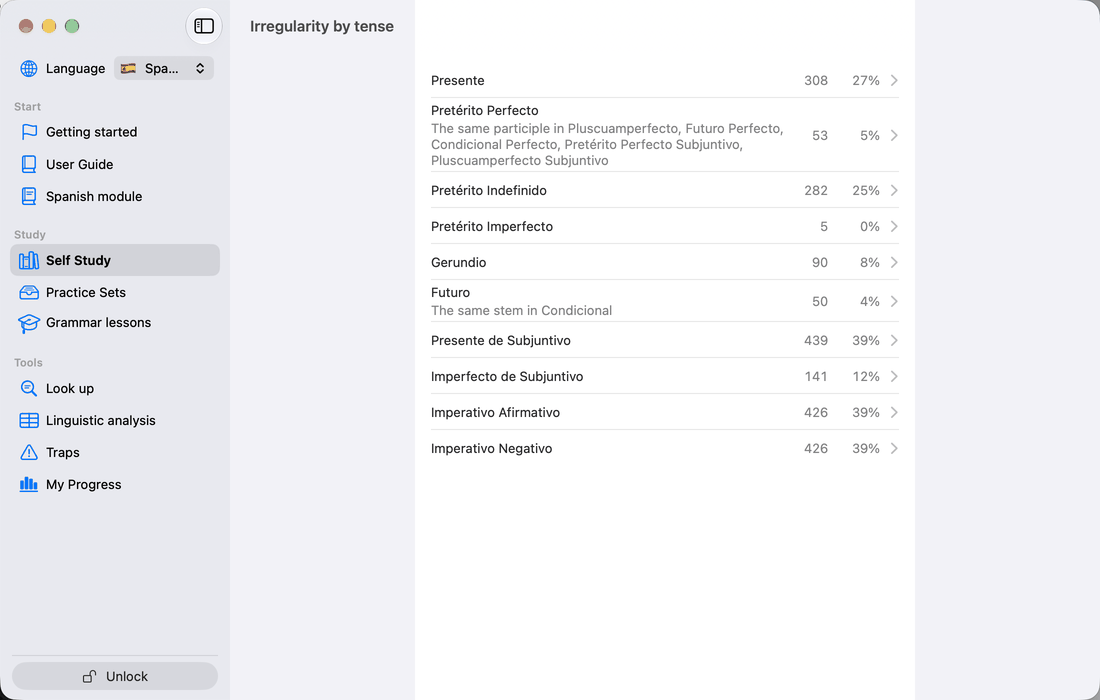
The verbs that break the pattern, tense by tense: the screen Irregularity by tense under Linguistic analysis, and the list behind each tense card's Irregular verbs on the Tenses page. It is described here, with the verbs, because it is where the drills for a single tense start.
One row per tense: how many things there are to learn there — a family of verbs that share one stem counts once, and so does a verb on its own — and the share of its verbs that are not fully predictable. Tenses that hold exactly the same verbs are folded into one row, and the row says what they share — the six compound tenses share one participle, the futuro and the condicional share one stem. A cap beside the number means there is a drill behind the row.
Opening a row lists those verbs, grouped under the patterns the tense's Formation card names — for the indefinido Strong preterite (u-stem), Vowel change in the 3rd person singular and plural, i → y in the 3rd person singular and plural and so on — with the number of verbs beside each heading. Every heading is open; tap one to close it. The headings name the visible change, so the same pattern has the same name in every tense: the presente de subjuntivo and the imperativo afirmativo share their headings, and above the imperative's list a line says why — apart from tú and vosotros (di, haz, pon; hablad), the affirmative imperative takes its forms from the present subjunctive.
The order menu in the toolbar sorts the list three ways:
- By pattern — the patterns of the Formation card, as above. The list opens this way.
- By reason — why each verb departs: The stem differs, The ending differs, and The stem and the ending differ for a verb that has both (pon has lost its ending, ponga has a different stem). For the compound tenses there are also the written accent (caído) and Regular where the family is not (bendecido). Each row shows the stem the verb takes in that tense, such as pondr-, and beside it the size of its family, such as +16. At the top, the box Fewer than the numbers suggest says how much there is to learn: in the futuro, for example, 51 verbs depart, but that is 13 things to learn — 6 families that share one stem, plus 7 verbs on their own.
- Alphabetical — every verb from A to Z.
The filter button in the toolbar is on when the screen opens: the list shows only the irregular verbs. Switch it off (Show all verbs) and the list shows every verb in your level, from A to Z, each opening at that tense. Only the irregular verbs show the explanation of why they depart. With the filter off, the order menu is hidden. Practise and the drills always work on the irregular verbs, with about one regular verb in five mixed in.
From there:
- tapping a verb opens its page at that tense, with the explanation of why it departs open under the table (for a folded row, at the first of its tenses, with what they share above the tabs);
- Practise starts the drill — Past participle, Gerund, Preterite or Future stem where Spanish has one for that tense, and otherwise Produce the conjugation over the verbs on the list, mixed the same way. Where the list falls under more than one heading, the menu's One pattern offers each heading on its own. Where other drills are about the tense as well, Practise is a menu: that drill first, then the others — for the indefinido Preterite stem, -ir stem change, Spelling changes and the two past-tense choices;
- Cycle through randomly shows one verb's conjugation at a time, and walks every verb on the list as it is shown.
What the list shows.
- The rows follow the order of the tenses in the app.
- A tense needs at least three irregular verbs before the cap appears; the row itself is always there, because a census that hides a tense with two is not a census.
- The verbs come from the whole catalogue, not from your verb selection.
The first time you open the screen it scans the catalogue, which takes a moment ("Scanning the catalogue…").