The choice drills
Most Spanish drills ask you to produce or recognise a form. The choice drills ask you to make a choice: which verb, tense, mood, preposition or pronoun a sentence needs, or which form of a word goes with a noun. That is where knowing the forms stops being enough.
Where to find them.
- Verbs — Ser or estar, Preterite or imperfect and Indicative or subjunctive, at the end of the Drills section.
- Prepositions — Contrast drill: the right preposition for the sentence (por or para, en, a or de).
- Pronouns — Which pronoun? (the pronoun a slot needs: direct object, indirect object or reflexive) and Agreement drill.
- Adjectives — Agreement drill and Shortening drill (bueno → buen, grande → gran).
- Numerals — Shortening drill (uno → un, ciento → cien) and Agreement drill (doscientos / doscientas, primero / primera).
- Traps — Ser or estar, limited to the adjectives whose meaning changes with the verb.
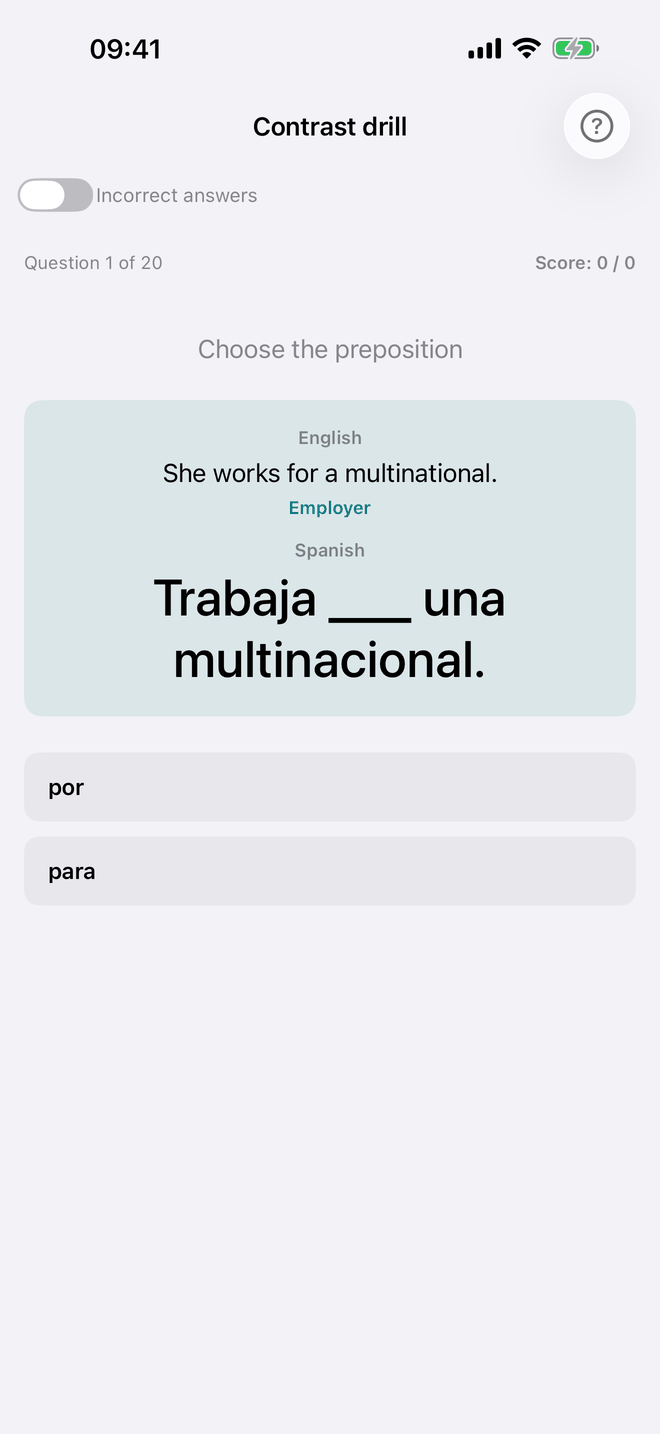
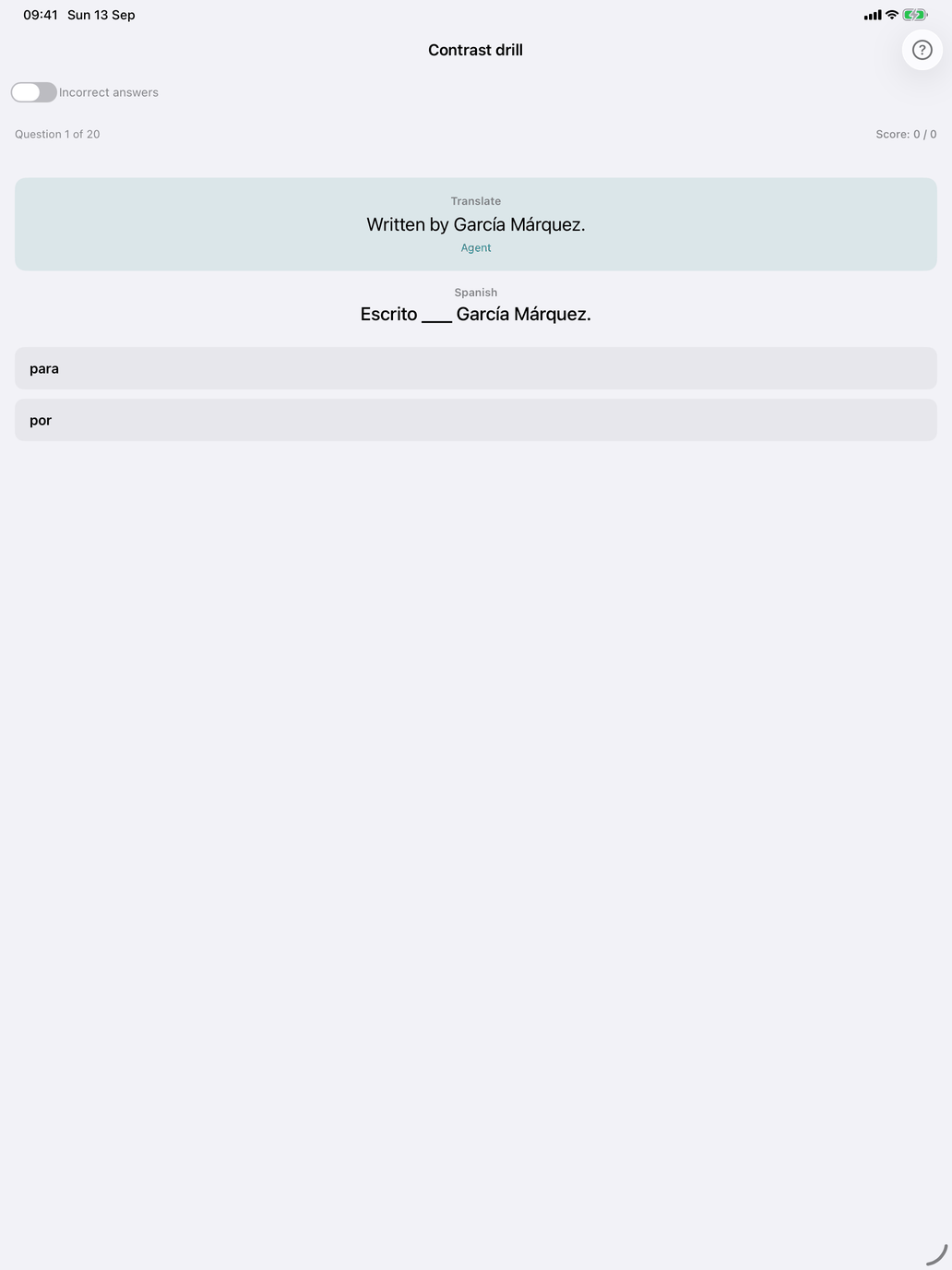
What the screen shows. At the top, the Incorrect answers switch, then "Question 3 of 10" and the running "Score: 2 / 2". Below that, the instruction ("Choose the tense", "Which form of bueno goes with this noun?") and a card with the material. The card comes in two kinds:
- A sentence — in the sentence drills (the three verb drills, Contrast drill, Which pronoun? and the numeral Agreement drill), the card shows the sentence in your own language, then the Spanish sentence with a gap. Each is labelled with its language. The option you tap fills the gap, so you can read the whole sentence.
- A word — in the agreement and shortening drills for adjectives and pronouns and the numeral Shortening drill, the card shows a noun (or a short phrase) with its gender and number, e.g. ciudad (f.sg), and its meaning.
Below the card are the options. Tap one: the right answer turns green with a tick, and a wrong pick turns red with a cross. Then tap Next question, or See results after the last question.
The principle badge. In Ser or estar, Preterite or imperfect, Indicative or subjunctive and the Contrast drill, a small coloured label under your-language sentence names the rule at work: Location of an event, Backdrop, Doubt / denial. It tells you which rule a mistake belongs to. Which pronoun? uses the same place to name the slot (Direct object slot).
The explanation. In the same four drills, a card appears after you answer: "Why es?", with a short explanation of the rule. In the Contrast drill it can end with a Read more in Theory link to the matching part of the prepositions Theory.
Your display language. The sentence in your language, the principle badge and the explanation are all shown in your display language. If you switch the display language during a drill, the card is redrawn in the new language. The Spanish sentence and the options stay in Spanish.
The session. A session is a fixed number of questions, set in Settings → Study → Questions per session; with ∞, a session has up to 50 questions, or as many as the drill has. At the end, Session complete appears with a New session button. The questions are picked based on your answer history and your Learning pace, so rules you keep missing come back more often. Incorrect answers limits the session to questions you have got wrong before. Ser or estar, Preterite or imperfect and Indicative or subjunctive also appear in guided lessons, where a session is always ten questions.
What's recorded. Every answer is recorded on your device. The grammar drills record the rule, not a word: Ser or estar records each rule for each verb, and the tense and mood drills record each principle. Those answers never count towards your vocabulary figures. The agreement and shortening drills record against the adjective, pronoun or numeral.
Reporting a sentence. Tap Help (the question-mark button) to read about the drill. Press and hold it to report a sentence that reads wrong; the report names the screen it came from.