Pronouns
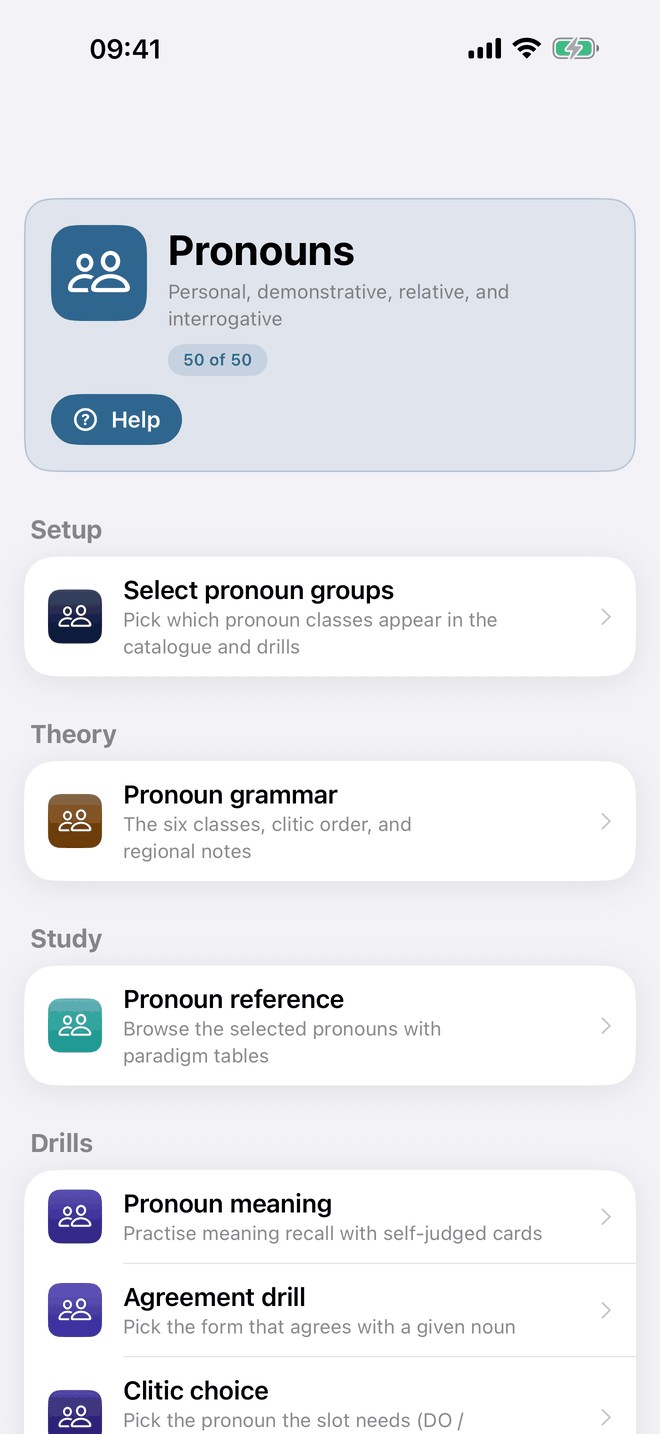
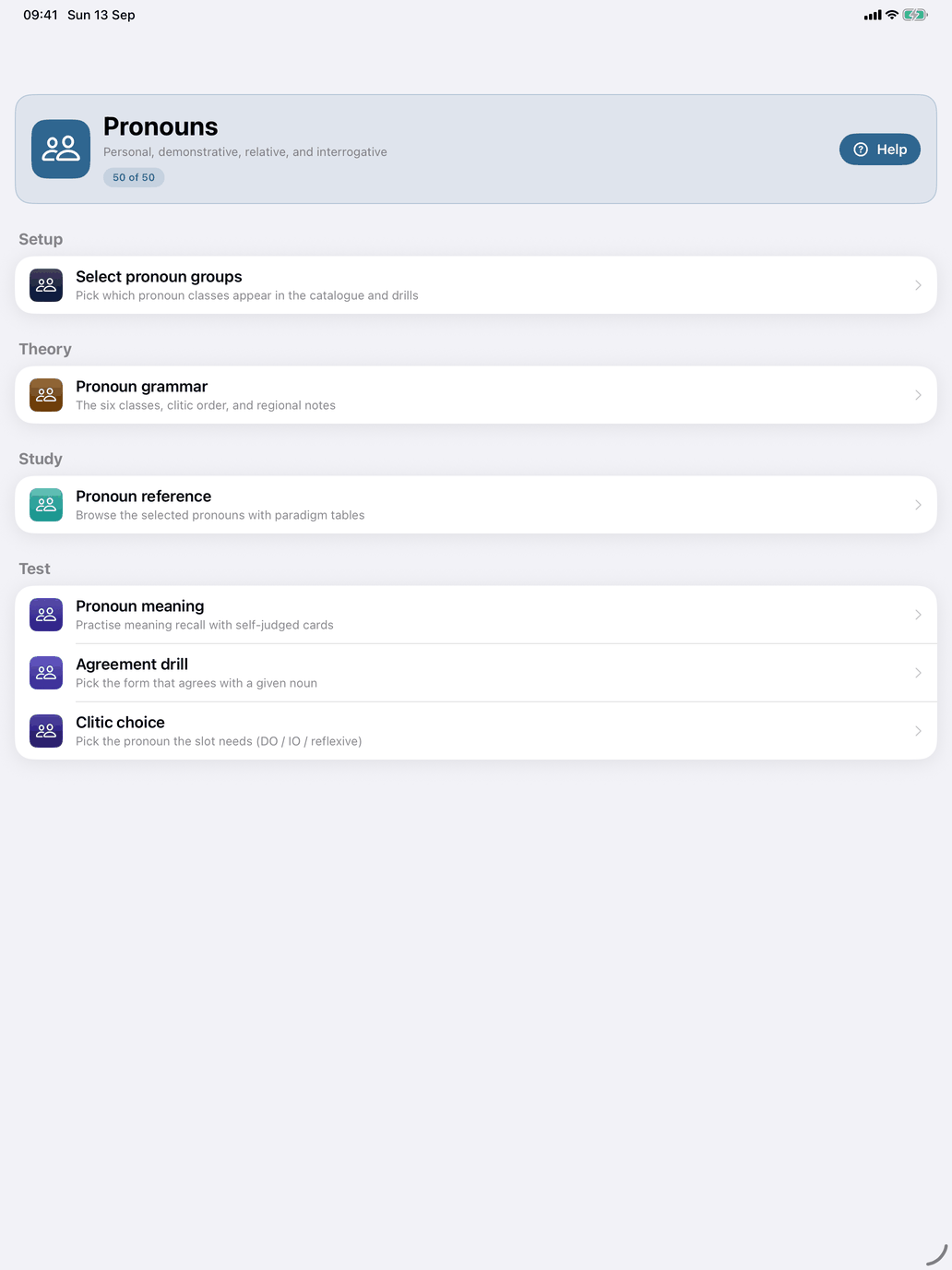
Open the Pronouns hub from the Pronouns tile on the Self Study screen. The Spanish catalogue has 50 pronouns in six classes:
| Class | Examples | Pronouns |
|---|---|---|
| Personal | yo, tú, él, nosotros | 12 |
| Demonstrative | este, ese, aquel | 3 |
| Possessive | nuestro, mío, tuyo | 8 |
| Relative | que, quien, cuyo | 4 |
| Interrogative | qué, quién, cuál, dónde, cuándo | 14 |
| Indefinite | alguien, algo, todo, alguno | 9 |
The badge under the title shows how many pronouns your selected classes contain. The level and topics in Select word scope do not narrow this hub.
The hub has these screens:
- Select pronoun groups (Setup): tick the classes you want. Tap ⓘ on a class for an explanation and its pronouns.
- Pronoun grammar (Theory): the six classes, where object pronouns go, and regional differences. The tables on this page are built from the same catalogue the drills use.
- Pronoun reference (Study): the selected pronouns.
- Pronoun meaning, Agreement drill and Which pronoun? (Drills).
Pronoun grammar
- Personal pronouns have five slots: subject, direct object, indirect object, reflexive, and the form used after a preposition. Me covers the direct object, indirect object and reflexive of yo. After a preposition you use mí and ti, and con combines with them into conmigo and contigo.
- Demonstratives have three distances: este (near me), ese (near you), aquel (far from both). Each has four forms. The neuter forms esto, eso, aquello refer to an idea or situation.
- Possessives have a short form before the noun (mi, tu, su, which only change for number; nuestro and vuestro also change for gender) and a full form after the noun or with an article (un amigo mío, el mío).
- Relatives join clauses: que for people and things, quien only for people, el cual in more formal writing, and cuyo, which agrees with the thing possessed: el autor cuyos libros leí.
- Interrogatives carry a written accent: qué asks, que joins. The accent stays in indirect questions: No sé dónde está.
- Indefinites: some never change (alguien, nadie, algo, nada). Others have four forms (alguno, ninguno, todo, otro). Alguno and ninguno shorten to algún and ningún before a masculine singular noun. A negative word after the verb needs no before it: No veo a nadie.
- Position and pronoun order: an object pronoun goes before a conjugated verb (te veo) and is attached to an infinitive, a gerund or an affirmative command (verte, viéndote, dímelo). With a verb plus an infinitive or gerund, either position works: te quiero ver or quiero verte. The indirect object comes before the direct object: me lo dio. When both are third person, le or les becomes se: se lo dio.
- Regional variation: Spain uses vosotros for informal "you" plural. Latin America uses ustedes for all plural "you". Some countries use vos instead of tú. The hub includes vosotros but not vos.
Pronoun reference
The selected pronouns, grouped by class, with a search field. Tap a class heading to open or close it. Tap a pronoun to open its page. A personal pronoun shows its Five syntactic slots: Subject, Direct object, Indirect object, Reflexive and Prepositional. A pronoun that changes for gender and number shows its Four-form agreement. Other pronouns are marked Invariant.
Pronoun meaning
Flashcards for the meaning of each pronoun. See Word meaning for how the flashcards work.
Agreement drill
This drill uses the pronouns that have four forms: the demonstratives, the possessives nuestro, vuestro, mío, tuyo, suyo, the relative cuyo, the interrogative cuánto, and alguno, ninguno, todo, otro. You see a noun with its gender and number, such as hermanas (sisters (f.pl)), and pick the form of the pronoun that agrees with it. The drill never asks for a form that Spanish does not use: ninguno is only asked with a singular noun. See How the choice drills work under Adjectives.
Which pronoun?
This drill needs the Personal class. It has 16 fixed sentences. Each shows an English sentence with the pronoun in bold, such as "We see her.", a label (Direct object slot, Indirect object slot or Reflexive slot) and a Spanish sentence with a gap before the verb: Nosotros ___ vemos. Choose the pronoun from four options (la). The drill tests which object pronoun fits, not where it goes; every gap is before the conjugated verb. For the position rules, see Pronoun grammar. Your results are recorded per sentence, not per pronoun.
Two pronouns at once
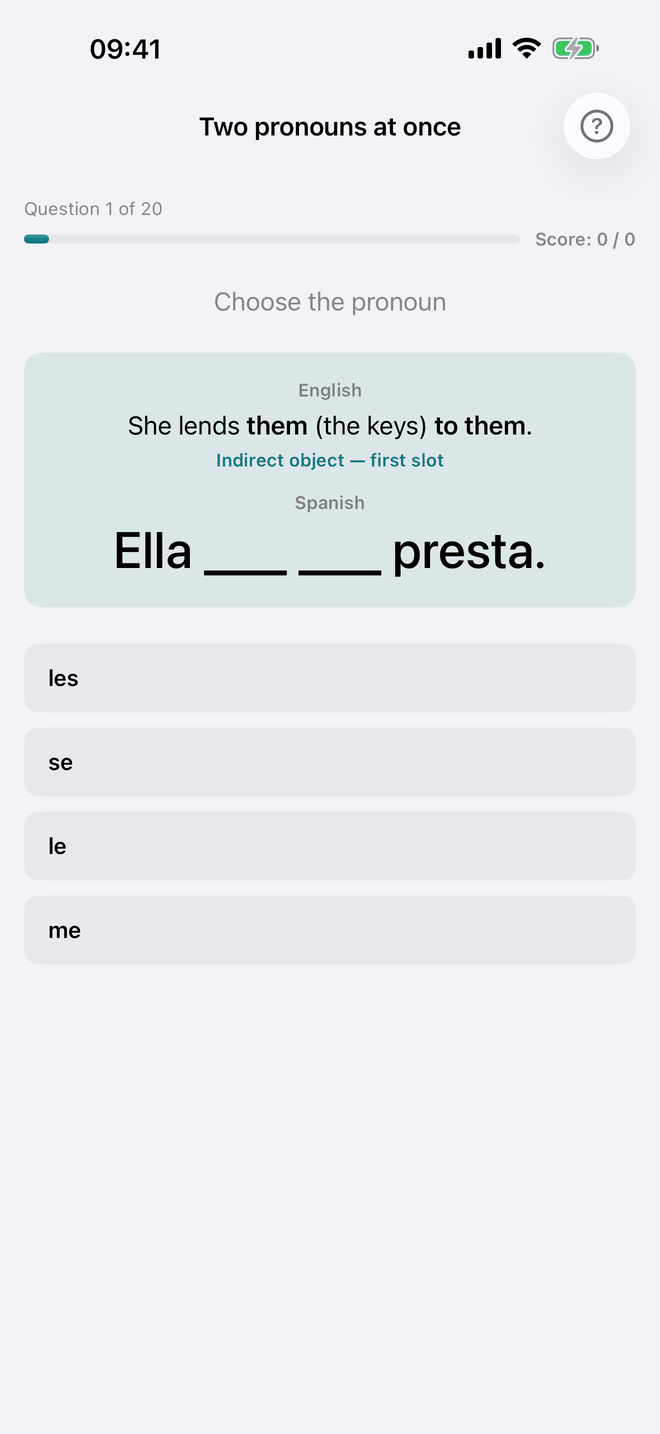
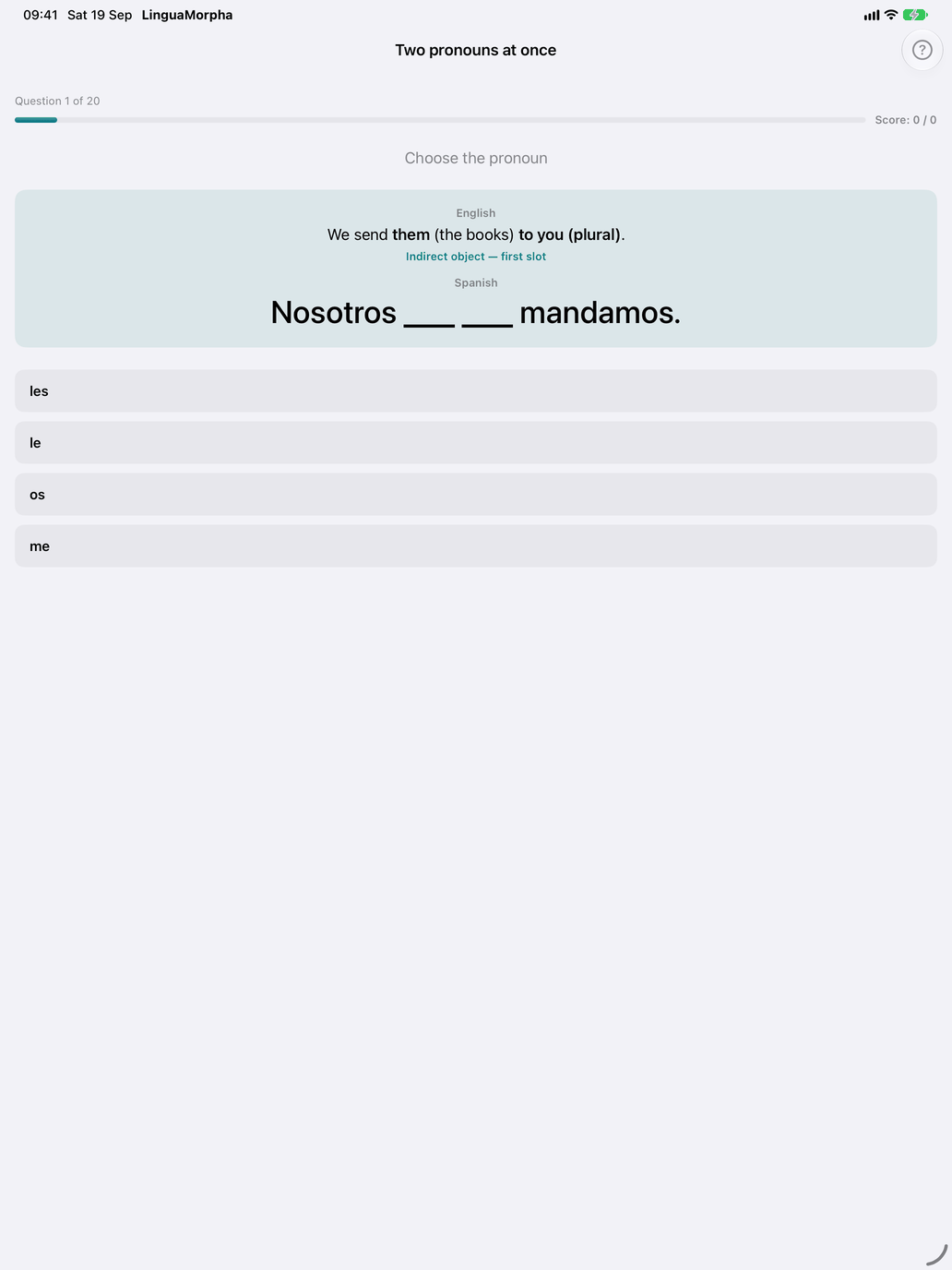
This drill also needs the Personal class. It has 24 fixed sentences — every indirect form (me te se nos os) with every direct form (lo la los las) — and asks one gap at a time.
Spanish puts the indirect object first and the direct object second, and that order forces a change: two third-person pronouns cannot both begin with l-, so le lo is impossible and the indirect le (or les) becomes se. Se lo di, never le lo di.
The first question asks the indirect object, with le among the four options — it is the form you will want to pick, and picking it is the mistake the drill exists to correct. The second question asks the direct object with your first answer already standing in the sentence, so Él ___ ___ da. has become Él se ___ da. and the order is there to read. Third-person sentences come up most often, because they are the ones where the substitution happens.
The explanation waits until both slots are answered: it covers the whole sentence, so showing it after the first question would give the second away. Right and wrong are still marked on each answer. It links to Pronoun grammar. Results are recorded per sentence and per slot, so having the order but not the substitution shows up as weakness on the first question alone.
Recommended workflow
- Start with only the Personal class.
- Run Pronoun meaning until the forms are familiar.
- Add Which pronoun? for the object pronouns.
- Add the demonstrative and possessive classes and practise them with the Agreement drill.
- Add Two pronouns at once once single object pronouns are secure.